


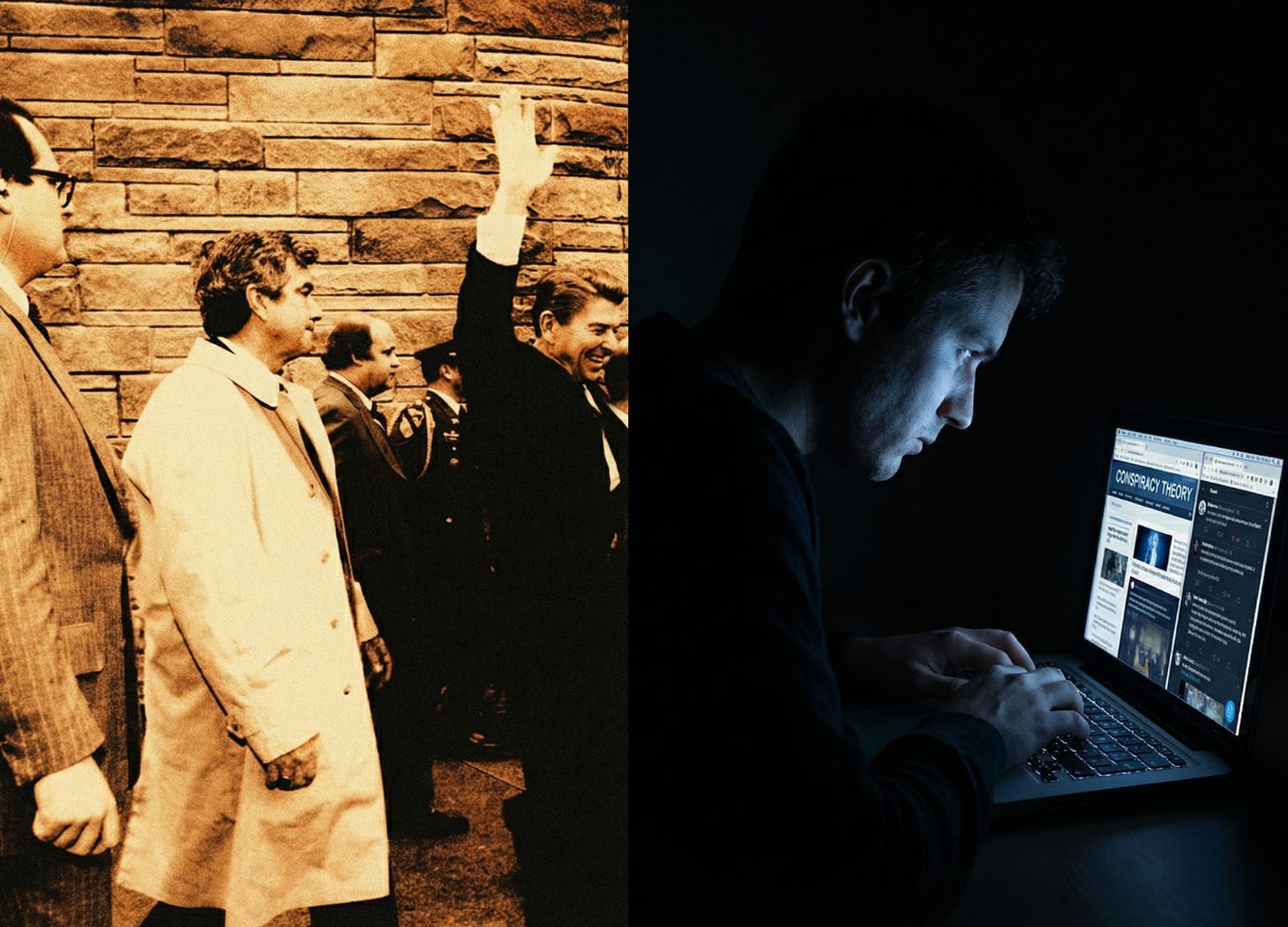
On March 30, 1981, John Hinckley Jr. fired six shots at President Ronald Reagan outside the Washington Hilton. One ricocheted off the limousine and lodged an inch from Reagan’s heart. Press Secretary James Brady took a round to the head. Secret Service Agent Timothy McCarthy spread his body to intercept bullets. When Reagan began coughing up blood, Agent Jerry Parr made a split-second decision that overrode protocol: he redirected to George Washington University Hospital instead of the White House. That choice saved Reagan’s life.
But here’s what makes that day echo strangely across four decades—Hinckley wasn’t trying to make a political statement. He was trying to impress Jodie Foster.
The Assassin Who Had Nothing to Say
Read through American political violence and you’ll find manifestos, grievances, ideological commitments. John Wilkes Booth shouted “Sic semper tyrannis!” Lee Harvey Oswald had defected to the Soviet Union. Even the incoherent gesture toward causes.
Hinckley had seen Taxi Driver and fixated on the teenage actress. He tracked her to Yale, called her dorm repeatedly until she stopped answering, then planned something to capture her attention. Hours before the shooting, he wrote: “Jodie, I would abandon this idea of getting Reagan in a second if I could only win your heart.” He called it “the greatest love offering in the history of the world.”
This wasn’t politics failing. It was reality failing for one person, catastrophically, in a way that nearly killed a president.
The Conspiracy Assembly Line
In 1981, Hinckley’s delusion required effort to sustain. He had to track magazine articles, travel to New Haven, maintain his fantasy through rejection. The friction of the physical world created breaking points where reality might intrude. His delusion was private, isolated, unsupported by any community.
Now imagine Hinckley with an algorithm and a conspiracy theory.
The contemporary version doesn’t leave his bedroom. He starts with a genuine grievance or confusion, then finds YouTube videos explaining the “real” story behind it. The algorithm recommends progressively more elaborate conspiracy content—each video connecting more dots, revealing deeper layers of hidden truth. Reddit threads provide “evidence” that mainstream sources suppress. Discord servers offer real-time validation from others who “see what’s really happening.”
Research on “third-generation online radicalization” suggests we’ve moved past propaganda distribution into something more efficient: automated systems identifying psychological vulnerabilities and systematically exploiting them. The key mechanism isn’t traditional ideology—it’s conspiracism itself, the intoxicating belief that you’ve discovered hidden patterns everyone else is too blind or corrupt to see.
Here’s what makes the current landscape genuinely novel: attackers emerge from conspiracy subcultures that resist simple categorization. Incel grievance threads through both far-right accelerationism and far-left revolutionary rhetoric. QAnon believers adopt tactics from anarchist movements. You see protesters enjoying every freedom the United States provides while shouting "Death to America” and calling for its collapse—some because they believe the country is irredeemably racist, others because they think it’s controlled by globalist elites.
The conspiracy framework allows these incompatible elements to coexist—because once you believe in vast hidden cabals, any ideology can be folded into the grand revelation.
They’ve been radicalized—but into what? Increasingly, into conspiracy-fueled violence itself, where the specific political content matters less than the structure: a hidden truth, a threatened awakening, a justified extreme response. Hinckley had one movie, one actress, one isolated plan. The modern version has an ecosystem of conspiracism designed to prevent him from ever coming back to shared reality.
What We’re Living With Now
In 1981, the response was clinical. Hinckley was found not guilty by reason of insanity and committed to psychiatric care. The system treated it as one person’s catastrophic breakdown, not evidence of broader crisis. The country moved forward without paranoia or paralysis.
Forty-five years later, that's nearly impossible to imagine. The Charlie Kirk assassination shows what a radicalized person will do and the wild conspiracy theories that come after. Everything feeds conspiracy thinking immediately. Every institutional failure becomes proof of deeper rot. Every attack gets reverse-engineered into grand narratives. And the actual infrastructure producing conspiracy-fed extremists—the recommendation algorithms, the borderline content that platforms won't remove, the communities offering alternate realities—operates while we argue about which side poses the greater threat.
We’ve lost two things that mattered in 1981: the capacity for calm in acknowledging danger, and the institutional competence that lets trained professionals make decisions that work. The first makes us perpetually frantic, prime targets for conspiracism. The second makes us genuinely vulnerable. And in that space, algorithms are assembling the next generation of attackers—not through coherent ideology, but through conspiracy frameworks that turn confusion into certainty and isolation into action.