


In the main square of Cortina d’Ampezzo, where the 2026 Winter Olympics just concluded, there stands a sculpture of an elegant woman clutching a Dior handbag and skis. She appears carved from ice, translucent and wintry. Touch her, and you discover the truth: She is plastic.
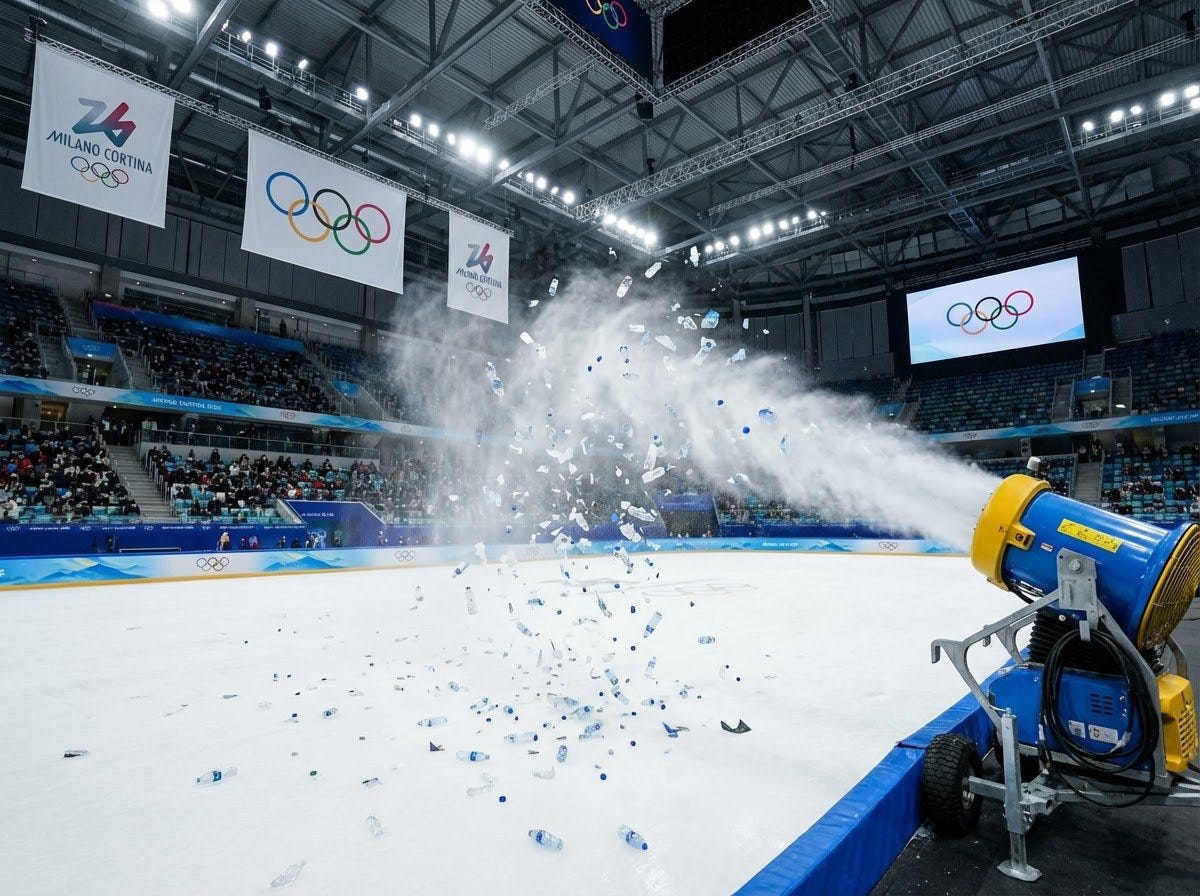
Walk beyond the square, and the metaphor deepens. Ski lifts ascend mountainsides of bare rock and brown grass, servicing narrow white strips—the only snow visible against the Dolomites’ winter landscape. Generators growl near the Boite River, where black pipes siphon 25 gallons per second to feed snow cannons roaring upslope. The stench of diesel mingles with mountain air. This is what 380 Olympic swimming pools worth of water looks like when converted into the appearance of winter.
The Milan Cortina Games required roughly 250 million gallons of water for artificial snow production alone—enough to supply 1.3 million people for a year. Around 95% of Italian ski resorts now depend on snowmaking technology, with more than 70% of slopes covered entirely by manufactured snow. The system works brilliantly. Fan-like cannons spray atomized water into cold air; droplets freeze mid-flight and fall as snow; grooming vehicles compress it into competition-grade surfaces indistinguishable from nature’s version. The International Ski Federation has refined this into “technical snow”—data-driven, tablet-controlled, optimized to exploit the coldest weather windows with adjustable density and quality.
This technological triumph raises an uncomfortable question: When reality becomes unreliable, should we manufacture it?
The physics are straightforward. The implications less so. Cortina’s 500 ancient larch trees survived two world wars but not Olympic preparations—felled to clear space for a bobsled track that Italian Deputy Prime Minister Matteo Salvini insisted must remain on Italian soil rather than using Austria’s existing facility. When chainsaws arrived, Italian cellist Mario Brunello sat on a stool playing classical music while the forest crashed down behind him, creating what one witness described as “dramatic and extraordinary contrast.”
Environmental assessments were skipped for more than 60% of the 98 Olympic construction projects. Water is extracted from Alpine rivers at rates that may deplete mountain aquifers. Snowmaking accounts for 30-40% of total energy consumption at Italian resorts—annual costs between €50 million and €100 million, roughly equivalent to Milan’s entire domestic electricity use for a year. Across the Alps, artificial snow production demands around 2,100 gigawatt-hours per winter season.
These costs could be justified as necessary adaptations to climate change. The Italian Alps have experienced a 10% decrease in cold days and cold spells over three decades. Resorts around 1,000 meters elevation have largely abandoned consistent operations. Skiing in the Apennines—once central Italy’s winter destination—has effectively shut down. Technology provides a bridge until conditions improve or alternatives emerge.
But that framing assumes adaptation rather than something more concerning: the normalization of manufactured reality as superior to natural variability.
Consider what “technical snow” actually achieves. Modern systems produce surfaces more controllable and durable than natural snowfall. Operators adjust quality and density via tablet, creating conditions better than authentic winter. This isn’t making do with second-best—it’s engineering improvements that eliminate weather’s inconvenient unpredictability. The artificial becomes preferable.
This logic extends far beyond Alpine slopes. We’ve become civilizations that instinctively reach for technical solutions to maintain desired experiences rather than adapting expectations to changing realities. Social media curates identities more compelling than messy authenticity. AI-generated content replicates creative output without the friction of human limitation. Deepfakes manufacture events indistinguishable from documentation. The plastic ice sculpture isn’t an aberration—it’s emblematic.
The danger isn’t that these interventions fail. It’s that they succeed so completely they delay recognition of underlying unsustainability. Economists call this “lock-in effect”—each successful adaptation justifies continued investment in the same trajectory, making alternative paths progressively harder to pursue. Italian ski pass prices have increased 40% since 2021, transforming winter sports into luxury experiences requiring constant capital infusion to maintain the illusion.
Some manufacturers now demonstrate snow production at ambient temperatures up to 20°C—a technological breakthrough that reinforces the narrative that innovation alone solves fundamental limits. This mindset treats climate change as an engineering problem rather than a signal requiring different frameworks entirely. The slopes stay white, bookings remain strong, and winter tourism continues generating €11 billion annually to Italy’s economy. Why question a system that appears to work?
Because metre by metre, the slope is getting steeper. When artificial snow eventually becomes unviable at certain altitudes—not tomorrow, but within foreseeable horizons—the transition will be abrupt. Resorts will face stranded assets, communities will experience sudden economic shocks, and regions will discover they’ve spent decades and billions optimizing a system with a climate-driven expiration date instead of developing alternatives.
This isn’t about condemning technology or romanticizing natural snowfall. It’s recognizing that successful short-term adaptation can masquerade as viable long-term strategy. The plastic sculpture captures something true: We’ve grown comfortable inhabiting spaces where the real and the manufactured become indistinguishable, where maintaining appearances feels more achievable than accepting changed circumstances.
Cortina’s elegant Dior lady stands in the square, translucent and beautiful, fooling nobody who touches her. The snow on the mountainsides above works differently—white and pristine, perfect for racing, sustained by infrastructure most visitors never see. That difference matters. One announces itself as representation. The other succeeds so completely that questioning it feels unnecessary.
Until someone checks the water bill.