


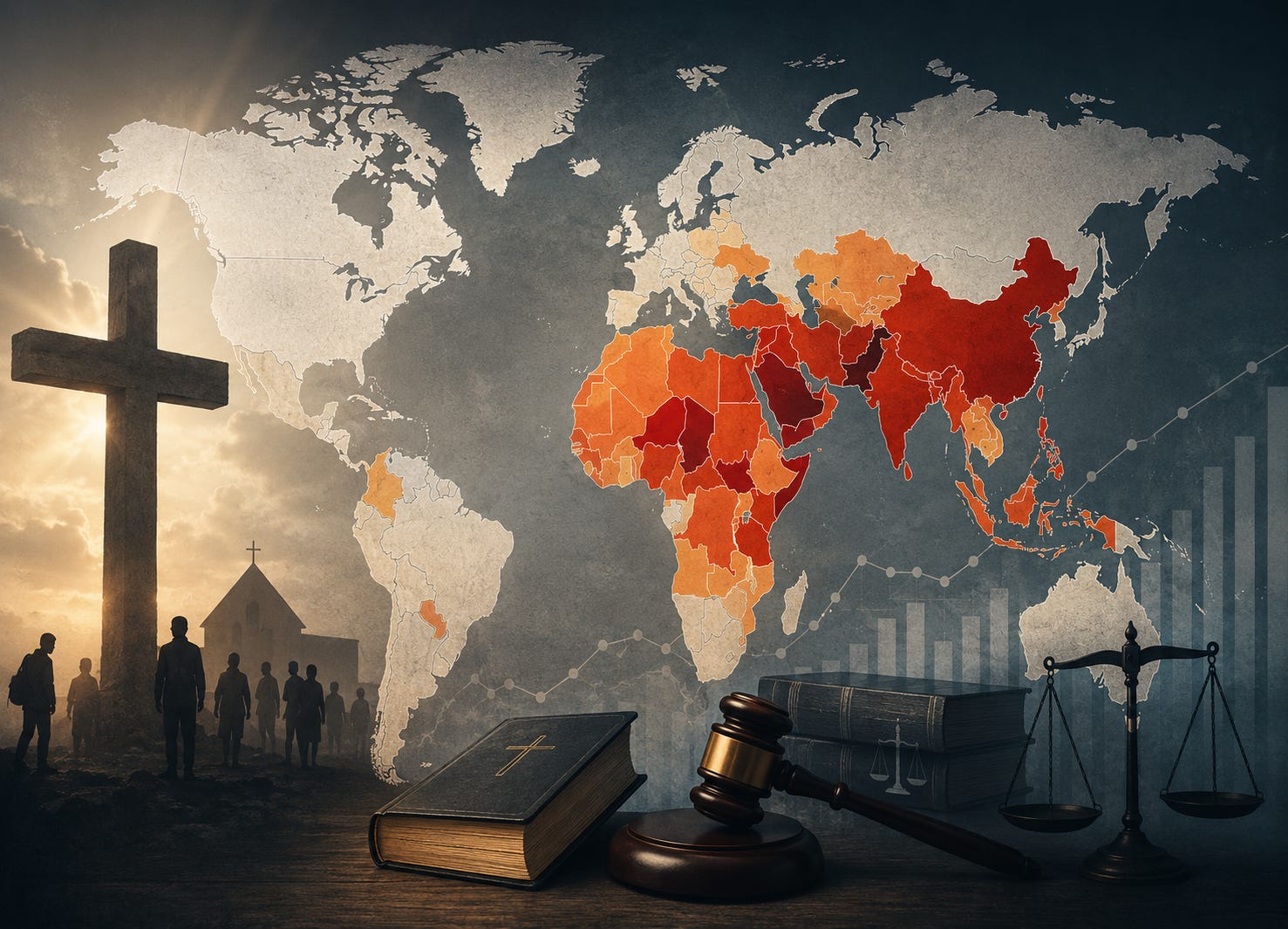
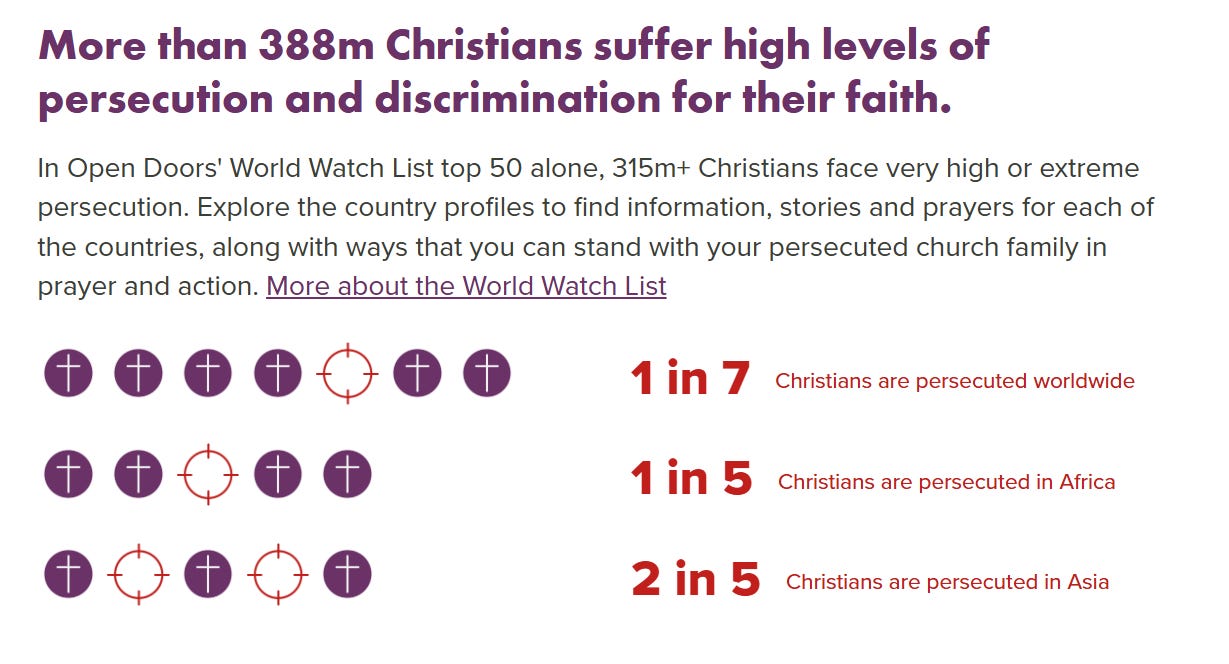
388 million Christians live under high levels of persecution. That’s one in seven believers worldwide, according to Open Doors’ newly released 2026 World Watch List— an annual ranking that documents where following Jesus can cost you everything.
The scale varies by region but the pattern is consistent. One in five Christians in Africa faces persecution. In Asia, a category that includes the Middle East, the figure rises to two in five. Even in Latin America, one in 12 believers lives under systematic hostility. The total has climbed by 8 million since 2019.
The data reveals something Western governments and media outlets consistently avoid: the ideological patterns behind the global assault on Christianity. Open Doors monitors 81 countries where Christians face “high,” “very high,” or “extreme” persecution levels. The numbers are climbing. The violence is escalating. And the persecution engines driving the assault are now impossible to ignore.
The Engines of Persecution
Open Doors’ methodology identifies nine “persecution engines”— the ideological forces systematically targeting Christians. Islamic oppression. Communist and post-Communist oppression. Religious nationalism. Dictatorial paranoia. Clan oppression. Ethno-religious hostility. Organized corruption and crime. Christian denominational protectionism. Secular intolerance.
But two engines dominate. Analysis of Open Doors' country-by-country persecution engine data shows Islamic oppression as the primary driver in approximately 50 of the 81 countries — appearing in seven of the top ten and accounting for more than 60 percent of the list. Communist regimes control another substantial segment, with China hitting an all-time high persecution score this year due to new internet crackdowns on house churches. Religious nationalism—particularly Hindu nationalism in India and Buddhist nationalism in Myanmar—is rising as a third force.
The top 50 countries alone reached a combined persecution score of 3,810 points—the highest total ever recorded. The trend line is clear: persecution is intensifying, not receding.
The Violence No One Talks About
Open Doors documented 4,849 Christians murdered for their faith between October 2024 and September 2025. Nigeria alone accounted for 3,490 of those deaths—72 percent of the global total. Boko Haram, Islamic State West Africa Province, and Fulani militants operate with near-impunity across the country’s northern and Middle Belt regions.
“They did this to us because we are Christians,” said Rifkatu, a Nigerian believer abducted and raped by Fulani militants. “Since I went to that camp, all those who were kidnapped, I didn’t see any Muslims held there.”
The numbers extend beyond killings. Open Doors verified 4,712 Christians detained without trial. Another 67,843 were physically or mentally abused—up from 54,780 the previous year. Sexual violence against Christian women rose 30 percent, with 4,055 documented cases of rape or harassment. Forced marriages of Christians to non-Christians jumped 40 percent to 1,147 cases.
More than 224,000 Christians were displaced or became refugees. Some 3,632 churches and Christian properties were attacked.
Where It’s Worst
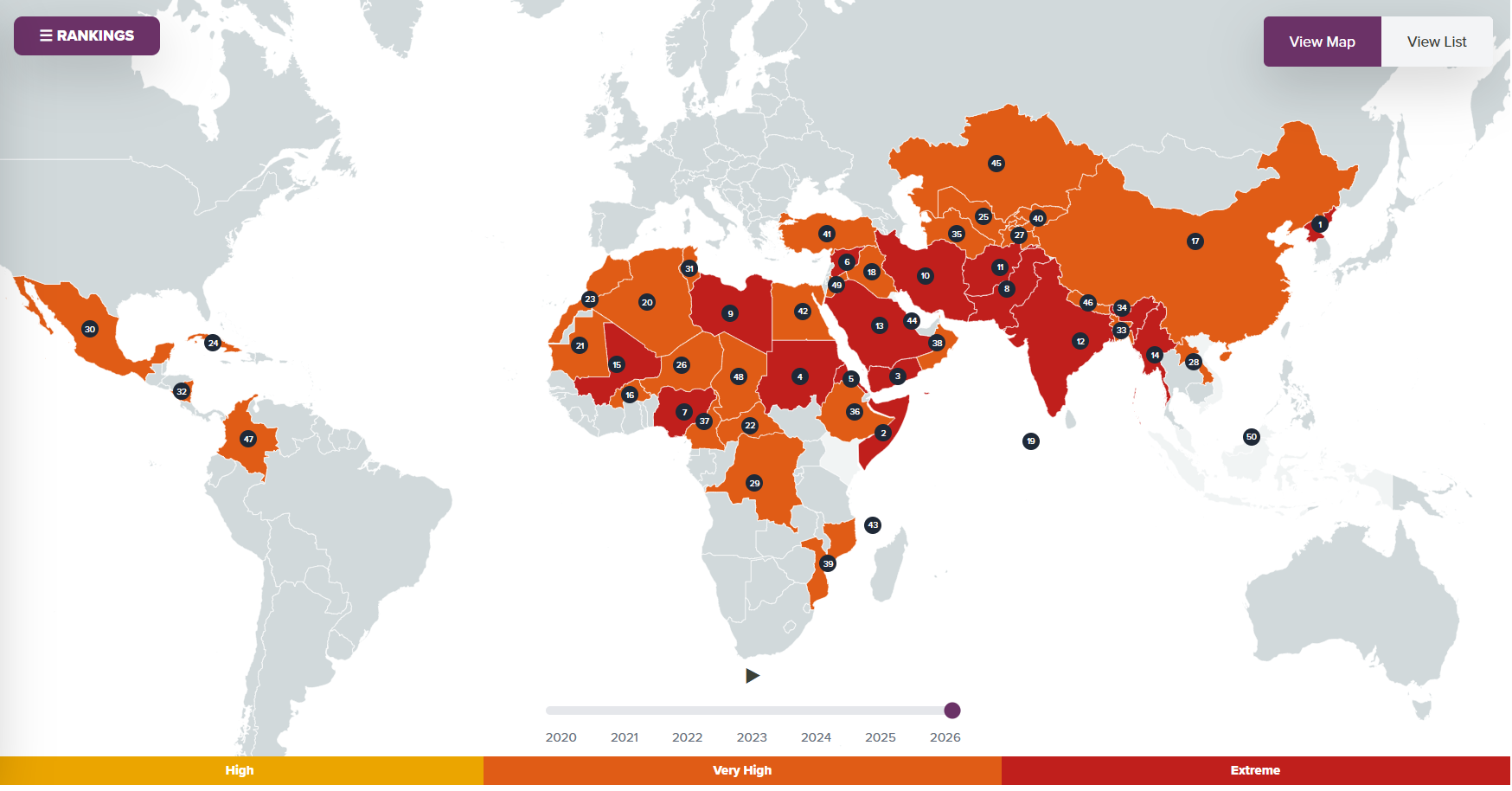
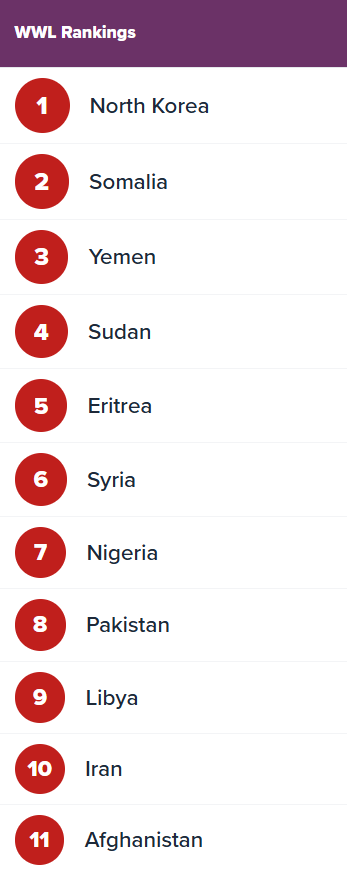
North Korea ranks first. Being discovered as a Christian means immediate execution or imprisonment in a labor camp — often for the believer’s entire family. “The underground church worships not with sound, but with whispered prayers and memorized Scripture,” Open Doors reported.
Somalia ranks second, where al-Shabaab enforces a brutal version of Islamic law and publicly executes anyone suspected of Christianity. Yemen follows at third — apostasy from Islam is punishable by death under the law.
Sudan, torn by civil war, sits at fourth. Both the Sudanese Army and the opposing Rapid Support Forces have targeted Christians, destroying hundreds of churches. Nearly 10 million Sudanese have been displaced, a population the size of London.
Syria is the only newcomer to the top ten, jumping from 18th to sixth place after the fall of the Assad regime. The new Islamist government, led by Hayat Tahrir al-Sham, has placed Islamic jurisprudence as the main source of legislation. At least 27 Syrian Christians were killed this reporting period, compared to zero the year before.
Pastor Edward Awabdeh in Damascus described Islamist actors using trucks with loudspeakers to call for Christian conversion. Posters appeared on churches demanding payment of the jizya tax — historically levied on non-Muslims under sharia. “A moderate Muslim shaykh told me that some Islamic militants believe they have the right to loot non-Muslim properties,” Awabdeh said.
Only an estimated 300,000 Christians remain in Syria, down from 1.5 to 2 million before 2011.
The Gulf’s Criminalizing of Faith
The pattern extends across the Middle East and Gulf states, where 13 countries appear on the World Watch List — all identifying Islamic oppression as the primary persecution engine, according to Open Doors' analysis. But the persecution takes a different form than the militant violence of sub-Saharan Africa.
Pakistan ranks eighth, where blasphemy laws are weaponized against Christians during property disputes or personal feuds. Even accusations can provoke mob violence. Most Pakistani Christians descend from an “untouchable caste” and face institutionalized discrimination, trapped in cycles of bonded labor.
Iran sits at tenth. House churches are raided, believers imprisoned under national security charges, and converts branded as Western spies. Following the ceasefire with Israel, authorities arrested at least 54 Christians in 21 cities. State media accused them of espionage, painting an entire faith community as a security threat.


Saudi Arabia, at 13th, considers all citizens Muslim by law. Converting from Islam technically carries the death sentence. Public churches are banned. The small number of converts must keep their faith secret or face being disowned and attacked by families. In 2025, several Christian expatriates were expelled from the country—some explicitly told the reason was Christianity.
Libya, Iraq, and Afghanistan round out the top 11. The Maldives officially prohibits any religion except Islam. Algeria systematically closed churches under a 2006 ordinance regulating non-Muslim worship—but has never approved a single church registration application. Even wealthy Gulf states with Western business partnerships make the list. Qatar ranks 44th, the United Arab Emirates 57th, Kuwait 60th.
“Most Muslims who come to Christ in Saudi Arabia will never tell their family,” Talal, a Christian who serves believers in the region, told Open Doors. “They must live their faith in secret with utmost caution and secrecy. This is why many Saudi Christians suffer from loneliness.”
The Gulf presents a strategic problem for Western governments: how to address systematic religious persecution by economic and military allies. While the State Department issues annual reports, enforcement remains absent. Oil, trade deals, and security partnerships take precedence over the documented criminalization of Christianity.
The Sub-Saharan Collapse
Twelve sub-Saharan African nations now rank among the 20 most violent countries for Christians. The region’s average persecution score rose from 68 to 78 over the past decade. Violence scores jumped from 49 percent to 88 percent of the maximum.


Sudan, Nigeria, and Mali are the only three countries globally to receive the maximum violence score. Islamic militant networks—including JNIM, Islamic State–Sahel, and Islamic State–Mozambique—control vast territories where Christians face extortion, forced displacement, and execution.
In Burkina Faso, militants killed at least 150 Christians and destroyed more than 100 churches. In Mozambique’s Cabo Delgado province, jihadists beheaded five Christians in July 2025, declaring it a warning to other communities.
Five of the 14 sub-Saharan nations on the list have seen their governments overthrown in the past five years. Two have suspended their constitutions. Weak governance creates vacuums—and Islamic militants fill them.
The Communist Crackdown
China reached its all-time high score of 79 points this year, driven not by physical violence but by state surveillance and legal restrictions. New regulations require all preaching to occur only on registered websites controlled by the official Catholic and Protestant associations. Church leaders must support the Communist Party and refrain from youth outreach or distributing Bible apps. House churches that once gathered openly now meet in groups of 10 to 20 believers, with government officials accusing unregistered pastors of provoking trouble.
Russia ranks 56th, where the government restricts non-Russian Orthodox church activities and targets Christians who oppose the war in Ukraine. The number of Christians arrested and sentenced rose during the reporting period. In Russia’s northern Caucasus, converts face pressure from both state authorities and Islamic families — a convergence of Communist control and Islamic oppression.
Across former Soviet Central Asia, Uzbekistan, Tajikistan, Turkmenistan, and Kyrgyzstan, post-Communist regimes maintain surveillance systems while Islamic social pressure intensifies, creating a dual persecution engine.
The Pattern the West Ignores
The 81 countries represent more than just statistics. They document a global pattern of systematic hostility toward Christianity, driven by identifiable ideologies and enforceable through state power, militant violence, and social pressure.
Islamic oppression dominates more than 60 percent of the list — present across the Middle East, North Africa, Central Asia, South Asia, Southeast Asia, and increasingly sub-Saharan Africa. Communist regimes account for another substantial segment, with East Asia’s authoritarian states perfecting surveillance-based control. Religious nationalism continues its rise as well.
For 388 million believers, following Jesus means risking everything. And the cost keeps rising.