



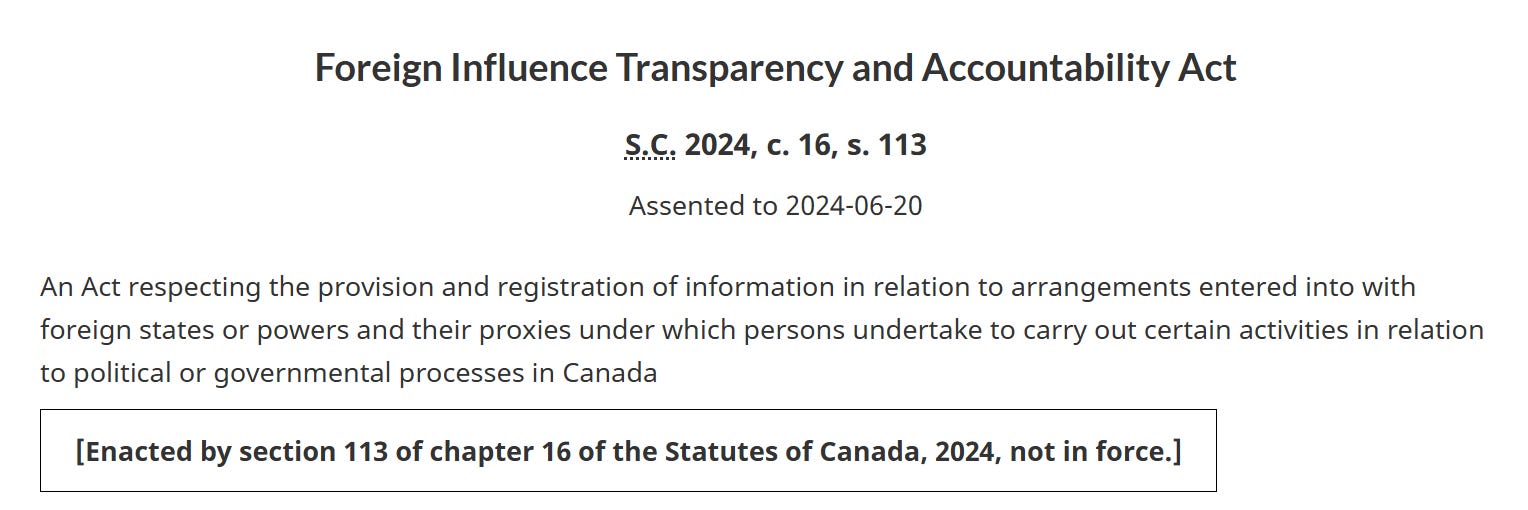
On August 4, Canada’s new Foreign Influence Transparency and Accountability Act switches on a public registry showing who is acting with a foreign principal to influence Canadian political or governmental processes. A new commissioner, Anton Boegman, the former chief electoral officer of British Columbia, will oversee it.
The law isn’t really aimed at spies in trench coats.
Its real target is the respectable middle layer where modern influence lives: law firms, consultants, state-owned companies, sovereign wealth funds, and proxy organizations that can shape domestic politics without looking foreign at all. A foreign government doesn’t have to hack an election if it can quietly rent voices inside the target country’s own political conversation.
What Triggers Registration
The trigger isn’t mere contact with a foreign client. It’s an arrangement, under the direction of or in association with a foreign principal, to communicate with officials, disseminate information by any means including social media, distribute money, or provide services connected to a Canadian political or governmental process.
That definition reaches not just foreign states but foreign powers, state-linked economic entities, and anyone acting at their direction or for their benefit, meaning a Canadian firm advocating for a foreign state-owned bank or energy company may now have a registration problem.
A Global Movement
Canada isn’t alone.
Australia’s Foreign Influence Transparency Scheme has required similar disclosure since 2018, though Australia’s own government has acknowledged the scheme failed to achieve its purpose and needs substantial reform.
The UK’s two-tier Foreign Influence Registration Scheme flags Russia and Iran as enhanced-risk powers requiring extra disclosure; officials describe it as meant to provide transparency, deter covert state-threat activity, and give police and MI5 earlier chances to disrupt hostile operations.
France, Singapore, and Taiwan have built their own versions too, from France’s High Authority for Transparency in Public Life to Singapore’s Foreign Interference Countermeasures Act to Taiwan’s Anti-Infiltration Act, each aimed at foreign efforts to shape domestic politics.
The American Pioneer That Fell Behind
The United States pioneered this model. The Foreign Agents Registration Act, or FARA, was enacted in 1938 amid concern over Nazi, fascist, and communist propaganda, requiring agents of foreign principals to disclose their relationships and activities.
Enforcement lagged for decades, though: a 2016 Justice Department inspector general report found that between 1966 and 2015, prosecutors brought only seven criminal FARA cases and sought no civil injunctive relief since 1991. It has picked up some since then, including a 2019 civil action that was DOJ’s first affirmative civil FARA case in nearly three decades, but a 1995 exemption still lets some foreign-principal work get routed through ordinary lobbying disclosure instead, so long as a foreign government or party isn’t the principal beneficiary.
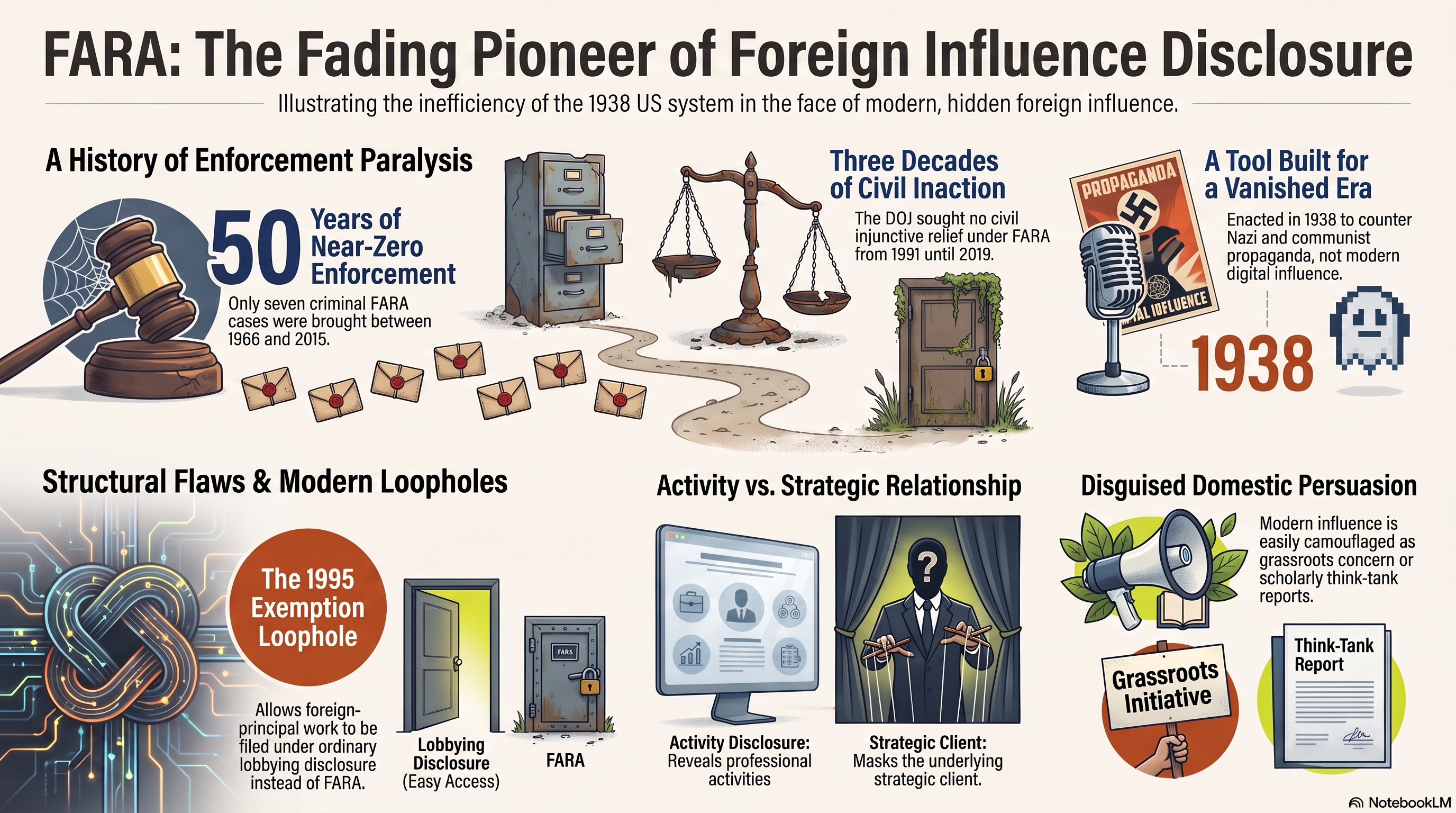
The distinction matters: lobbying disclosure tells you someone is lobbying, while FARA is supposed to tell you when the underlying client is foreign. One discloses a professional activity; the other discloses a strategic relationship.
Foreign “Agent” vs. Foreign “Influence”
That gap matters because modern influence rarely looks foreign.
A think-tank report can look like scholarship; a lobbying push can look like grassroots concern.
A healthy disclosure regime shouldn’t treat every international relationship as suspicious; democracies need foreign students, researchers, and diaspora advocates. But it should reveal when domestic persuasion is being directed or financed by a foreign power, especially outside the elections that get all the attention.
Sanctions policy, defense procurement, energy infrastructure, and university partnerships all attract quieter foreign interest, and the question that matters is not whether a foreign government may speak, but whether it may disguise its speech as someone else’s.