


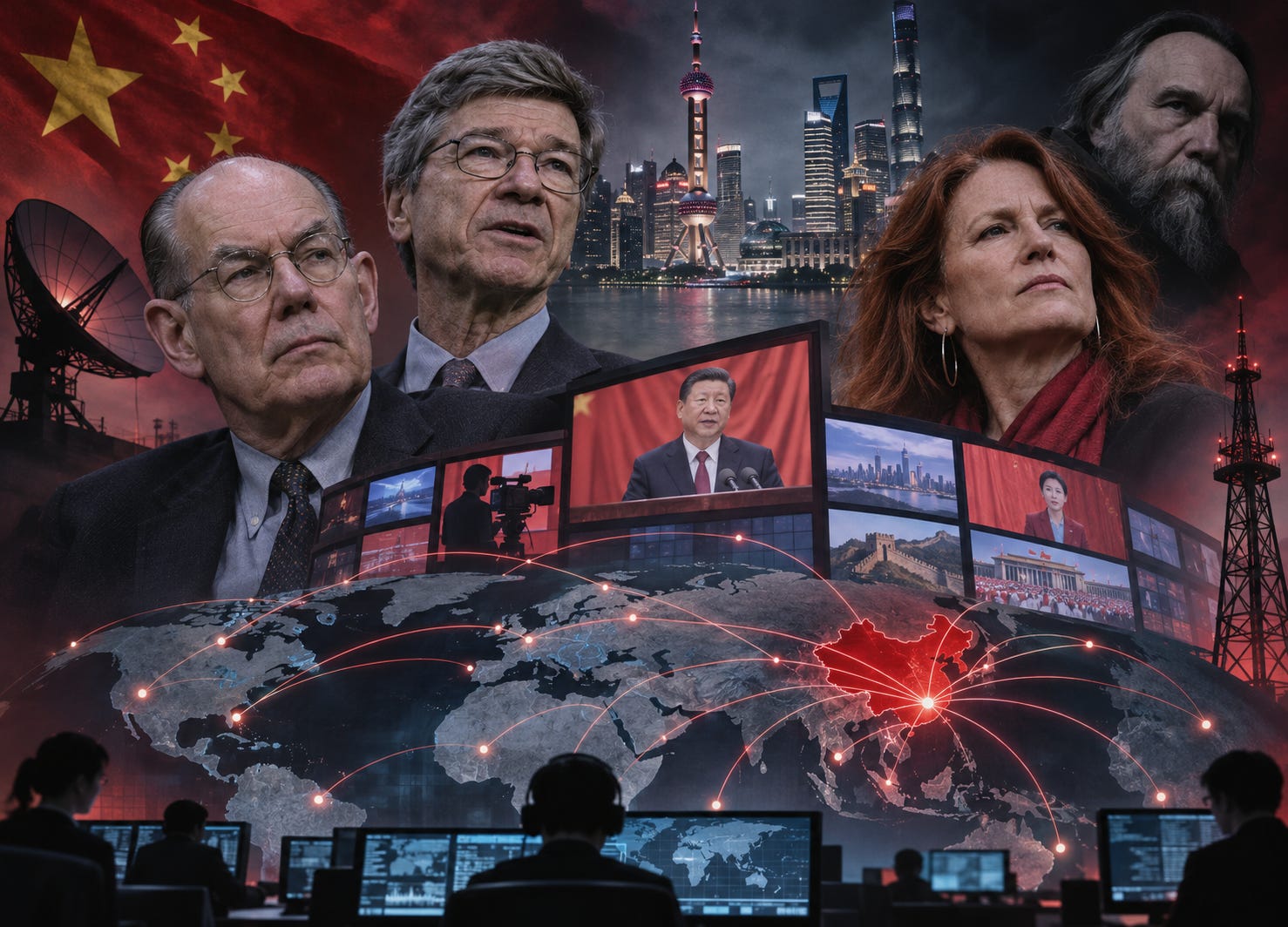
An English-language platform featuring American professors, former officials and activists operates within a Chinese political-media network whose production partners collaborate with state-owned broadcasters.
The website, The China Academy, publishes interviews and commentary featuring University of Chicago professor John Mearsheimer and Columbia economist Jeffrey Sachs. Its contributor roster also includes CODEPINK co-founder Jodie Evans, BreakThrough News host Rania Khalek and Tricontinental director Vijay Prashad, figures connected through organizations associated with financier Neville Roy Singham. The platform has also sponsored a discussion featuring Aleksandr Dugin, a Russian ideologue sanctioned by the United States.
Chinese university and business records trace the platform to a Shanghai production company working with Fudan University’s China Institute. A company producer has openly discussed using overseas media and influencers to shape foreign opinion.
How the Network Was Built
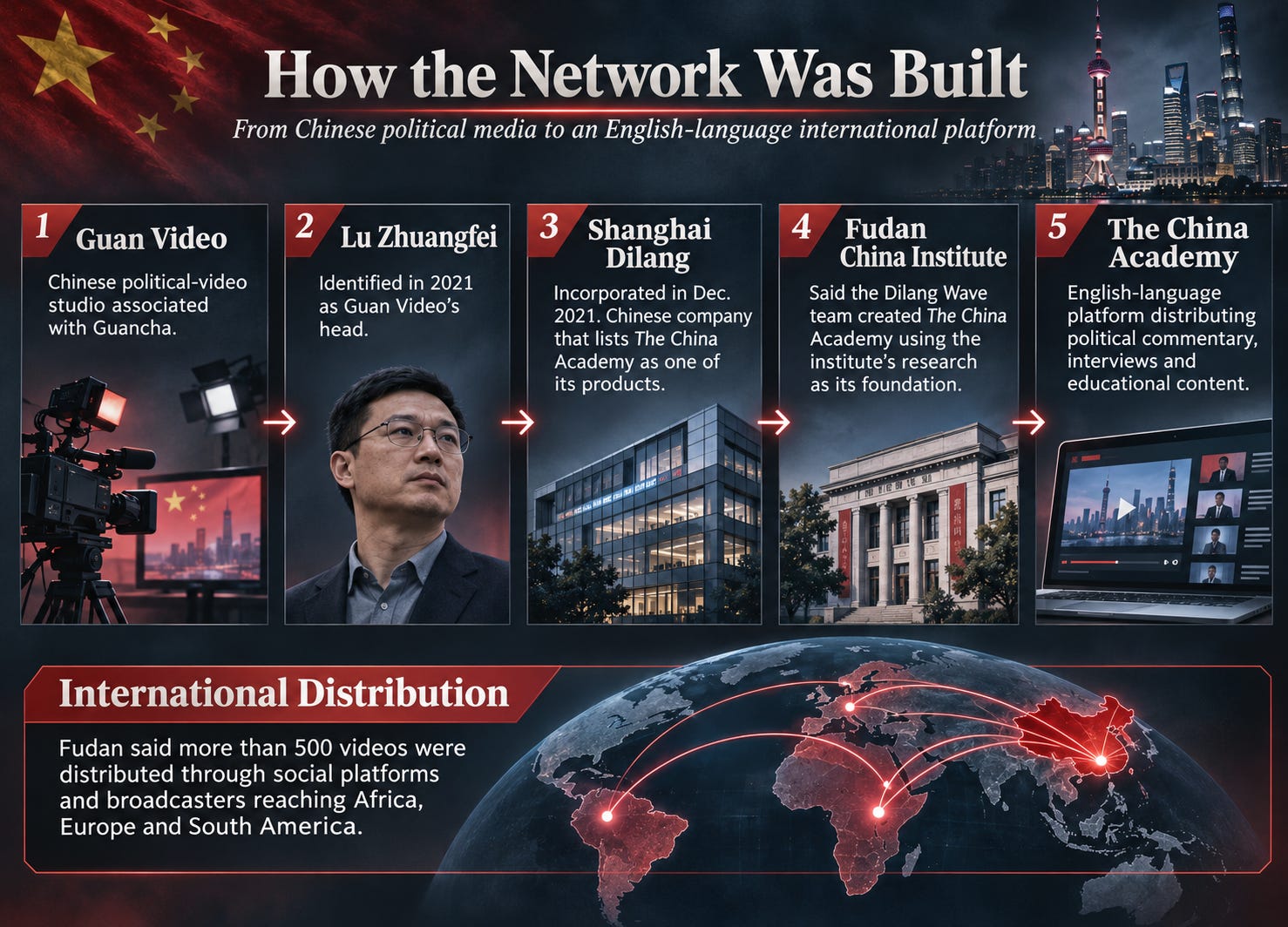
The trail starts with Guan Video, a Chinese political-video studio associated with the commentary outlet Guancha. In a January 2021 interview, Lu Zhuangfei was identified as the studio’s head. Guancha was founded by investor Eric Li, who is also listed as an adviser to The China Academy.
That December, Shanghai Dilang Culture Communication was incorporated with Lu as its legal representative.
Dilang’s Chinese recruitment profile names The China Academy as one of its products. It claims its team’s earlier content accumulated more than 10 billion views across online platforms. That figure is unverified and refers to previous productions, not the Academy’s audience.
The institutional link is unusually explicit. In a February 2024 report, Fudan University’s China Institute, directed by political commentator Zhang Weiwei, said the Dilang Wave team created The China Academy using the institute’s research as its foundation. By 2023, it reported distributing more than 500 videos through social platforms and broadcasters reaching Africa, Europe and South America.
In 2025, Fudan documented jointly producing with Dilang an English-language version of This Is China, a political program aired by Dragon TV, part of state-owned Shanghai Media Group. The partners used translation, AI dubbing and short clips to adapt the broadcasts for overseas viewers, with transcripts appearing on The China Academy. The show is marketed in English as China Now.
Fudan quoted a Chinese Foreign Ministry spokesperson praising the program for explaining Communist Party governance and countering criticism of China.
The strategy was articulated even more directly by Dilang producer Zhai Guanhua. In a September 2023 speech, he described overseas broadcasting in Ghana and urged cooperation among Chinese companies, private media and influencers to sustain publicity abroad. He called for machinery capable of fighting a “cognitive and public-opinion war.” The speech shows an explicitly advocated influence strategy, not government control over every Academy contributor.
The American Contributors
The Academy’s directory lists Americans and U.S.-affiliated figures whose relationships with the platform vary:
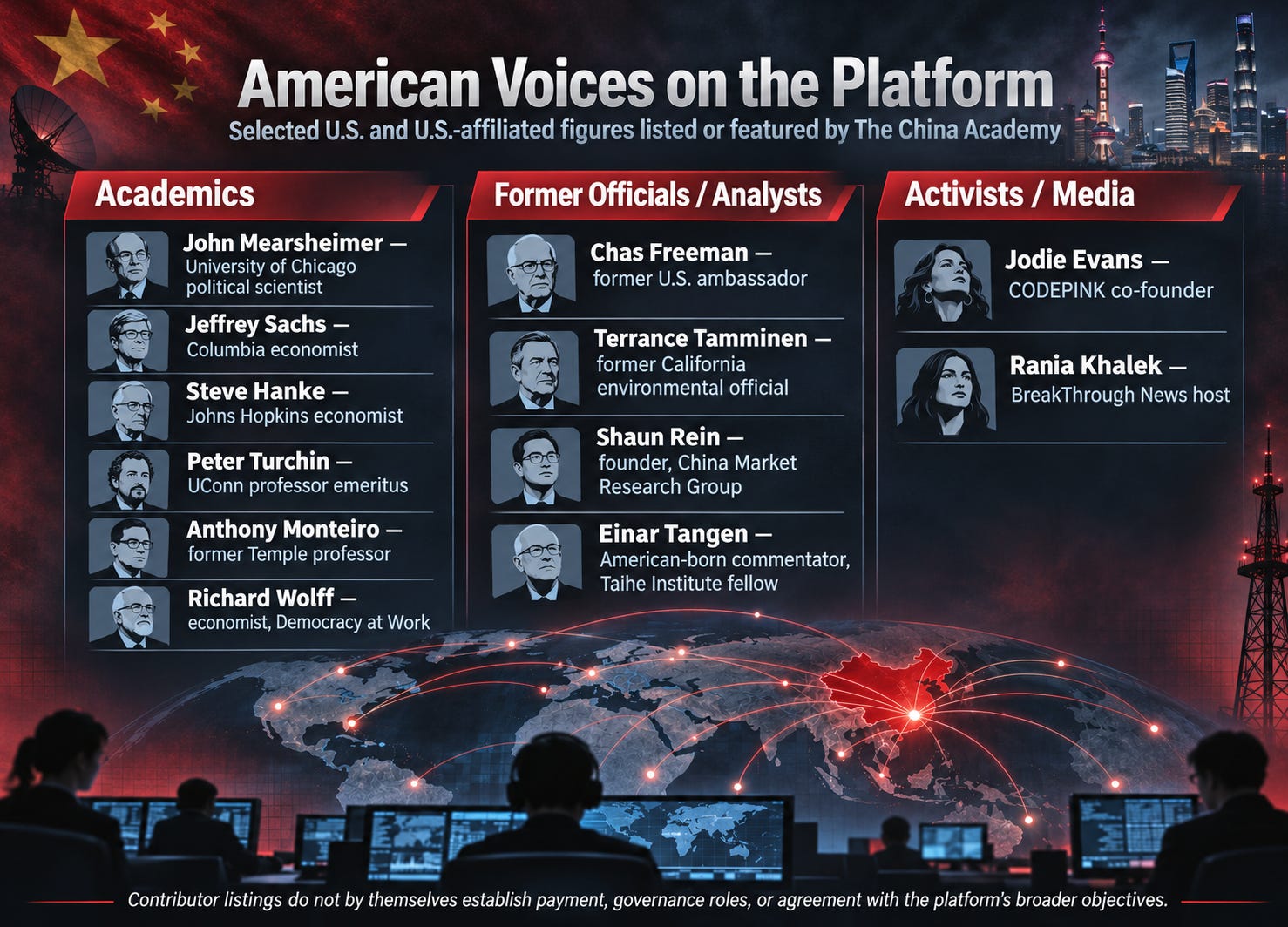
John Mearsheimer, University of Chicago political scientist. Joined an Academy-sponsored discussion with Dugin in December 2024.
Jeffrey Sachs, Columbia University economist. Featured in conversations with Zhang Weiwei about China and international affairs.
Chas Freeman, former U.S. ambassador to Saudi Arabia. Featured in commentary on U.S.-China relations.
Steve Hanke, Johns Hopkins economist. Interviewed about monetary policy and economic developments.
Richard Wolff, Democracy at Work founder and economist. Interviewed about capitalism and American economic risks.
Peter Turchin, University of Connecticut professor emeritus. Interviewed about historical cycles and instability.
Anthony Monteiro, former Temple University professor. Listed for his work on Marxism and race.
Terrance Tamminen, former California environmental official. Listed for environmental-policy expertise.
Jodie Evans, CODEPINK co-founder and wife of financier Neville Roy Singham. Appeared in Academy programming and promoted its China trips.
Rania Khalek, Lebanese-American BreakThrough News host. Listed as a contributor.
Shaun Rein, American founder of China Market Research Group. Featured in geopolitical interviews, including on November 13.
Einar Tangen, American-born Taihe Institute fellow. Appeared in an earlier directory.
The roster also includes Indian historian Vijay Prashad, executive director of Tricontinental Institute for Social Research, whose international advisory board is chaired by Singham. The New York Times documented Singham-linked financing of Tricontinental, while congressional investigators identified funding to BreakThrough News through Singham-linked organizations.
The directory also lists former Chinese military officer Wang Xiangsui. The Academy separately identifies Renmin University professor Di Dongsheng as an adviser. Contributor status does not establish payment or agreement with the platform’s objectives.
The Sanctioned Russian Connection
Dugin’s involvement is more than an isolated interview. His connection to Fudan, whose research helped underpin The China Academy, predates the platform’s creation.
In 2018, Fudan’s China Institute invited Dugin for a monthlong visit that included lectures and a geopolitics course. The Academy’s biography says he was appointed a Fudan senior fellow in 2019. A later Fudan account credited the visit with deepening his support for a Russia-China strategic partnership.
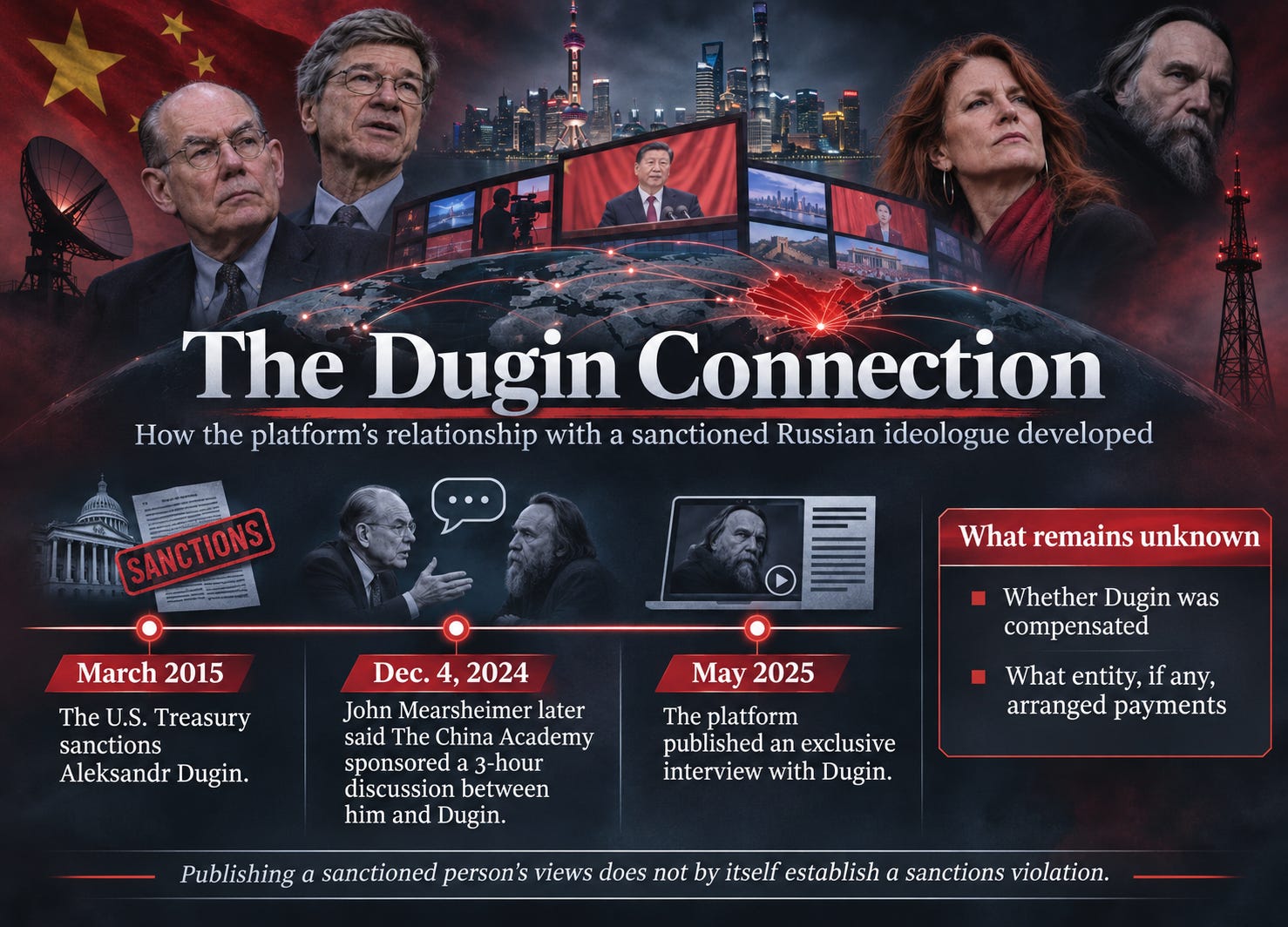
The U.S. Treasury sanctioned Dugin in March 2015 as a leader of the Eurasian Youth Union, which it said recruited combat-experienced individuals to fight for Russian-backed separatists in eastern Ukraine. In 2022, Treasury also identified Dugin as controlling Geopolitica, a website it described as spreading Russian ultranationalist propaganda and disinformation to foreign audiences.
On December 4, 2024, Dugin held a discussion lasting more than three hours with Mearsheimer, who confirmed The China Academy sponsored it. The Academy subsequently published an exclusive Dugin interview in May 2025 and continued featuring his commentary on Ukraine, Iran, Israel and U.S. politics through October 2025.
The platform has not publicly disclosed whether these appearances involved payment. Publishing a sanctioned person’s views does not itself establish a sanctions violation.
Who Funds It?
The Academy advertises consulting, courses, study trips and policy-advisory work for Chinese governments at local and central levels. It also solicits patrons and corporate sponsors.
Earlier reporting documented personnel overlaps with Singham-associated organizations, including CODEPINK and BreakThrough News, but not direct ownership or funding by Singham.
The Academy’s ultimate owners, principal funders and contributor payment arrangements remain unverified. What is established is a Shanghai-linked political-media production operation, partnered with Chinese state television and university researchers, that presents Western voices to international audiences.