


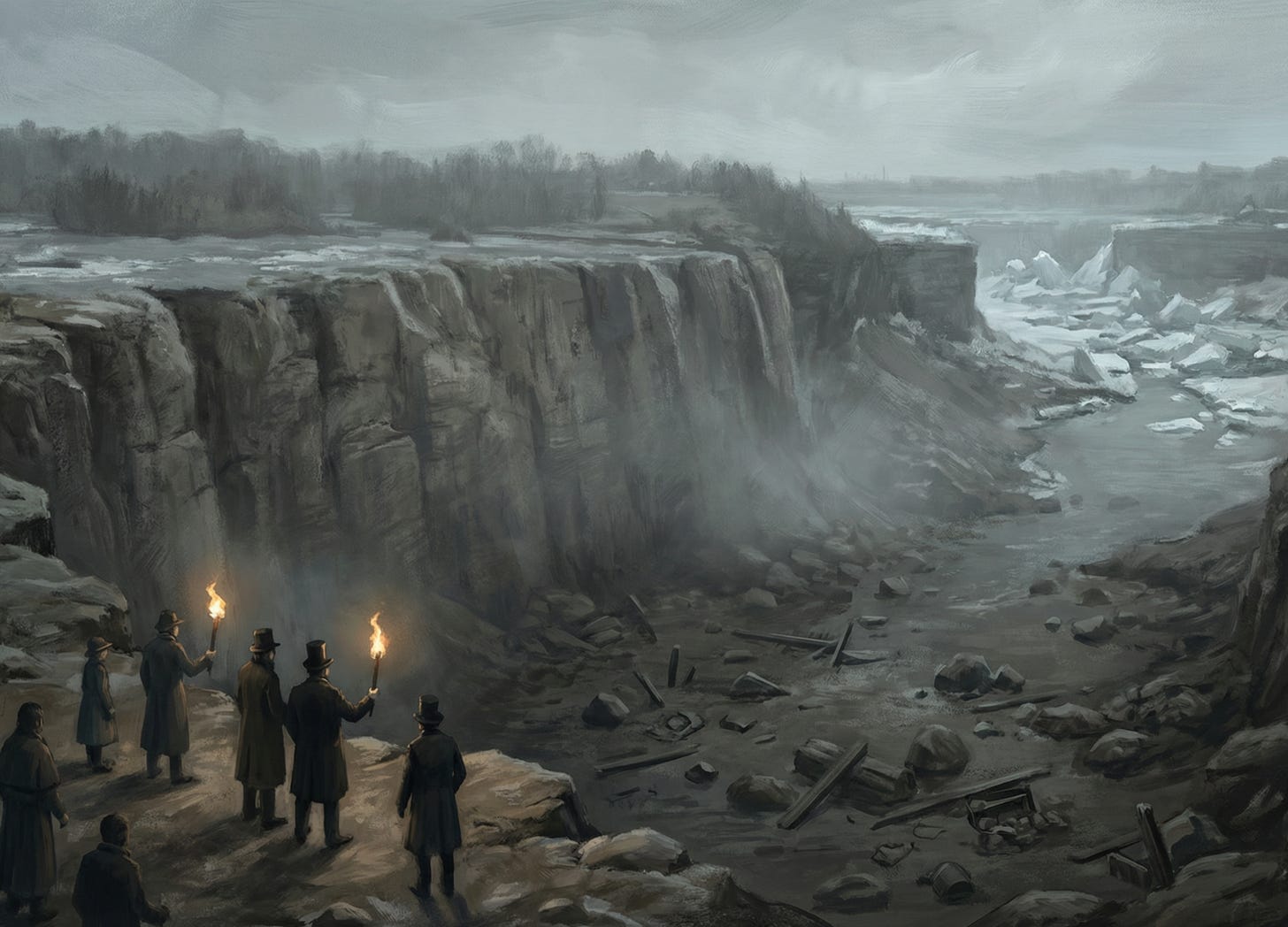
On March 29, 1848, Niagara Falls stopped flowing.
Residents awoke to silence where there should have been thunder. The Horseshoe Falls had been reduced to dripping cliffs. The exposed riverbed revealed muskets and bayonets from the War of 1812 lodged in mud. Locals walked across the dry gorge with torches, peering into the abyss where millions of gallons should have been cascading.
Many believed it was the end of the world.
It wasn’t. A warm spell after a brutal winter had fractured ice on Lake Erie, and winds drove the floes into the Niagara River’s mouth, forming a natural dam. Thirty hours later, the ice gave way and the Falls resumed. But for those who lived through it, the silence must have felt apocalyptic—not because they were foolish, but because the permanent had become temporary without warning.
The interesting question isn’t why people panicked. It’s why humans are so consistently terrible at distinguishing actual collapse from temporary disruption.
When Science Fuels the Fire
In May 1910, astronomers announced that Earth would pass through Halley’s Comet tail—which contained cyanogen gas, a relative of cyanide. The response was immediate and global. German farmers stopped planting crops. Creditors defaulted on loans. Snake-oil salesmen peddled “comet pills,” while bartenders promised that enough scotch would protect you from cyanogen.
Astronomers pleaded for calm, emphasizing that a comet’s tail was sparser than a cloud. The reassurances went unheard. In Puerto Rico, a 15-year-old named Fernando Colón-Vásquez and his family trekked two hours through thorny terrain to shelter in a remote cave. Deep inside, Fernando scratched a drawing on limestone: a five-pointed star with a sweeping tail crashing into a tomb topped with a cross.
The comet passed. Nothing happened. Fernando lived another 40 years.
Here’s the uncomfortable part: science amplified the panic. Camille Flammarion, the Carl Sagan of his era, mused in a Paris newspaper that hydrogen in the comet’s tail might strip oxygen from our atmosphere. He prefaced this with caveats, but once the cinematic horror was printed, it took on its own life. Prestige gave weight to wild speculation.
The Y2K Paradox
The Y2K panic was based on a real technical problem—computer systems storing years in two-digit format genuinely risked failure. The United States spent over $100 billion preparing; worldwide, nearly $300 billion. When midnight struck and nothing catastrophic happened, many concluded it had all been hype.
That’s backwards. Y2K didn’t cause chaos because of the massive remediation effort. Yet the dominant cultural memory is of people stockpiling canned goods for nothing, which makes it harder to take subsequent warnings seriously. We learned exactly the wrong lesson.
The Confidence of Partial Information
What’s changed since 1910 isn’t human psychology—it’s the speed at which partial information becomes confident narrative. In Fernando’s era, panic spread through newspapers that reached towns days later. In 2026, the same process happens in hours.
The structure of modern media rewards certainty over comprehension. Someone who watched a 90-second explainer on the Strait of Hormuz crisis can sound remarkably authoritative while missing the previous decade of sanctions policy, the economic relationships that make simple narratives impossible to sustain, or the historical precedents that would complicate confident predictions.
Now everyone has access to enough fragments to construct a plausible-sounding story, and platforms amplify whichever stories generate the most engagement—which tend to be the ones offering the most clarity about inherently complex situations.
We have more information than any generation in history, yet our collective ability to distinguish between “I’ve seen part of the picture” and “I understand what’s happening” seems to have deteriorated.
What Real Collapse Looks Like
When civilizations actually collapsed, contemporaries often didn’t realize it was happening.
The Fall of Rome wasn’t a single cataclysm—it was decades of institutional decay, tax erosion, and military defeats. Many Romans assumed things would stabilize as they always had. The Black Death killed between one-third and one-half of Europe’s population, yet society adapted in real time, reorganizing economic structures even as mass graves filled.
Real collapses happen slowly enough that humans keep adjusting their baselines. We’re remarkably good at normalizing catastrophe while simultaneously panicking over temporary disruptions.
The Current Catalog
In March 2026, Americans are processing several “unthinkable” disruptions simultaneously. The Strait of Hormuz has been effectively closed for weeks—a chokepoint we assumed could never actually be blocked, much like Niagara Falls in 1848. Institutions that seemed permanent fixtures of American life—from major banks to federal agencies—are operating under constraints that would have been unimaginable a decade ago.
Which represents temporary disruption, and which represents genuine structural failure? We won’t know for years. The Strait will eventually reopen, or energy infrastructure will route around it. Institutions will either reform or decay past repair.
What we can observe is that our calibration mechanisms haven’t improved since 1848. We still oscillate between normalcy bias—assuming permanent features can’t possibly fail—and availability heuristic panic, where the most vivid recent example dominates our sense of probability. Fernando crawling into a cave and millions currently doomscrolling aren’t separated by psychological sophistication, only by the medium through which they consume their fears.
What We Don’t Know
The pattern across these episodes suggests a simple lesson that’s surprisingly hard to internalize: confidence in the moment is no substitute for historical context.
Fernando’s family didn’t know that comet tails are too sparse to affect Earth’s atmosphere. They had fragments of scientific information filtered through newspaper speculation. The Germans who stopped planting in 1910 didn’t know how atmospheric chemistry actually worked. They knew cyanogen was poisonous and Earth would pass through the tail—two true facts that, without the full picture, pointed to the wrong conclusion.
The people declaring with certainty what the Strait of Hormuz closure means for global order, or what AI development means for human civilization, or what any given conflict’s trajectory will be—most are working from the same kind of partial information. A few data points, a plausible mechanism, confidence in the narrative. What they’re usually missing is the decade of context that would reveal why simple stories rarely capture complex systems, or the historical precedents that would show how similar situations actually unfolded.
This doesn’t mean all warnings are false or that skepticism is always warranted. It means that in the absence of comprehensive understanding, the appropriate response is usually not the certainty that dominates our current discourse. The Falls stopped flowing, and they started again. The comet passed, and nothing happened. And somewhere, right now, someone is constructing a confident narrative about 2026’s crises from fragments of information, unaware of what they don’t know.
The ice always melts eventually. The question is what we do in the thirty hours of silence before it does.