


Four astronauts entered quarantine last month in Houston. If everything goes according to plan, they’ll fly around the Moon sometime in the next few weeks, the first humans to make that journey since December 1972.
That’s a 54-year gap. To put that in perspective, the entire span from the Wright Brothers’ first flight to the Moon landing was only 66 years. We’ve now spent nearly as long not going to the Moon as it took us to invent powered flight and reach it in the first place.
The question isn’t why we’re going back. The question is why it took half a century.
When the Money Stopped
Apollo 17 splashed down on December 19, 1972. Eugene Cernan climbed back into the lunar module, and that was it. No farewell ceremony, no dramatic final words. NASA had already canceled Apollo 18 and 19 two years earlier, pivoting to something cheaper. The agency wanted a reusable space shuttle that could fly dozens of times per year.
The reason was brutally simple. Nobody wanted to pay for it anymore. At Apollo’s peak in 1966, NASA consumed 4.4% of the federal budget. The entire program cost $257 billion in today’s dollars, spent across just 13 years. By comparison, the Interstate Highway System, built over roughly the same period, cost more than twenty times that amount and barely registered as political controversy. But highways connected voters to jobs. The Moon connected America to a geopolitical contest.
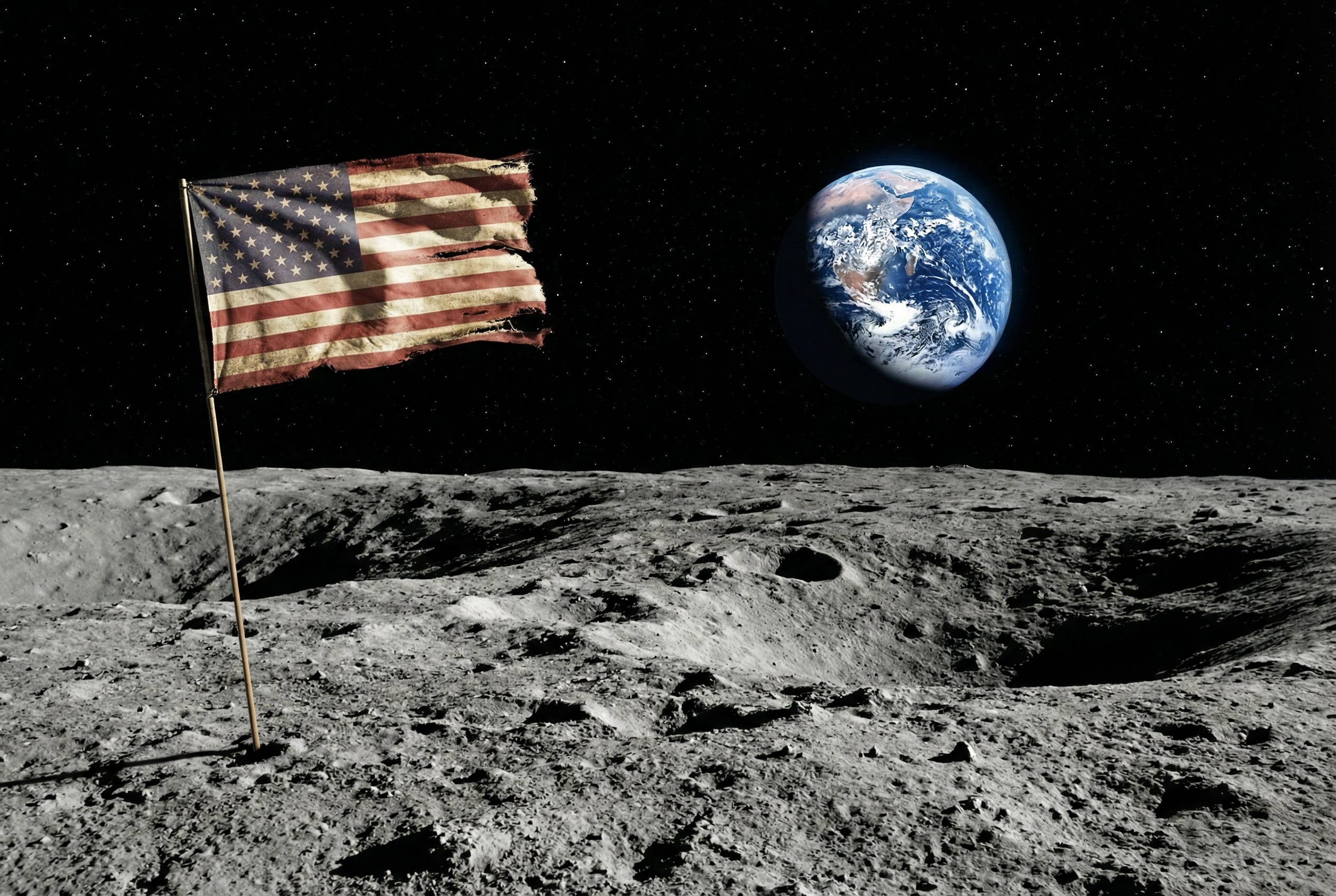
Once Neil Armstrong planted the flag and the Soviets fell behind, the contest was over. Richard Nixon slashed NASA’s budget by 10% in 1971, right after Apollo 11’s triumph. When the Office of Management and Budget proposed canceling the final two lunar missions in 1971, the rationale was frank. We’d already won.
The deeper issue was that Apollo had been designed as a sprint, not a marathon. The Saturn V was magnificent engineering but staggeringly expensive and operationally impractical for sustained exploration. Each launch required essentially hand-building a new rocket. There was no infrastructure for permanent presence, no plan for what came after the flags and footprints. Apollo proved we could reach the Moon. It didn’t prove we could stay.
The Fifty-Four Year Intermission
For half a century, no human traveled beyond low Earth orbit. The Space Shuttle flew 135 missions, but never higher than a few hundred miles up. It went far enough to service satellites and build the International Space Station, but nowhere near the 240,000-mile journey to the Moon. Plans for lunar bases appeared and vanished with each administration. George H.W. Bush proposed a return in 1989, and it died in budget negotiations. George W. Bush announced the Constellation Program in 2004. Obama canceled it in 2010.
What changed wasn’t American technological capability. The United States could have returned to the Moon at any point in those fifty years. What changed was the absence of a compelling reason that could survive budget cycles and shifting priorities.
And then, quietly, China started landing robots on the far side of the Moon.
The New Contest
China’s Chang’e program began in 2007 with an orbiter. By 2013, they’d soft-landed a rover, the first nation to do so since 1976. In 2019, Chang’e 4 became the first spacecraft ever to land on the Moon’s far side. In 2020, Chang’e 5 returned lunar samples. Each mission more ambitious than the last, each demonstrating systematic progress toward a long-term goal.
In 2023, China announced plans to land astronauts on the Moon by 2030. They weren’t proposing flags and footprints. They were describing a permanent research base near the lunar south pole, built in partnership with Russia and powered by a nuclear reactor. The International Lunar Research Station would support continuous human presence, enabling resource extraction and serving as a staging ground for deeper space missions.
Suddenly, the Moon wasn’t about past glories. It was about future capabilities.
The Artemis program, named after Apollo’s twin sister in Greek mythology, had been announced before China’s timeline became clear, but the urgency accelerated noticeably. This wasn’t Apollo’s sprint logic. Artemis is designed around sustainability. It includes a reusable lunar lander, a space station called Gateway that will orbit the Moon, and infrastructure meant to enable dozens of missions over decades. The target is the south pole, where permanently shadowed craters hold water ice that could be converted to rocket fuel.
It’s also explicitly international in ways Apollo never was. Jeremy Hansen, the Canadian astronaut now in quarantine with his three American crewmates, represents a coalition of 50 nations that have signed the Artemis Accords. The accords create a framework for lunar exploration that looks more like a treaty organization than a national program. China and Russia aren’t among them. They’re building their own bloc instead.
What Geopolitics Buys
The Artemis II crew of Reid Wiseman, Victor Glover, Christina Koch, and Jeremy Hansen won’t land on the Moon. That comes later. This mission is a test flight, ten days around the Moon and back, verifying that the Orion spacecraft and the massive Space Launch System rocket can safely carry humans beyond Earth orbit. It’s the same flight profile as Apollo 8 in 1968, the mission that first took humans around the Moon as a dress rehearsal for the landing.
If Artemis II succeeds, Artemis III will attempt the landing, potentially as soon as 2027. Then Artemis IV, V, and beyond, a cadence of missions building toward permanent presence. The whole program has cost roughly $93 billion so far, comparable to Apollo when adjusted for inflation, but spread over a longer timeline and designed for sustainability rather than speed.
The Logic of Decades
What’s different this time is the assumption of permanence. Apollo was an expedition. Artemis is infrastructure. The distinction matters. Infrastructure persists through administrations and budget cycles because it becomes embedded in the bureaucratic architecture of government. The ISS has survived four presidents and countless budget battles because terminating it became harder than continuing it. Artemis is being designed with the same logic. These are commitments that are expensive to reverse.
Whether that works remains to be seen. The program has already survived multiple delays and near-cancellations. It faces skepticism from those who see the money as better spent on Earth, and from those who question whether NASA’s approach is too expensive compared to commercial alternatives.
But for now, four astronauts are in quarantine, waiting for the first launch window. A rocket stands on the pad at Kennedy Space Center that can send them around the Moon. And in a few weeks, if the tests come back clean and the weather cooperates, humans will travel beyond Earth orbit for the first time since 1972.
Fifty years is a long time to wait. But it turns out that’s how long it takes for geopolitical competition to reach escape velocity again.
Great job taking a chainsaw to the nonsense as usual! There are, to put it nicely, some people with very active imaginations trying to tell us the 'real' reason we stopped going to the Moon.
Nice piece. Also decline in public interest. Would suggest that also escalation and cost of Involvement in Vietnam, and later the Apollo 13 mission (concerns about losing astronauts in another accident) also contributed to the cancellations. John Logsdon and Roger Launius have good books on the subject.