


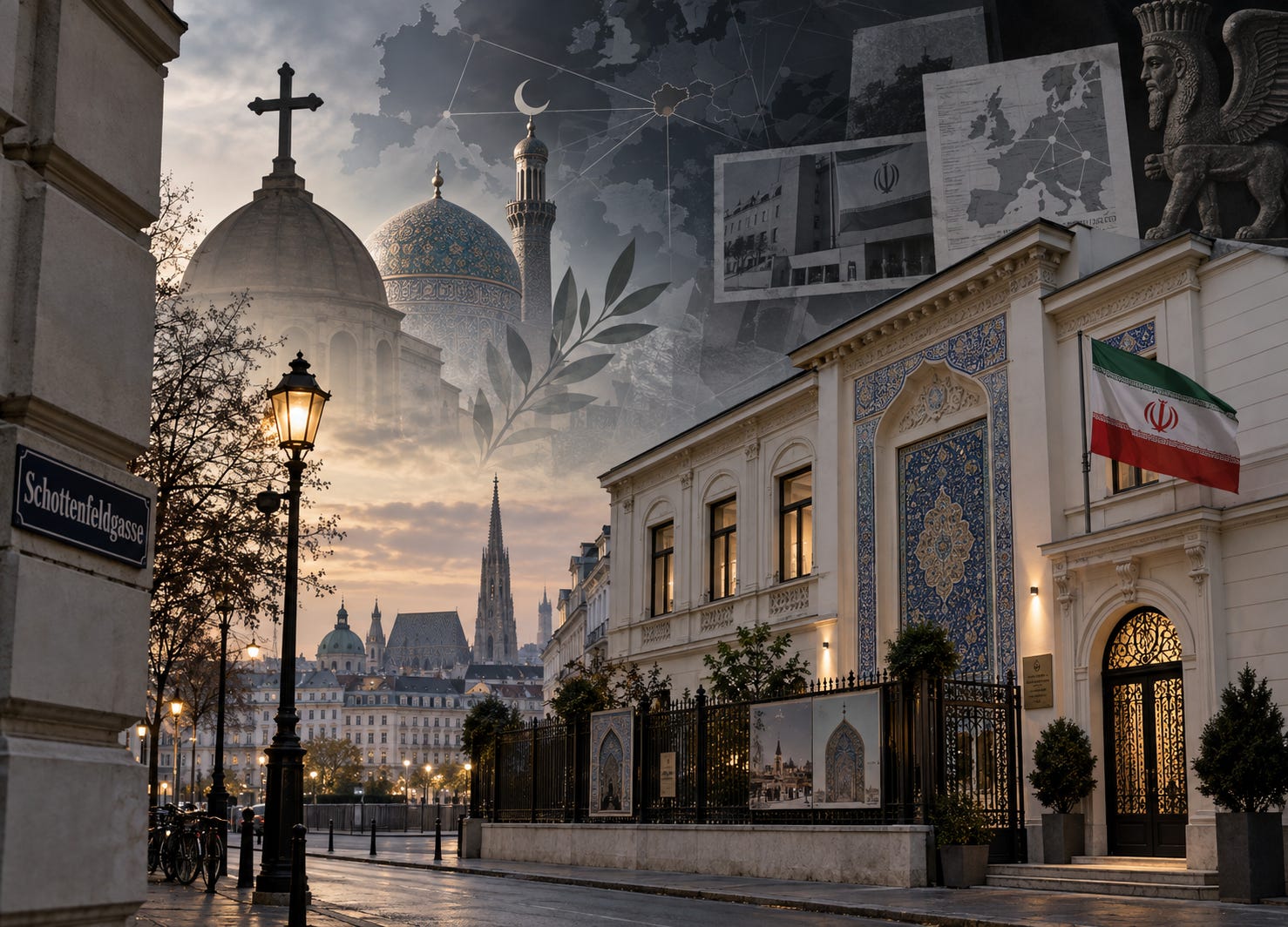
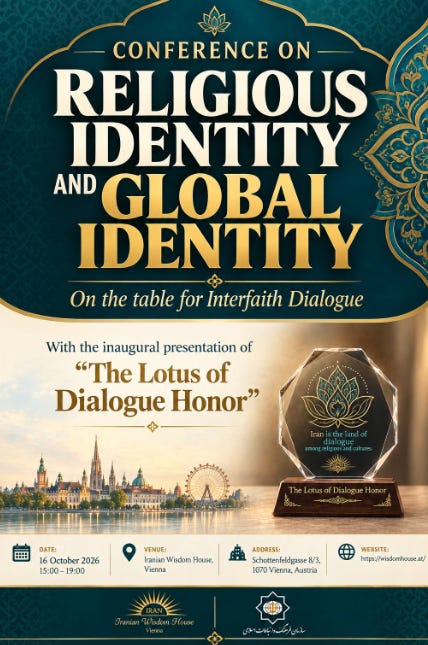
An organization operating under the guidance of the Islamic Republic of Iran’s official cultural representation in Austria is preparing to host a Christian-Muslim interfaith conference in Vienna on Friday, October 16, as part of a broader network of academic, religious, and cultural initiatives extending across Europe.
The conference, titled Religious Identity and Global Identity, is being organized by Iran’s Islamic Culture and Relations Organization (ICRO) in partnership with the Iranian Wisdom House, a Vienna-based institution that describes itself as promoting pluralism, moderation, peace, and coexistence. The gathering is expected to bring together Muslim and Christian scholars to discuss religious identity, globalization, migration, and interfaith relations.
But the institution’s own disclosures, Austrian government records, and past programming reveal extensive connections to Tehran’s cultural establishment, including a director who serves as Iran’s accredited cultural counselor and previous events commemorating the Islamic Republic’s former supreme leader, Ayatollah Ali Khamenei.
The Wisdom House acknowledges that it operates under the guidance and support of Iran’s cultural representation in Austria. Its venue is located at Schottenfeldgasse 8/3 in Vienna, the same address as the Iranian Embassy’s cultural section, according to Austria’s Foreign Ministry.
The ministry identifies Reza Gholami as Iran’s cultural counselor, a position he has held since May 2024. Gholami is also identified as the head of the Iranian Wisdom House.
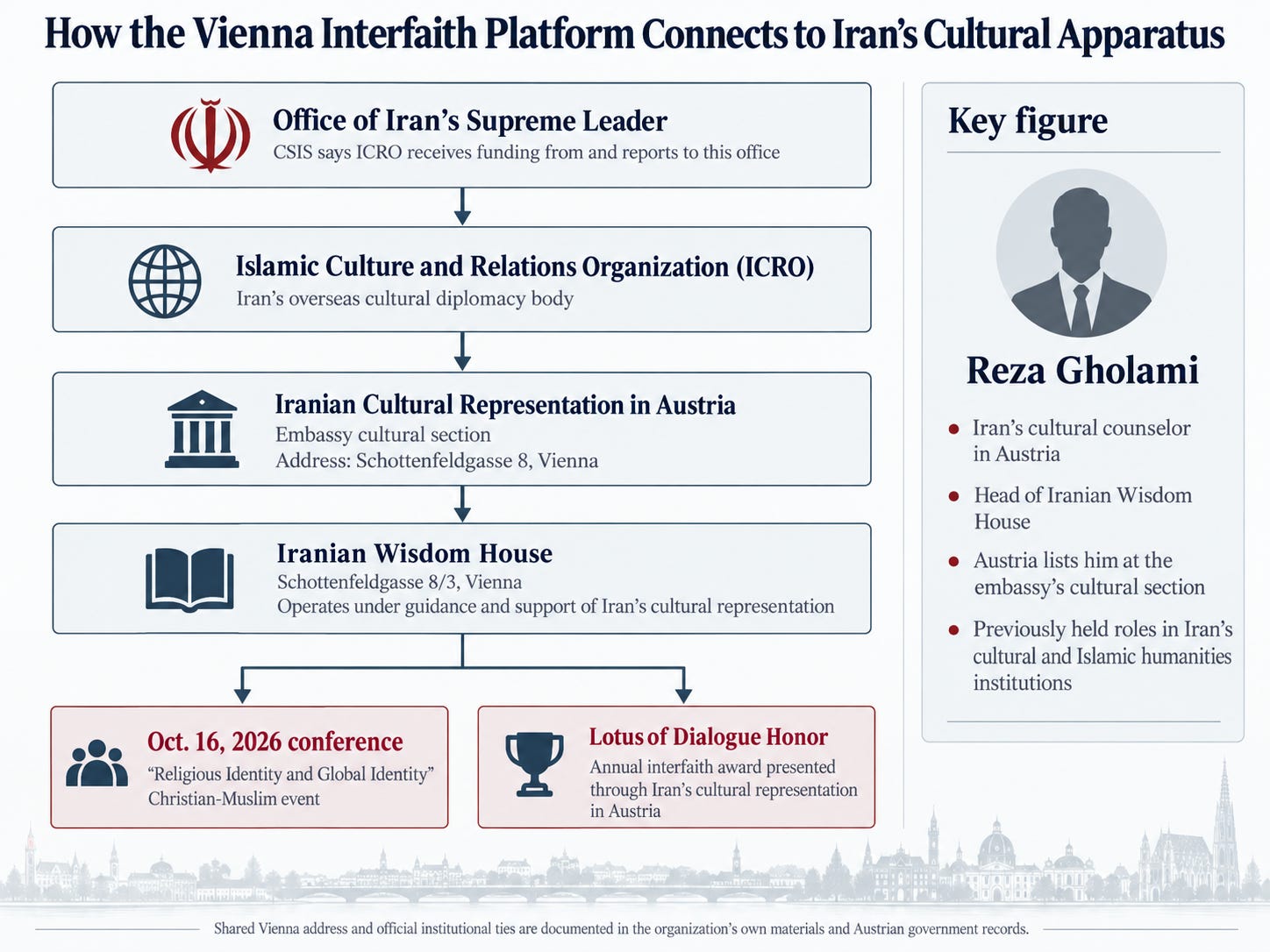
The institutional connection extends beyond Vienna. According to the Center for Strategic and International Studies, ICRO, which is organizing Friday’s conference, was established to coordinate Iran’s overseas cultural and religious outreach. The organization is nominally under Iran’s Ministry of Culture and Islamic Guidance but receives funding from and reports to the office of the supreme leader.
CSIS identifies ICRO’s objectives as including the export of Iran’s revolutionary ideals, the promotion of Islamic unity, and the cultivation of foreign relationships through educational, religious, and cultural programs.
An Interfaith Center That Honored Khamenei
The Wisdom House’s previous programming offers a revealing contrast to its stated commitment to political independence. On March 17, 2026, the institution hosted a conference titled Khamenei: Half a Century of Seeking Justice in the World, dedicated to reviewing the former supreme leader’s legacy.
The event’s official description referred to Khamenei as a martyred leader and condemned the U.S.-Israeli military campaign against Iran as an “illegitimate and criminal war.”
Participants included Gholami, Shia scholar Mohammad Waldmann, Mohammad Lenser of Austria’s Institute for Islamic Culture and Education, and Austrian journalist Dieter Reinisch.
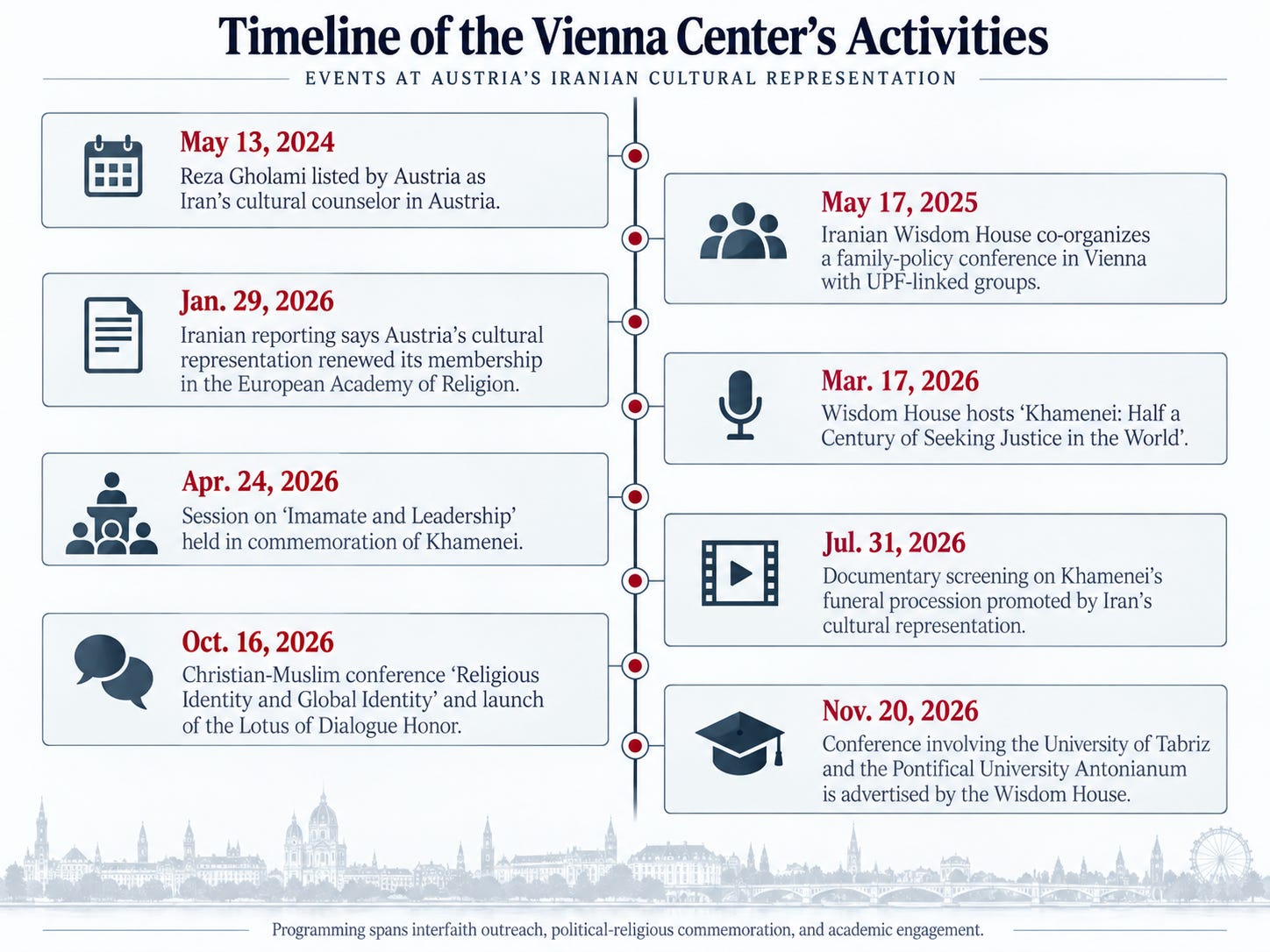
The organization held another session on April 24 examining Islamic political and religious leadership in commemoration of Khamenei. In July, Iran’s cultural representation advertised a documentary screening at its Vienna premises commemorating the former supreme leader’s funeral procession.
Yet the Wisdom House’s website says the institution refrains from political or ideological affiliations and is committed to intellectual independence. Gholami’s professional history also connects him to Iran’s political and religious establishment.
His publicly accessible academic profile lists previous positions with Iran’s Supreme Council of the Cultural Revolution and leadership roles in the Supreme Council of Islamic Humanities, the Iranian Institute for Social and Cultural Studies, and the Sadra Islamic Humanities Research Center. Some positions are listed as ongoing, although the profile does not independently establish whether he continues to hold them while stationed in Vienna.
Building Religious and Academic Partnerships
The Wisdom House’s operations extend beyond conferences at the Iranian cultural mission. In May 2025, it helped organize a Vienna conference on family-centered policies alongside the Universal Peace Federation (UPF) Austria, the Family Federation for World Peace and Unification, and the Austrian Women’s Federation for World Peace.
A report published by UPF independently identifies the Iranian Wisdom House as a co-organizer. The event took place at UPF’s Peace Centre and featured Gholami alongside representatives of the participating organizations.
UPF and the Women’s Federation for World Peace belong to a network of organizations founded by Sun Myung Moon and Hak Ja Han, the leaders of the religious movement commonly known as the Unification Church.
The Iranian institution has also expanded its academic relationships. It is listed as a participating institution in a forthcoming November 20 conference organized by Iran’s University of Tabriz in collaboration with the philosophy faculty of the Pontifical University Antonianum, a Franciscan university in Rome.
Separately, the Wisdom House’s website identifies the Hafez and Hammer-Purgstall Cultural Association, founded and directed by Hassan Javaheri, as an organization that includes the Wisdom House among its initiatives.
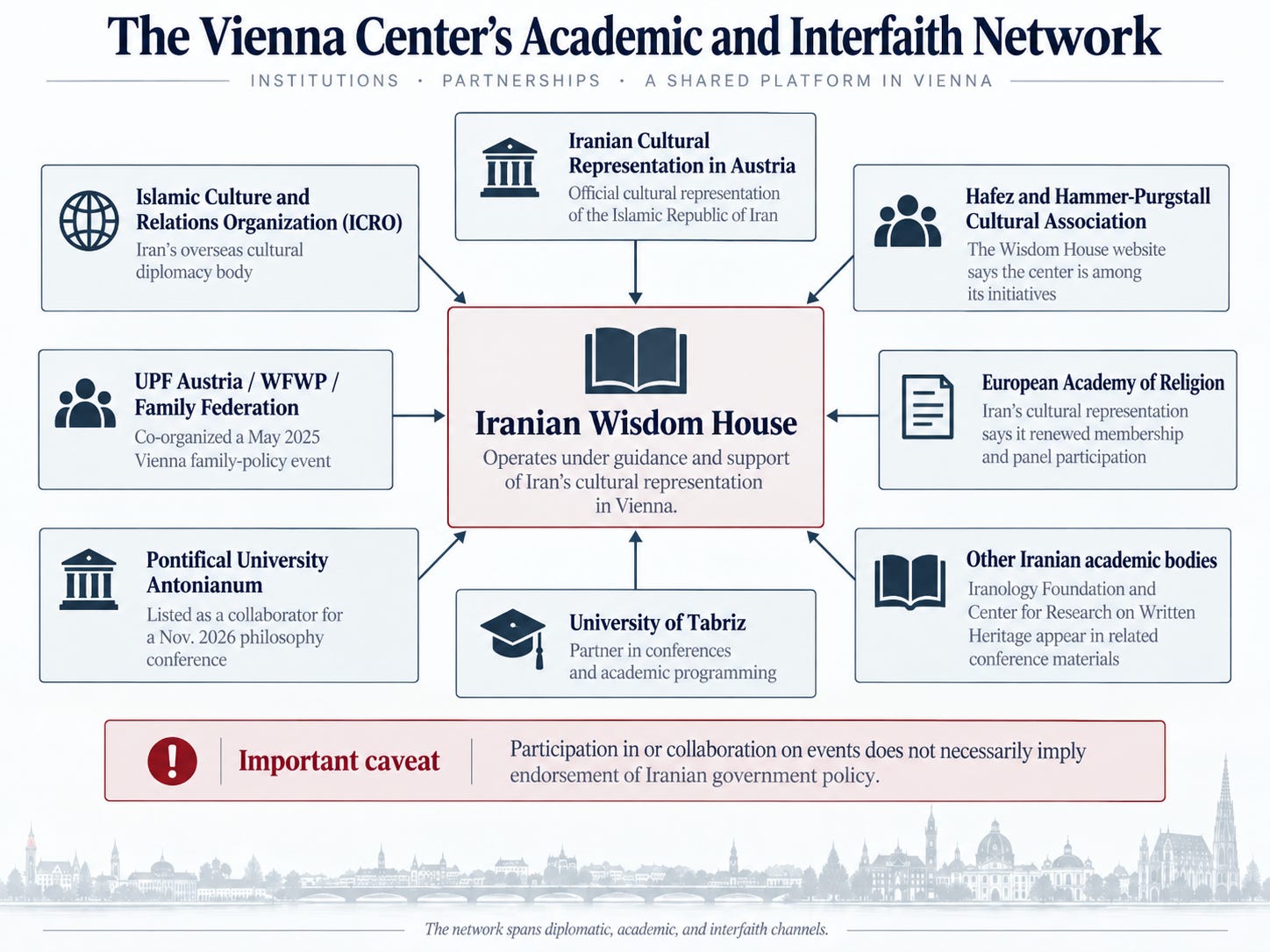
These relationships demonstrate the institution’s efforts to engage European religious, academic, and cultural circles, although participation in its programs does not establish endorsement of Iranian government policies.
Religious Dialogue Abroad, Persecution at Home
The initiative comes amid persistent international criticism of Iran’s treatment of religious minorities, including Christians. In its 2026 annual report, the U.S. Commission on International Religious Freedom documented the Iranian government’s systematic targeting of religious minorities, including Christians, Jews, Baha’is, and Sunni Muslims.
A separate British government assessment, updated in August 2026, found that Iranian authorities continue to arrest and detain Christian converts, particularly religious leaders and organizers. Iran recognizes certain longstanding Christian communities but places substantial restrictions on conversion from Islam and Christian evangelism.
The contrast raises questions about how Tehran’s official cultural representatives approach religious freedom in international forums while the government continues restricting religious activity domestically.
Friday’s conference is expected to feature Christian and Muslim academics, although the official announcement reviewed by Cross Currents does not identify a complete roster of speakers.
The precise financing of the Vienna institution and the conference also remains unclear. While the Wisdom House openly acknowledges Iranian diplomatic support, its publicly available materials do not provide a detailed budget or identify all funding sources.
What is documented is an Iranian government-linked cultural institution, headed by an accredited Iranian diplomat, operating from the address of Tehran’s embassy cultural section while developing relationships with European academic and religious organizations.
The October 16 gathering represents another public event in that network, this time presenting Iran’s state-sponsored cultural diplomacy through the language of Christian-Muslim cooperation and religious coexistence.