


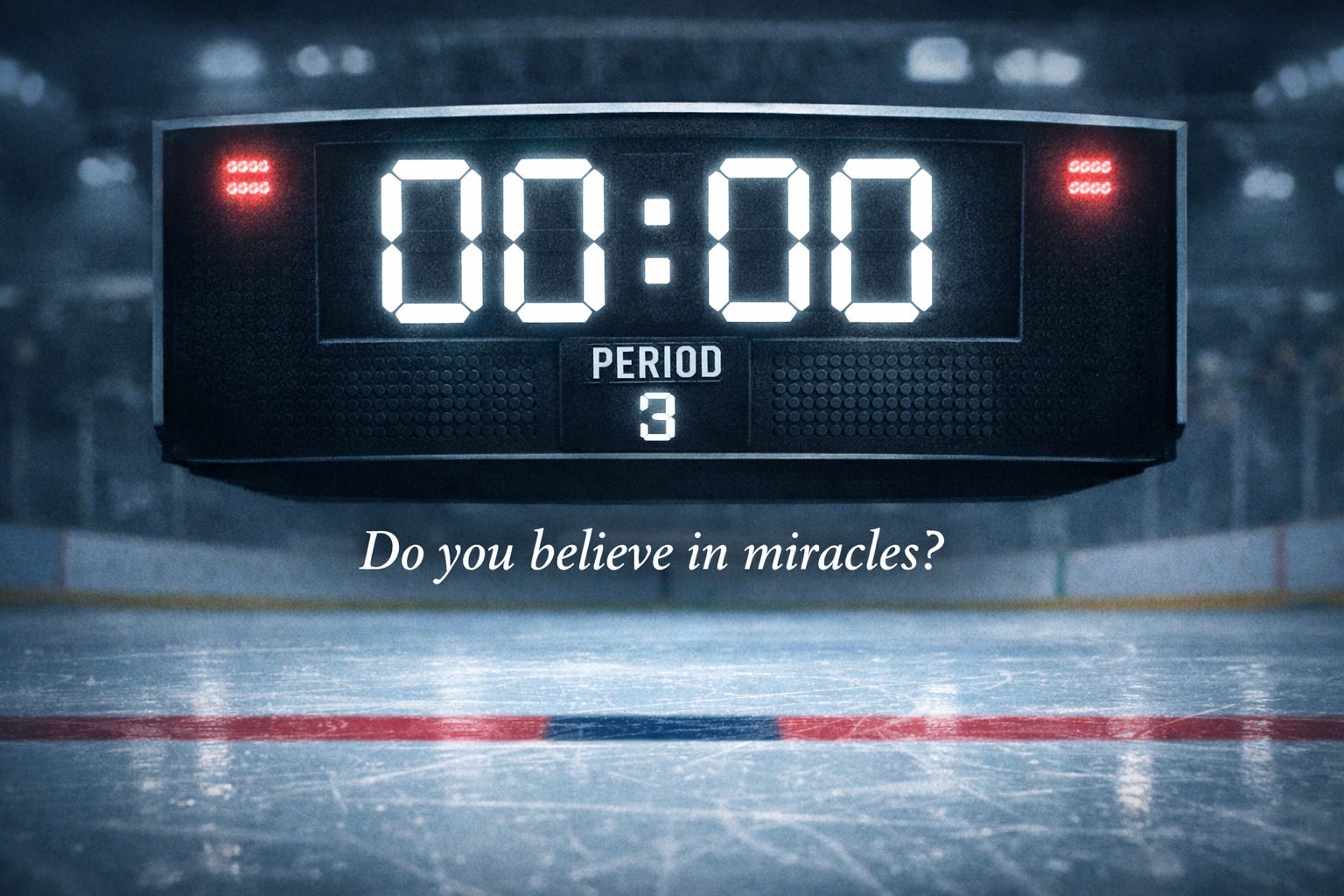
Forty-six years ago today, college hockey players beat the Soviet Union in Lake Placid. The game wasn’t for the gold medal—that came two days later against Finland—but it’s the game everyone remembers. Al Michaels’ question “Do you believe in miracles?” functions as its own timestamp, a way of saying February 22, 1980 without having to say it.
Today, another American hockey team takes the ice in Milan, attempting to win the country’s first Olympic gold since that night in upstate New York. The players are professionals this time, not college kids. The opponent is Canada rather than the Soviets. The geopolitical backdrop has changed entirely.
Or has it?
The Crisis Inventory
To understand why the 1980 hockey game resonated so profoundly, you need to reconstruct what Americans were living through that winter. The Iran hostage crisis had entered its 110th day—fifty-two Americans captive in Tehran, their blindfolded faces a nightly television fixture. A rescue mission was being planned that would fail catastrophically two months later. Inflation had hit 13.3 percent. Gas lines stretched for blocks. Unemployment neared 6 percent.
Sixty days before the Miracle on Ice, Soviet forces invaded Afghanistan, beginning what would become a decade-long occupation. President Carter threatened to boycott the Moscow Olympics and reinstated draft registration. The Cold War, which some thought was thawing, had frozen solid again.
Seven months earlier, Carter had delivered what became known as the “malaise speech”, describing “a crisis of confidence” that “strikes at the very heart and soul and spirit of our national will.” Polling showed he was describing something real—trust in institutions was cratering, optimism was declining, American power felt finite rather than assured.
This was the atmosphere in which a hockey game became something more than sport.
The Team USA roster offers its own commentary: college players from Minnesota and Massachusetts, Michigan and Wisconsin, who’d been demolished 10-3 by the Soviets in an exhibition just days before the Olympics. The Soviets had won gold in 1964, 1968, 1972, and 1976, gone 27-1-1 in Olympic competition since 1968, and beaten the NHL All-Stars in 1979.
That the Americans won 4-3, then beat Finland for gold, created a narrative perfectly calibrated to the moment: scrappy individuals had beaten the machine. The game offered proof that American grit could still triumph when odds suggested otherwise—a desperately needed message in February 1980.
What’s worth noting is that this meaning was imposed almost entirely by Americans. Soviet sports officials didn’t treat the loss as civilizational catastrophe; they’d just won four straight golds and would remain dominant for years. It was Americans who needed the game to be existential, who required symbolic victory to compensate for actual strategic stalemate.
The Pattern Returns
Recent polling shows Americans heading into 2026 expecting difficulty across 13 measured dimensions—political cooperation, international disputes, economic prosperity, employment, taxes, prices, crime. Only the stock market garners majority-level optimism. Another survey found Americans expecting “high quality lives” dropped nine percentage points to around 60 percent—a generational low.
The geopolitical backdrop offers its own echoes. Tensions with Iran have escalated dramatically since mid-January, with U.S. carrier groups repositioning to the Persian Gulf, protests being violently suppressed, and both sides issuing threats that narrow space for de-escalation. The crisis combines internal instability with external military pressure—a combustible mixture. Negotiations continue, but so does military buildup.
Today, these negotiations occur against the backdrop of an Olympic hockey final. American athletes attempting to accomplish something that hasn’t happened since Lake Placid. The professional roster represents a different model than 1980’s college kids, but the symbolic stakes may function similarly—not because officials draw the connection, but because audiences hungry for clear victories in an unclear moment will draw it themselves.
Why Miracles Function
The 1980 game worked because it provided narrative closure during a period when everything else felt open-ended. The hostages weren’t coming home (not for another 306 days). Inflation wasn’t being tamed. The Soviet Union wasn’t weakening. But in Lake Placid, on a Friday night in February, there was a beginning, middle, and end. The story made sense.
This is what societies do during prolonged crisis—they locate meaning wherever it can be found, often in places disconnected from actual sources of stress. The hockey game didn’t solve anything strategic. It didn’t bring hostages home or lower inflation or stop Soviet advances. But it provided evidence that outcomes weren’t predetermined, that preparation still mattered, that David could beat Goliath.
Whether the same symbolic mathematics operates today is unclear. The crises are different—no hostages in Tehran currently, though tensions are high; inflation is not at 1980 levels, though economic pessimism is widespread; no superpower confrontation quite mirrors the Cold War’s clarity. The team is different too—professionals rather than amateurs.
But the need for clear victories during unclear times operates according to its own logic. When actual strategic situations feel intractable, symbolic wins acquire outsize significance. Not because they solve underlying problems, but because they offer proof that winning is still possible at all.
Forty-six years ago, a hockey game became a pressure-release valve for a nation processing multiple simultaneous crises. It didn’t solve those crises, but it demonstrated that outcomes could surprise, that underdogs could win, that effort mattered.