


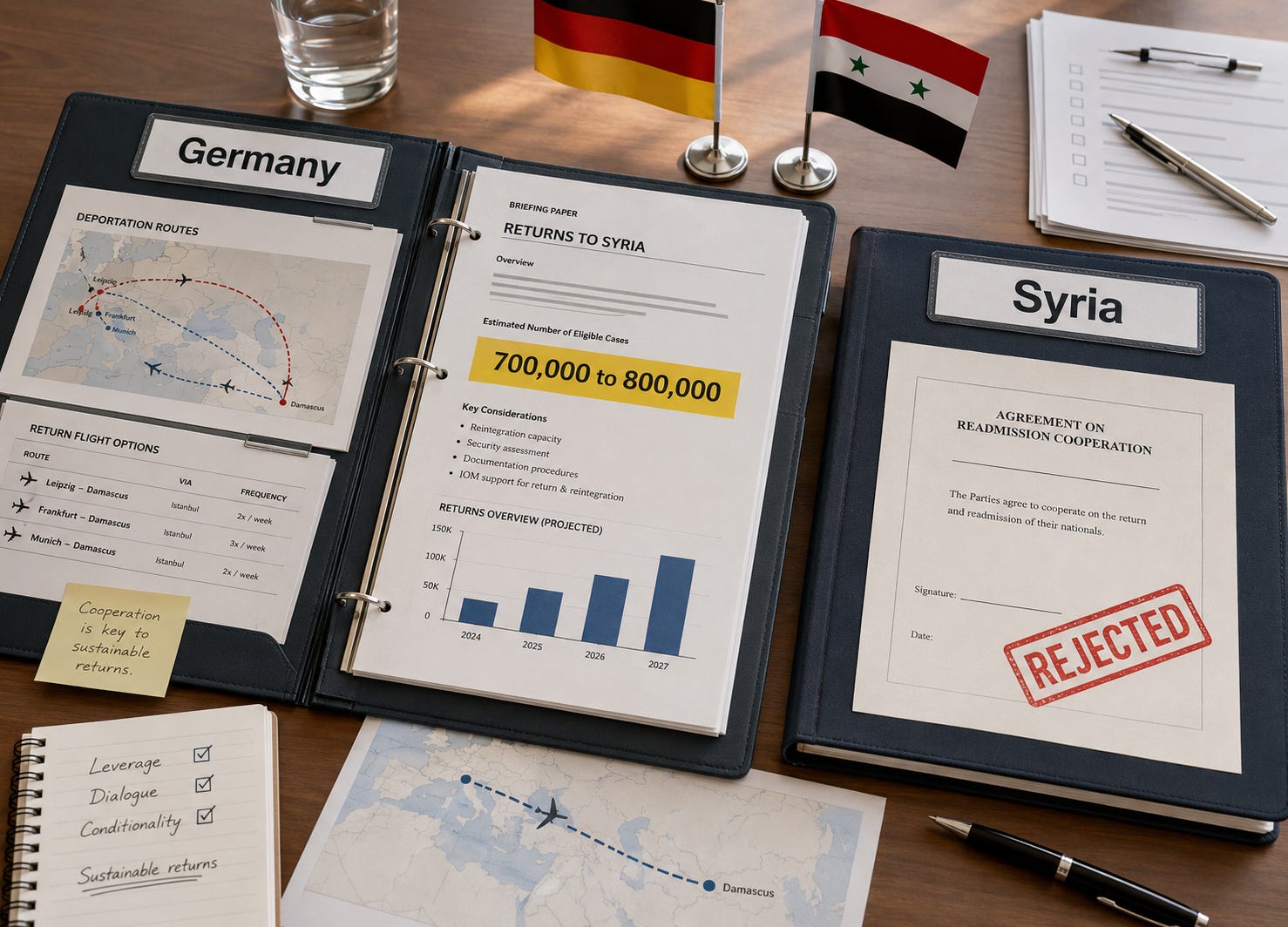
On March 30, 2026, German Chancellor Friedrich Merz stood beside Syrian interim President Ahmed al-Sharaa in Berlin and announced that roughly 80% of the 700,000 to 800,000 Syrians seeking asylum in Germany would return to Syria within three years. Merz attributed the figure to al-Sharaa’s own “wish.” Within 24 hours, the Syrian president contradicted him from a podium at Chatham House in London, saying “I did not say this.” Days later, Syria’s foreign minister posted on X that Damascus “categorically reject[s] any attempts at forced deportation” — a public refusal of the bilateral cooperation Germany legally requires to carry out mass removals. The unraveling reveals a deportation plan built on a partnership that does not exist.


What Merz Announced in Berlin
Merz told reporters at the chancellery that 80% of Syrians in Germany were expected to return home over the next three years, with priority given to those without valid residence rights and those with criminal records. He pledged roughly €200 million in German support for Syrian reconstruction and announced a “joint task force” to coordinate returns.
The chancellor framed the timeline as al-Sharaa’s preference: “Looking ahead over the next three years – as Sharaa has expressed his hope – around 80% of Syrians currently residing in Germany are expected to return to their home country.”


Damascus Pushes Back — Hard
Speaking the next evening at Chatham House in London, al-Sharaa flatly denied the attribution: “This statement is somewhat exaggerated. I did not say this. It was said by others, by the chancellor.” He added that “the return of the refugees is directly linked to the reconstruction of Syria” and warned against “just sending people on airplanes to go back.”
Two days later, Syrian Foreign Minister Asaad al-Shaibani escalated the rejection on X, declaring that “Syrians in exile are strategic national assets, not burdens” and that Damascus would “categorically reject any attempts at forced deportation.” German broadcaster DW described the dispute as threatening “to develop into a diplomatic incident.”



Why Syria Holds the Cards
Under international migration law, deportations are bilateral. Origin countries must verify identity, issue travel documents, and authorize landings before removals can occur. Aaron Reichlin-Melnick of the American Immigration Council explained that “any country has the sovereign right to refuse a deportation flight from a foreign country.”
Research by the Migration Policy Institute documents how “recalcitrant” countries — those refusing to take back nationals — typically obstruct through bureaucratic non-response, impossibly high identity verification standards, claims of administrative incapacity, and refusal of charter flights. Cuba famously blocked US deportations from the mid-1960s until 2017. As of mid-2020, the United States classified 13 countries as recalcitrant, including Iran, Iraq, China, and Russia.
Germany has been seeking a formal readmission agreement with Syria since September 2025, when Interior Minister Alexander Dobrindt told the Rheinische Post Berlin wanted a deal “this year.” No such agreement has been signed. Syria has a built-in justification for delay: more than a decade of civil war damaged government recordkeeping and infrastructure, giving Damascus credible administrative cover to slow-walk identity verification indefinitely.
The Numbers Don’t Add Up
Even with full Syrian cooperation, the math collapses. Hesse-based migration lawyer Nahla Osman calculated that returning 80% within three years would require deporting roughly 730 people per day — “a logistical scenario without any realistic basis.”
Germany’s Federal Office for Migration and Refugees reported that only 3,678 Syrians took the government’s voluntary return offer in 2025, despite a €1,000 grant per adult. Germany’s administrative courts face a backlog of 180,000 asylum cases. And Syrian doctors constitute the largest group of foreign physicians in Germany — a fact even Merz’s own party acknowledges as a problem. “If they return, we will have a problem,” CDU foreign policy expert Roderich Kiesewetter told Handelsblatt.
The Domestic Political Driver
Al Jazeera’s Berlin correspondent characterized Merz’s statement as “very much meant for domestic consumption.” Germany’s next federal election falls in exactly three years — the same window as Merz’s deportation pledge. His CDU has been bleeding voters to the surging anti-immigration Alternative for Germany (AfD) party.
Even the AfD has noted that Syria appears to be winning the standoff. The party officially declared that Syria was effectively “dictating migration policy to the federal government,” with co-chair Alice Weidel adding that “the governmental chaos of the past few days makes it clear: Merz will comply with this demand.” Coalition partner SPD’s Anke Rehlinger told Redaktionsnetzwerk Deutschland that throwing out concrete figures “raises expectations that he may not be able to meet.” German Foreign Minister Johann Wadephul, standing in a destroyed Damascus suburb in October 2025, had previously said that “here people can hardly live in dignity.”

A Plan That Requires a Signature That Isn’t Coming
The pattern is familiar to Americans. The United States has spent decades negotiating around uncooperative origin governments — Cuba, Venezuela, China — that use migration cooperation as diplomatic leverage.
Damascus has now signaled it intends to do the same. Merz pledged €200 million to a Syrian government that, days later, publicly rejected the central premise of his domestic political pitch. The chancellor announced a deportation timeline that physically cannot proceed without the cooperation of a foreign government that has just refused, in writing, to provide it.
And yet many people continue to insist that the West is not becoming a dumping ground for any given country's undesirables.