


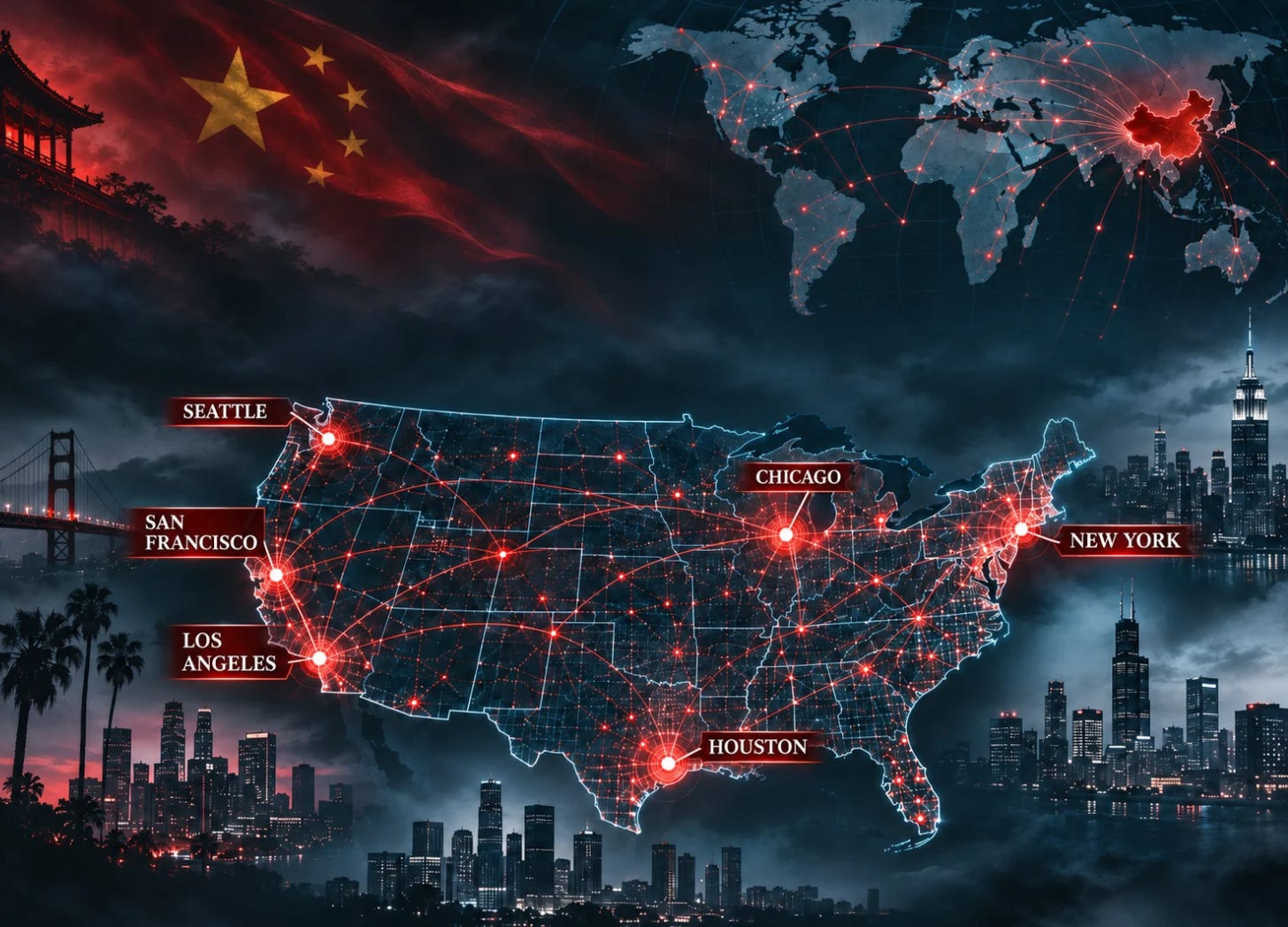
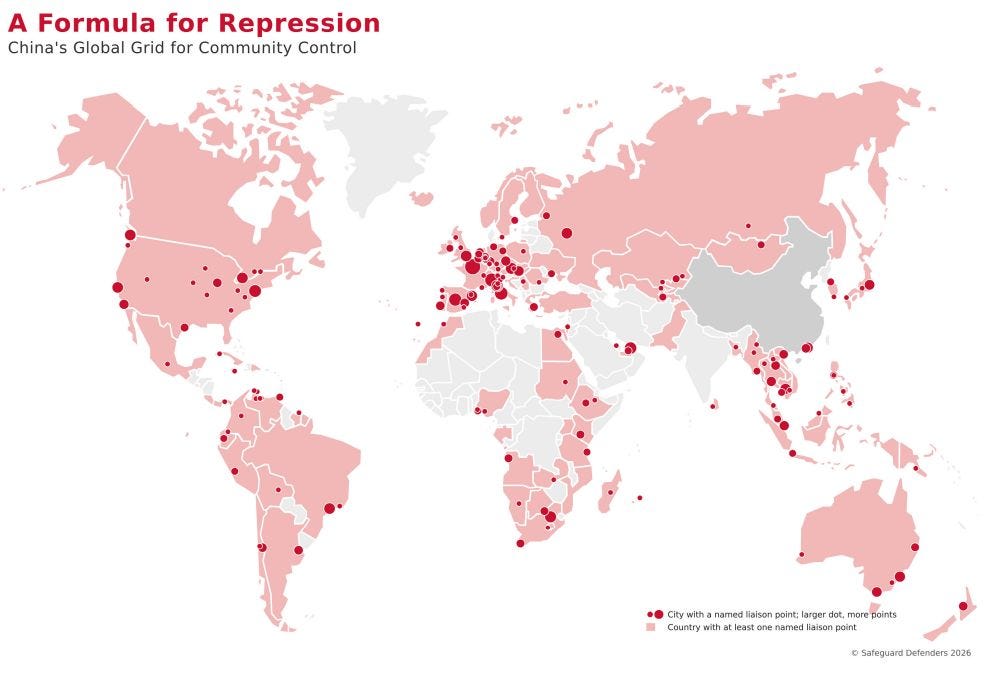
A new report by human rights organization Safeguard Defenders identifies an extensive network of Chinese government-designated liaison points across American cities, warning that the Chinese Communist Party (CCP) is extending its surveillance and political control apparatus into overseas communities. Released November 6, A Formula for Repression documents 1,247 designated liaison points across at least 91 countries, including locations in New York, Los Angeles, San Francisco, Chicago, Houston and Seattle.
The investigation finds that Beijing’s overseas policing infrastructure continued expanding after undeclared Chinese
police stations were exposed in 2022. Rather than dismantling the underlying system, Chinese authorities have increasingly operated through established diaspora associations, community-service centers and liaison offices linked to the CCP’s United Front apparatus.
Drawing on Chinese government publications, police records and official organizational documents, the researchers describe a coordinated system for gathering intelligence, monitoring political activity, influencing diaspora communities and extending Chinese security operations beyond national borders.


American Connections
Jinan’s Overseas Chinese Federation, in Shandong province, reported 45 overseas stations by March 2025, with U.S. locations in New York, Houston, Los Angeles and San Francisco. In July 2024, Jinan’s police, prosecutors, intermediate court and justice bureau signed a formal agreement with the federation establishing cooperation on diaspora-related activities, including information sharing and coordinated services.
Hangzhou’s federation reported 119 overseas liaison offices worldwide by 2023, including locations in San Francisco, Seattle, Chicago and Los Angeles. At conferences involving overseas association leaders in 2024 and 2025, local Chinese police officials briefed participants on their operations and policies, according to the report’s records.
Wuxi’s federation reported 156 overseas “hometown stations” worldwide in November 2023, including a New York liaison. Its overseas student-support program was organized with Wuxi’s education, public-security and state-security authorities.
The program included ideological and political guidance intended to counter what Chinese officials called “unhealthy trends of thought” encountered abroad. A separate municipal account described New York liaison personnel assisting two newly arrived Chinese students in 2022.
The report also identifies centrally designated Overseas Chinese Service Centers in American locations including Salt Lake City, Omaha, St. Paul, St. Louis and Charlotte. These centers were established through existing Chinese community associations selected by Beijing’s overseas-affairs authorities.
The Manhattan Police Station
The most prominent American enforcement case involved an undeclared Chinese police station at 107 East Broadway in Manhattan’s Chinatown.
On May 13, 2026, a federal jury convicted Lu Jianwang of acting as an illegal agent of the Chinese government and obstructing justice. His co-defendant, Chen Jinping, had pleaded guilty in December 2024 to conspiring to act as a Chinese government agent.
Federal prosecutors established that the station operated under the direction of China’s Ministry of Public Security. Lu was instructed to locate a pro-democracy advocate in California and had previously participated in operations targeting Chinese dissidents. After the FBI searched the premises in October 2022, the defendants deleted communications exchanged with their Chinese official contact.
Safeguard Defenders traces the station’s creation to an existing diaspora network coordinated through Fuzhou’s Overseas Chinese Federation, which helped select associations to host police liaison points.
In April 2026, the CCP’s Central United Front Work Department confirmed that Fuzhou’s federation continued operating a police-overseas-Chinese cooperation mechanism alongside arrangements involving prosecutors and tax officials.
The findings demonstrate how the institutional infrastructure behind the original police stations continued functioning under broader federation-led arrangements.


An Overseas Surveillance Architecture
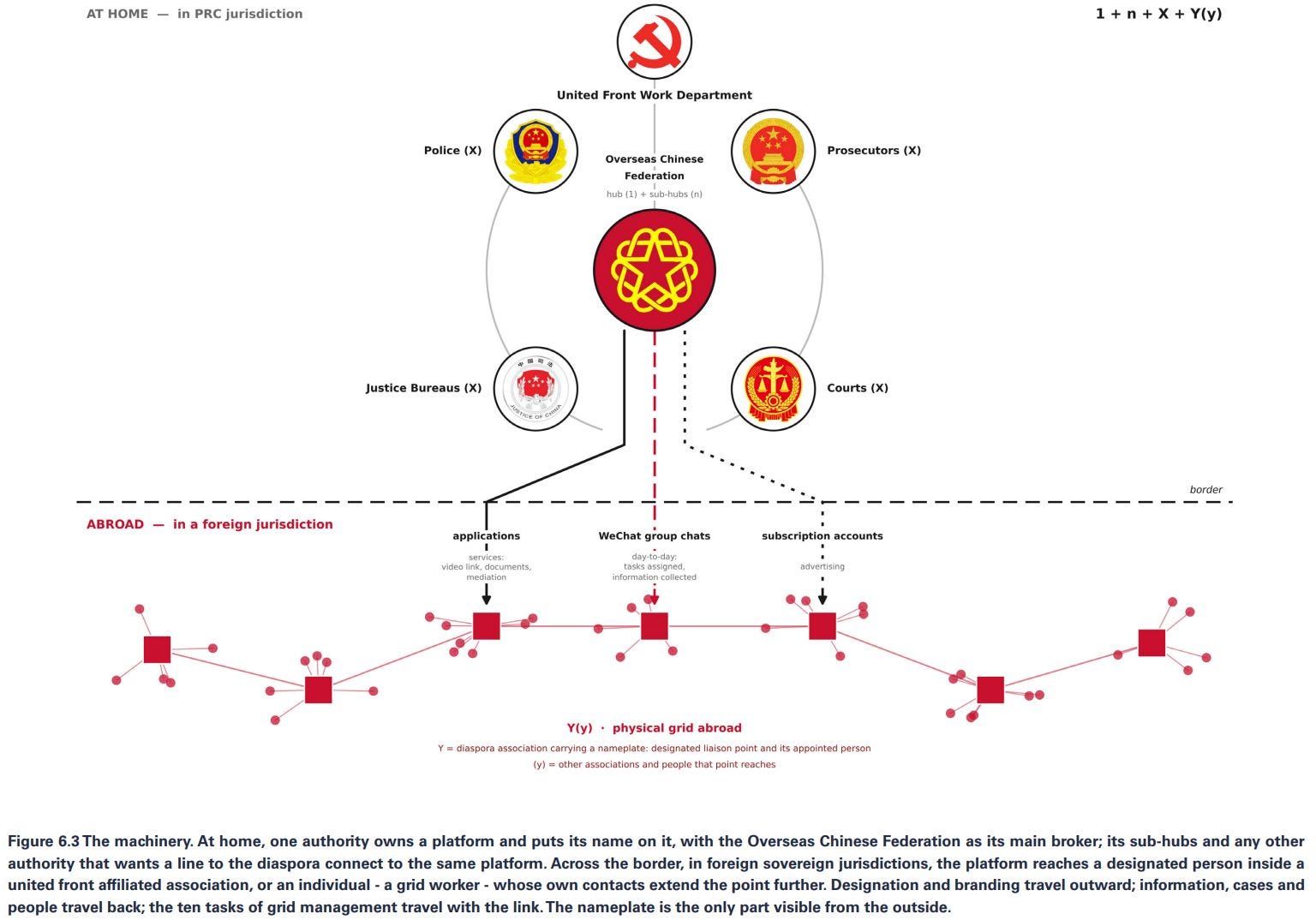
At the center of the investigation is China’s domestic “grid management” system, which divides communities into small administrative units whose workers gather information on residents, monitor public sentiment and identify potential political-security concerns.
Safeguard Defenders documents how overseas liaison officers and diaspora associations serve comparable functions, connecting communities abroad with Chinese authorities through messaging groups, digital platforms and government-service systems.
One of the clearest examples comes from Qingtian county police, whose officials described a global network involving 135 overseas association leaders and liaison officers supported by more than 1,000 informants.
A 2019 police account described monitoring “stability-related key persons” overseas during politically sensitive periods. The system also included visits to relatives remaining in China, where authorities conducted what they termed “educational persuasion.”
The arrangement allowed Chinese security authorities to combine overseas monitoring with domestic pressure on family members, creating an enforcement mechanism that crossed national borders.
Repression on American Streets
The report also examines organized intimidation and violence against anti-CCP demonstrators during visits by Chinese leader Xi Jinping to the United States.
A six-month Washington Post investigation into Xi’s November 2023 San Francisco visit documented Chinese diplomatic coordination with pro-Beijing welcoming groups and physical assaults against protesters. China’s Los Angeles consulate paid for some supporters’ accommodation and meals, while organizers mobilized buses carrying hundreds of participants.
During Xi’s September 2026 visit to Washington, Human Rights in China reported further confrontations, including protesters being pepper-sprayed, beaten and stripped of their banners. Accounts from the welcoming side described the involvement of approximately 100 overseas Chinese associations, including groups that transported supporters from other American cities.

The incidents demonstrate how organized pro-Beijing mobilization can extend beyond political messaging into physical intimidation of the CCP’s opponents on American soil.
A separate U.S. National Counterintelligence and Security Center advisory warned about Chinese influence operations targeting American political institutions, businesses and communities through local relationships, economic incentives and coercive tactics.
The Framework
Safeguard Defenders argues that the overseas police stations exposed in 2022 represented only the visible portion of a much larger institutional system. Its investigation identifies a structure through which the CCP’s United Front organizations provide overseas connections for police, prosecutors, courts and other Chinese government authorities.
The researchers recommend stronger scrutiny of United Front-linked organizations, foreign-agent transparency requirements and enforcement against transnational repression.
For the United States, the findings expose a national-security challenge extending beyond isolated clandestine police offices. Beijing’s overseas networks operate through relationships embedded in ordinary civic institutions, creating channels for political influence, information collection and coercion inside American communities.