


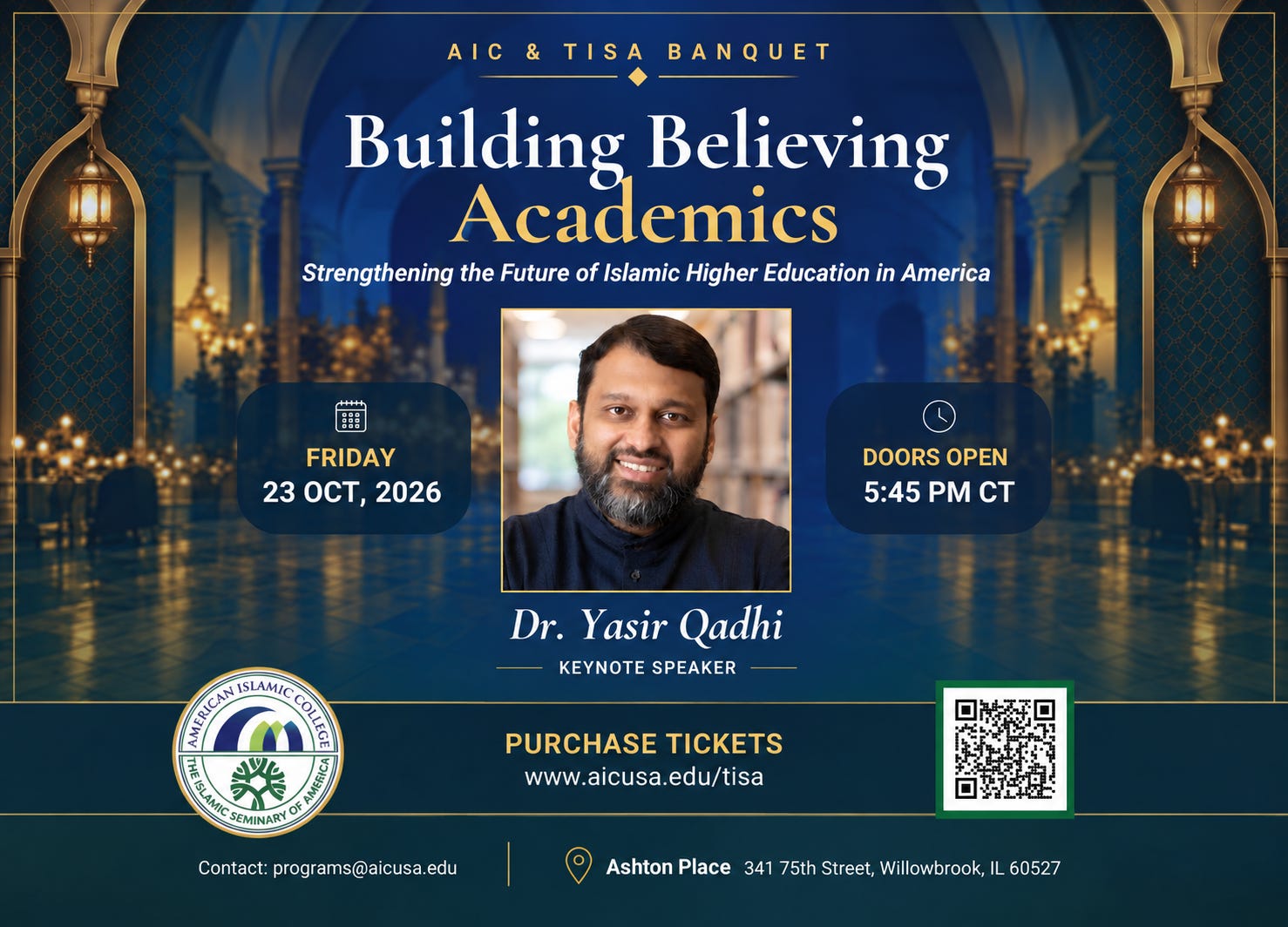
An accredited Chicago college is building an academic partnership with a Texas seminary whose dean, Yasir Qadhi, publicly identified himself in 2025 as a member of an international scholars’ union that months earlier called jihad against the occupation an individual obligation and demanded weapons, expertise and intelligence for fighters.
American Islamic College (AIC) and The Islamic Seminary of America (TISA) will promote the project at an October 23, 2026, fundraising dinner in Willowbrook, Illinois. Yasir Qadhi, TISA’s dean of academic affairs, is the advertised keynote speaker. The lineup also includes former national leaders of the Council on American-Islamic Relations (CAIR), a Muslim civil rights and civil liberties advocacy organization, and a former Holy Land Foundation (HLF) fundraiser.


The institutions say the partnership will prepare future Muslim scholars, chaplains, educators and community leaders. TISA president Abdullah al Mamun says the agreement is intended to make Islamic higher education more accessible and offer students additional academic, spiritual and professional opportunities.
Qadhi’s International Affiliation
In a June 2025 post discussing International Union of Muslim Scholars (IUMS) president Ali al-Qaradaghi’s support for Zohran Mamdani, Qadhi identified himself as a member, calling it “the most respectable and mainstream group of global scholars in the world.”


The Qatar-based organization was founded by Yusuf al-Qaradawi, whom George Washington University’s Program on Extremism describes as the Muslim Brotherhood’s longtime spiritual leader.
In a fatwa, or religious ruling, dated March 28, 2025, the IUMS Committee for Ijtihad and Fatwa demanded military intervention against Israel, citing its renewed Gaza offensive.
The ruling declared supplying fighters with “weapons, expertise, and intelligence” a binding duty. It called jihad against the occupation an individual obligation for every capable Muslim and required wealthy Muslims to finance fighters.
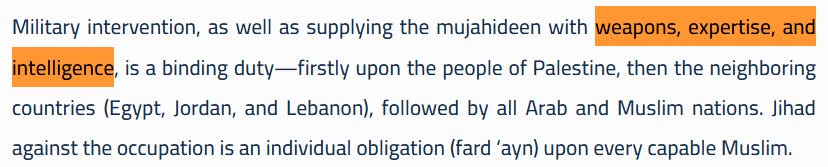
The English version was published April 1. Its signature block names committee secretary Fadl Abdullah Murad and chairman Ali Mohieddin al-Qaradaghi.
A Former Holy Land Foundation Fundraiser
Advertised speaker Kifah Mustapha worked for approximately five years through 2001 as HLF’s sole Illinois employee and raised funds for it, according to a 2013 federal court opinion.


HLF and five leaders were convicted in 2008 of providing material support to Hamas. The Justice Department said they provided approximately $12.4 million through Hamas-affiliated committees and organizations. Mustapha was not among those five defendants.
The opinion, concerning his challenge to losing an Illinois State Police chaplaincy, described a performance featuring Mustapha. It reproduced English subtitles including, “O, Hamas, teach us the rifle.”
Mustapha testified that he was approximately 19 at the time, before his HLF employment. He characterized the song as cultural and told investigators he condemned Hamas and suicide bombings.
The Leadership Overlap
AIC’s interim president and chief academic officer, James Jones, simultaneously serves as TISA’s executive vice president. CAIR’s biography says he spent nine years on its national board, including service as treasurer and secretary.
Roula Allouch, an AIC trustee and advertised speaker, chaired CAIR’s national board for eight years and now co-chairs its Emeritus Board. CAIR identifies her as a TISA faculty member; the seminary also lists her on its advisory board.
The institutional overlap extends beyond CAIR. TISA trustee chair Iqbal Unus previously directed the Fairfax Institute at the International Institute of Islamic Thought. His biography identifies him as Muslim Students Association president in 1975 and Islamic Society of North America secretary general during the 1980s.
The October dinner seeks backing for a project intended to train future imams, chaplains and institutional leaders. The result is an accredited Chicago college building that pipeline with a seminary whose dean publicly identifies as an IUMS member and whose leadership includes the figures documented above. At the same time, the institutions’ public announcements do not specify how degrees would be awarded or who would exercise academic oversight over the proposed joint programs.