


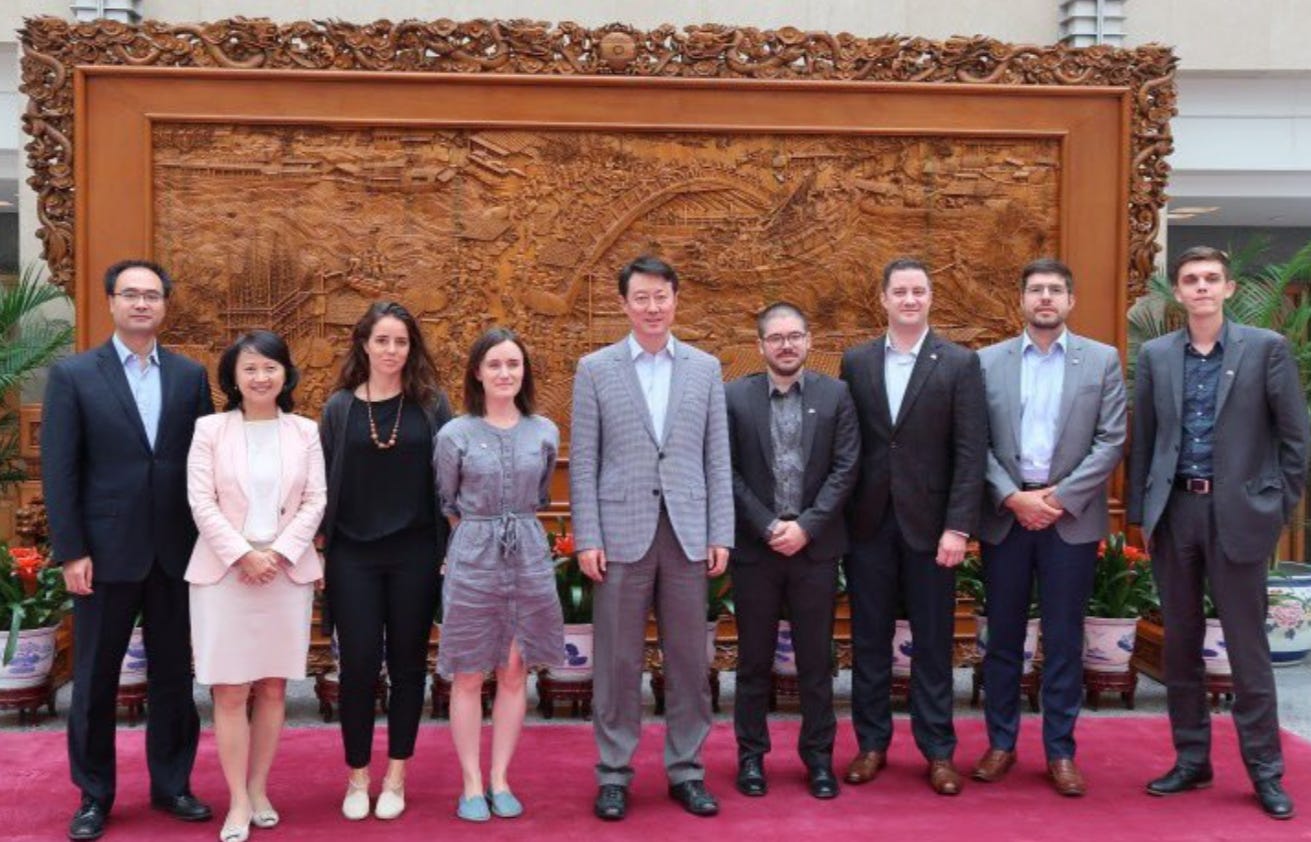
A Hong Kong foundation with longstanding ties to senior Chinese political figures sponsored at least 54 American journalists on trips to China between 2010 and 2018, placing reporters from The New York Times, The Washington Post, CNN, NBC News, NPR, Bloomberg, Politico and Reuters in meetings arranged with help from China’s Foreign Ministry. The foundation’s own records say the program sought to deepen American journalists’ understanding of China and included discussions about how media coverage of each country could be “improved.” In separate descriptions of its overseas outreach, the foundation said it sought to promote positive stories about Hong Kong and mainland China.
The trips raise questions about how Beijing-aligned organizations cultivate the foreign journalists responsible for interpreting China for American audiences.
Inside the Journalist Exchange
The names were compiled by investigative reporter Natalie Winters from archived delegation records published by the Better Hong Kong Foundation, which describes itself as an independent nonprofit promoting understanding of Hong Kong.

The participants included senior reporters, producers and editors. Among those identified were CNN supervising news editor Saeed Ahmed, NPR investigative editor Robert Little, Washington Post editorial writer Stephen Stromberg, New York Times staff editor Juliet Lapidos, Politico Magazine deputy editor Elizabeth Ralph and Reuters correspondents Valerie Volcovici and Diane Bartz. Other delegations included journalists from Bloomberg, NBC News, Barron’s, the Los Angeles Times, HuffPost, The Boston Globe, Newsweek and MSNBC.
The available records do not establish that the journalists accepted cash payments, surrendered editorial control or knowingly participated in a Chinese influence operation. They do, however, show that the foundation paid for or sponsored access-intensive trips constructed with the assistance of Chinese government bodies.
Beijing Curated the Access
The Better Hong Kong Foundation states that it began inviting American journalists to China and Hong Kong in 1996 and sponsored and organized their travel. China’s Ministry of Foreign Affairs helped arrange meetings with central and municipal officials.
During the 2018 exchange, six senior American journalists traveled through Beijing, Guangzhou, Zhuhai, Dongguan, Shenzhen and Hong Kong. Their itinerary included China’s Foreign Ministry, CCP-controlled Global Times, the All-China Journalists Association, government-linked policy institutes and selected technology and industrial sites.
The delegation also met Tung Chee-hwa and C.Y. Leung while both men served as vice chairmen of the Chinese People’s Political Consultative Conference, or CPPCC.
Earlier trips followed the same structure. The foundation’s account of its 2010 exchange shows journalists meeting officials from the ministries of foreign affairs, commerce and health, visiting Baidu and state-linked research institutions, and attending dinners hosted by government representatives.
The program concluded with American and Chinese journalists discussing how reporting about each country could be “improved.”
The United Front Connection
The U.S.-China Economic and Security Review Commission identifies the CPPCC as part of China’s United Front system, describing it as an advisory body the Party-state uses to coordinate with influential figures in business, academia, religion and other sectors. The congressionally created U.S.-China Economic and Security Review Commission (USCC) describes United Front work as an effort to cultivate influential people and institutions, weaken opposition to Communist Party policies and advance narratives favorable to Beijing.
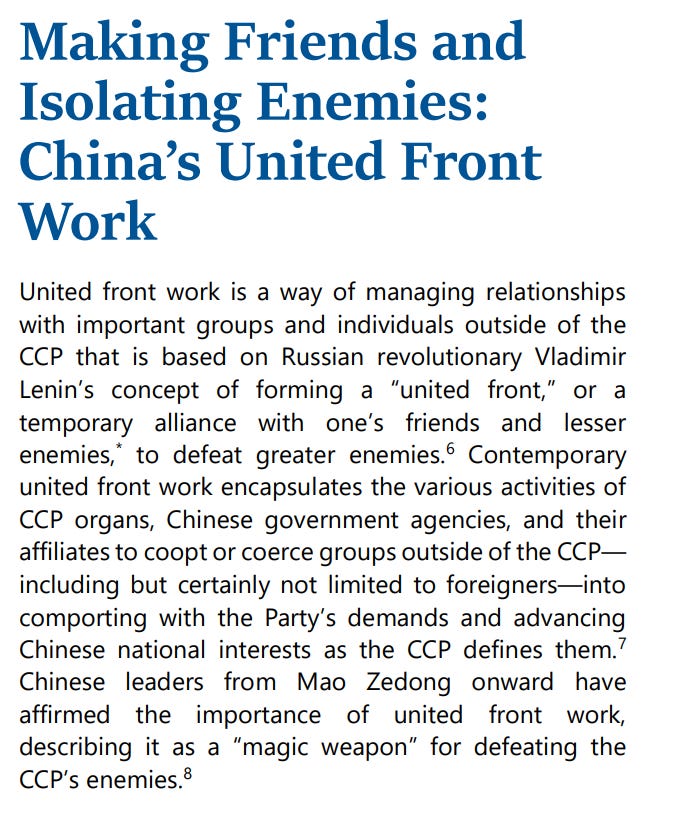
The Commission says the United Front Work Department contributes significantly to overseas operations involving political influence, intelligence collection and technology transfer. It separately identifies the CPPCC as an institution through which the Party-state coordinates with influential figures outside the Communist Party to carry out United Front work.
The foundation has even used the term “united front” to describe its own overseas advocacy, although not explicitly as a reference to the Communist Party’s formal United Front system. In a 2005 press release, its chief executive called one overseas delegation a “united front” that would deliver a single strong message and convey a positive image internationally.
That does not prove every foundation program was secretly controlled by the Communist Party. It does place the journalist exchanges within a broader political ecosystem designed to shape how influential foreign audiences understand China.
Access Without Adequate Scrutiny
Sponsored reporting trips are not inherently improper. News organizations routinely send journalists on travel financed by governments, corporations and advocacy groups, provided the arrangement is disclosed and editorial independence is protected.
The concern here is the combination of foreign-linked funding, government-selected access and an explicitly stated ambition to improve coverage. Beijing did not need to dictate an article for the program to be useful. It could determine which officials journalists met, which companies they toured and which version of China they encountered.
The foundation’s archives establish who traveled and who arranged the access. What remains unclear is how each newsroom reviewed the sponsorship, what disclosures accompanied the resulting coverage and whether participating outlets later examined the political relationships behind the program.
Those are questions the news organizations should now answer publicly.
Journalists have gone from speaking truth to power to being puppets for those in power. No wonder the 'legacy' media is viewed with so much suspicion these days.