

China's Money at Stanford: Whistleblower Documents Expose Millions in Opaque Foreign Funding
The Stanford Review exposed a network of unreported and opaquely reported donations from China — some exceeding $3 million.

The Stanford Review reported on June 1, 2026 that a whistleblower had leaked Stanford University’s non-public foreign-funding disclosures, including a 2025 restricted gift of at least $3 million from a donor recorded only as “Chen Yuan” of China, for directed research at the Hoover Institution. The disclosure was filed under Section 117 of the Higher Education Act, which requires federally funded universities to report single-source foreign gifts and contracts totaling $250,000 or more in a calendar year.
The Review argued the name, nationality, and apparent capacity best matched Chen Yuan, the former president of the China Development Bank and chairman of the China Association for International Friendly Contact (CAIFC) — an organization the U.S.-China Economic and Security Review Commission has identified as part of the Chinese Communist Party’s overseas United Front influence apparatus.
Hoover Institution forcefully disputed the identification as “innuendo and speculation,” said it was a case of mistaken identity, and announced it had notified Stanford’s general counsel, federal and local authorities, the Department of Education, and the leadership of congressional China committees about what it described as misuse of leaked confidential reporting information.
The Disputed Donor
The Review’s argument is built on what the disclosure shows and what it does not. The filing names “Chen Yuan” with country “China” and a 2025 restricted gift exceeding $3 million for Hoover-directed research, routed through a San Francisco law firm. The Review noted that few private Chinese donors with that name have the documented financial profile to make such a gift, and concluded the most plausible match was the senior banker who runs CAIFC.
Hoover’s statement said the Review had it wrong and that China scholar Glenn Tiffert warned the publication before it ran the piece. Stanford Review editor-in-chief Julia Steinberg told Newsweek the magazine stood by its reporting, saying Hoover’s pre-publication responses were “cryptic” rather than a flat denial. Hoover has demanded a retraction.

What CAIFC Is
Regardless of which Chen Yuan signed the check, CAIFC itself is not a generic friendship society. The U.S.-China Economic and Security Review Commission described the organization as part of a People’s Liberation Army-linked united front network that targets foreign elites to shape political environments favorable to Beijing.
The House Select Committee on the CCP’s primer on the United Front describes the system as the Party’s mechanism for “co-opting sources of opposition” abroad. CAIFC is named in the foundational Hoover-published 2018 report China’s Influence and American Interests — co-authored by Hoover’s own senior fellows — as one of the front organizations through which Beijing pursues that work.
The Broader Pattern
The single disputed gift is not the only finding in the leaked file. According to the Stanford Review’s reporting, Stanford’s Section 117 disclosures also record:
$254,000 from BOE in 2019
$250,000 in Huawei-related contracts or gifts in 2019–2020
$1.5 million from State Grid in 2019
$1.1 million from the Chinese Academy of Sciences in 2018
$380,000 from CNPC across 2023–2026
$3.9 million from JD.com from 2018–2021
$4.75 million from the Guangdong Qitian Institute from 2019–2023
Each of these can be defended in isolation as legitimate scientific collaboration. None individually proves influence. Taken together they describe an entry pattern in which Chinese state-owned enterprises, party-linked academies, and tech firms appear repeatedly across Stanford’s energy, engineering, information-systems, and executive-education portfolios.
The Disclosure Gap
Section 117 answers one question: was the foreign money reported? The Department of Education’s latest data covers more than 8,300 transactions worth over $5.2 billion in 2025 alone — bringing total reported foreign funding since 1986 to $67.6 billion. The statute does not require universities to identify ultimate donors, intermediaries, restrictions, recipient labs, or the relationship of the funding to sensitive research. The Stanford story exists in that gap.
The university filed paperwork that named “Chen Yuan.” The paperwork could not, by itself, tell the Stanford Review or Hoover or the public which Chen Yuan it was, what restrictions came with the $3 million, which Hoover scholars or projects it touched, or whether the donor had any further ties to the United Front system Hoover itself has published landmark research about.
The Stakes
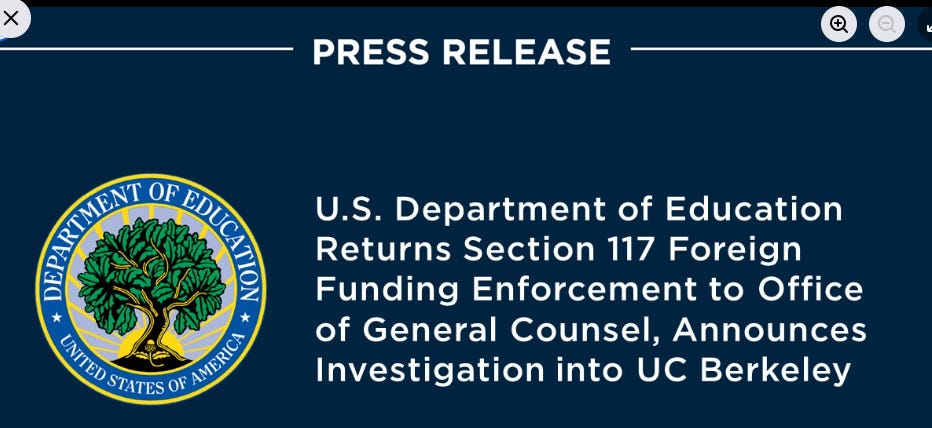
The Department of Education in 2026 opened a Section 117 investigation into UC Berkeley over its own foreign-funding disclosures. The Stanford Review whistleblower file now puts the same statutory framework — and Hoover, one of the country’s most prominent institutions studying authoritarian influence operations — squarely in front of the same regulators.
Hoover’s referral of the matter to the Department of Education ensures federal review will happen. Whether the donor on the disputed gift is the CAIFC chairman or another individual sharing his name, the leaked file establishes a separate, documented question: a U.S. elite research institution accepted millions of dollars from Chinese state-linked entities under a disclosure regime designed to be inspectable, but whose architecture made the most important questions about that money impossible to answer from the public record.