

Chinese Government Contractors Used ChatGPT to Undermine American AI Infrastructure
OpenAI report reveals commercial propaganda ecosystem targeting U.S. data centers — mirroring tactics used against rare earths companies in 2022

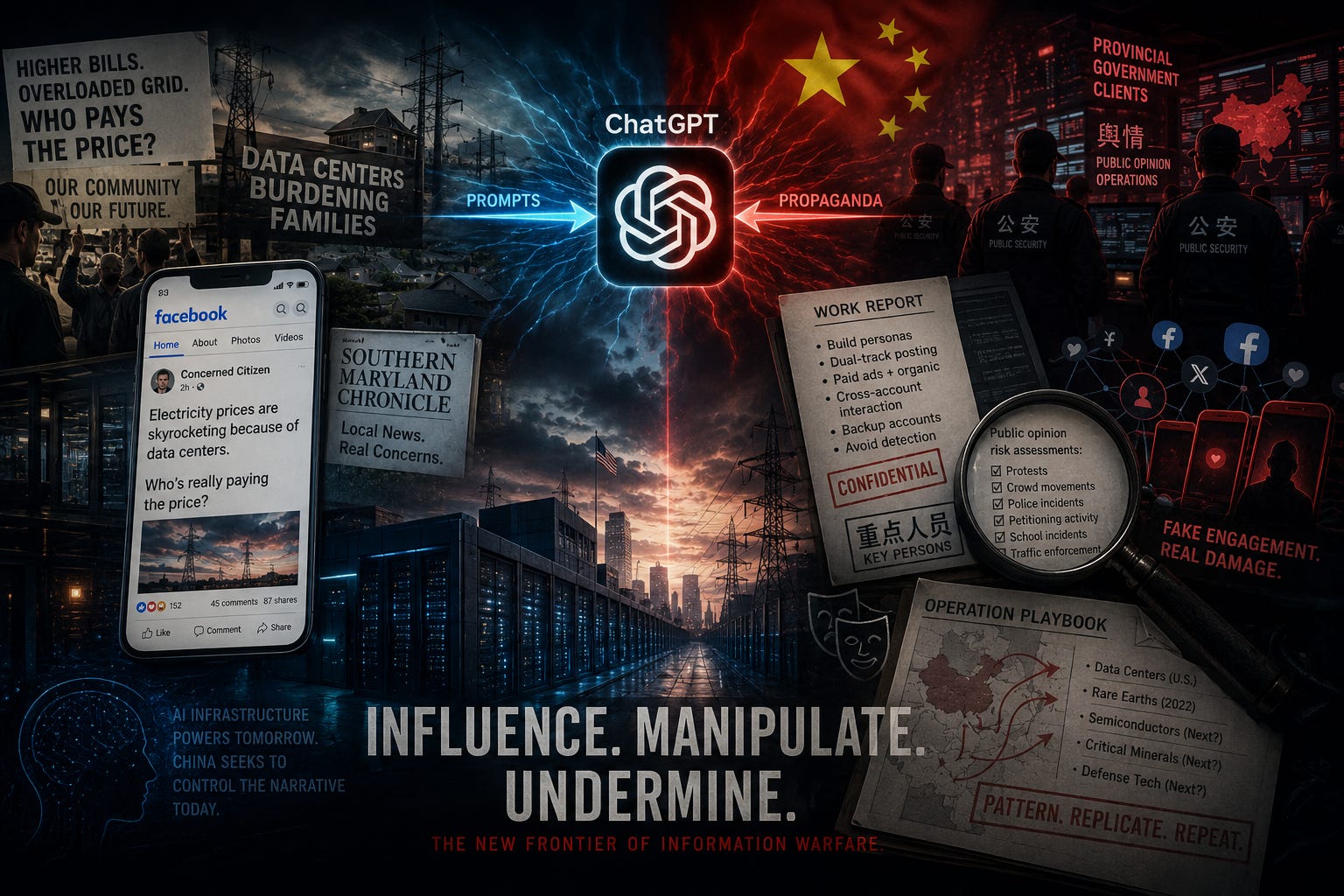
Private Chinese technology firms working for provincial-level government clients used ChatGPT to generate social media content attacking American AI infrastructure, according to an OpenAI threat report released in June 2026. The operations — dubbed “Data Center Bandwagon” and “Tech and Tariffs” — targeted legitimate debates about electricity costs and U.S. trade policy, attempting to covertly insert foreign influence into domestic American discourse.
The campaigns failed to gain traction, but they revealed a troubling pattern: China is deploying the same playbook it used to undermine U.S. rare earths companies in 2022, now adapted for AI — a sector Beijing elevated as a strategic priority in its 15th Five-Year Plan. The timing is striking: just days before OpenAI’s disclosure, House Republicans requested FBI and White House investigations into whether foreign actors were fueling anti-data center activism. The report provides documented evidence that PRC-origin actors attempted to exploit U.S. debates over data centers and technology policy, while also showing vocabulary and tasking patterns consistent with China’s domestic public-security and public-opinion monitoring ecosystem.
A Commercial Ecosystem Serving Party-State Priorities
OpenAI identified the Data Center Bandwagon operators as “likely part of a social media operations team at a private Chinese technology company conducting work for Chinese provincial-level government clients.” This points to China’s commercial 舆情 (yuqing) — public opinion monitoring — industry, where private firms compete for propaganda department contracts to shape narratives domestically and abroad.
The operators uploaded their own work reports to ChatGPT for editing, inadvertently leaking an operational playbook. One document focused specifically on Facebook strategy: building “real, trustworthy and daily life personas,” creating cover content about lifestyle and current affairs, deploying dual-track organic posting plus paid ads, using cross-account interactions to fake engagement, and maintaining backup accounts to evade platform detection. OpenAI summarizes the document but has not published it in full, a rare primary-source glimpse into how Chinese government contractors operationalize influence on Western platforms.


Public-Security Vocabulary and Stability-Maintenance Clues
The Tech and Tariffs cluster displayed vocabulary consistent with China’s Ministry of Public Security: operators requested “public opinion risk assessments concerning protests, school-bullying incidents, crowd movements in Shanghai, police-related incidents, petitioning activity and traffic enforcement.” One user asked ChatGPT to design a system to scrape “harmful” information from “key persons” (重点人员) — a term standard in Chinese policing for surveillance targets.
OpenAI said it could not establish the operators’ “precise institutional affiliation,” but the terminology is consistent with China’s stability-maintenance and public-security vocabulary, 维稳/weiwen), work conducted by provincial Public Security Bureaus. The overlap suggests possible connective tissue between China’s domestic public-security ecosystem and foreign influence activity, Although OpenAI did not prove direct institutional command, a pattern consistent with OpenAI’s October 2025 disruption of an individual linked to Chinese law enforcement who targeted dissidents and planned “cyber special operations” against Japan’s prime minister.
Weaponizing Legitimate Local Journalism
Data Center Bandwagon operators asked ChatGPT to create content based on reporting from Southern Maryland Chronicle, a regional outlet covering legitimate concerns about PJM Interconnection capacity auction prices. The operators used real journalism about electricity rate increases, PJM prices surged 833 percent due to projected data center demand, to anchor AI-generated commentary that framed data centers as burdens on ordinary families.
The tactic is sophisticated: exploit credible local reporting to lend authenticity to foreign narratives. It mirrors the 2022 Spamouflage/DRAGONBRIDGE campaign, where Chinese-linked accounts posed as Texas residents opposing Lynas Rare Earths facilities, leveraging legitimate environmental concerns to undermine U.S. efforts to reduce rare earths dependence on China.
Coordinated Infrastructure Across Multiple Campaigns
OpenAI noted account-level overlap between Tech and Tariffs and Operation Nine-Emdash Line — a separate campaign targeting the Philippines with fabricated imagery of President Marcos using drugs. One X account posted both ChatGPT-generated Trump cartoons and Marcos content, suggesting shared tasking or centralized coordination.
The report also identified a “ChatGPT compromise” sub-network — accounts spreading fabricated claims that ChatGPT user data had been leaked, impersonating victims with stories like “Doxxed through ChatGPT. Reputation destroyed, job lost.” These accounts repeatedly interacted with Tech and Tariffs content, amplifying anti-OpenAI narratives. The false-flag operation parallels DRAGONBRIDGE’s attacks on rare earths companies, demonstrating a template for targeting U.S. strategic industries.
Congressional Investigation Already Underway
On June 4, 2026, House Energy and Commerce Chairman Brett Guthrie (R-Ky.), along with Reps. Bob Latta (R-Ohio) and John Joyce (R-Pa.), requested FBI and White House investigations into whether “Chinese Communist Party-backed entities and other foreign adversaries” were influencing American data center debates. The letter cited reports from the Bitcoin Policy Institute documenting how “foreign state media, the CCP-aligned Singham network, and foreign-billionaire funding are routed through U.S. nonprofits.”
OpenAI’s June 2026 report, released days after the congressional request, substantiates a narrower but important concern: PRC-origin actors attempted to exploit American debates over data centers, electricity prices, tariffs, and technology policy. The report does not prove every element raised in the House letter, including claims about nonprofit funding networks, but it does show that foreign influence operators were already trying to insert themselves into the same domestic fights lawmakers had flagged.
The Bigger Pattern: A Playbook for Strategic Industries
OpenAI explicitly compares this operation to the rare earths campaigns, noting both occurred after China securitized those sectors in Five-Year Plans. The 14th Five-Year Plan (2021) prioritized rare earths; the 15th Five-Year Plan (2026-2030) elevated AI as a strategic technology, mentioning it over 50 times and launching a nationwide “AI+” initiative.
The pattern is replicable: identify a U.S. strategic industry where China faces competition, wait for legitimate local controversies, then amplify them using inauthentic accounts to slow American progress. Likely next targets include semiconductors, critical minerals, and defense technology, any sector where local concerns about water use, energy demand, or environmental impacts can be weaponized.
The campaigns generated little engagement, but their significance lies in what they reveal about intent. As OpenAI concludes, “foreign influence operations have long sought to latch onto existing local issues and sincerely held beliefs, using them to build credibility, amplify divisions or exacerbate public distrust.” In the race for AI dominance, the operation resembles the pro-PRC playbook used against U.S. rare-earths companies in 2022 — and American communities debating data center impacts are the battleground.
The irony is that free societies are most vulnerable to this type of manipulation.