


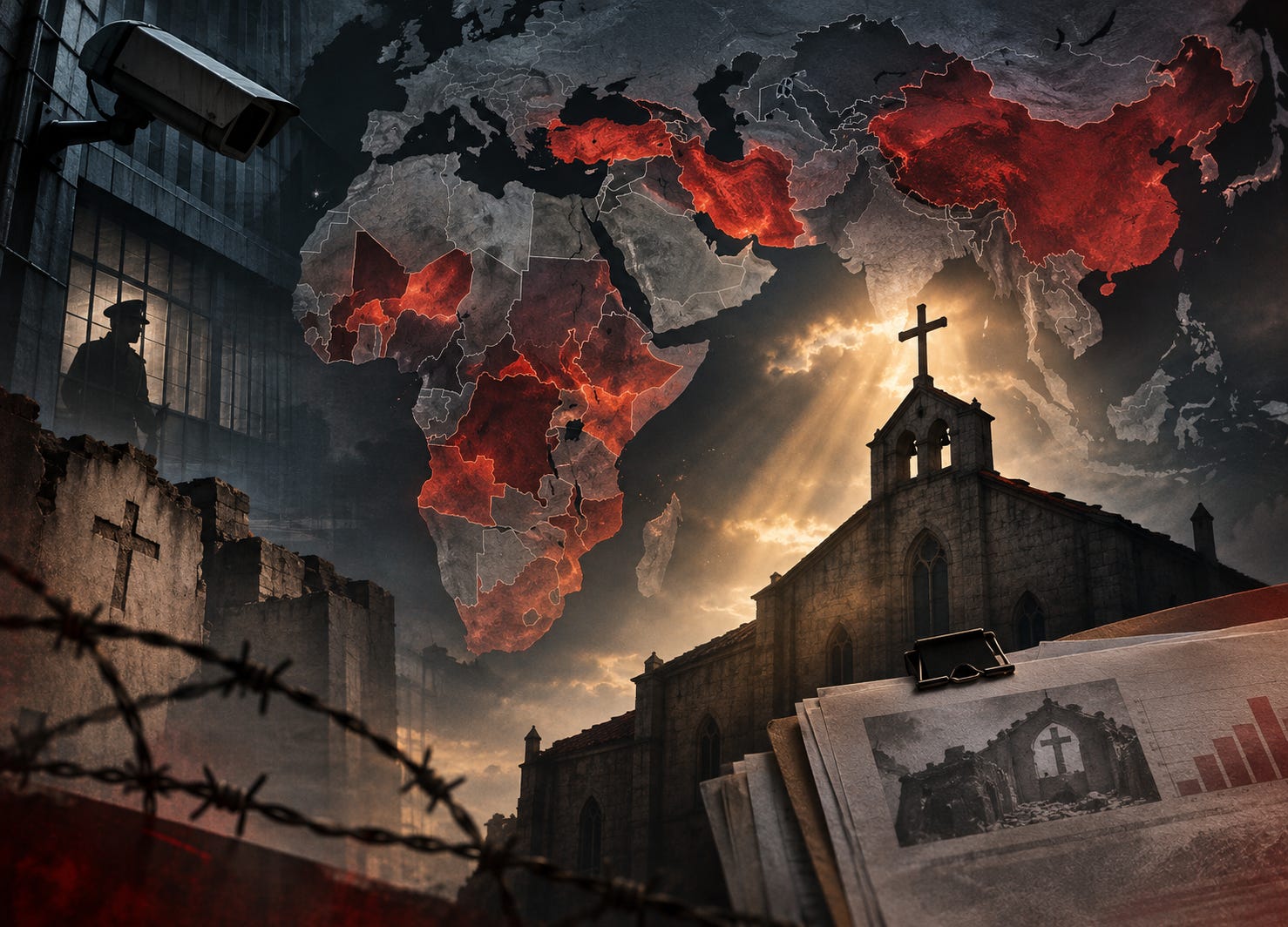
Christian persecution worsened in 10 of the 18 countries examined by an international Catholic charity, according to a newly published report documenting abuses ranging from government restrictions on worship to church seizures, forced conversions and attacks by armed militants.
The 44-page report, Persecuted and Forgotten? 2024–2026, released on October 27 by Aid to the Church in Need (ACN), examined conditions between August 2024 and June 2026. None of the countries studied registered an overall improvement.
ACN estimates that approximately 220 million Christians worldwide are directly exposed to persecution. Its investigation focuses on 18 countries selected because of serious religious-freedom concerns, rather than a representative sample of all countries.
The findings describe how Christian communities face increasingly varied threats, including authoritarian repression, discriminatory legislation, religious nationalism and terrorist violence.
Iran and China Tighten Control Over Christianity
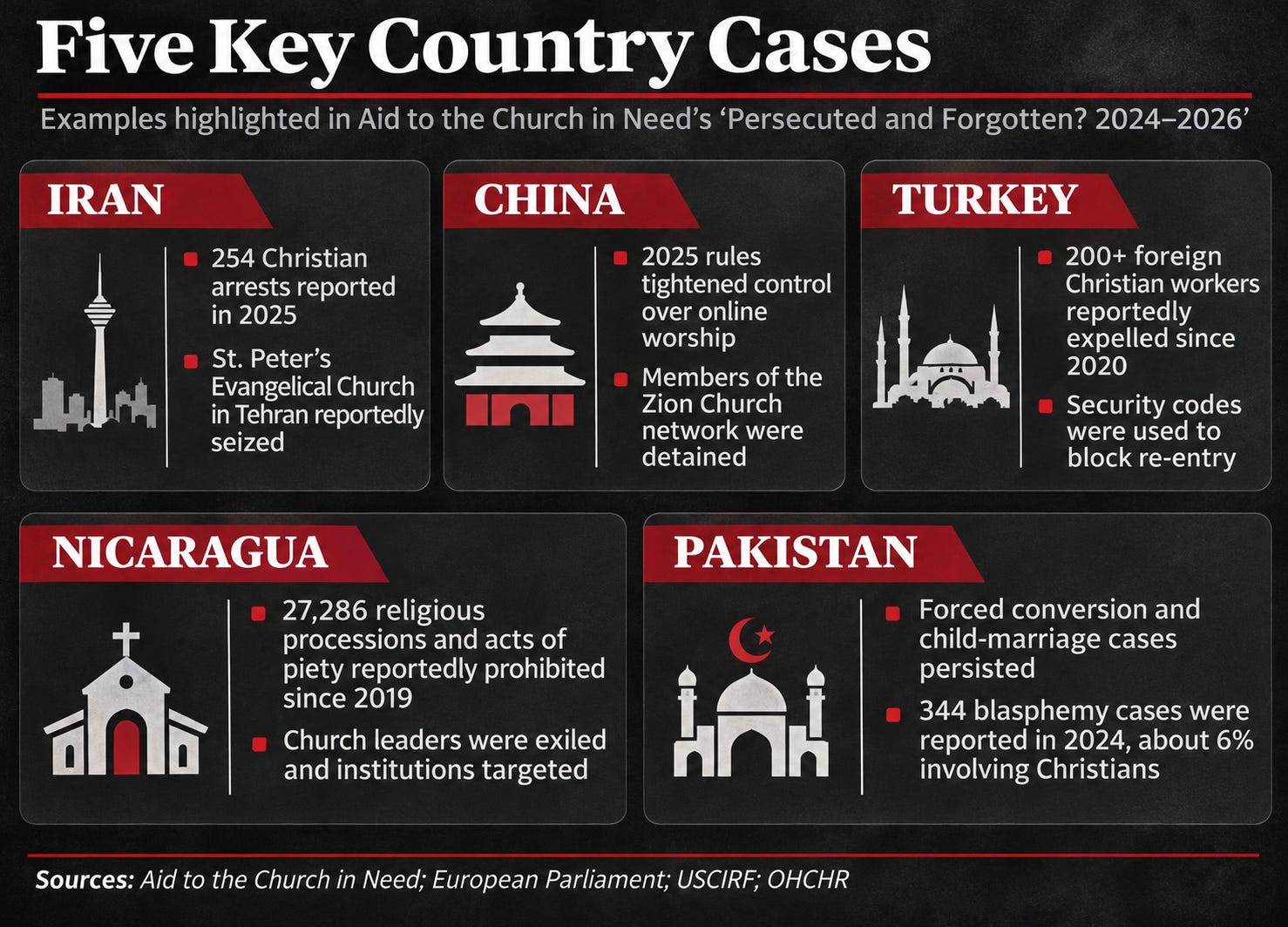
In Iran, the report recorded 254 arrests of Christians in 2025, nearly double the 139 reported a year earlier. Many of those targeted were converts from Islam or members of evangelical churches, whom authorities have accused of national-security offenses.
The study highlights the June 2026 takeover of St. Peter’s Evangelical Church in Tehran. According to ACN, six security officers entered during worship and informed the congregation that the building would be requisitioned. The report says a subsequent property deed identified the Islamic Revolutionary Guard Corps (IRGC) as the owner, while families living on the compound were ordered to leave.
United Nations experts independently condemned the seizure in July, reporting that the final resident had left by July 12 following eviction orders and threats of arrest. The complex had housed members of Iran’s recognized Armenian and Assyrian Christian minorities.


In China, the Communist Party expanded restrictions on religious life both inside churches and online. A September 2025 regulation governing religious personnel limits online preaching to licensed religious organizations and prohibits unauthorized livestreamed worship, online prayer meetings and religious instruction to minors.
The regulations, published by China’s State Administration for Religious Affairs, specifically restrict clergy from organizing online worship through livestreams, messaging groups and video meetings outside authorized channels.
ACN also details the October 2025 detention of at least 30 leaders and members of the unregistered Zion Church network. Its congregants had used Zoom and small in-person gatherings to reach approximately 5,000 members across nearly 50 cities. Twelve remained detained at the end of January 2026, the report says.
Turkey’s Expulsions and Nicaragua’s Restrictions
Turkey presents a different model, in which administrative decisions and restrictions on religious institutions have affected Christian communities.
ACN reports that more than 200 foreign-born Christian religious workers had been expelled since 2020, while Protestant churches continued to face restrictions on training clergy domestically.
The European Parliament went further in a February 2026 resolution, stating that at least 300 foreign Christian pastors, missionaries and family members had been deported and denied re-entry through administrative security codes N-82 and G-87.
The resolution condemned the use of national-security designations without adequate evidence or judicial safeguards. Turkey’s Foreign Ministry rejected the allegations as unfounded.
The report also highlights the continued closure of the Greek Orthodox Halki Seminary, which has been unable to train clergy on-site for more than half a century.
In Nicaragua, the government of Daniel Ortega and Rosario Murillo has used policing, institutional closures and expulsions to restrict religious activity. ACN documents the expulsion of Catholic leaders, seizure of church property and restrictions on ordaining priests.
A separate 2026 assessment by the U.S. Commission on International Religious Freedom reported that as many as 27,286 religious processions and acts of piety had been prohibited since 2019. It also described surveillance of worshippers and restrictions on public Holy Week processions.
Islamist Violence and the Displacement of Communities
Elsewhere, the report identifies militant violence and war as major threats, particularly across sub-Saharan Africa.
In Mozambique’s Cabo Delgado province, Islamic State-linked militants have attacked Christian communities, kidnapped children and burned churches and homes. ACN cites reports of more than 1,000 Christian deaths attributed to the insurgency since 2017.
In Nigeria, attacks by jihadist groups, armed bandits and other militias have contributed to extensive displacement. ACN estimates that at least one million Christians are among the more than 3.5 million internally displaced people, especially in the country’s north and Middle Belt.
The report also recognizes that the violence involves broader ethnic, communal and security conflicts affecting other religious groups.
In Sudan, ACN reports that more than 100 churches have been damaged or destroyed since civil war erupted in 2023. It describes attacks and restrictions affecting Christians in areas controlled by rival armed forces.
Forced Conversions and Religious Nationalism
In Pakistan, the study highlights the abduction and forced conversion of Christian and Hindu girls, sometimes followed by marriages to adult men. It documents cases in which courts have reportedly upheld child marriages despite statutory age protections.
United Nations human rights experts raised similar concerns in April 2026, reporting that approximately one-quarter of women and girls affected by forced conversion through marriage in 2025 were Christian, with most of the others Hindu.
In India, ACN documents assaults on Christians, vandalism of churches and disputes over burials. It links part of the pressure to Hindu nationalist activism and state-level anti-conversion laws, which Christian organizations say have been used to intimidate religious minorities.
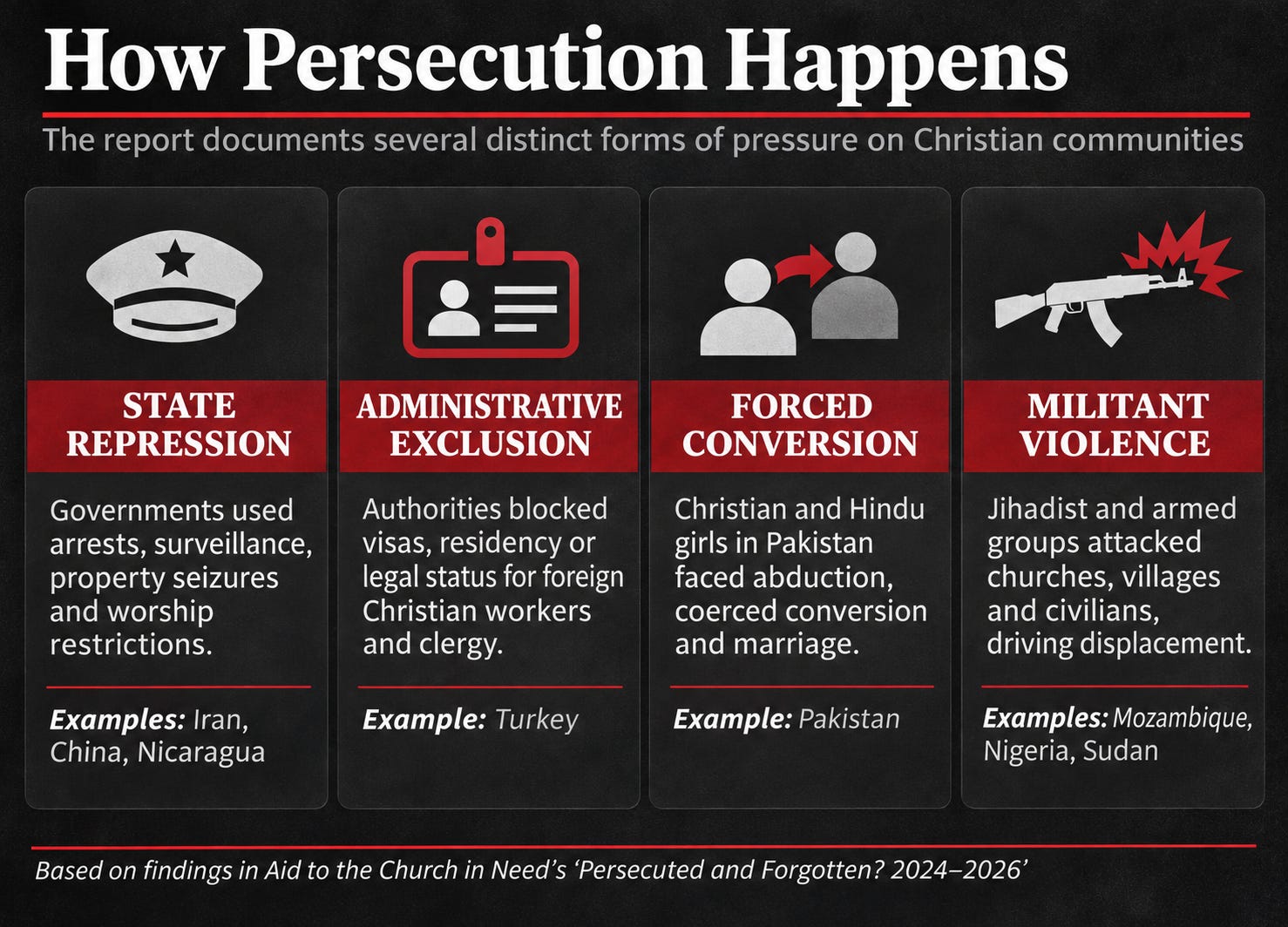
Taken together, the findings portray persecution not as a single phenomenon but as a combination of authoritarian control, discriminatory legislation, extremist violence and displacement.
For some communities, the immediate danger is an armed attack. For others, it is the gradual loss of the legal right to teach, gather, own a place of worship or train the next generation of religious leaders.