


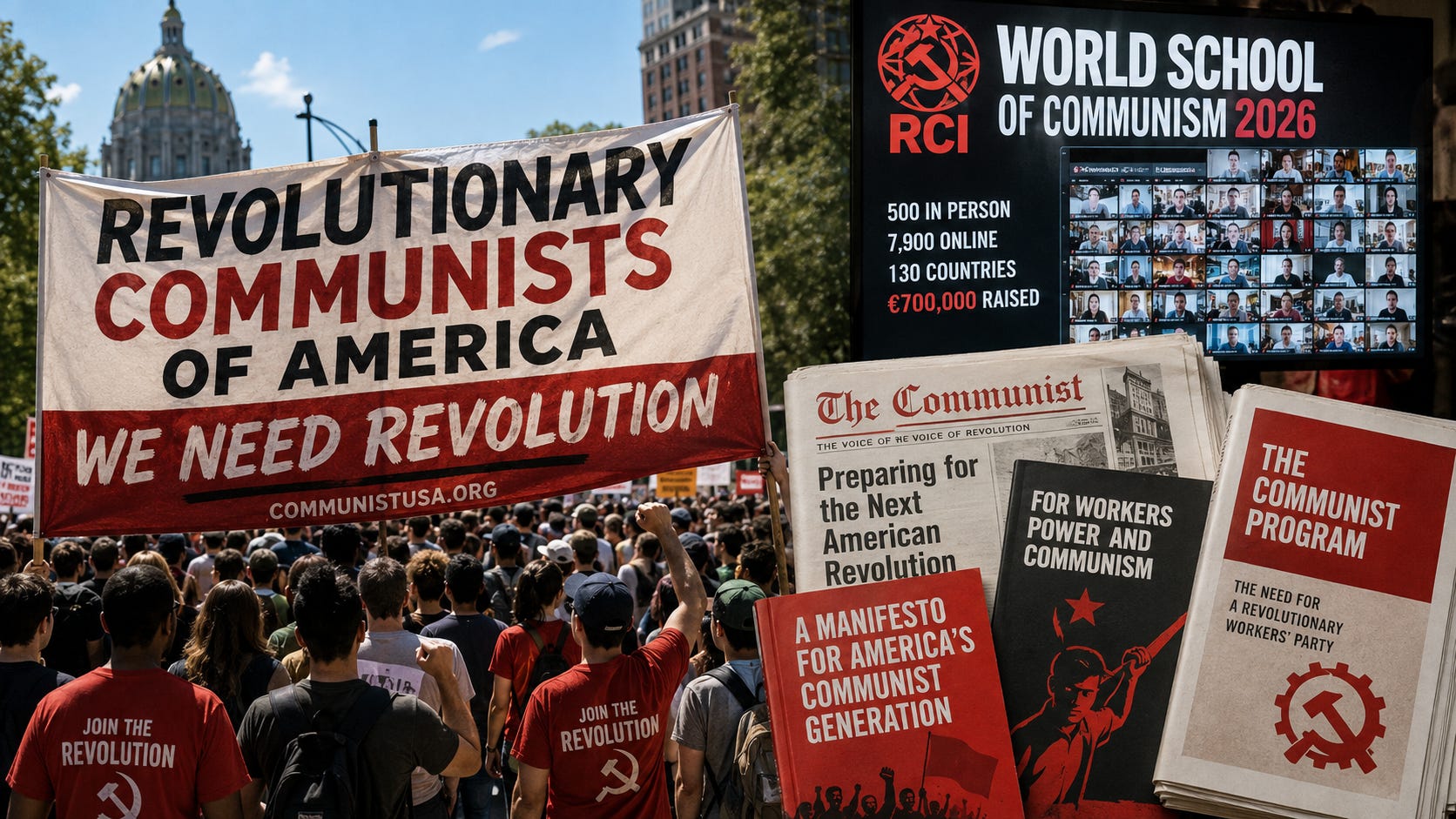
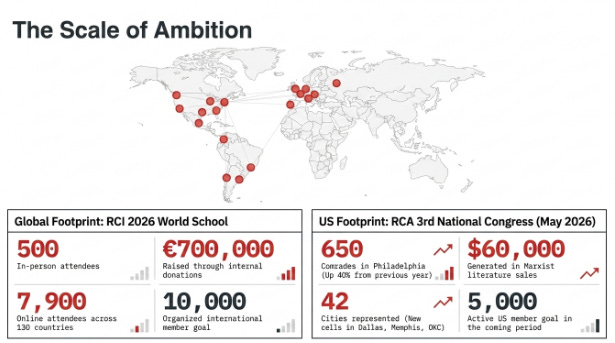
On August 11, the Revolutionary Communist International’s Irish section republished a post-event report on its 2026 World School of Communism. RCI reported 500 attendees in person, 7,900 online registrants from more than 130 countries, and a collection of more than €700,000. The organization also announced an immediate goal of 10,000 organized members internationally.
The World School was not just ideological broadcasting. RCI said 4,400 people who registered for the event asked to join, making it a major recruitment funnel for its national sections. In the United States, the Revolutionary Communists of America is building workplace, campus, and neighborhood cells in cities including Dallas, Pittsburgh, Cleveland, Memphis, and Oklahoma City. The American branch held its Third National Congress in Philadelphia on May 30 and 31, 2026, with nearly 650 attendees, up about 41% from 460 the previous year. Delegates unanimously adopted the party’s 2026 U.S. Perspectives document and a separate organizational resolution; the published congress report was titled “Preparing for the Next American Revolution.”
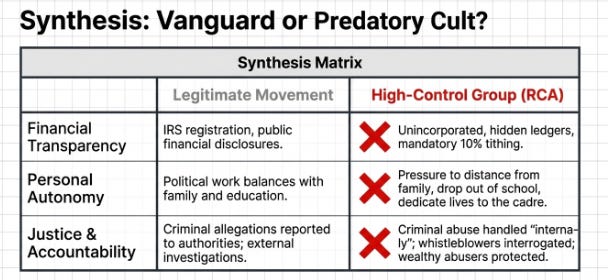
But as RCI expands, former members in several countries have alleged financial pressure, the mishandling of sexual-abuse reports, and cult-like control over young recruits. RCI and its national sections have denied cover-ups and disputed several of those accounts. The organization’s program, its fundraising practices, and the testimony of people who left raise a serious question: is this legitimate political organizing, or something more predatory?
From Theory to Action
RCI is a Trotskyist political international that says it is active in more than 70 countries. The present organization traces its roots to the Committee for a Marxist International, formed in 1992 by Ted Grant and his supporters after they were expelled from Militant. It became the International Marxist Tendency in 2004 and adopted the RCI name at a founding conference in June 2024.
Grant was a South African-born British organizer whose Daily Telegraph obituary called him “the founding father and undisputed eminence grise of Militant Tendency,” the Trotskyist group that nearly destroyed the Labour Party in the 1980s. Grant was expelled from the Labour Party in 1983, not 1993. He and Alan Woods were expelled from Militant in 1992, after which they established Socialist Appeal and the new international tendency. At its height, Militant had three Labour MPs and controlled Liverpool’s city council, but those developments preceded the 1992 split.
The American section’s manifesto is explicit: “We vow to carry out the American socialist revolution in our lifetime.” RCA’s program describes a party committed to overthrowing capitalism, nationalizing major banks and monopolies, and placing major companies under democratic workers’ control.
The same manifesto says members should engage in daily political activity through cells in workplaces, industries, trade unions, campuses, and neighborhoods. It rejects the Democratic Socialists of America for refusing to break with the Democratic Party and portrays the Communist Party USA as trapped in the same reformist politics.
A Novel Organizational Threat
Unlike fragmented campus groups or online theorists, RCA is building the infrastructure that failed movements often lack: disciplined cells, member funding, ideological training, and international coordination. The Third National Congress focused heavily on workplace activity, campus recruitment, union work, local leadership, and training new organizers. Its nearly $60,000 in literature sales produced revenue while reinforcing the party’s ideological program.
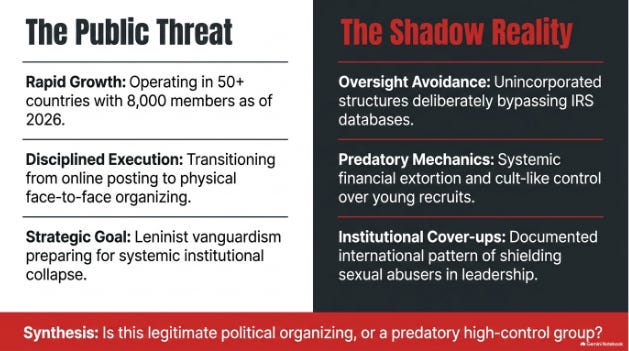
Congress attendance rose about 41% in one year. RCA attributes that expansion to organized recruitment, training, and face-to-face work in local branches. Its 2026 analysis presents declining trust in American institutions, economic instability, and political polarization as conditions that could produce a revolutionary opening. History shows that small, disciplined revolutionary organizations can seize power when institutions collapse and moderates hesitate. Weimar Germany had 4 million unemployed when the Nazis took power with a party that spent years building, not just philosophizing.
RCA’s reading of history is dark, but its diagnosis overlaps with anxieties visible far beyond its own ranks. That is what can make a vanguard dangerous: not simply that it is strong, but that it is organized when other institutions are weak
The Money Question
RCI’s fundraising operates at scale. Beyond the €700,000 reported after the 2026 World School, the organization said it had raised €2.5 million “over recent years” to purchase an international headquarters, according to a 2024 fundraising appeal. At its first World Congress in 2025, RCI reported a global collection of more than €500,000 from sections and watch parties, according to its congress report.
The organization says it has no billionaire patrons and depends on contributions from workers and young supporters. RCA’s public dues page says it is a political party, not a charity, and asks active members to make significant financial sacrifices. Its suggested contribution levels are tied to fractions of a day’s wages, with a custom amount also available. These published options establish that member funding is central to the model, but they do not by themselves establish coercion.
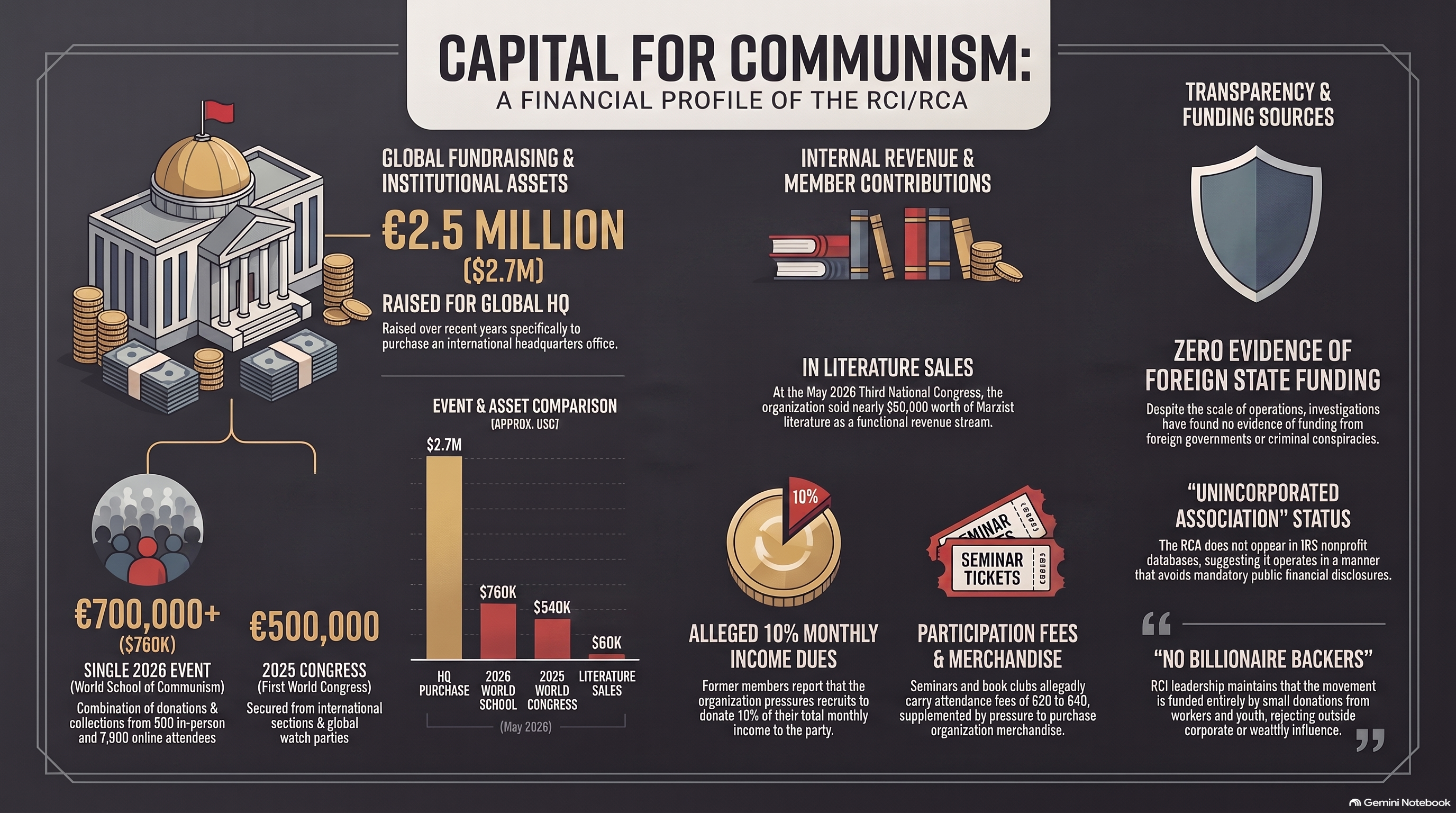
A self-described former member of RCI’s Greek section made more serious claims in an anonymous 2025 Reddit post. The writer alleged pressure to contribute 10% of monthly income, pay for seminars and book clubs, buy merchandise, and perform unpaid full-time work. The writer also objected to the organization’s internal handling of sexual-abuse allegations.
Allegations Across Borders
In March 2018, members of CUPE 3903 voted to ban Fightback, then the Canadian section’s name, from York University strike picket lines and union spaces. Fightback’s own statement confirmed the organizational ban while arguing that it rested on unnamed allegations and misinformation. Individual Fightback members were still permitted on the picket lines.
Jamie Graham, a former Fightback member, later wrote that the dispute involved the treatment of an ex-member who raised sexual-assault allegations. In a detailed 2022 account, Graham alleged being sexually harassed by a recruiter at a 2019 event and later experiencing domestic and sexual violence in a relationship with another member in 2021.
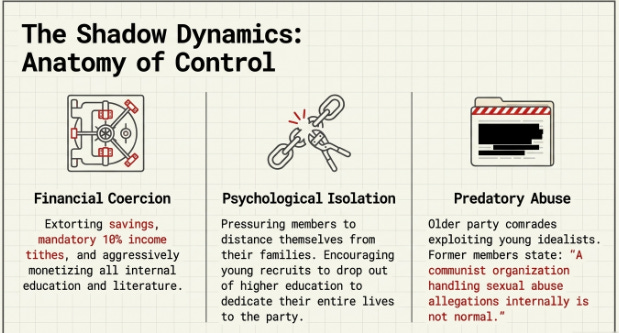
Graham wrote that the latter member had already admitted wrongdoing to the executive committee, yet executive member Alex Grant required Graham to recount the abuse again. According to Graham, Grant responded to a concern about physical safety by asking, “So are you going to move?” and later characterized Graham as irrational and emotional. Graham also alleged that a wealthy cadre accused of assault was allowed to host branch meetings during an investigation, with women and transgender members sent to the home without being told about the allegation.
Fightback responded in July 2022, denying a cover-up and saying that it had investigated complaints, disciplined offenders, and removed abusers from the organization. It accused critics of weaponizing abuse allegations and disputed Graham’s characterization of its procedures.
A Growing Movement
The organization moved from the Committee for a Marxist International in 1992 to the International Marxist Tendency in 2004 and then to the Revolutionary Communist International in 2024, when a founding conference unanimously approved its new manifesto. It has also survived internal fractures, including a major split involving its former Spanish leadership and supporters in several countries in 2009 and 2010.
In February 2026, RCI leaders said global membership had risen from about 4,400 in 2023 to more than 8,000. That number is an organizational claim, reported in an internal meeting account, not an independently audited figure.
The American section’s Third National Congress included branch delegates from 42 cities, up from 33 the year before, while members from more than 70 cities attended. The party reported new cells in Western Massachusetts, Pittsburgh, Cleveland, Memphis, Oklahoma City, Ames and Iowa City, Columbia in South Carolina, California’s Inland Empire, and Portland, Oregon. The congress report also describes video greetings from RCI sections in Venezuela, Britain, Puerto Rico, Ireland, Denmark, Taiwan, and Pakistan.
RCA’s manifesto frames this growth in historical terms, arguing that capitalism’s crises will create a much larger communist constituency. Its final ambition is captured in one line: “Tomorrow’s party of millions will grow out of today’s party of thousands.”
When trans-panic has lost its sting.
"Oooooo nuuuuuuu coooomuuunooozm!