


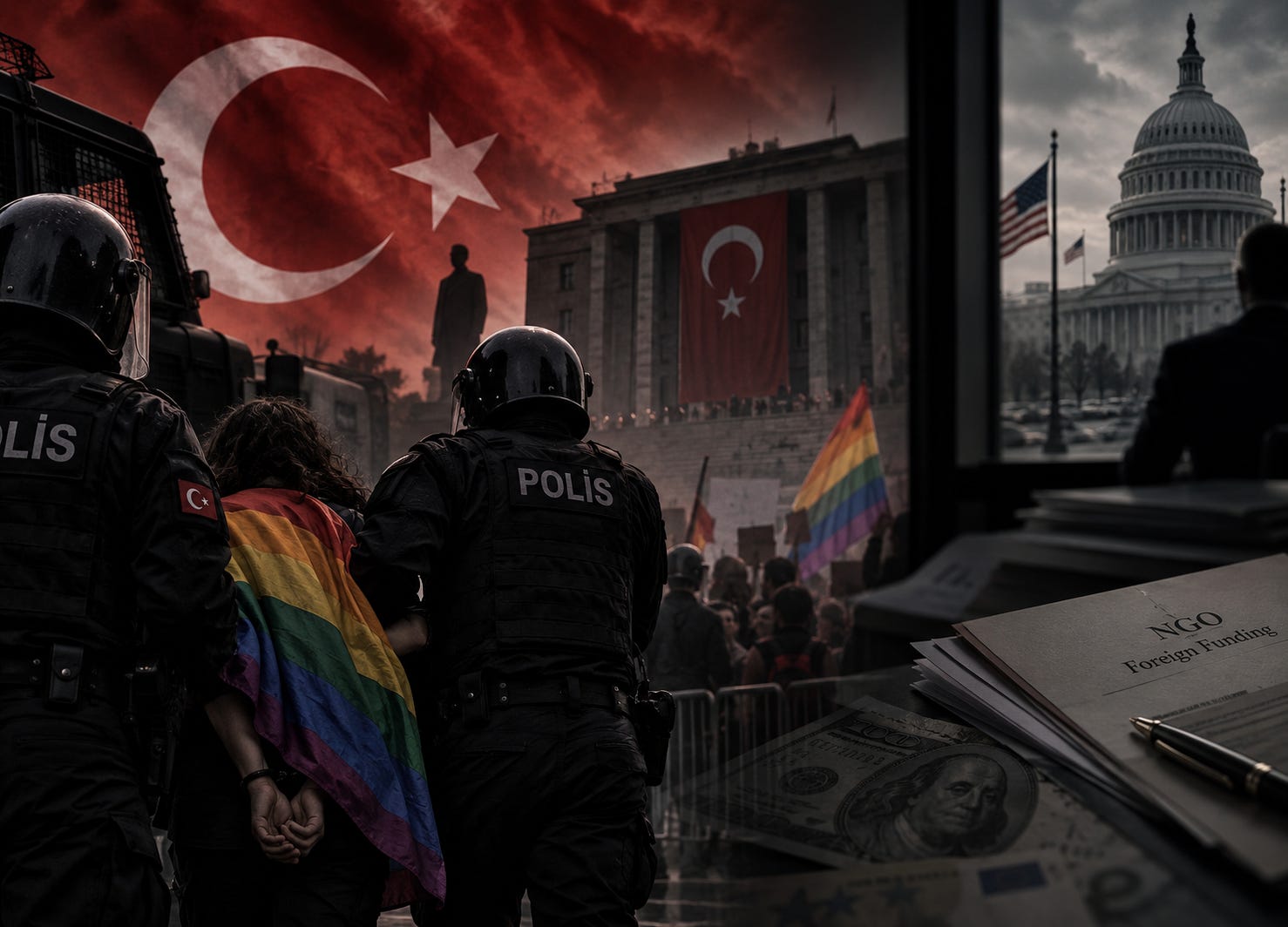
Sixty-five House Democrats are pressing Secretary of State Marco Rubio to confront Turkish President Recep Tayyip Erdoğan over a sweeping crackdown that has targeted LGBT advocacy groups, HIV organizations, journalists and protesters, placing Washington in the middle of a widening dispute over civil society, foreign funding and Erdoğan’s campaign to defend traditional family structures.
In an October 1 letter to Rubio, lawmakers led by Reps. Yassamin Ansari and Dina Titus accused Ankara of using criminal law and state institutions to suppress LGBT advocacy. The signatories include House Foreign Affairs Committee ranking member Gregory Meeks, Nancy Pelosi, Jamie Raskin, Pramila Jayapal, Josh Gottheimer, Debbie Wasserman Schultz, Jared Moskowitz and Ritchie Torres.


The lawmakers demanded that the State Department raise the issue directly with Turkey, press for the release of people detained for what they described as legitimate human-rights activity, direct the U.S. Embassy in Ankara to monitor court proceedings and oppose efforts to dissolve LGBT organizations. According to Ansari’s office, the lawmakers gave Rubio until October 30 to respond.
But the confrontation is about more than LGBT policy. Turkish authorities are simultaneously examining foreign funding received by several organizations caught in the raids, including support linked to European governments, international institutions and private organizations.
Turkey Launches “My Family Is Safe”
The crackdown began in September under an operation the Turkish government calls “My Family Is Safe.” Justice Minister Akın Gürlek said authorities had taken judicial action against 162 suspects, nine associations and 13 businesses across investigations centered in five cities and spanning 15 provinces. According to the Turkish Justice Ministry, prosecutors are investigating allegations including obscenity, prostitution-related offenses, drug crimes and activities allegedly exposing children to obscene material.
Authorities said they used undercover investigators, surveillance, witness testimony and digital evidence before carrying out coordinated searches and seizures. The government has tied the operation to Erdoğan’s broader family-policy agenda and efforts it says are intended to protect children, families and public order.


Rights organizations sharply dispute that characterization. Human Rights Watch said coordinated raids between September 12 and 14 targeted seven LGBT organizations and two groups working with people living with HIV. According to HRW, at least 112 people were arrested, with 82 still detained under court orders when it published its September 18 report.
Reuters subsequently reported that at least 31 people had been jailed pending trial and 126 protesters detained in Ankara and Istanbul. The crackdown has also moved beyond arrests. On September 30, a Turkish court ordered access blocked to independent news outlet T24 after Turkish authorities identified 118 pieces of content they characterized as LGBT “propaganda.” Reuters reported that the order formed part of the wider campaign against LGBT-related content and organizations.
The Foreign Funding Question
One of the least examined dimensions of the operation is Ankara’s focus on foreign money. Gürlek said Turkish financial-intelligence authorities had identified substantial transfers from foreign public institutions and organizations to associations promoting LGBT causes. The Justice Ministry statement said investigators were examining both the origin of the money and whether it was connected to activities under investigation.
Records attributed to Istanbul provincial authorities subsequently provided a clearer picture. According to Turkish news agency DHA, six organizations under investigation recorded approximately 32.1 million Turkish lira in foreign assistance during 2025 alone.
SPoD reportedly received 11.2 million lira, HEVİ 7.4 million, Pozitif Yaşam 7.2 million, Pozitif İz 2.9 million, LİSTAG 2.6 million and Lambda İstanbul roughly 841,000 lira. The reported donor trail reaches deep into Western institutions.
DHA reported that LİSTAG received funding from the European Endowment for Democracy, the Dutch Foreign Ministry, the German Consulate General and the Swedish Consulate General in Istanbul. Pozitif Yaşam reportedly received money from the United Nations Population Fund, the European Commission, Gilead Sciences and a British-based charitable payment organization.
The same inspection reports cited alleged administrative irregularities at some organizations. According to DHA, inspectors reported that Pozitif İz failed to provide certain financial books and expense records, while Lambda İstanbul was cited over recordkeeping issues and an allegedly unauthorized venue operation.
Those findings are administrative allegations and do not establish the broader criminal accusations made against the groups. Human Rights Watch argues that the foreign-funding issue is being used as a pretext. The organization noted that receiving foreign funding is legal in Turkey so long as recipients comply with reporting requirements and said it had seen no evidence that the targeted associations violated those requirements.
That dispute now sits at the center of the case: Ankara portrays foreign financing as relevant to an investigation into organizations it accuses of undermining family policy, while rights groups say the government is criminalizing lawful civil-society activity.
Washington Enters the Fight
The congressional intervention adds another layer. The October 1 letter does not discuss the foreign-funding records. Instead, its authors characterize the operation as part of a long-running erosion of freedom of speech, assembly and association under Erdoğan.
They also turned Rubio’s own past language against him, quoting a previous statement that the United States should never tolerate human-rights violations based on political views, religious beliefs or sexual orientation.
According to Ansari’s office, the letter is backed by the Human Rights Campaign, Council for Global Equality and Planned Parenthood Federation of America.
That puts the Trump administration in an awkward position. Turkey remains a NATO ally and a central actor in regional security, Syria, Russia and the eastern Mediterranean. Yet Washington is now being asked by dozens of members of Congress to directly intervene in a domestic campaign Erdoğan’s government has explicitly tied to family policy, children and foreign-backed civil-society organizations.
There is also precedent for American concern. Previous State Department human-rights reporting criticized Turkey for restrictions affecting LGBT organizations and noted complaints that NGOs critical of the government faced heightened scrutiny, including over foreign funding.


What is different now is the scale. Turkey has moved from sporadic bans and investigations to coordinated raids, large-scale arrests, website blocks, organizational scrutiny and financial investigations across the country. Congress, in turn, has moved from criticism to a formal demand that the State Department engage Ankara.
For Washington, the emerging question is no longer simply whether it agrees with Erdoğan’s social policies. It is whether the United States will challenge a NATO ally over the methods being used to enforce them, while several organizations swept into the crackdown have also received documented funding from Western governments and international institutions.