


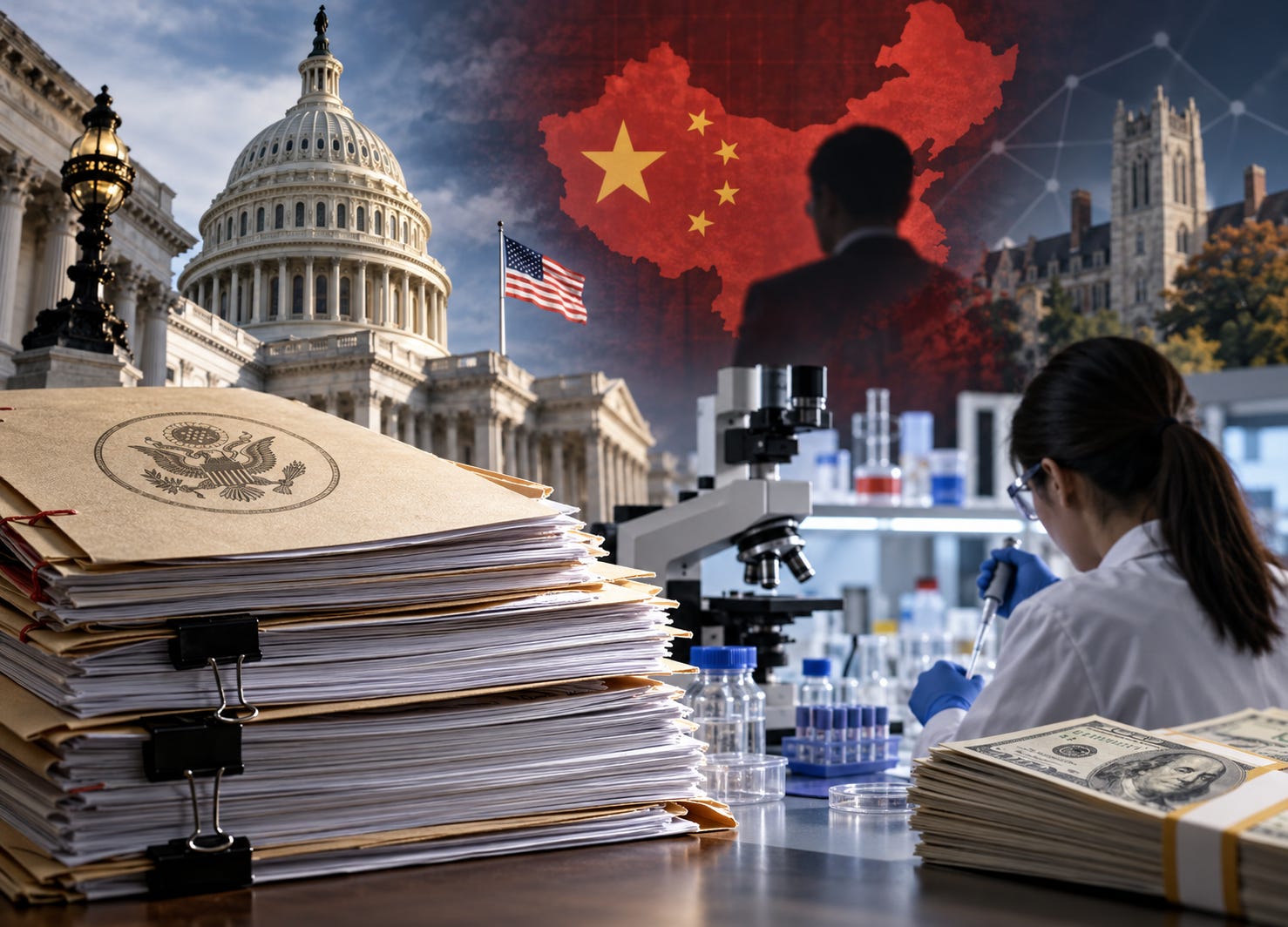
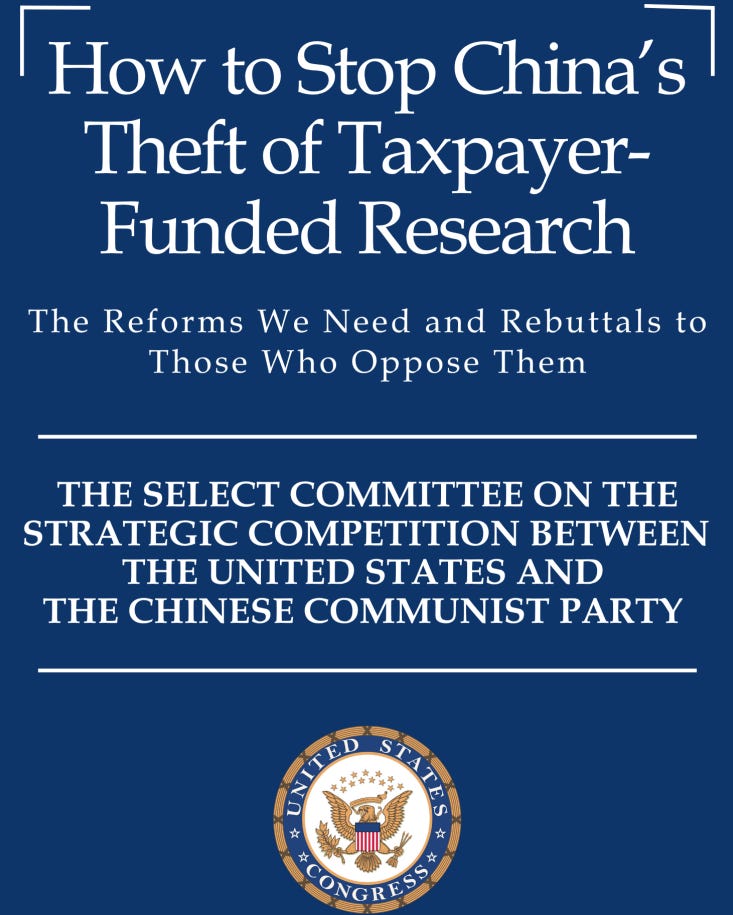
The House Select Committee on China released a new report on October 13 detailing how undisclosed Chinese research affiliations, foreign financial arrangements, and failures by American universities to enforce disclosure requirements have exposed taxpayer-funded scientific research to potential exploitation by Beijing.
Accompanying the 40-page report are more than 700 pages of previously non-public investigative records from the National Science Foundation’s Office of Inspector General (NSF OIG). The documents include investigative findings, correspondence, financial information, Chinese talent-recruitment agreements, and recommendations concerning the suspension or debarment of researchers from federal funding.
The committee, chaired by Rep. John Moolenaar (R-MI), describes cases involving undisclosed Chinese university appointments, parallel foreign-funded research projects, failures to report outside compensation, and institutional oversight deficiencies. The findings cover several leading American universities and federally funded research programs involving artificial intelligence, advanced materials, robotics, and other technologies with potential military applications.
Among the cases highlighted are investigations involving Stanford University, the University of Maryland, and a former senior administrator at the University of California, Irvine.
Stanford’s Undisclosed Foreign Research
According to the report, NSF investigators identified at least 26 research awards involving Stanford-affiliated researchers who were simultaneously participating in foreign-funded projects that had not been disclosed as required.
The undisclosed projects were associated with more than $12.8 million in claimed federal award costs. They spanned fields including artificial intelligence, robotics, biotechnology, engineering, materials science, and autonomous systems.
Investigators also identified a Stanford principal investigator who allegedly held an undisclosed appointment under China’s Thousand Talents Program, which recruits scientific and technical expertise from overseas. The position reportedly required the researcher to spend several months annually working at a foreign university.
According to the committee, Stanford had been aware of the position for years, although it had not been disclosed to NSF. Investigators also reported that a senior Stanford research administrator acknowledged the university relied largely on faculty members to report their own outside funding and affiliations rather than independently verifying those disclosures.
Stanford previously agreed to pay $1.9 million in October 2023 to resolve separate Justice Department allegations involving undisclosed foreign support for 12 faculty members on federal research proposals. The settlement did not establish legal liability.

Former UC Irvine Provost’s Chinese Defense Research Connections
Another case concerns Enrique Lavernia, formerly the provost and executive vice chancellor of the University of California, Irvine.
According to NSF investigative findings described in the congressional report, Lavernia repeatedly failed to disclose Chinese university appointments, compensation, and research support while receiving federal funding from NSF, NASA, and the Department of Energy.
His reported positions included an appointment as a strategic scientist at Wuhan University of Technology, leadership of a Chinese materials science institute, and participation in the Thousand Talents Program.
Investigators also found that he omitted relevant foreign affiliations during a Department of Energy Top Secret security-clearance reinvestigation and in connection with NASA-funded research subject to restrictions on Chinese collaboration.
Perhaps the most striking evidence appears on page 29 of the congressional report, which reproduces a Chinese Academy of Engineering document describing a 12-year research partnership involving Lavernia.
According to the committee’s translation, the Chinese document credited the partnership with contributing to the development of materials and technologies for advanced Chinese defense weapons and equipment, including nanomaterials and additive manufacturing.
UC Irvine announced in March 2020 that Lavernia had been placed on administrative leave pending an external investigation into his research activities. He resigned as provost later that month.
The newly released congressional report provides further detail about the findings underlying the federal investigation, including the Chinese government’s own description of the military applications associated with his research partnership.
Huawei Funding at the University of Maryland
The report also revisits a University of Maryland case involving research funding from Chinese telecommunications company Huawei.
According to correspondence cited by the committee, a university professor encountered difficulties obtaining approval for a proposed research contract with Huawei and subsequently discussed arranging the funding as a gift instead.
The professor wrote, “if you confirm that it is a gift,” the arrangement might proceed. A Huawei representative subsequently offered to provide the funding as a research gift.
The committee argues that the correspondence contradicts the explanation that subsequent disclosure failures were merely administrative mistakes.
In July 2024, the university agreed to pay $500,000 to settle Justice Department allegations that researchers had failed to disclose support from Huawei and Chinese e-commerce company Taobao, part of Alibaba, in five federal grant proposals. The settlement involved research supported by NSF and the Department of the Army, and did not constitute a determination of liability.
Universities Lobby Congress Over Research Security
The committee’s findings emerge amid an ongoing congressional debate over the Securing Innovation and Research from Adversaries Act, introduced by Moolenaar and Sen. Jim Banks (R-IN) earlier this year.
The legislation would restrict the use of federal research funding for collaborations involving entities on specified U.S. government restricted lists, including organizations designated for national security, military, export-control, or sanctions concerns. It also provides for limited agency waivers.
Federal lobbying records show that Stanford itself reported lobbying on the proposed legislation during the second quarter of 2026. Its disclosure lists both the House and Senate bills among a broader set of science and research-policy issues. The filing does not specify the university’s position on the legislation. The committee’s report challenges arguments that additional safeguards would threaten academic freedom, restrict international scientific collaboration, or impose excessive administrative burdens on universities.
It recommends tighter federal oversight, standardized disclosures identifying individual researchers’ contributions to publications, incentives for universities that adopt stronger safeguards, and wider use of administrative suspension and debarment procedures when investigators establish serious violations.
In his announcement, Moolenaar called for Congress to enact the legislation and establish uniform safeguards across the federal research system. The newly disclosed investigative findings add specific examples to that debate, documenting how American research institutions handled foreign funding, Chinese government-linked research appointments, and disclosure obligations involving millions of dollars in federal awards.
They also demonstrate why the distinction between publicly available academic research and access to the expertise, laboratories, and scientific relationships behind that research has become central to Washington’s efforts to protect American technological development.