



A U.S. government report exposes what Qatar prefers to keep hidden: Muslims who convert to Christianity face discrimination, harassment, surveillance, and police monitoring under a legal system that criminalizes apostasy as a hudud crime punishable by law with death. The U.S. Commission on International Religious Freedom’s 2026 Annual Report on Qatar documents a country where conversion from Islam is not officially recognized, Christian worship operates under suffocating restrictions, and religious minorities live in constant fear of detention or deportation. While there are no documented cases of the death penalty being carried out for apostasy, the legal threat remains codified and converts face active surveillance, harassment, and detention.
Apostasy Carries the Death Penalty
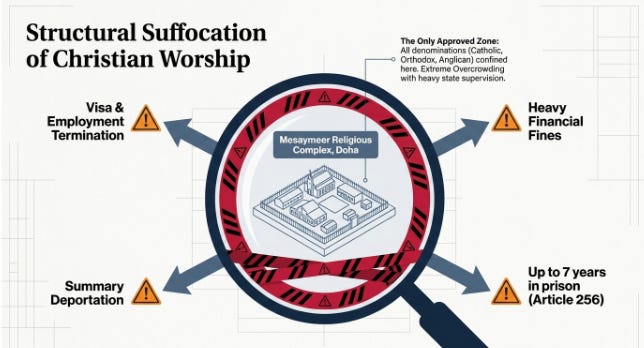
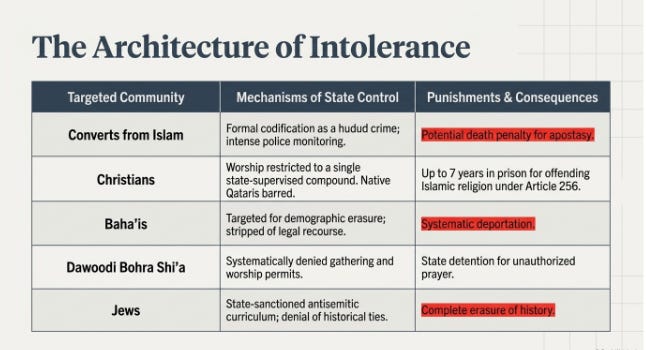
The legal framework is unambiguous. Under Qatar's Penal Code (Law No. 11 of 2004), apostasy—leaving Islam for another faith—is formally codified as a hudud offense for which the law allows the death penalty, though no executions for apostasy have been documented. Article 256 imposes prison sentences of up to seven years for “offending the Islamic religion” or “insulting any of the prophets.” The government reviews, censors, and bans media containing what it deems objectionable religious content. Conversion from Islam, the USCIRF report states bluntly, “is not officially recognized.”


Life Under Surveillance for Converts
Both Qatari citizens and migrant workers who convert to Christianity experience what the commission describes as systematic persecution. Converts face discrimination from authorities, harassment in daily life, and active police monitoring of their activities. They cannot legally change their religious identity on government documents. Unauthorized religious gatherings can result in visa termination, loss of employment, detention, fines, or deportation.
Qatar's male guardianship system compounds the threat. The 2006 Family Law, governed by Sunni religious rulings and Sharia jurisprudence, mandates that a couple divorce if one spouse engages in apostasy—meaning conversion forces the legal dissolution of families. Qatari women need male guardian permission to work in government institutions, and unmarried women under 25 require guardian approval to travel abroad, making it nearly impossible for female converts to escape persecution.
Converts live in constant calculation: Is this gathering too visible? Will a neighbor report us? Can my family survive if I’m deported? Unrecognized faith groups cannot open bank accounts, legally hire staff, or solicit funds. Worship in residential spaces, the only option for many, offers no legal protection from arbitrary enforcement.
Foreign Christians: One Compound, Heavy Surveillance
Foreign Christians, while relatively freer than converts, worship under heavy state supervision. The government restricts all Christian worship to a single government-approved compound: the Mesaymeer Religious Complex in Doha. Eight Christian denominations—Roman Catholic, Greek Orthodox, Syrian Orthodox, Coptic Orthodox, Maronite, Anglican, and Evangelical Protestant—share this facility under constant state monitoring.
The Christian Churches Steering Committee reports overcrowding and limited resources. Churches cannot display crosses, bells, or steeples on their exteriors. Native Qataris are barred from entering the compound. The government actively monitors worship activities and requires permits even for private gatherings. Security personnel screen attendees. This is worship as state-supervised performance —religious freedom in name only.
A Broader Pattern of Religious Persecution
Christians are not alone. In early 2025, authorities detained several members of the Dawoodi Bohra Shi’a Muslim community for gathering for prayer without a permit. They were held without due process and subjected to irregular judicial proceedings based solely on religious identity.
The Baha’i community faces systematic erasure. Between 2003 and 2025, Qatar deported at least 14 Baha’is on account of their religion. Since March 2026, at least four more Baha’i leaders have been ordered to leave without legal recourse, including lifelong residents with elderly parents dependent on their care.
Only Sunni Muslims, Shi’a Muslims, and eight Christian denominations are legally registered in Qatar. Everyone else, Hindus, Buddhists, Baha’is, unregistered Christian groups, exists outside the law. They cannot publicly display their faith, distribute religious materials, or organize legally. The USCIRF report characterizes these restrictions as having become “systematic” in 2025.
The Image Versus the Reality
The contradiction is stark. Qatar projects an international image of religious tolerance and multicultural engagement. The government hosts international conferences through the Doha International Center for Interfaith Dialogue to promote religious coexistence. State officials committed to the State Department that they would reform intolerant content in textbooks.
Yet the 2026 IMPACT-se report documents that government curriculum still teaches that “polytheism” is “the greatest sin” and portrays non-Muslims in deeply negative terms. History textbooks discussing Adolf Hitler omit antisemitism and make no reference to the Holocaust. Behind the carefully constructed public relations, the persecution continues.
USCIRF recommends Qatar be placed on the Special Watch List for engaging in or tolerating severe violations of religious freedom. The commission calls for Congress to hold hearings on religious freedom conditions and urges the State Department to work with Qatar’s National Human Rights Committee to incorporate religious freedom protections.
Behind Qatar’s facade of tolerance, Christians who convert live under the shadow of a death penalty that remains on the books. They worship in secret, avoid authorities, and calculate daily whether their faith is worth the risk of losing everything. The USCIRF report exposes what Qatar’s public relations apparatus works to hide: religious freedom does not exist for those who choose Christianity in a country where apostasy is a crime.