



Conservative data researcher DataRepublican has unveiled a major expansion of her Mass Migration Explorer, an interactive database designed to trace how taxpayer money flowed through America’s immigration and refugee-resettlement system, including payments to nonprofits, private contractors and local governments that provided services to migrants.
The updated tool, developed in partnership with the Oversight Project, now maps 1,275 organizations and 2,814 documented relationships, supported by more than 13,000 evidence items. Its latest expansion incorporates Federal Emergency Management Agency (FEMA) shelter grants and migrant-related contracts from major cities and states, allowing users to examine funding relationships that previously required searching multiple government databases.
In an October 15 announcement, DataRepublican explained that the project had expanded beyond federal spending records to incorporate local budgets and the organizations receiving government money.
“Follow the people. Trace the money,” she wrote.
The new release also identifies 150 federal awards that were terminated, shortened or not renewed following President Donald Trump’s return to office. Those awards had a combined value of approximately $537 million before the changes, according to the database.


Following the Money From Washington to Migrant Shelters
One of the explorer’s most significant additions is its ability to connect federal shelter funding with local governments and service providers.
FEMA’s Shelter and Services Program, established to help communities cover the costs of assisting migrants released from federal immigration custody, provided money to nonprofit organizations and local governments. Those governments could then contract with other organizations and businesses to operate shelters, provide transportation or deliver related services.
The expanded NGO Explorer distinguishes between 56 organizations with direct FEMA shelter awards, 13 with documented FEMA money routed through a city, county or other agency, and 65 receiving city or state payments for migrant services where a FEMA funding connection has not been established.
This distinction allows users to examine who ultimately received government funding without assuming that every municipal contract was financed by FEMA. The database incorporates records from New York City, Chicago, Denver, San Diego, El Paso County, Pima County, California, Massachusetts and other jurisdictions. The scale of those local expenditures is substantial.
In Chicago, an official procurement record shows that a migrant-staffing contract with Favorite Healthcare Staffing, originally authorized for up to $40 million in October 2023, was subsequently expanded to a maximum of approximately $334.6 million.
In Denver, the City Council approved a sole-source hotel-services purchase order with Colorado Hospitality Services, operated by Quebec Hospitality LLC, with a ceiling of $25 million for migrant sheltering.
Those figures represent authorized contract limits rather than confirmed payments. Nevertheless, they illustrate the scale of local spending that the explorer’s expanded coverage is designed to make easier to investigate.
A Network of Nonprofits, Contractors and Government Grants
Beyond individual expenditures, the database maps relationships between national refugee-resettlement agencies, their local affiliates, government-funded service providers, legal organizations and private foundations.
Users can search organizations by name, location or employer identification number and explore the results through organizational cards, a geographic map or an interactive network diagram. Individual records provide funding information, organizational connections and links to supporting evidence.
Among the organizations appearing in the database are Catholic Charities, the United States Conference of Catholic Bishops, the International Rescue Committee, HIAS and numerous local service providers.
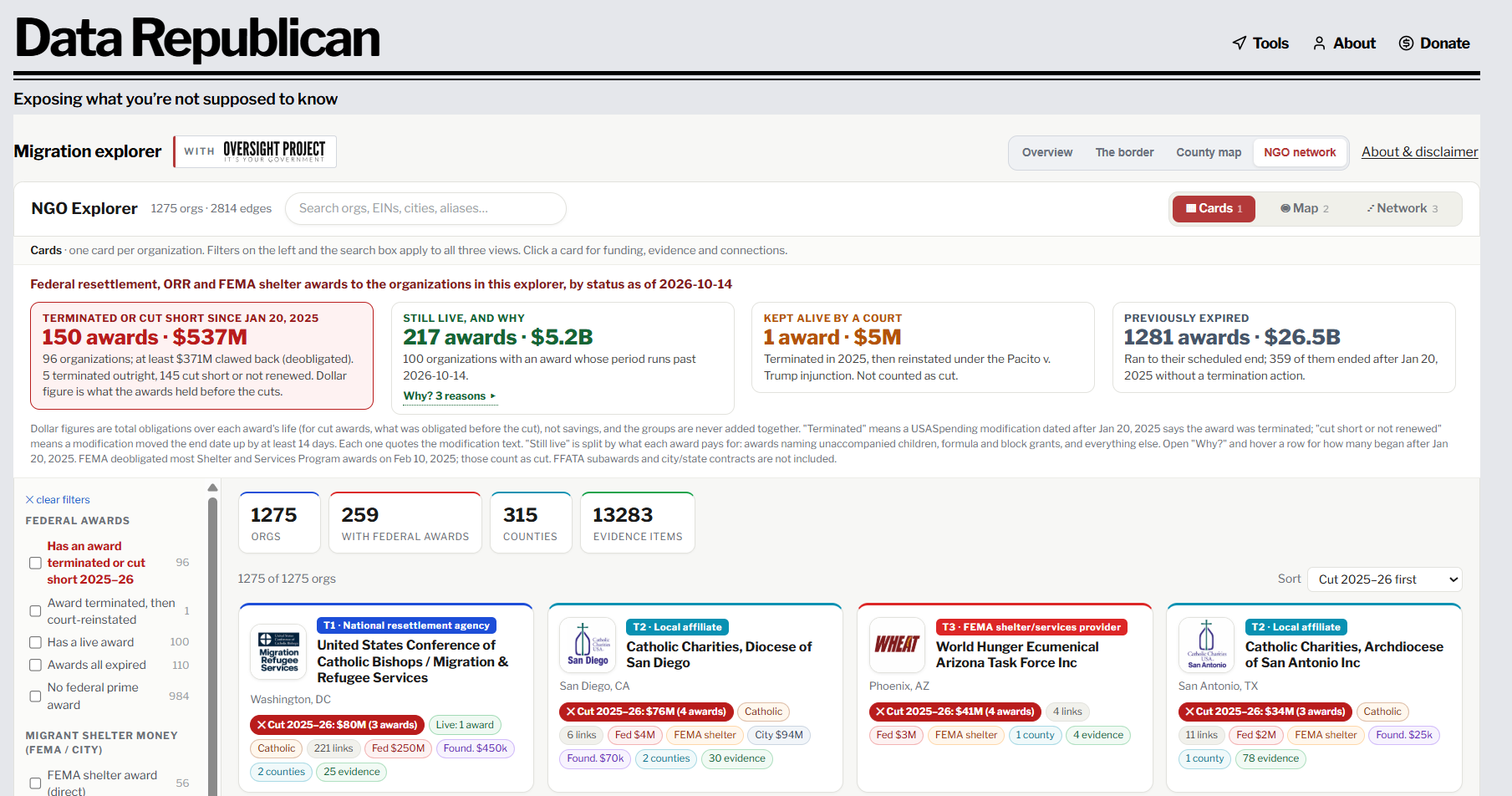
The explorer identifies approximately $80 million in affected awards associated with the United States Conference of Catholic Bishops’ Migration and Refugee Services program. It separately lists approximately $76 million in affected awards for Catholic Charities of the Diocese of San Diego.
The platform draws from USAspending.gov, Internal Revenue Service filings, federal agency records and municipal procurement disclosures. Organizations appear because a financial relationship or affiliation is documented, not because the database has established misconduct.
Tracking Which Awards Were Cut and Which Remain Active
The expansion also provides a detailed accounting of federal grants affected by the administration’s immigration policy changes. According to the explorer’s October 14 funding snapshot, 150 awards involving 96 organizations had been terminated, shortened or not renewed since January 20, 2025.
The database places the combined pre-cut value of those awards at $537 million and identifies at least $371 million in deobligations, meaning reductions or reversals of previously recorded federal obligations. Such reductions do not necessarily represent cash recovered from recipients.
At the same time, the explorer identifies 217 awards worth approximately $5.2 billion whose performance periods extend beyond October 14, 2026. About $3.4 billion of those awards is associated with care for unaccompanied children already in federal custody. Another portion supports assistance to refugees already living in the United States, including programs authorized under the Refugee Act of 1980. These figures reflect award values over their respective periods, not necessarily funds paid out during the current fiscal year.
Mapping Three Decades of Immigration
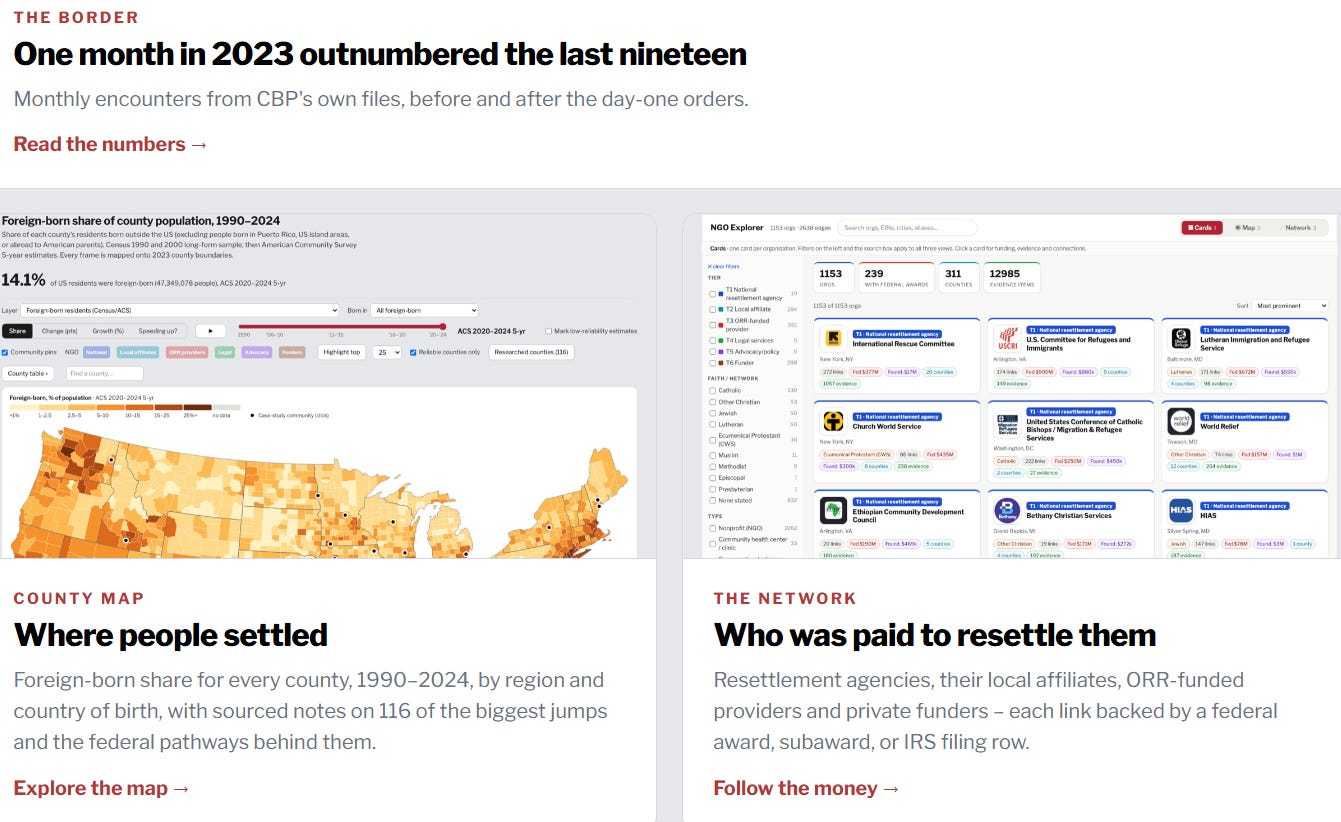
The financial network is only one component of the larger Mass Migration Explorer.
Its interactive county map tracks changes in America’s foreign-born population from 1990 through 2024, using U.S. Census Bureau and American Community Survey data.
Users can examine individual counties, filter by country or region of birth, compare changes across decades and investigate 116 researched county-level immigration patterns. Additional layers cover refugee arrivals, immigration-related administrative records and other government programs. The project shows the foreign-born share of the U.S. population increasing from approximately 7.9 percent in 1990 to 14.1 percent in the 2020–2024 survey period.
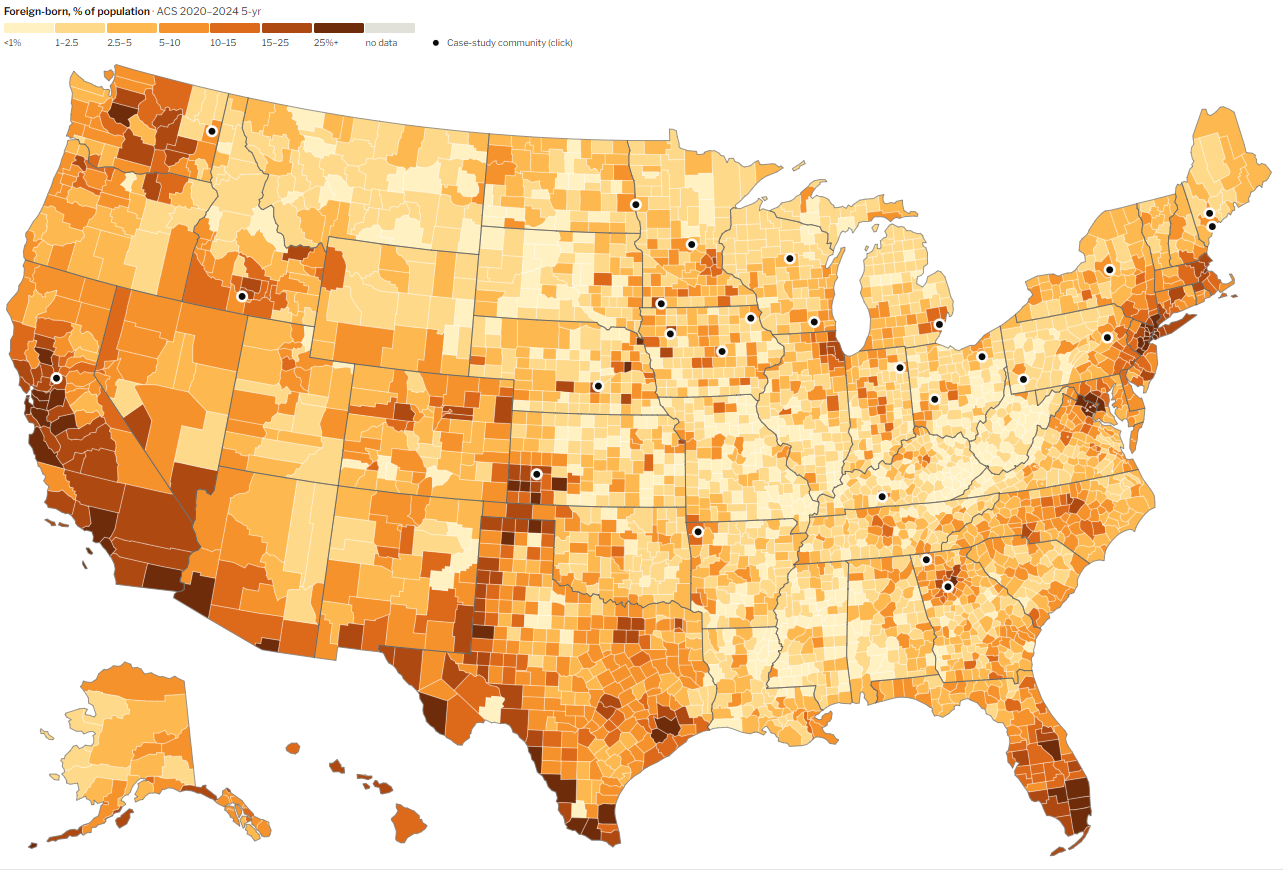
Because the Census data includes naturalized American citizens, lawful permanent residents, visa holders and unauthorized immigrants, the map does not independently measure illegal immigration.
The explorer also features an interactive border chart comparing monthly encounters recorded by U.S. Customs and Border Protection. Its figures show southwest border encounters falling from 301,981 in December 2023 to 12,242 in August 2026, a decline of approximately 96 percent between those two months.
The project further calculates that December 2023 alone recorded more encounters than the combined total from February 2025 through August 2026. The border presentation explicitly connects the decline with Trump’s immigration policies and concludes with an appeal for Republican turnout in the November midterm elections.
A New Tool for Public Oversight
DataRepublican, whose real name is Jennica Pounds, joined the Oversight Project as a visiting fellow in February 2026. The organization announced her appointment as part of its efforts to investigate government waste, fraud and abuse.
Rather than limiting users to a single national funding total, the platform allows them to examine individual organizations, their federal awards, local contracts, financial relationships and the geographic distribution of immigration-related programs.
Its distinguishing feature is the integration of records scattered across federal agencies, city procurement systems, nonprofit disclosures and Census databases into one searchable interface.
For taxpayers seeking to understand the financial infrastructure behind America’s immigration system, the explorer offers something that has often been difficult to obtain: a searchable view connecting the organizations, the government contracts and the money.