

Dogs Over Wives: The Taliban's 119-Article Penal Code
Afghanistan's new legal code reveals what permanent repression looks like.

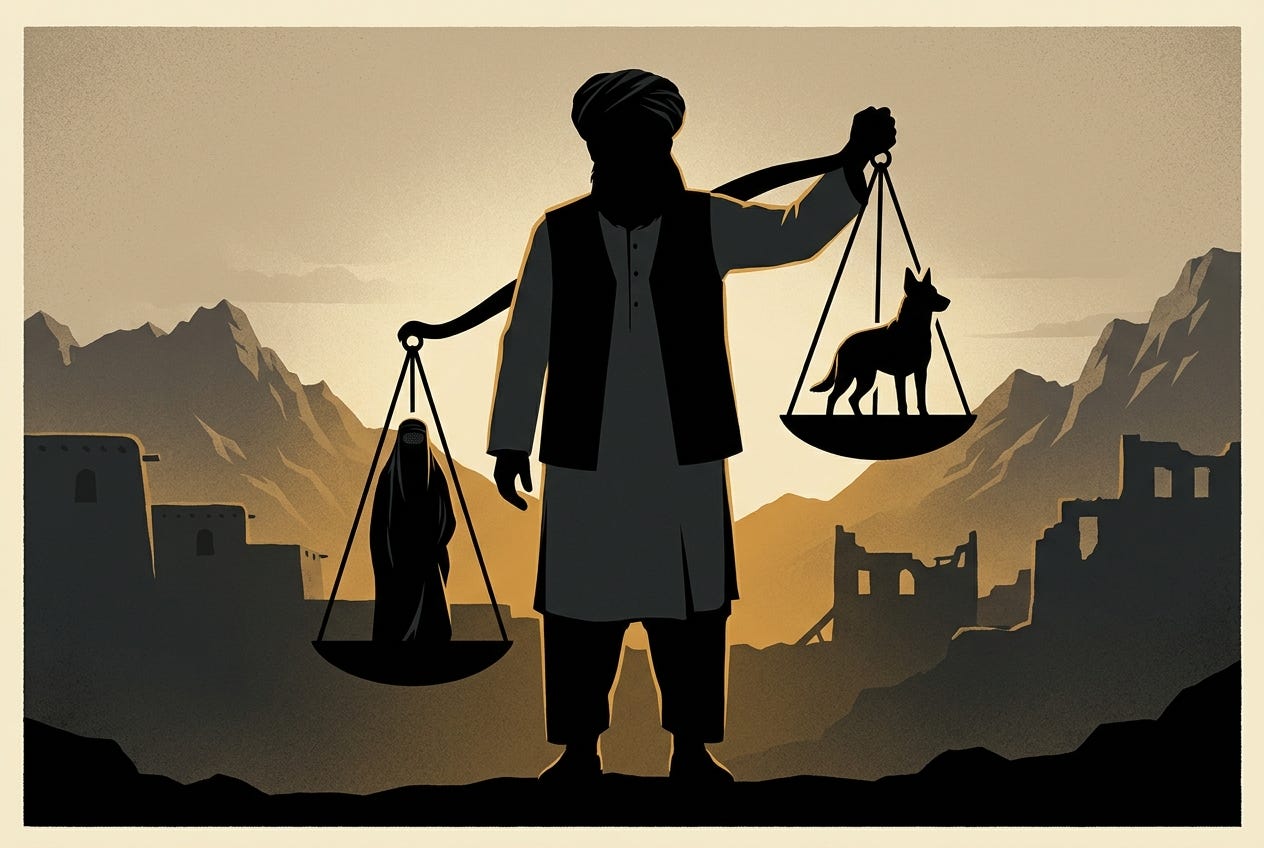
Break your wife’s bones, fifteen days in prison. Force dogs to fight, five months.
That’s the penalty structure in Afghanistan’s new Taliban penal code, issued in January 2026 and leaked last month to the Afghan rights group Rawadari. The decree specifies exactly how much violence a husband can inflict before the state considers it excessive, “a broken bone,” “an open wound,” or “a black and blue wound” that appears on her body. Anything short of that threshold remains legal.
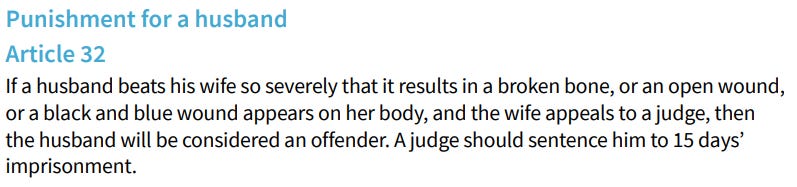

You can read a society’s values through its penalty structure. The math here is unambiguous: animal welfare rates higher than women’s bodies. Teachers who break a student’s bone lose their jobs, fathers who beat children for failing to pray face no punishment at all unless bones break. The precision isn’t accidental. It’s administrative.
Building to Last
These punishments aren’t new. The Taliban has always permitted domestic violence, always restricted women’s movement, always governed through intimidation. What changed in January is that they wrote it down.
Codification matters. When practices become policy, they create precedent. They train judges in what to enforce and signal to the population what’s permanent versus provisional. The decree’s clinical specificity, distinguishing between bruises that fade and wounds that mark, serves an institutional purpose. It removes discretion, standardizes rulings, and transforms ad hoc brutality into durable legal infrastructure.
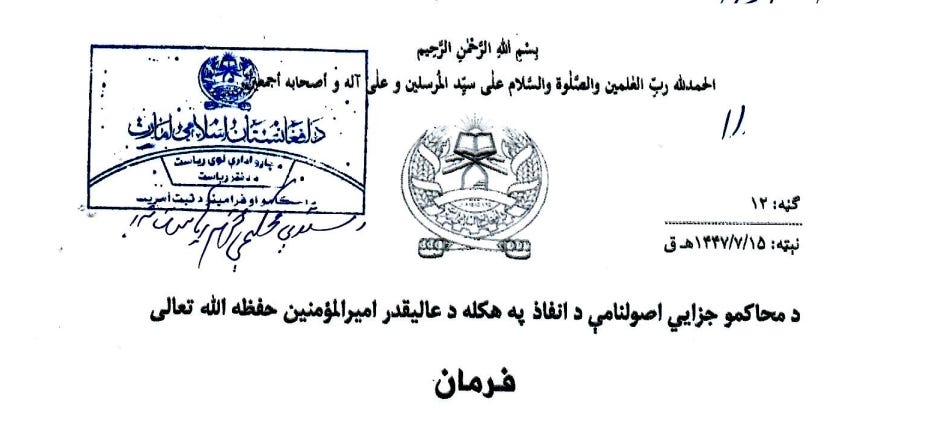
This is what settling in looks like. The Taliban isn’t just ruling by force anymore; they’re building an administrative state with formal procedures, penalty schedules, and bureaucratic distinctions. The 119-article code covers everything from theft and sodomy (both punishable by death) to insulting the Taliban leader (39 lashes plus a year in prison). It’s comprehensive, detailed, and designed for longevity.
The Legitimacy Claim
The Taliban insists all its rulings align with Islamic Sharia law and carry religious legitimacy. That claim matters strategically, both domestically and internationally. It positions the decree not as political repression but as theological obligation, something beyond negotiation or reform.
The gap between claim and reality is enormous. Many Islamic scholars reject these interpretations as distortions of Islamic jurisprudence. But the Taliban’s use of religious authority as a legitimizing mechanism makes the system harder to challenge from within. Dissent becomes heresy. The code explicitly criminalizes spreading “doctrines contrary to Islam,” with death as the potential penalty.
This weaponization of religious authority isn’t unique to the Taliban, but the formalization marks a shift. Extremist interpretations that once existed in practice are now enshrined in state law, complete with judicial procedures and enforcement mechanisms.
The Silence
The decree received minimal media coverage despite being genuinely shocking. Part of this reflects Afghanistan fatigue, the sense that the story ended when American troops withdrew in 2021. Part reflects normalization. We’ve accepted Taliban control as a fact, and facts stop generating headlines.
But the decree tells us something important about trajectory. The Taliban isn’t moderating or adapting to international pressure. It’s consolidating. The legal infrastructure being built now will outlast any particular leader or crisis. It trains the next generation of judges, normalizes these standards for the population, and makes reversal exponentially harder.
Women’s rights activist Mahbouba Seraj, speaking from Kabul, described the practical reality, “the men have the right to rule completely the women. His word is the word of law—that’s it.” Even when women meet the injury threshold, they cannot leave home without a male guardian to report abuse. Their testimony in court is worth half a man’s. The decree creates the appearance of limits while ensuring those limits can never be enforced.
The UN’s top human rights official warned that “Afghanistan is a graveyard for human rights.” The metaphor is apt. What’s being buried isn’t just rights but the mechanisms for claiming them. That’s what makes codification different from practice, and why fifteen days versus five months isn’t just cruelty.
It’s architecture.
Treating women as less than dogs, that's bad. Anyone even the least bit familiar with the religion/culture knows that calling a Muslim a 'dog' is about the worst insult you can give.