


The U.S. Justice Department issued an opinion on Nov. 25 clarifying how police across the United States can use radar, cameras and public identification broadcasts to detect drones and protect the public while complying with federal surveillance laws. The guidance gives federal, state, local, tribal and territorial authorities a clearer legal basis to detect drones near places like stadiums and prisons, where officers may need to determine quickly whether an aircraft poses a threat.

The 55-page opinion, addressed to the White House counsel, examines four kinds of detection technology under the federal Wiretap Act and the Pen-Trap Statute, which governs certain tools that collect information about communications, such as where they come from and where they go. The Justice Department’s Office of Legal Counsel concluded that radar, acoustic sensors, and optical and infrared systems generally fall outside both laws. Radiofrequency tools require a closer look because some can read the contents of a transmission.
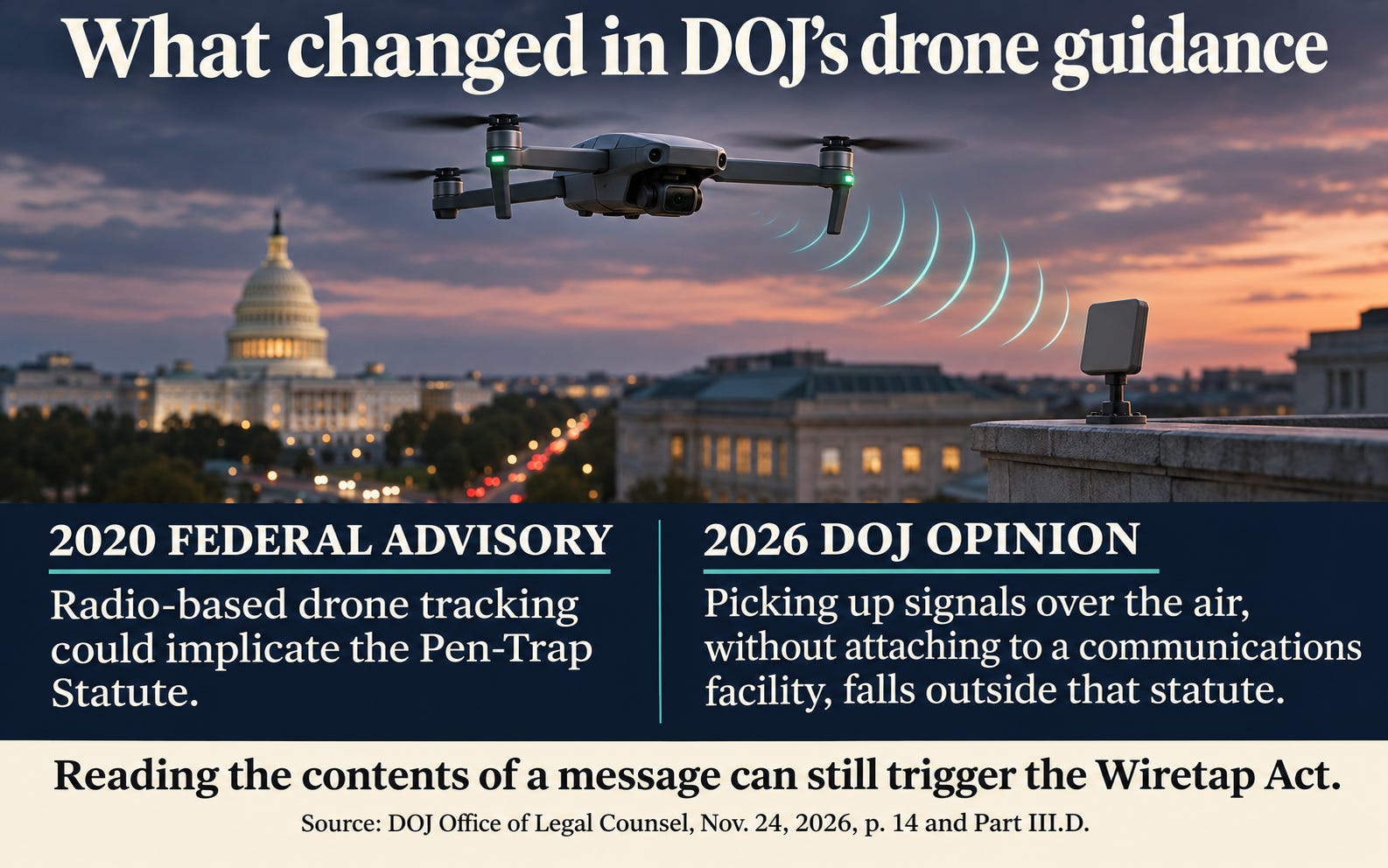
What Changed in DOJ’s Drone Guidance
For officers who spot a drone near a stadium or prison, the next question is what they can learn about it. In 2020, federal agencies warned that using radio signals to track drones could implicate the Pen-Trap Statute. The new opinion clarifies that receiving signals over the air falls outside that statute when the equipment is neither attached nor applied to a telephone line or other communications facility. Reading the contents of a transmission raises a separate question under the Wiretap Act. One signal officers can read is the public identification broadcast that most drones are required to send
What Officers Can Learn From a Public Broadcast
The Federal Aviation Administration requires most drones to transmit a public identification signal known as Remote ID. The FAA likens it to a digital license plate. The signal identifies the aircraft and reports its position and speed. Depending on the equipment, it can also give the location of the controller or the point where the drone took off. The Justice Department concluded that officers can receive those broadcasts under the Wiretap Act’s exception for communications readily accessible to the public.
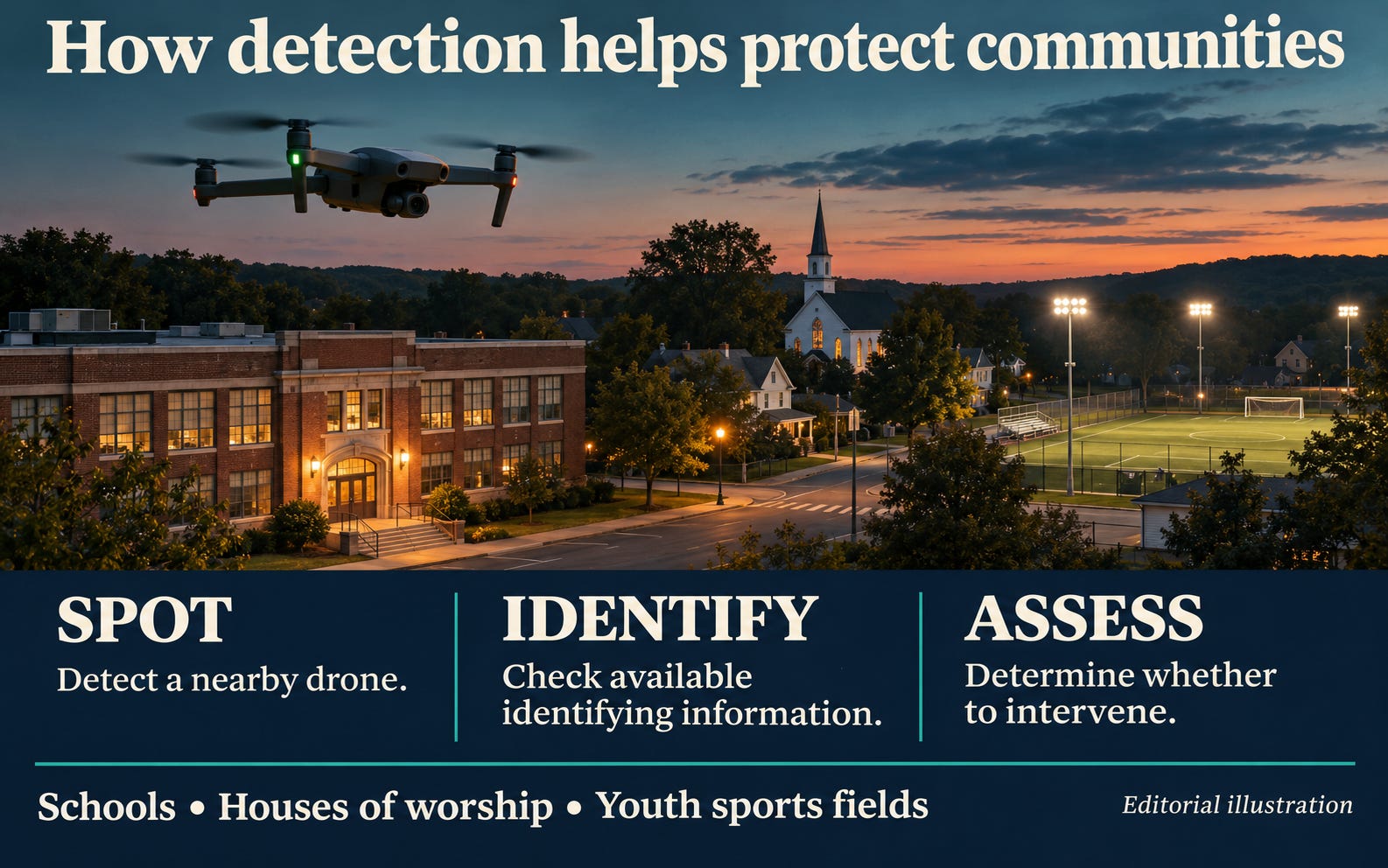
Consider a drone spotted near a prison. Officers can use radar to determine where it is and check the public broadcast for identifying information. If they seek to obtain the same location by reading a message the drone sends to its controller, they would be acquiring the contents of a communication. Whether they can intercept it depends on how the message is transmitted and whether a legal exception applies. The opinion also says officers must comply with applicable Fourth Amendment protections when using equipment that reads those signals.
Knowing where a drone is and what its public broadcast reveals can help officers assess whether it poses a threat. Any action to stop it involves a separate set of rules.
When Police Can Act to Stop a Drone
The Justice Department’s opinion addresses detection. Jamming a signal or bringing down a drone requires separate legal authority. Under the SAFER SKIES Act, eligible state, local, tribal and territorial law enforcement and corrections agencies can carry out certain counter-drone operations under federal rules that set training, certification and privacy requirements.
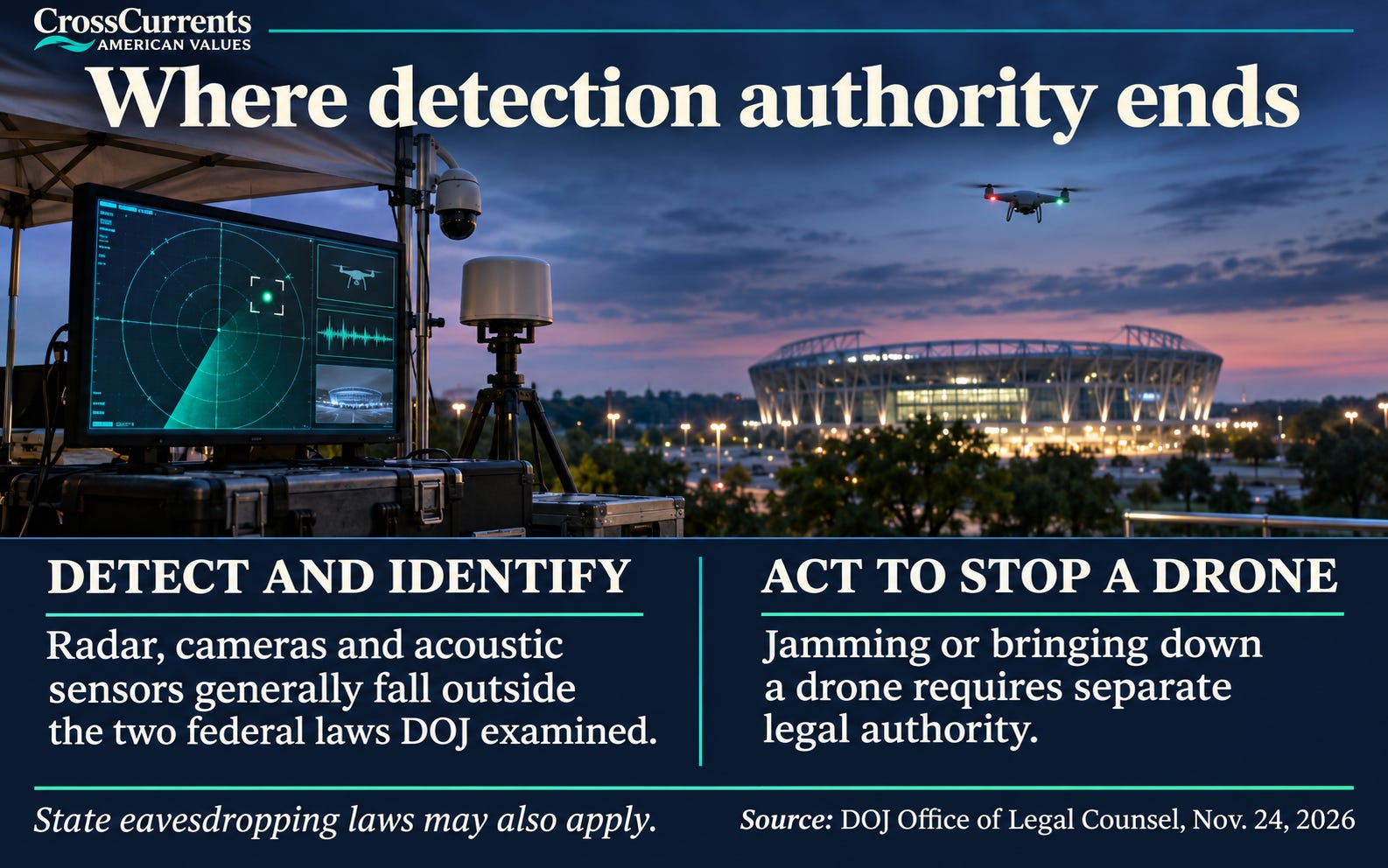
The opinion finds that agencies can use many common detection tools without relying on that special authority because those uses generally fall outside the two federal laws it examined. State eavesdropping laws may still apply when local agencies use those tools outside the federal framework.
A drone near a prison could be carrying contraband. At a community event, it could belong to a photographer or an emergency response crew. The new opinion gives police a clearer legal basis to find out what’s in the air and assess whether it poses a threat. That first step can help officers protect the places where children learn, families worship and communities gather, from schools and churches to youth sports fields.