

DSA Member And Activist Linda Sarsour Calls for Replacing the Declaration of Independence
The former Women's March leader with a history of extremist associations says it's time to "build a document that is our values"

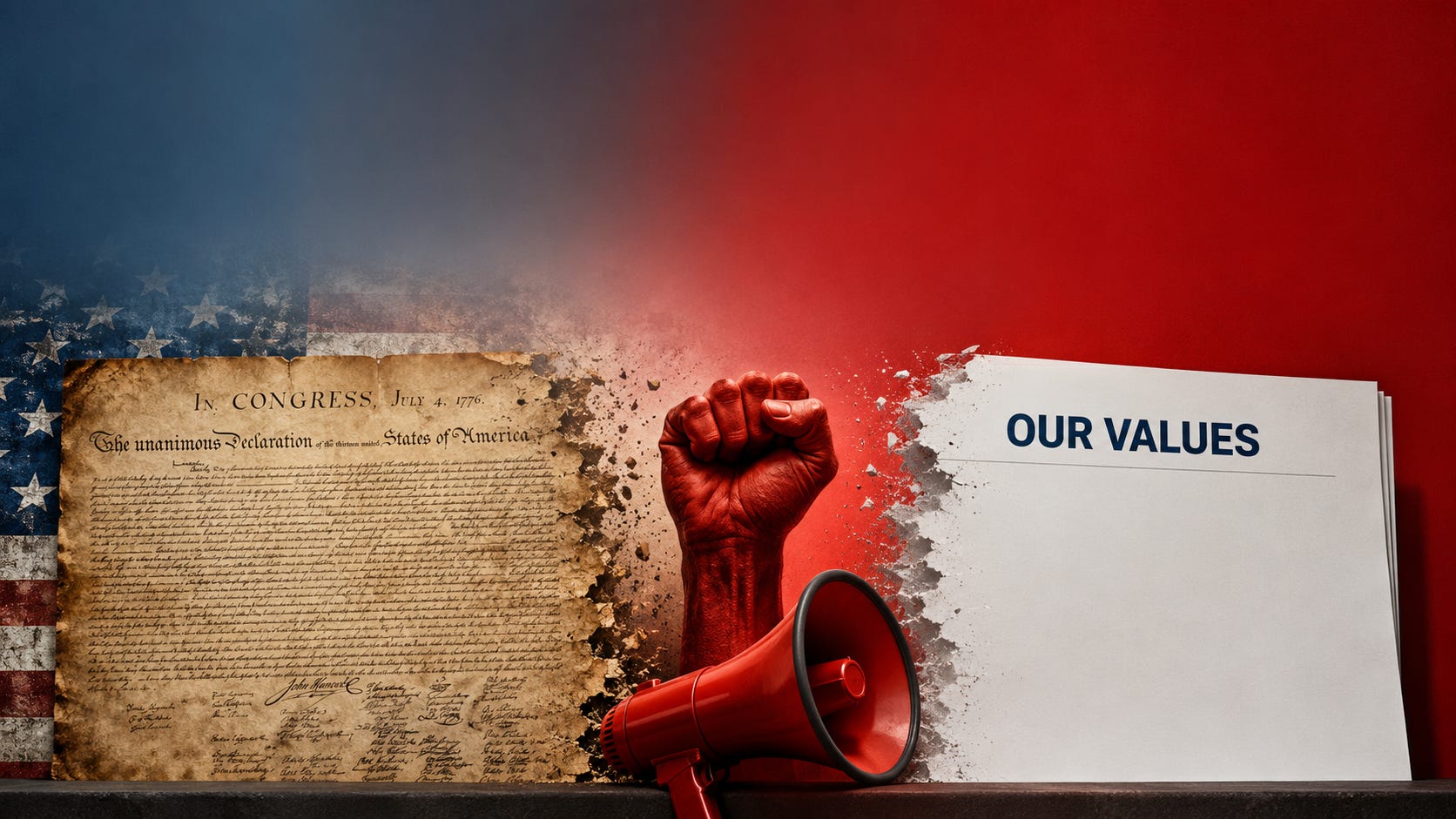
Democratic Socialists of America member Linda Sarsour has called for replacing the Declaration of Independence with a new document reflecting “our values.” The statement, captured on video and circulating on social media this week, marks the latest incendiary remark from the Palestinian-American activist whose career has been defined by a pattern of extremist associations and inflammatory statements.
Sarsour, who co-chaired the 2017 Women’s March before stepping down amid antisemitism controversies in 2019, has previously praised sharia law, refused to condemn Nation of Islam leader Louis Farrakhan, shared a stage with a convicted terrorist bomber, and attacked critics of Islamist ideology. The call to replace America’s founding document now raises questions about how activists with such backgrounds gain and maintain legitimacy within progressive institutions.

A Track Record of Extremist Associations
Sarsour’s most troubling association involves Rasmea Odeh, a Palestinian terrorist convicted by Israeli courts for her role in a 1969 Jerusalem supermarket bombing that killed two Hebrew University students, Leon Kanner, 21, and Edward Joffe, 22. Odeh was sentenced to life in prison and served ten years before being released in a 1980 prisoner exchange.
In April 2017, at a conference organized by the anti-Israel group Jewish Voice for Peace, Sarsour shared the stage with Odeh. According to the Jewish Standard, Sarsour told the audience she was “honored and privileged to be here in this space, and honored to be on this stage with Rasmea.”
Odeh was later convicted in U.S. federal court for immigration fraud after concealing her terrorism conviction to obtain American citizenship, and was deported to Jordan in 2017.
The Farrakhan Connection and Women’s March Collapse
Sarsour’s tenure as co-chair of the Women’s March unraveled over her refusal to clearly condemn Louis Farrakhan, the Nation of Islam leader whose decades of rhetoric attacking white Americans and the United States itself have been extensively documented.
Farrakhan has repeatedly dehumanized white people, telling the Philadelphia Inquirer in March 2000 that “white people are potential humans—they haven’t evolved yet.” In an October 2018 speech marking the 23rd anniversary of the Million Man March, he told followers that Nation of Islam founder Elijah Muhammad “came to save us from the sins of white people that have been imposed on us since we have been under their rule.”
His hostility toward the United States itself has been equally explicit. In an August 1997 statement published in the New York Amsterdam News, Farrakhan declared: “A decree of death has been passed on America. The judgment of God has been rendered and she must be destroyed.” In a 1996 Saviours’ Day speech in Chicago, he warned that unnamed enemies had “wrapped your tentacles around the U.S. government, and you are deceiving and sending this nation to hell.”
Despite Farrakhan’s long record of such statements, Sarsour and fellow co-chair Tamika Mallory initially declined to distance themselves from him. In November 2018, Women’s March founder Teresa Shook called for Sarsour and her co-chairs to step down, accusing them of allowing “anti-Semitism, anti-LBGTQIA sentiment and hateful, racist rhetoric to become a part of the platform.”
A Pattern of Inflammatory Statements
Beyond organizational ties, Sarsour has a documented history of inflammatory statements on social media and in public appearances.
In 2011, she tweeted that “shariah law is reasonable and once u read into the details it makes a lot of sense. People just know the basics.” The statement drew criticism from those who noted that sharia law in practice often involves severe restrictions on women’s rights, religious freedom, and free expression.

Most controversially, in a 2011 tweet directed at activists Ayaan Hirsi Ali and Brigitte Gabriel, both outspoken critics of Islamist ideology, Sarsour wrote: “She’s asking 4 an a$$ whippin’. I wish I could take their vaginas away - they don’t deserve to be women.” The statement was particularly offensive given that Ali is a survivor of female genital mutilation.
When confronted about the tweet during a 2017 appearance at Dartmouth College, Sarsour dismissed the question by citing the race and gender of her questioner, a white male student, suggesting he lacked standing to challenge her. She later told The Washington Post the tweet was “stupid” but did not fully apologize for the sentiment.
From Women’s March to Democratic Socialists
Following her departure from the Women’s March, Sarsour joined the Democratic Socialists of America and has remained active in progressive politics. She spoke at the DSA’s 2019 national convention and has been a vocal supporter of far-left political candidates.


Her recent call to replace the Declaration of Independence represents a natural extension of this trajectory. In the video, Sarsour asks: “Do we have the audacity to…build a document that is our values?”
The statement raises obvious questions: Whose values? What would such a document contain? And why would someone who has praised sharia law, honored a convicted terrorist, and refused to condemn antisemitic figures be trusted to articulate the foundational principles of American democracy?
The Institutional Enablement Problem
What makes Sarsour’s continued prominence remarkable is not simply her individual statements, but the institutional support she has received despite them.
She was recognized by the Obama White House as a “Champion of Change” in 2012. She served as a surrogate for Senator Bernie Sanders’ 2016 presidential campaign. Time magazine named her one of the “100 Most Influential People” in 2017.
When she was selected to deliver the commencement address at the City University of New York’s Graduate School of Public Health in 2017, even some progressive Jewish groups defended her right to speak, despite protests from Holocaust survivors and conservative Jewish organizations.
This pattern reveals how activists with extremist associations can gain legitimacy through progressive institutional networks — and how criticism of such associations is often deflected as racism, Islamophobia, or right-wing smear campaigns.
Big Picture
Linda Sarsour’s call to replace the Declaration of Independence is not an isolated statement. It is the latest expression of a worldview that has been evident throughout her career—one that rejects core Western values, associates with extremist figures, and views American founding principles as obstacles to be overcome rather than foundations to be defended.
The question is not whether one activist holds these views. The question is why progressive institutions continue to provide platforms, legitimacy, and protection to individuals whose associations and statements would disqualify them from public life in any movement genuinely committed to democratic values, human rights, and the rejection of extremism.