



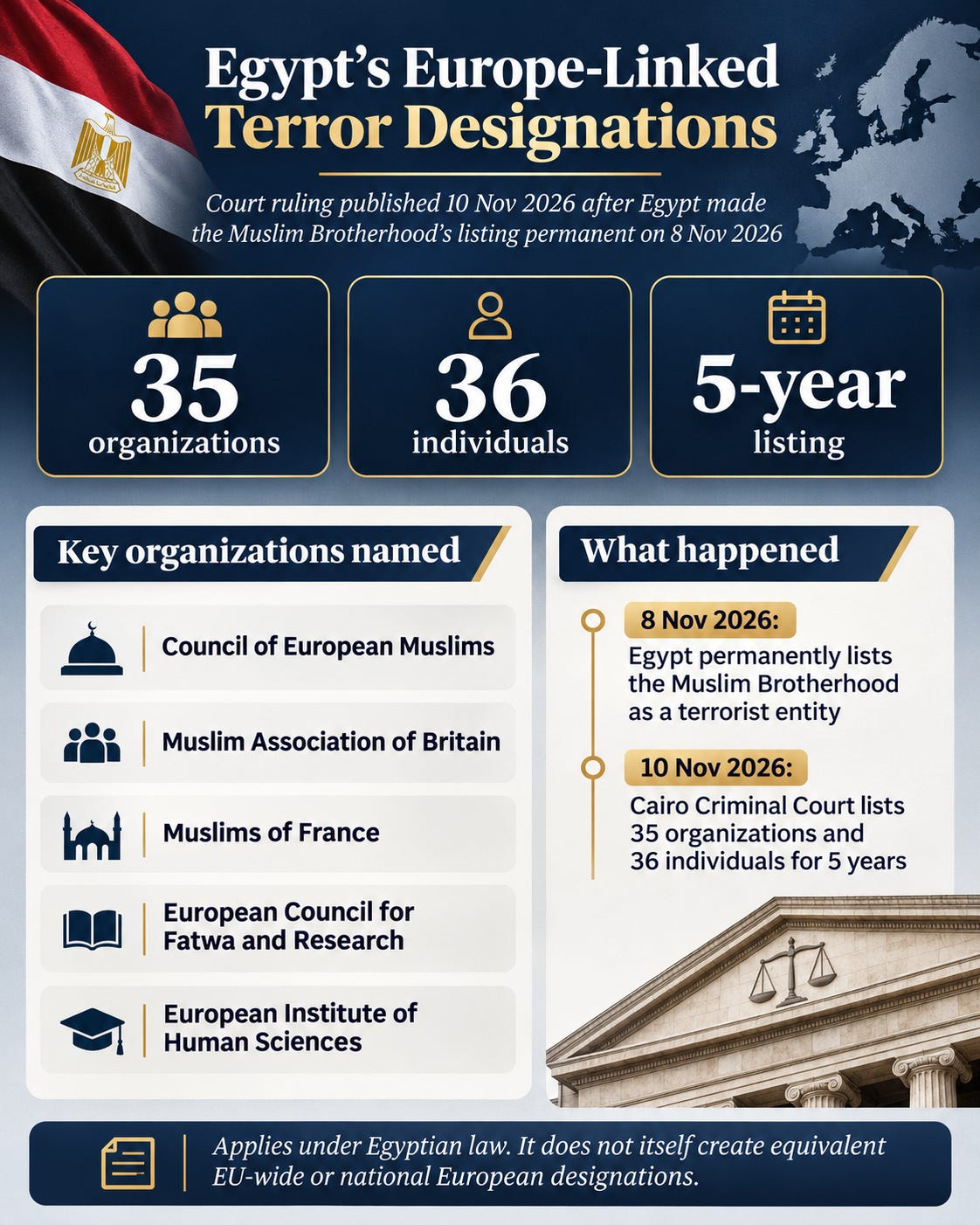
Egypt has designated 35 Europe-linked Islamic organizations and 36 individuals as terrorists in a sweeping judicial decision targeting religious associations, educational institutions and Muslim community networks operating across the continent.
The ruling, issued by the Cairo Criminal Court and published on November 10, 2026, places the organizations and individuals on Egypt’s terrorism lists for five years.
The ruling follows a separate decision published in Egypt’s official gazette on November 8, making the Muslim Brotherhood’s national terrorism listing permanent and replacing its previous time-limited designation.
Among the newly designated organizations are the Council of European Muslims, the Muslim Association of Britain, Muslims of France, the European Council for Fatwa and Research and the European Institute of Human Sciences.
The measures also follow an October European Parliament resolution calling for stronger scrutiny of Muslim Brotherhood influence networks and consideration of terrorist designations for associated organizations.
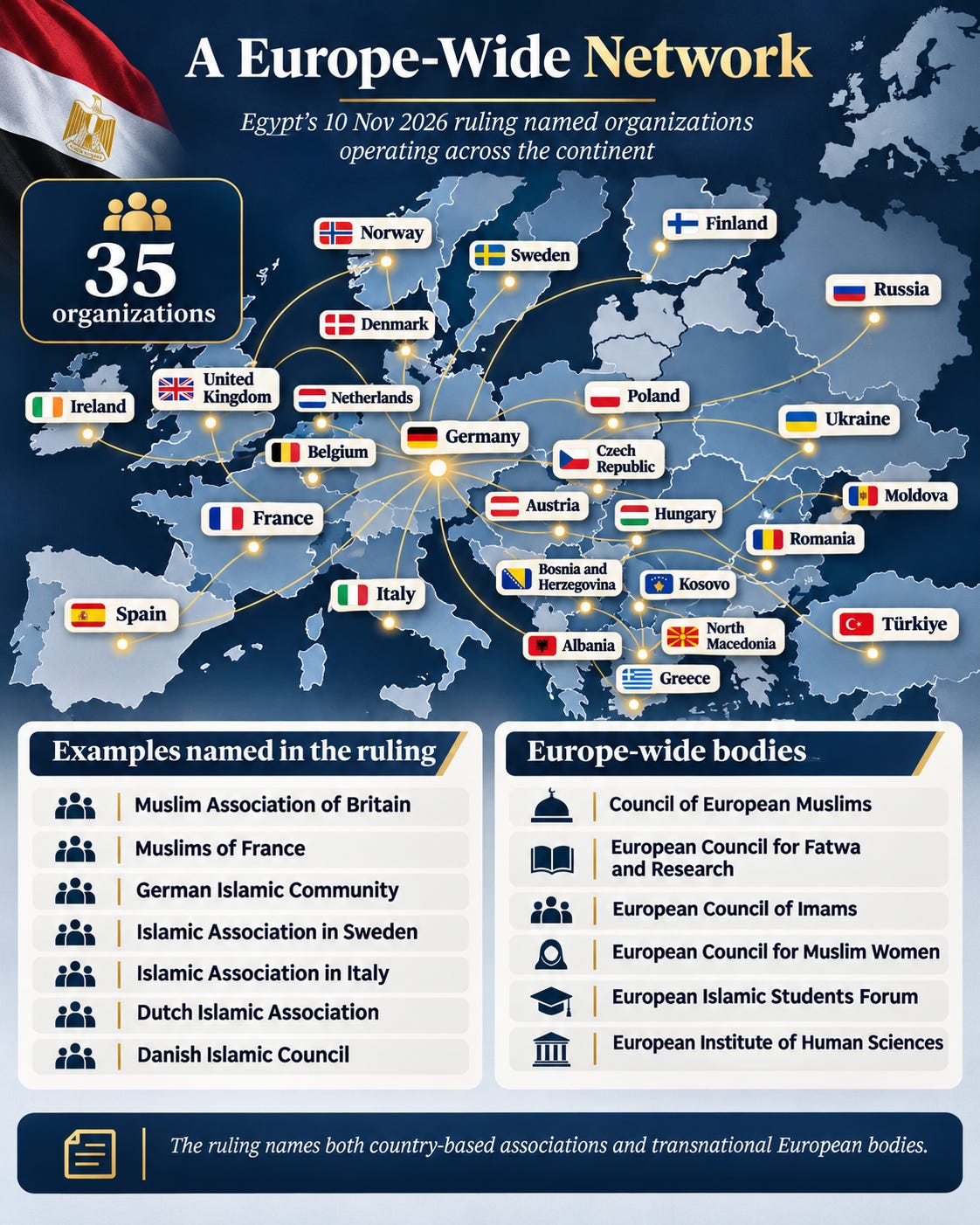
A Europe-Wide Network of Organizations
The Egyptian court’s decision was issued under Case No. 11108 of 2026, registered with the Supreme State Security Prosecution, and published in Issue No. 250 (Supplement) of Al-Waqa’i Al-Masriyya, Egypt’s official gazette.


According to the published list, the designated entities include the Council of European Muslims and its branches, Muslims of France, the Muslim Association of Britain, the Swiss Muslim League, the German Islamic Community and Islamic associations in Sweden and Italy.
Additional organizations operate in Spain, Ireland, Poland, Romania, Hungary, Türkiye, Albania, Ukraine, Belgium, Bosnia and Herzegovina, Russia, North Macedonia, Finland, Norway, Kosovo, Denmark, Austria, the Netherlands, Moldova, Greece and the Czech Republic.
The court also listed several transnational institutions, including the European Council for Fatwa and Research, the European Council of Imams, the European Council for the Muslim Family, the European Council for the Holy Quran, the European Council of Muslim Women, the European Islamic Students Forum and the European Institute of Human Sciences, including its branches.
Together, the organizations cover activities ranging from religious scholarship and imam training to educational programming, student organizing and community representation.
The Council of European Muslims, a central organization named in the ruling, was formerly known as the Federation of Islamic Organisations in Europe. Established in 1989, it adopted its current name in 2020.
Prominent Individuals Among Those Designated
The ruling also identifies 36 individuals, including Anas Altikriti, Ibrahim el-Zayat, Hussein Halawa, Khaled Hanafy and Abdallah Ben Mansour.
Altikriti, a British Muslim political figure and founder of the Cordoba Foundation, is an active director of the Muslim Association of Britain, according to official UK Companies House records. He was appointed on March 4, 2026. Both Altikriti and the association appear on Egypt’s lists.
El-Zayat previously chaired the Islamic Community in Germany, while Hanafy serves as dean of the European Institute of Human Sciences in Frankfurt and deputy secretary-general of the European Council for Fatwa and Research, according to a June 2026 announcement.
Ben Mansour was re-elected president of the Council of European Muslims in May 2026 for another four-year term.
The inclusion of these figures alongside their associated institutions illustrates the organizational reach of Egypt’s designation across European Islamic networks.
Egypt Makes Muslim Brotherhood Listing Permanent
In a decision published on November 8 and reported the following day, Egyptian authorities permanently placed the Muslim Brotherhood on the country’s list of terrorist entities, replacing earlier time-limited designations under Egyptian counterterrorism legislation.

The decision, issued through the Public Prosecution’s Office for Regulating Lists of Terrorist Entities and Terrorists, also permanently listed three individuals following final judicial convictions.
Egypt initially designated the Muslim Brotherhood a terrorist organization in December 2013.
The latest decision follows action by Washington earlier this year. On January 13, the U.S. Treasury Department designated the Egyptian and Jordanian branches of the Muslim Brotherhood as Specially Designated Global Terrorists, citing material support for Hamas. The Lebanese branch was also designated by the United States.
Egypt has previously participated in terrorism designations targeting other transnational Islamic institutions.
In November 2017, Egypt, Saudi Arabia, the United Arab Emirates and Bahrain jointly designated the International Union of Muslim Scholars (IUMS), then headed by Yusuf al-Qaradawi, alongside the International Islamic Council and 11 individuals.
The four governments accused the organizations of exploiting religious activities to facilitate terrorism and alleged links to Qatari support.
IUMS was not among the 35 entities named in Egypt’s November 2026 court ruling.
European Parliament Had Already Raised Concerns
The Egyptian decisions follow a major political development in Brussels.
On October 8, the European Parliament adopted a resolution addressing Islamist entryism and Muslim Brotherhood influence networks across Europe, with 381 members voting in favor, 167 against and 15 abstaining.
The resolution identified the Brotherhood as an example of a transnational Islamist network operating through religious, educational, charitable and social organizations.
It specifically addressed the Council of European Muslims and associated organizations, including the Forum of European Muslim Youth and Student Organisations (FEMYSO).
Parliament called for organizations linked to the council to be excluded from EU institutional access and urged consideration of Muslim Brotherhood-linked individuals and entities for the EU terrorist list where legal criteria are satisfied.
It also requested stronger scrutiny of public funding, foreign financial relationships and transnational partnerships, particularly those involving actors linked to Qatar and Türkiye.
The resolution did not itself designate any organizations as terrorists.
Earlier concerns were also raised in France. A government-commissioned report published in May 2025 identified Muslims of France as Brotherhood-linked and warned about the movement’s influence through religious, educational and civic institutions. Muslims of France disputed the characterization.
What the Egyptian Designations Mean
Under Egypt’s Law No. 8 of 2015, inclusion on the country’s terrorism lists triggers significant legal and financial restrictions.
For designated organizations, these include prohibitions on activities, restrictions on financing and fundraising, closure of premises and asset freezes.
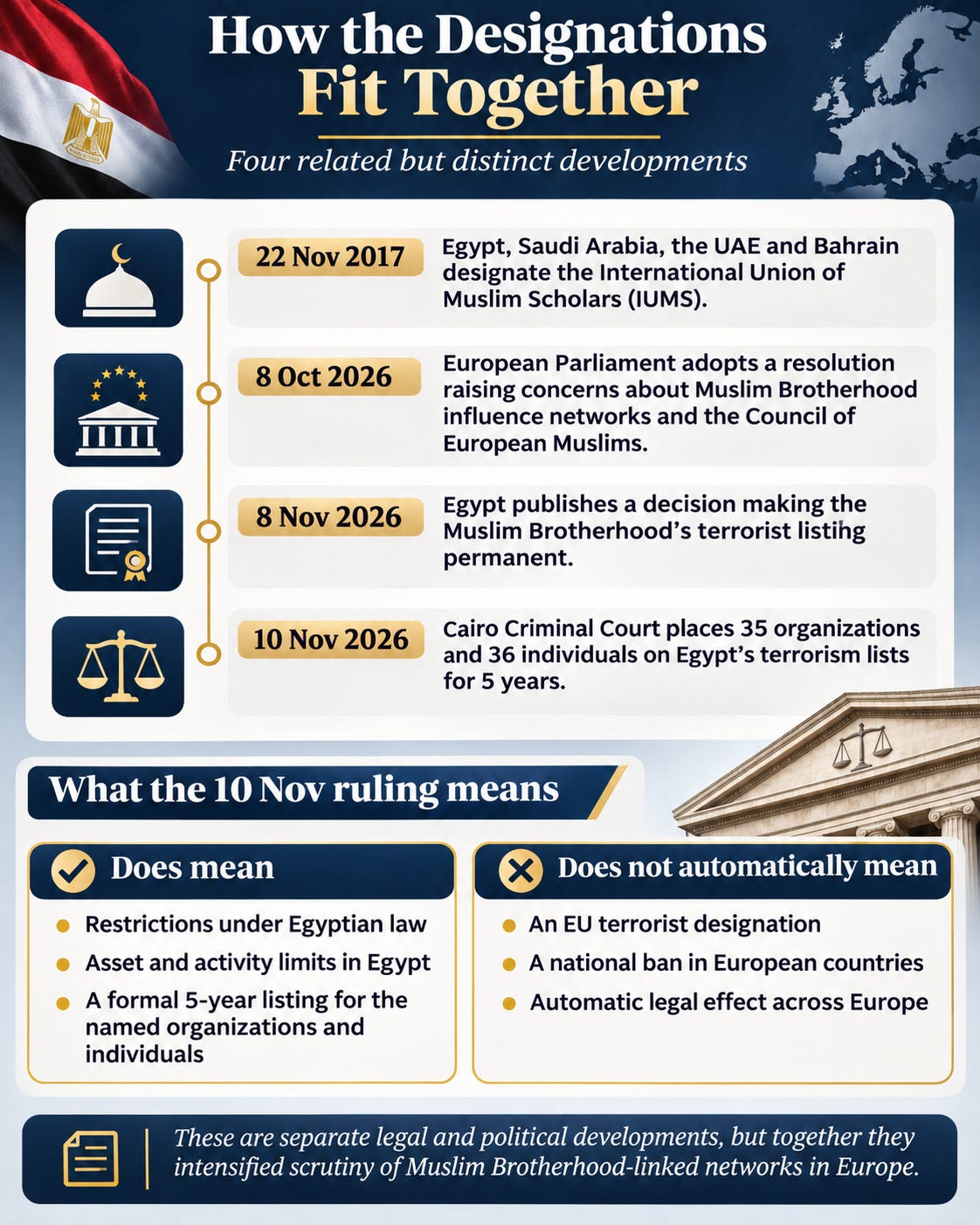
Individuals may face travel bans, passport restrictions, asset freezes and prohibitions on certain public, professional and organizational activities.
The Egyptian designations do not automatically prohibit the organizations from operating in European countries or place them on the European Union’s terrorist list.
The November rulings nevertheless represent a significant expansion of Egypt’s counterterrorism measures against Islamic institutions operating beyond its borders.
Coming just weeks after the European Parliament called for stronger action against Muslim Brotherhood influence networks, the decisions add another dimension to the debate over the movement’s institutional presence and legal status across Europe.
And half of the American political establishment chooses to bury its head in the sand . . .