


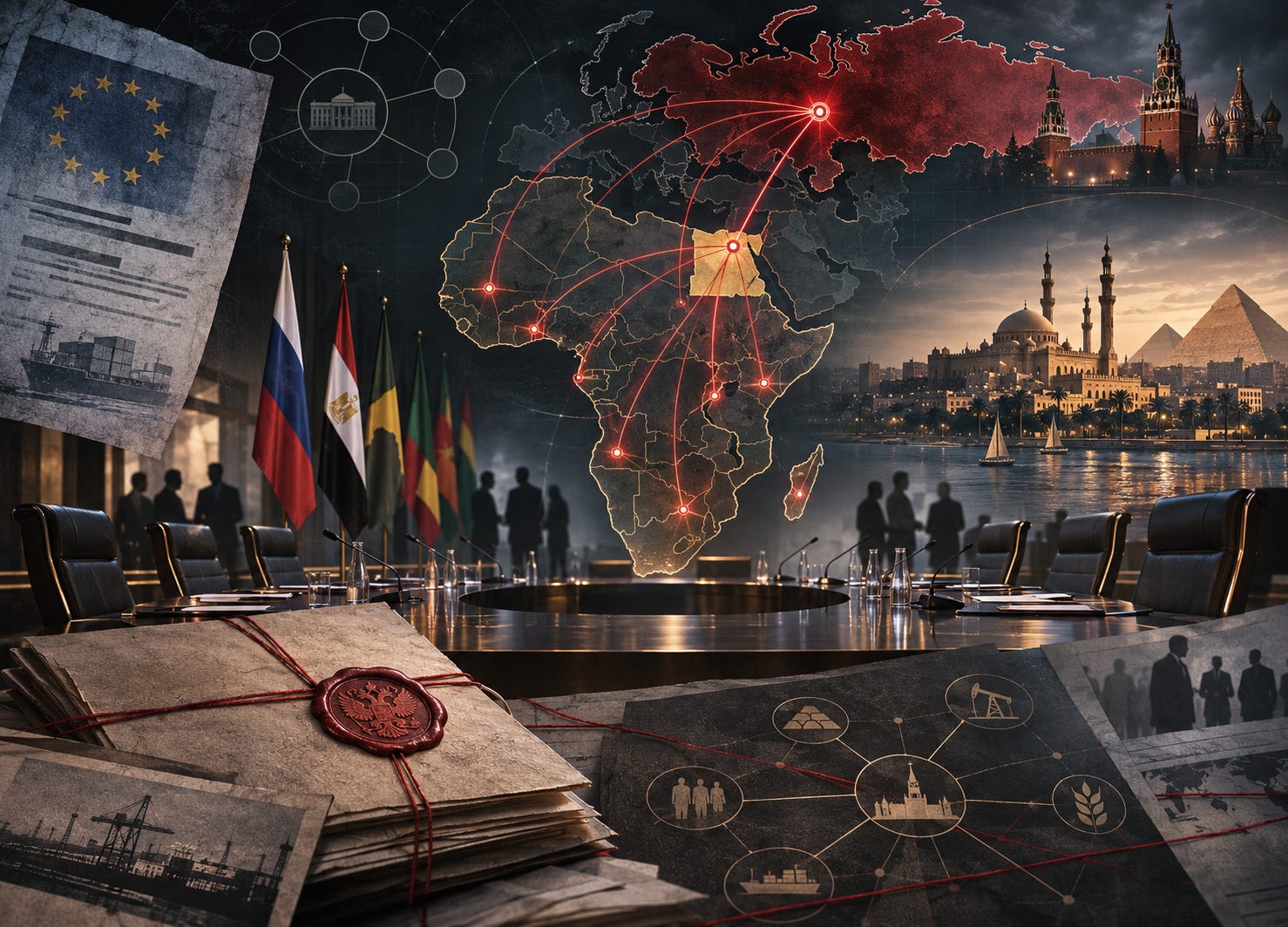
An Egyptian government institution is partnering with Russia’s Valdai Discussion Club to host an international conference on November 18 featuring a Russian foreign-policy figure sanctioned by the European Union and the leader of an organization the EU has designated for conducting information-manipulation activities on behalf of Moscow.
The Fourth Russia–Africa Conference, scheduled for Wednesday in Cairo, is being organized in partnership with the Egyptian Cabinet’s Information and Decision Support Center (IDSC), an institution responsible for economic monitoring, public-opinion research and government digital transformation.
Among the announced participants are Fyodor Lukyanov, research director of the Valdai Discussion Club, and Souleymane Anta Ndiaye, a Senegalese organizational leader who heads the executive board of the International Russophile Movement.
Both Lukyanov and the movement represented by Ndiaye were sanctioned by the European Union on December 15, 2025, as part of measures targeting Russian foreign information manipulation and interference. Ndiaye himself is not identified as personally sanctioned in that designation.
The conference comes as Moscow expands its political, economic and institutional engagement across Africa, including through organizations that European authorities have formally identified as instruments of Russian influence.
EU Sanctions Target Valdai’s Research Director
Lukyanov is one of Russia’s most established foreign-policy commentators. Beyond his position at Valdai, he serves as editor-in-chief of Russia in Global Affairs and belongs to the Russian International Affairs Council, an organization established with the involvement of Russia’s Foreign Ministry.
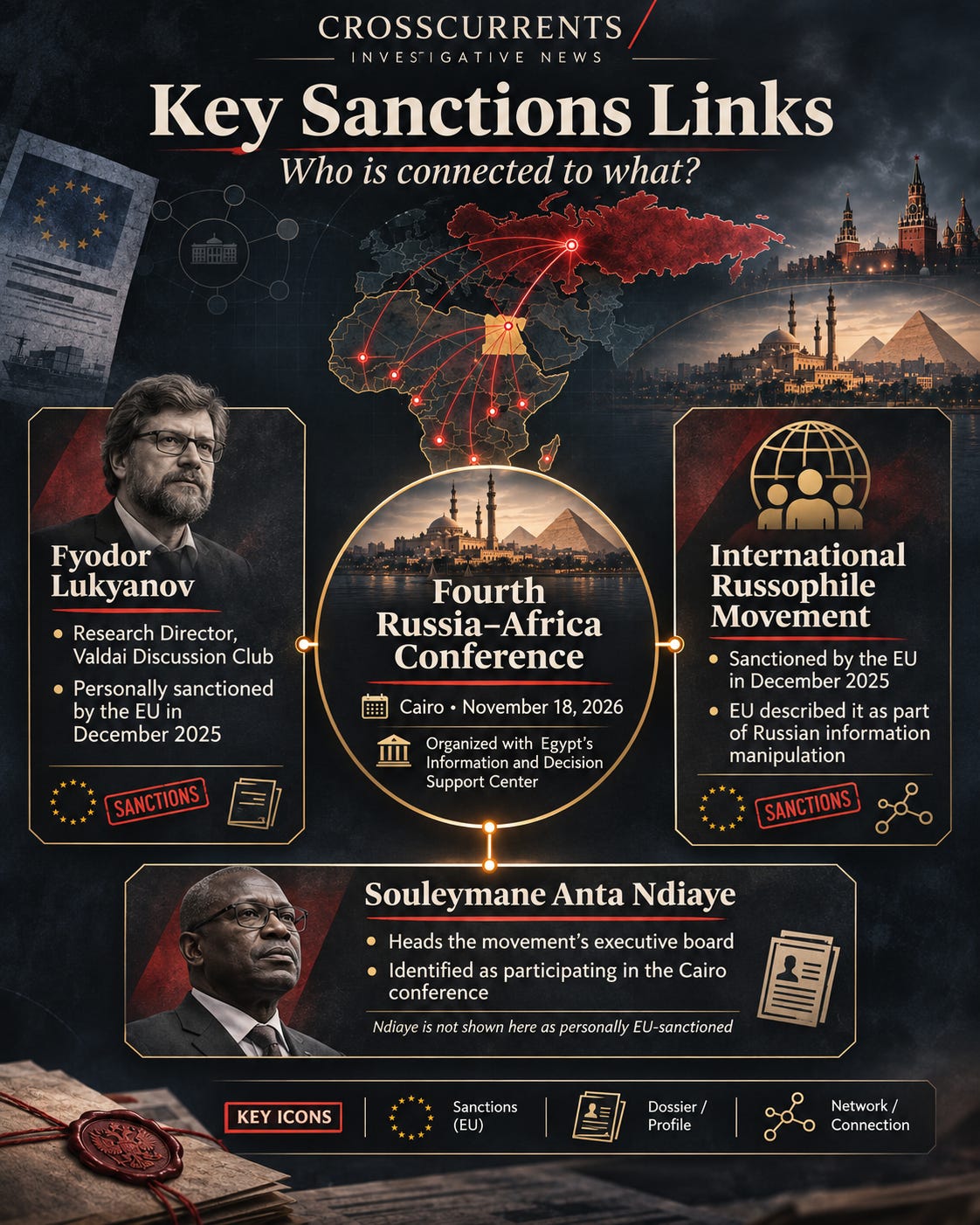
He has also regularly moderated discussions involving Russian President Vladimir Putin at Valdai’s annual gatherings. In its December 2025 sanctions regulation, the European Union described Lukyanov as an influential analyst whose work advances Kremlin narratives internationally.
The EU specifically accused him of portraying Russia’s invasion of Ukraine as a defensive response to Western policy, blaming NATO and the United States for provoking the war and presenting Ukraine as a Western proxy. The regulation described his work at Valdai and Russia in Global Affairs as contributing to systematic disinformation campaigns that shift responsibility for the conflict away from Moscow.
The EU also identified Valdai itself as a platform closely connected to Russian leadership and frequently used to promote official government narratives. Founded in 2004, Valdai has developed into a major international forum for Russian political and strategic discussions, regularly bringing foreign academics, policy specialists and political figures into dialogue with Russian officials.
Its founding institutions include the Russian International Affairs Council, MGIMO University, which is affiliated with Russia’s Foreign Ministry, the Higher School of Economics and the Council on Foreign and Defense Policy.
A Sanctioned Russian Influence Organization Expands Across Africa
The participation of Ndiaye introduces another dimension to the conference. Valdai identifies him as president of the executive board of the International Russophile Movement, also known by its Russian acronym MIR, and president of the African Renaissance Forum. The International Russophile Movement was formally sanctioned by the European Union in December 2025.
The EU accused the organization of amplifying destabilizing narratives globally on behalf of the Russian government and maintaining close connections to Russia’s Foreign Ministry. Its official designation states that the movement is associated with Aleksandr Dugin, the Russian nationalist ideologue, and Konstantin Malofeev, the sanctioned Russian media oligarch.
According to the regulation, Moscow uses the movement as a means of influencing foreign public opinion, promoting anti-Western sentiment and circulating Kremlin messaging. The organization’s connections to senior Russian officials remain visible.
On September 17, 2026, Russian Foreign Minister Sergey Lavrov addressed the movement’s fourth congress in Moscow, criticizing Western governments and accusing them of preparing for confrontation with Russia.
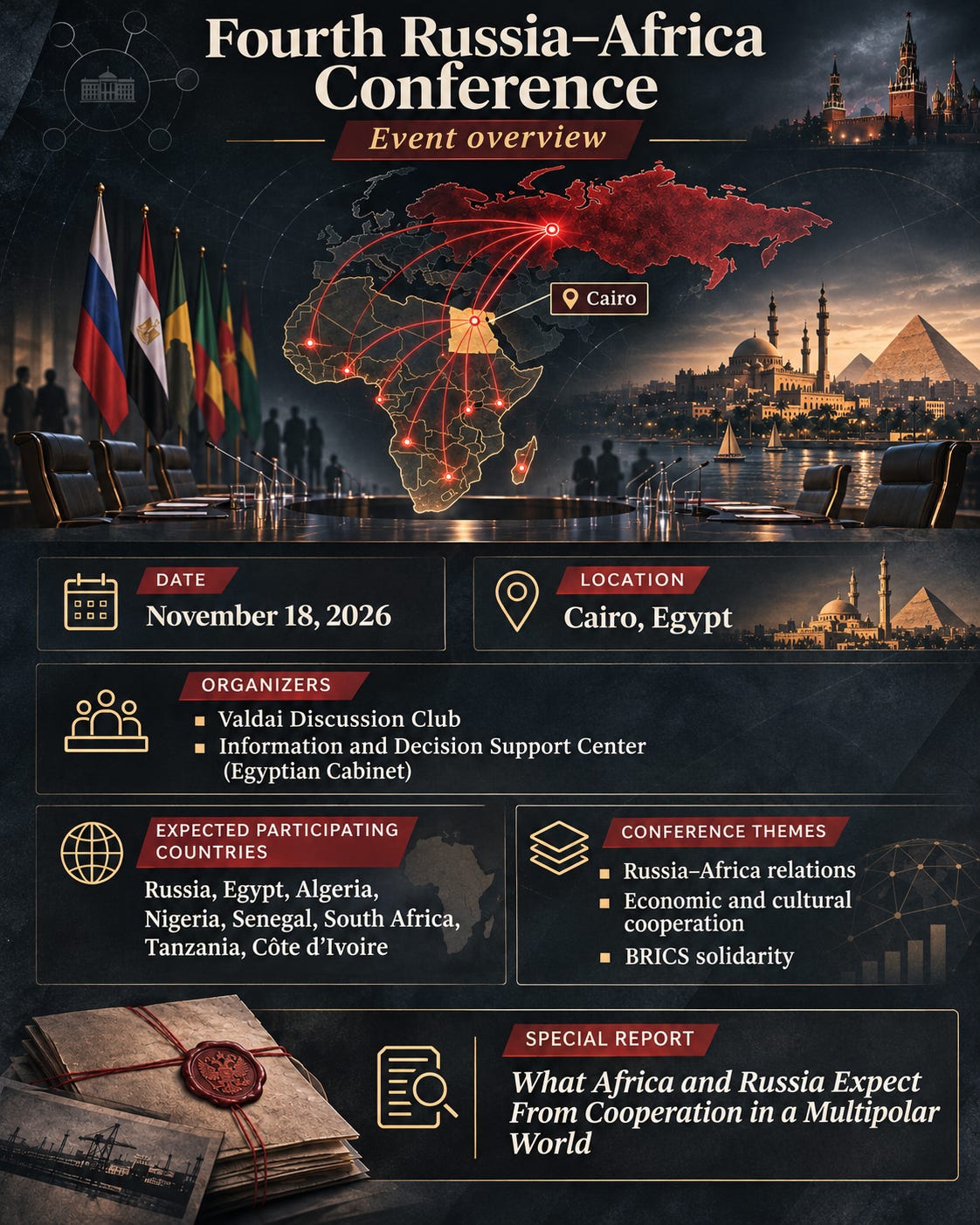
The gathering also featured Ndiaye, Russian State Duma Deputy Chairman Pyotr Tolstoy and movement founder Nikolay Malinov. A photographic record published by TASS, Russia’s state news agency, also documented the participation of Dugin and Malofeev at the congress.
Less than six weeks later, Ndiaye was listed as moderator of a session at the October 28 Russia–Africa Economic and Humanitarian Forum in Moscow. The session’s title explicitly addressed the role of the International Russophile Movement and nongovernmental organizations in developing Russian-African partnerships.
Its official program identified speakers including Niger’s minister of technical and vocational training, a Nigerien Interior Ministry official, the secretary-general of the Egyptian-Russian Friendship Society and a representative promoting Russian science and education in Guinea. The agenda discussed using Russian-language education, friendship societies, alumni networks and nongovernmental organizations to expand Russia’s cultural and institutional influence across the continent.
It also identified the Institute for the Study and Support of Russophilia as part of efforts to develop African and youth initiatives. The October gathering provides a documented example of Ndiaye’s role in connecting the EU-sanctioned movement with government officials, educational networks and civic organizations outside Russia.
An Existing Relationship With Egypt’s Government
The Cairo conference is not the first documented collaboration between Valdai and senior representatives of Egypt’s Information and Decision Support Center. On June 4, 2026, the center’s chairman, Osama Elgohary, participated in a Valdai discussion at the St. Petersburg International Economic Forum.
That session was moderated by Lukyanov and opened by Valdai Foundation chairman Andrey Bystritskiy. Other participants included Kaspersky Lab founder Eugene Kaspersky and international policy representatives. Valdai published photographs documenting Elgohary’s participation alongside the Russian organizers.
Elgohary also serves as an assistant to the Egyptian prime minister, giving the institutional relationship a direct connection to the country’s executive government. The November 18 conference extends that relationship into an event jointly organized in Cairo. The organizers say the meeting is intended to expand the community of Russian and African experts and develop recommendations for practical foreign-policy cooperation.
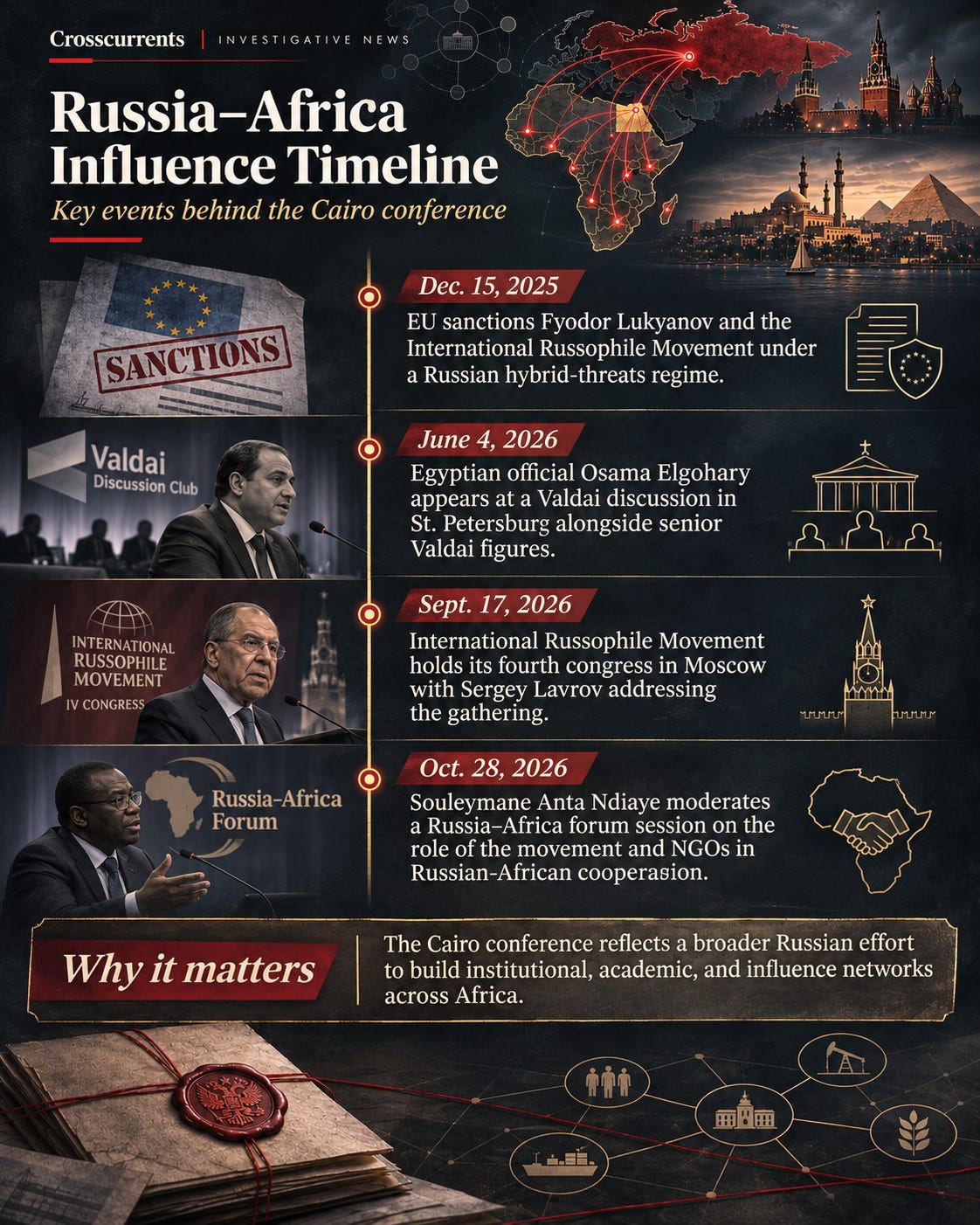
Its three sessions will address Russia–Africa relations, economic and cultural cooperation, and solidarity within BRICS, the international grouping that includes Russia, China, India and Egypt, among other members.
Russian and Egyptian experts have also prepared a special report titled What Africa and Russia Expect From Cooperation in a Multipolar World.
According to Valdai’s announcement, the report examines competition for influence in Africa and identifies Russian-Egyptian grain cooperation as a strategic component of regional food security.
African Academics and Policy Figures Join the Discussions
Additional announced participants include Egyptian Senator and Cairo University professor Nourhan ElSheikh, Algerian defense journalist Akram Kharief, Nigerian Institute of International Affairs research director Joshua Olusegun Bolarinwa, and South African academic Rasigan Maharajh.
Russia’s delegation includes HSE University dean Anastasia Likhacheva, Middle East specialist Andrei Baklanov, Russian Academy of Sciences researcher Sergey Kostelyanets and Valdai program director Oleg Barabanov.
The organizers also anticipate participants from Tanzania and Côte d’Ivoire.
While these affiliations do not independently establish involvement in sanctioned activities, the conference brings together government-connected researchers, foreign-policy specialists and organizations operating within Moscow’s expanding Africa-focused institutional networks.
The meeting illustrates how Russian international outreach extends beyond diplomatic summits and economic agreements into academic conferences, expert communities and civil-society partnerships.
In Cairo, that outreach will include a personally EU-sanctioned Russian foreign-policy figure and the executive-board leader of a movement that European authorities have formally identified as an instrument of Russian information manipulation.
The conference’s opening and first session are scheduled to be broadcast publicly beginning at 9:30 a.m. Cairo time on November 18.