


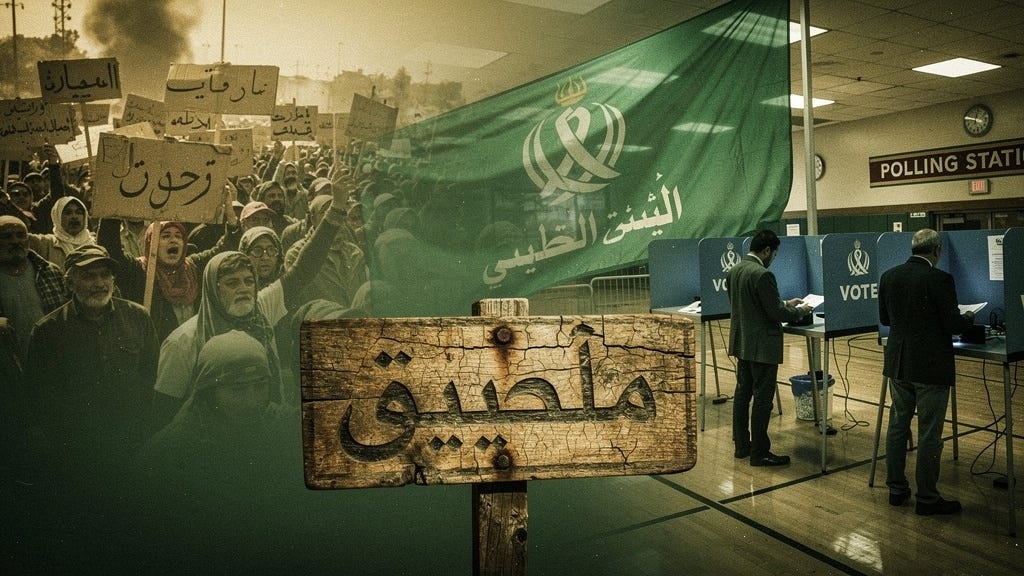
Hours after Abdul El-Sayed won Michigan's Democratic Senate primary on August 5, 2026, the Muslim Brotherhood's official news site ran a front-page article celebrating his victory. Egyptian media outlets and activists who overthrew the Brotherhood in 2013 immediately raised alarms about El-Sayed's alleged Brotherhood connections.
Arabic-language newspapers, social media figures, and Egyptian religious officials pointed to a 2012 statement circulating on social media that they say shows El-Sayed supported Mohamed Morsi's dictatorial decree, alongside his current criticism of Egypt's government and documented family ties to U.S. organizations named as Muslim Brotherhood affiliates in federal terrorism-financing cases. As Ikhwan Online featured El-Sayed's photo under a headline framing the win as a defeat of "Zionist" forces, Egyptian voices from Cairo to Dearborn are telling Americans: we lived under Brotherhood rule, and we're warning you what we see.
Egyptian Warnings
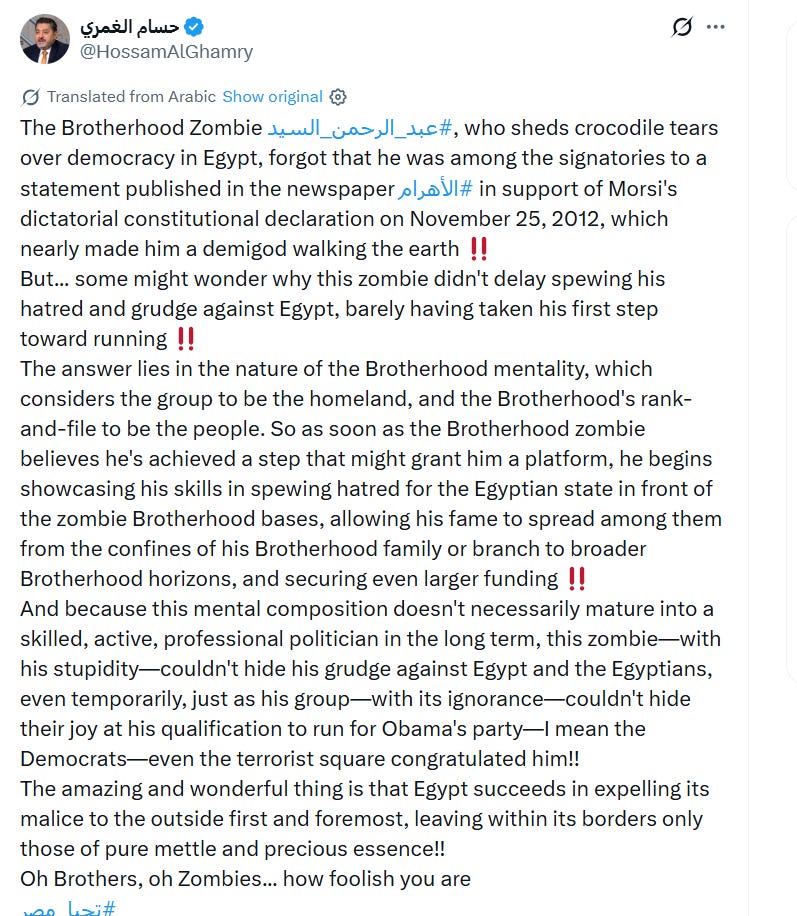
Egyptian activists and writers who overthrew the Brotherhood in 2013 are now issuing sharp warnings. Hossam Al-Ghamry, a prominent Egyptian journalist, posted on X that El-Sayed was a “Brotherhood zombie” who “sheds crocodile tears on democracy in Egypt.” Al-Ghamry’s post alleges that El-Sayed signed a statement published in Al-Ahram newspaper on November 25, 2012, supporting Mohamed Morsi’s constitutional declaration. Cross Currents has not independently verified the existence of this document, though the claim circulates widely among Egyptian expat communities on social media.


Egyptian writer Abdel Gawad Abu Kab warned in Asharq Al-Awsat not to celebrate El-Sayed, calling his history “hostile to Egypt.” Dr. Khaled Montaser, writing in the same outlet, denounced El-Sayed’s vaccine claims as “lies.” Sheikh Ahmed Turki, head of the Senate Religious Affairs Committee, said El-Sayed’s comments “insult Egypt.”
The 2012 Constitutional Declaration
The Egyptian criticism centers on a document Al-Ghamry and others cite from November 2012 which they claimed El-Sayed signed. On November 22, 2012, President Mohamed Morsi from the Muslim Brotherhood issued a constitutional declaration granting himself sweeping powers. The decree placed his decisions above judicial review, immunized the constitutional assembly from dissolution, and granted Morsi authority to “take any measures” to protect the revolution.
The declaration sparked massive protests across Egypt. Critics called it a power grab that made Morsi a “new pharaoh.” The move accelerated the political crisis that led to the military’s removal of Morsi on July 3, 2013, after millions demonstrated against Brotherhood rule.
What Further Angered the Egyptians
El-Sayed told The New Arab that Egypt “lacks democracy” and that he does not want U.S. taxpayer money used to impose a “strangling grip” on Egyptians. He recalled childhood visits to Egypt, saying he “might have been a taxi driver” if his father had not migrated to the United States. He also claimed that being born in Egypt rather than the U.S. would have meant “I might not have lived past the age of five” due to vaccine shortages—a statement Egyptian doctors disputed.
The candidate opposes unconditional U.S. military aid to Egypt, Israel, Pakistan, and Saudi Arabia, calling such aid support for “genocide, apartheid, or a war we don’t need to fight.”
The Brotherhood Celebrates
The Brotherhood’s official news site, Ikhwan Online, ran a front-page article the day after El-Sayed’s primary win, featuring his photo and framing the victory as a defeat of “Zionist” forces. The site’s content was reported by The Midwesterner, which noted the Brotherhood website highlighted El-Sayed’s call to end unconditional U.S. military aid to what it termed the “Zionist occupation” and pointed to growing division in the Democratic Party over U.S.-Israel policy.


The celebration was not limited to one outlet. Pro-Hamas Palestinian media Shehab News described El-Sayed as an “American Muslim of Egyptian descent” whose victory came “despite his opponent’s campaign having received over $60 million, most of which came from pro-Israel groups.” Sabereen News, which supports Iran-backed Iraqi militias, noted that AIPAC had spent $36 million backing Stevens. The ISNAD Foundation— founded by Turkey-based, Muslim Brotherhood-linked Egyptian filmmaker Ezzeldeen Dwedar—congratulated El-Sayed on defeating “the Zionist AIPAC candidate” and asserted he “rejects the military coup and military rule in Egypt.”
Family and Funding Ties
El-Sayed’s father-in-law, Jukaku Tayeb, sits on the Islamic Society of North America (ISNA) Founders Committee and served as CAIR-Michigan president from 2005 to 2010. Both organizations were named unindicted co-conspirators in the 2007 Holy Land Foundation terrorism-financing case, in which federal prosecutors identified ISNA as a Muslim Brotherhood member.
Tayeb donated $200,000 to the Fighting for Michigan super PAC supporting El-Sayed—nearly half the PAC’s total first-quarter 2026 fundraising. Fox News reported that El-Sayed’s campaign received more than $115,000 from at least 41 donors affiliated with CAIR, including senior CAIR leaders Manal Fakhoury, Eyas Abdeen, and Emad Sabbah.


CAIR has been designated a terrorist organization by the United Arab Emirates and was labeled as such by Texas and Florida governors under 2025 executive orders.
A Pattern Egyptians Recognize
For Egyptians who lived through 2011–2013, the pattern is familiar: a charismatic figure with Brotherhood ties rises through democratic politics while the organization celebrates from the sidelines. The Dearborn-centered Islamic community merged with Michigan’s progressive left to deliver El-Sayed’s narrow victory, replicating the coalition-building that brought Morsi to power in Egypt’s 2012 election.
Instagram posts warning about El-Sayed now circulate among Egyptian Americans, many of whom fled after the Brotherhood’s brief rule. Their message: we’ve seen this before, and we know how it ends. El-Sayed will face Republican Mike Rogers in the November 2026 general election.