


Former Obama administration officials have proposed that foreign governments quietly gather evidence against Defense Secretary Pete Hegseth and senior U.S. military commanders, potentially pursuing murder charges after President Donald Trump leaves office.
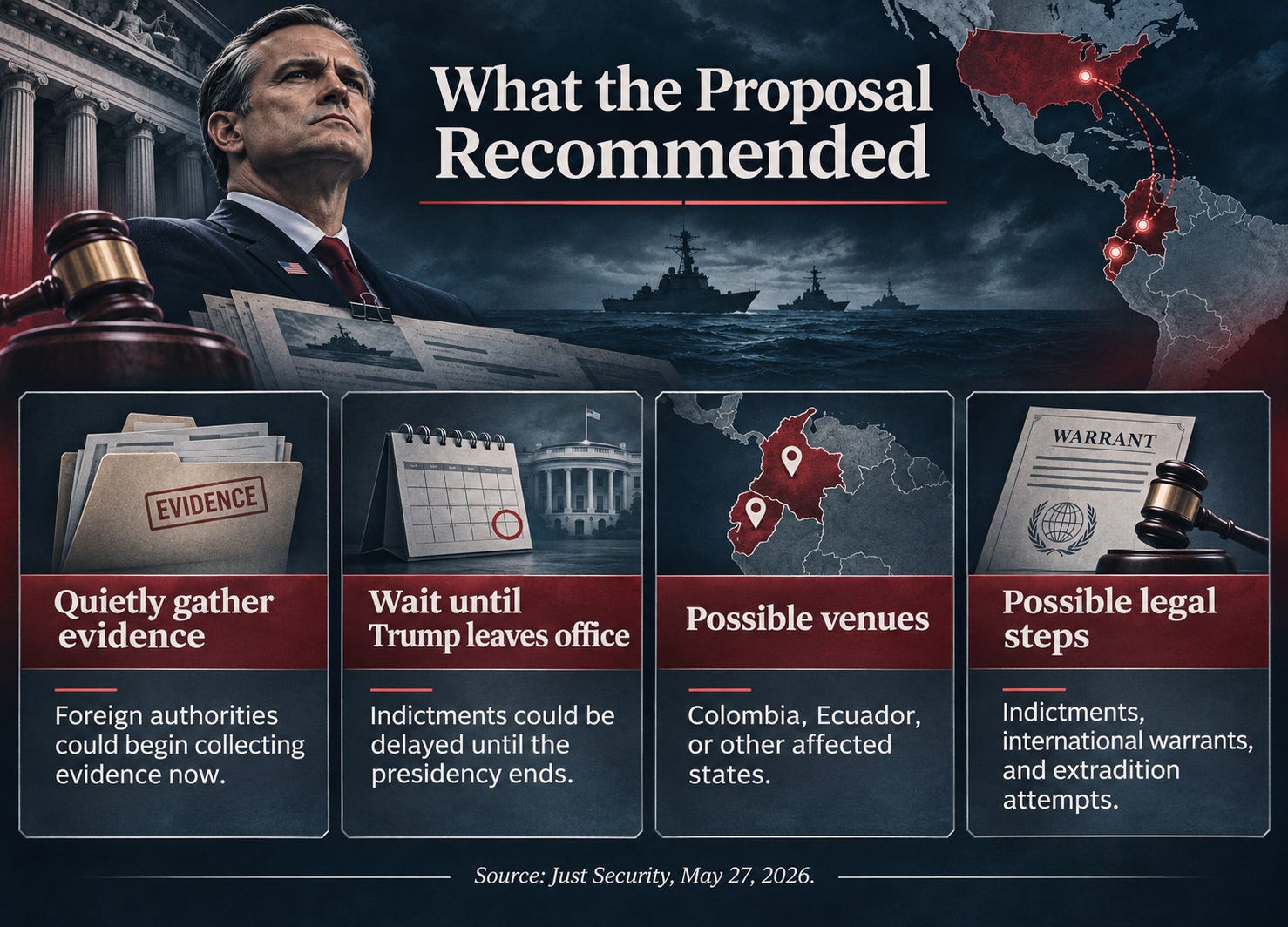
The proposal, published by the national security law outlet Just Security, identifies Colombia, Ecuador and other countries as potential venues for criminal proceedings over American military strikes against suspected drug-trafficking vessels. Its authors suggest collecting evidence before Trump leaves office, delaying indictments until his departure and potentially seeking international arrest warrants against senior U.S. officials.
Although originally published on May 27, the proposal attracted renewed attention on November 14, when U.S. Attorney Aaron Reitz warned that the activities being advocated could violate federal law and declared that the Justice Department would examine the matter.
The controversy comes amid additional publications by former Obama and Biden administration officials outlining legal and administrative mechanisms for investigating Trump administration personnel after his presidency.
Foreign Countries Encouraged to Prepare Murder Cases
The May article, titled International Accountability for U.S. Crimes in the Caribbean and Pacific, was written by Tracey Begley, Benjamin R. Farley and Sarah Harrison, three lawyers with backgrounds in U.S. national security and international law.
The authors characterize U.S. strikes against suspected drug-trafficking vessels in the Caribbean and Pacific as unlawful killings and examine possible avenues for criminal proceedings outside the United States.
They argue that countries whose citizens were killed could potentially establish jurisdiction under domestic murder statutes, allowing their courts to prosecute American officials responsible for ordering or directing the operations.
Rather than recommending immediate proceedings, the authors explicitly suggest waiting until Trump’s presidency ends.
“Officials in Colombia, Ecuador, or other affected States could quietly gather evidence of the crimes and wait to issue indictments until Trump is out of office,” they wrote.
The article identifies three senior American officials as potential defendants: Defense Secretary Pete Hegseth, Admiral Frank Bradley, commander of U.S. Special Operations Command, and General Francis Donovan, commander of U.S. Southern Command.
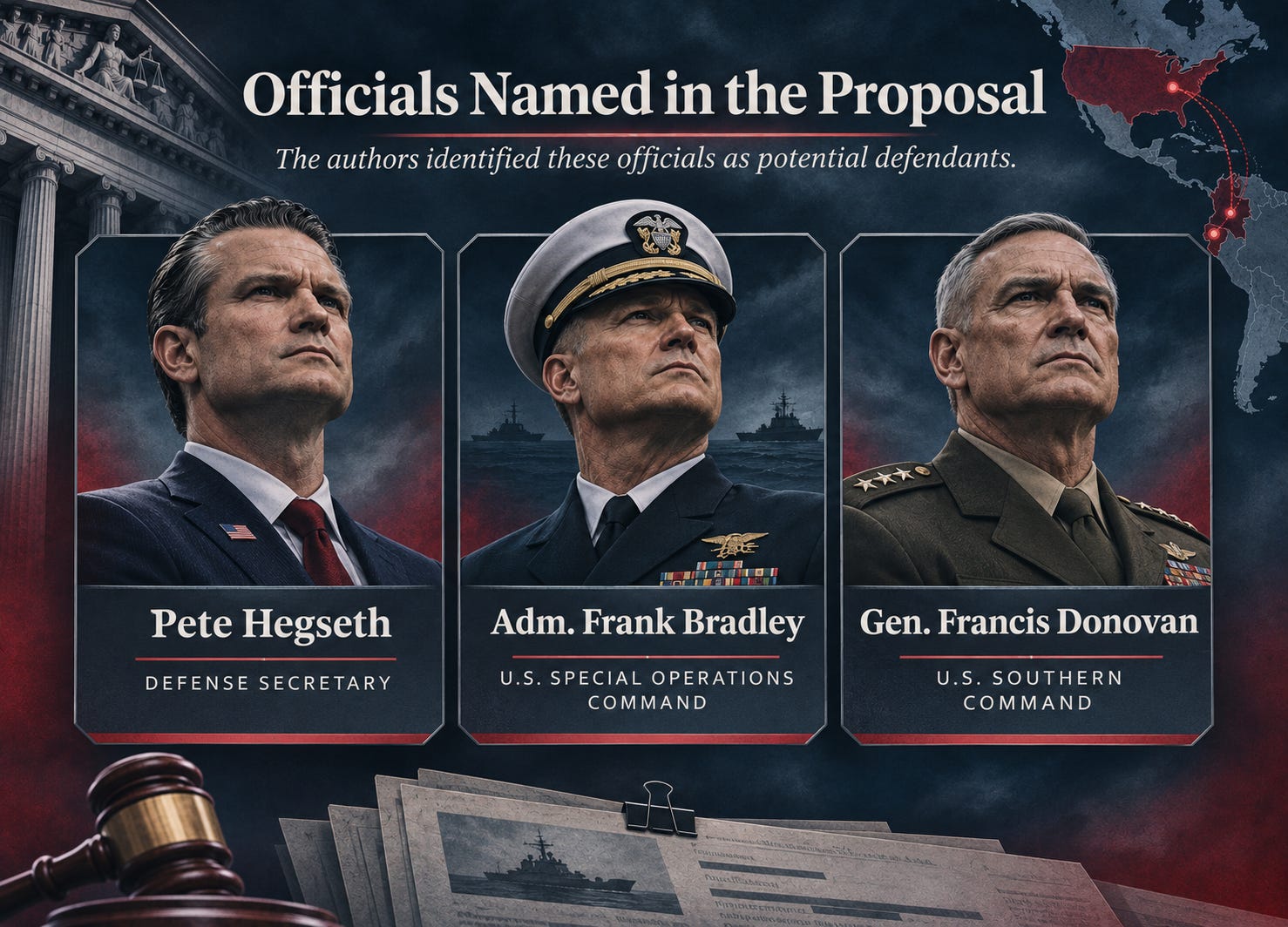
The authors describe the three as potential perpetrators because of their reported responsibilities for directing military operations.
They acknowledge that securing custody of American officials would present substantial obstacles but argue that foreign prosecutors should not be deterred. Countries pursuing charges could convert national warrants into international warrants or initiate extradition proceedings under applicable treaties.
Even without successful arrests, the authors suggest that potential prosecutions could restrict the international travel of officials seeking to avoid detention abroad.
They also discuss universal jurisdiction laws, under which certain countries can prosecute serious international crimes committed beyond their borders, including crimes against humanity.
Who Are the Former Officials Behind the Proposal?
Two of the article’s authors held positions during Barack Obama’s presidency.
Sarah Harrison served as counselor to the secretary of Homeland Security from 2015 to 2017 before becoming an associate general counsel at the Pentagon. She subsequently worked on national security and international legal issues outside government.
Benjamin Farley served as a senior adviser to the State Department’s special envoy for Guantanamo closure between 2013 and 2017. He later represented a defendant before the September 11 military commission and served as director of the State Department’s Office of Terrorist Detentions. He currently works as supervisory counsel for Democracy Defense at the National Immigration Law Center.
The third author, Tracey Begley, formerly served as a senior adviser in the State Department’s Office of Global Criminal Justice and as deputy head of the International Committee of the Red Cross’s legal department for the United States and Canada. Her publicly available biography does not establish whether her State Department position was held during the Obama administration.
DOJ Prosecutor Warns of Possible Illegal Activity
The proposal resurfaced on November 14 when journalist Natalie Winters highlighted its recommendation that foreign governments gather evidence and consider delaying indictments against Trump administration officials.


U.S. Attorney Aaron Reitz, the chief federal prosecutor for the Southern District of Texas, responded by accusing former Obama and Biden administration officials of encouraging foreign governments to prepare criminal proceedings against current American officials.
“Former Obama-Biden Admin officials are urging foreign adversaries to gather evidence so that a future Democrat White House can partner with them to detain and prosecute Trump Admin officials,” Reitz wrote on X.
“This kind of seditious meddling may be illegal. DOJ will smoke it out. More to come.”
Reitz assumed office in July 2026 after previously leading the Justice Department’s Office of Legal Policy and serving as chief of staff to Republican Senator Ted Cruz.
His warning represents a significant escalation in the dispute, although no formal criminal investigation into the article’s authors has been independently confirmed.
The original May publication discusses potential prosecutions by countries including Colombia and Ecuador, as well as possible future American accountability proceedings. It does not establish that the authors have coordinated with foreign governments or a future Democratic administration.
Separate Proposals Outline Post-Trump Investigations
The controversy follows two additional Just Security articles published in November that discuss how a future administration could investigate alleged wrongdoing under Trump.
On November 3, former Biden administration Air Force Secretary Frank Kendall published a nine-step framework for examining potential misconduct within the Pentagon.
Kendall proposed bipartisan oversight, investigations of potentially unlawful military operations and administrative remedies for personnel found responsible for misconduct. He also argued that planning for accountability should begin before the next presidential administration takes office.
A November 10 article by Tess Bridgeman and Ryan Goodman, both former Obama-era national security officials and co-editors of Just Security, advocated additional mechanisms for investigating senior Trump administration personnel.
Their proposals include congressional subpoenas, cooperation between federal and state authorities, and potential prosecutions for new offenses such as perjury or contempt, even if officials receive presidential pardons for earlier conduct.
Bridgeman previously served as associate counsel to President Obama and deputy legal adviser to the National Security Council. Goodman served as special counsel to the Pentagon’s general counsel between 2015 and 2016.
Unlike the May article, the November publications focus primarily on domestic accountability under future American leadership. Their authors emphasize due process and describe the proposals as measures for addressing alleged wrongdoing rather than political retaliation.
The publications demonstrate a broader discussion among former government officials about potential post-Trump investigations, although there is no established evidence of a coordinated prosecutorial campaign.
Growing Pressure on Hegseth
The renewed attention comes amid separate congressional efforts to hold Hegseth accountable for military operations conducted during Trump’s second term.
On November 9, Republican Representative Thomas Massie unveiled eight articles of impeachment against Hegseth, alleging violations involving military operations against Iran, suspected drug-trafficking vessels and other actions.
The following day, the House voted 211–204 to refer the resolution to the Judiciary Committee rather than proceed with impeachment.
Hegseth rejected the allegations, maintaining that the military operations were lawful, authorized by Trump and properly reported to Congress. He characterized the impeachment effort as a politically motivated spectacle.
The proposed foreign prosecutions would face substantial legal and diplomatic obstacles, including questions about jurisdiction, official immunity, evidentiary standards and the difficulty of compelling senior American officials to appear before foreign courts.
Nevertheless, the May proposal explicitly contemplates pursuing criminal proceedings after Trump’s departure from office. Together with the newer domestic accountability proposals and Reitz’s response, it highlights an emerging dispute over how far future legal efforts against Trump administration officials could extend.
Whether foreign governments pursue the suggested strategy, or the Justice Department takes formal action in response, remains unresolved.
The number of drug overdose deaths in the USA is staggering and these people are crying over dead drug runners? Fishermen out trying to make a living don't use (nor could they afford) those high-powered speedboats. As someone who grew up in the 'Just Say No' era, I am living in a world I increasingly don't understand.
https://www.cdc.gov/nchs/nvss/vsrr/drug-overdose-data.htm