


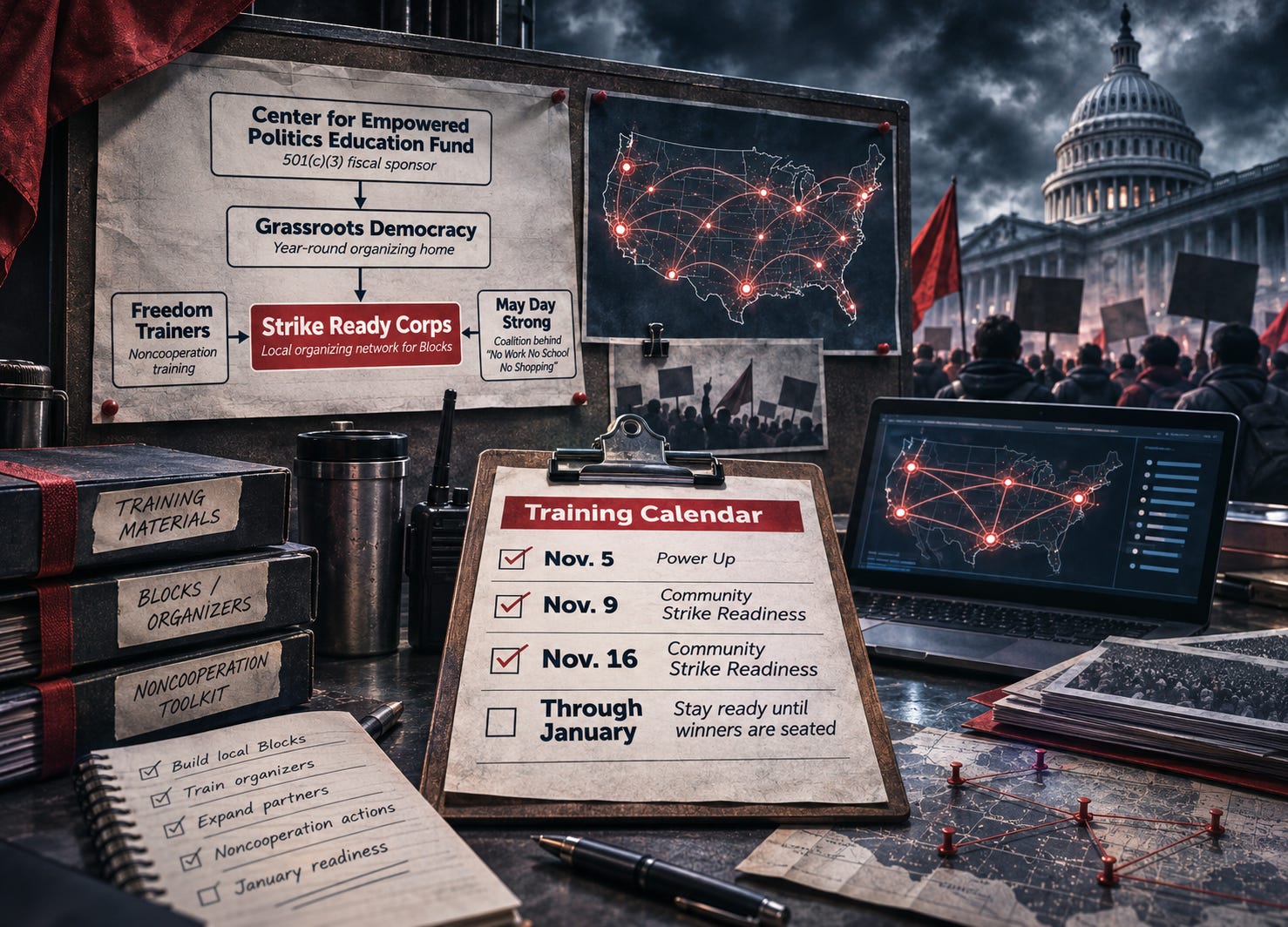
A national activist network that spent the run-up to the midterms preparing Americans for a potential post-election “social strike” is continuing its organizing effort even after Democrats won control of Congress in Tuesday’s midterm elections.
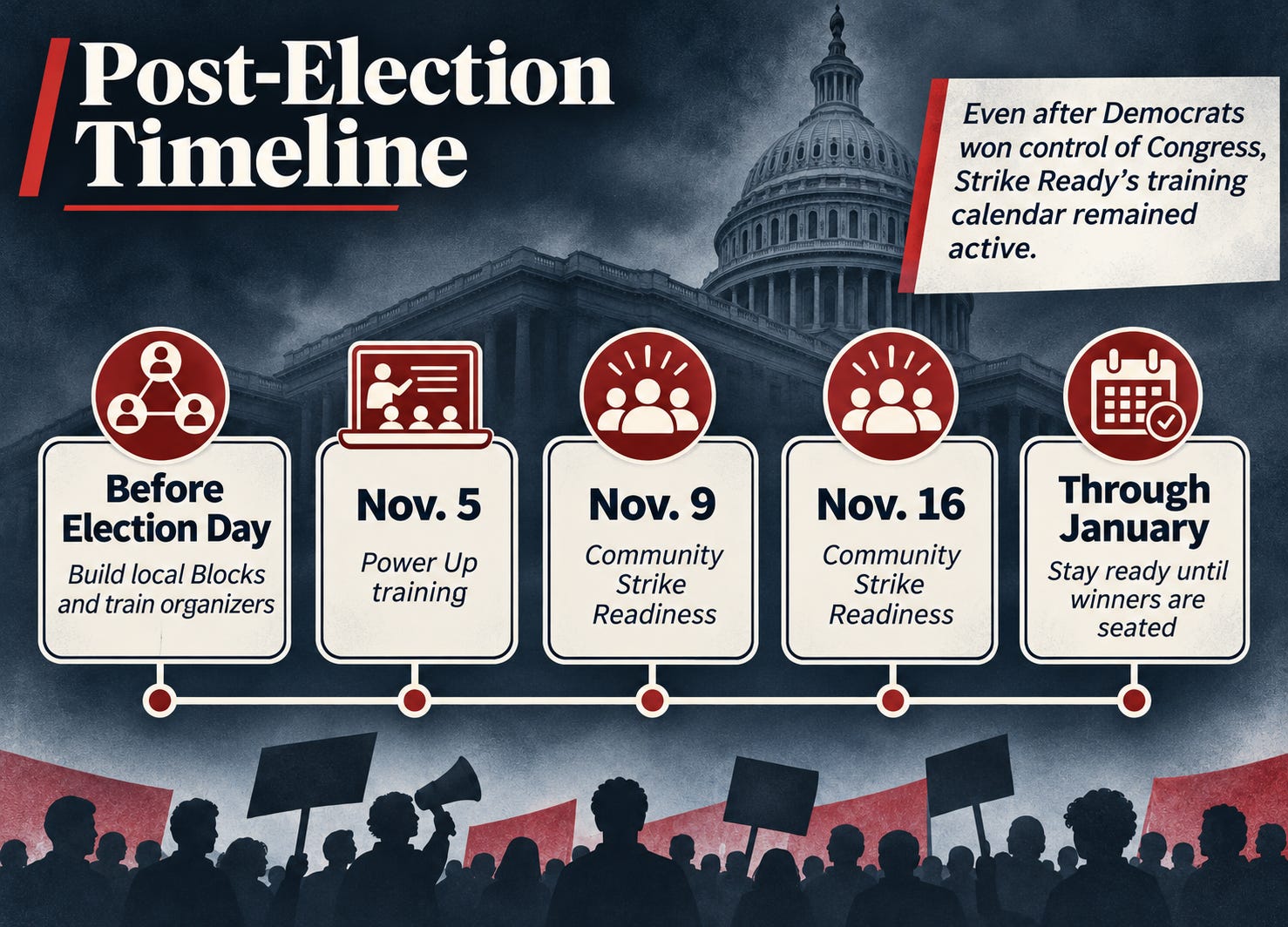
Strike Ready Corps is still advertising a November 5 “Power Up” training intended to prepare activists to sustain protests for “potentially days and weeks.” Its website also tells members to remain prepared through January, when newly elected lawmakers take office.
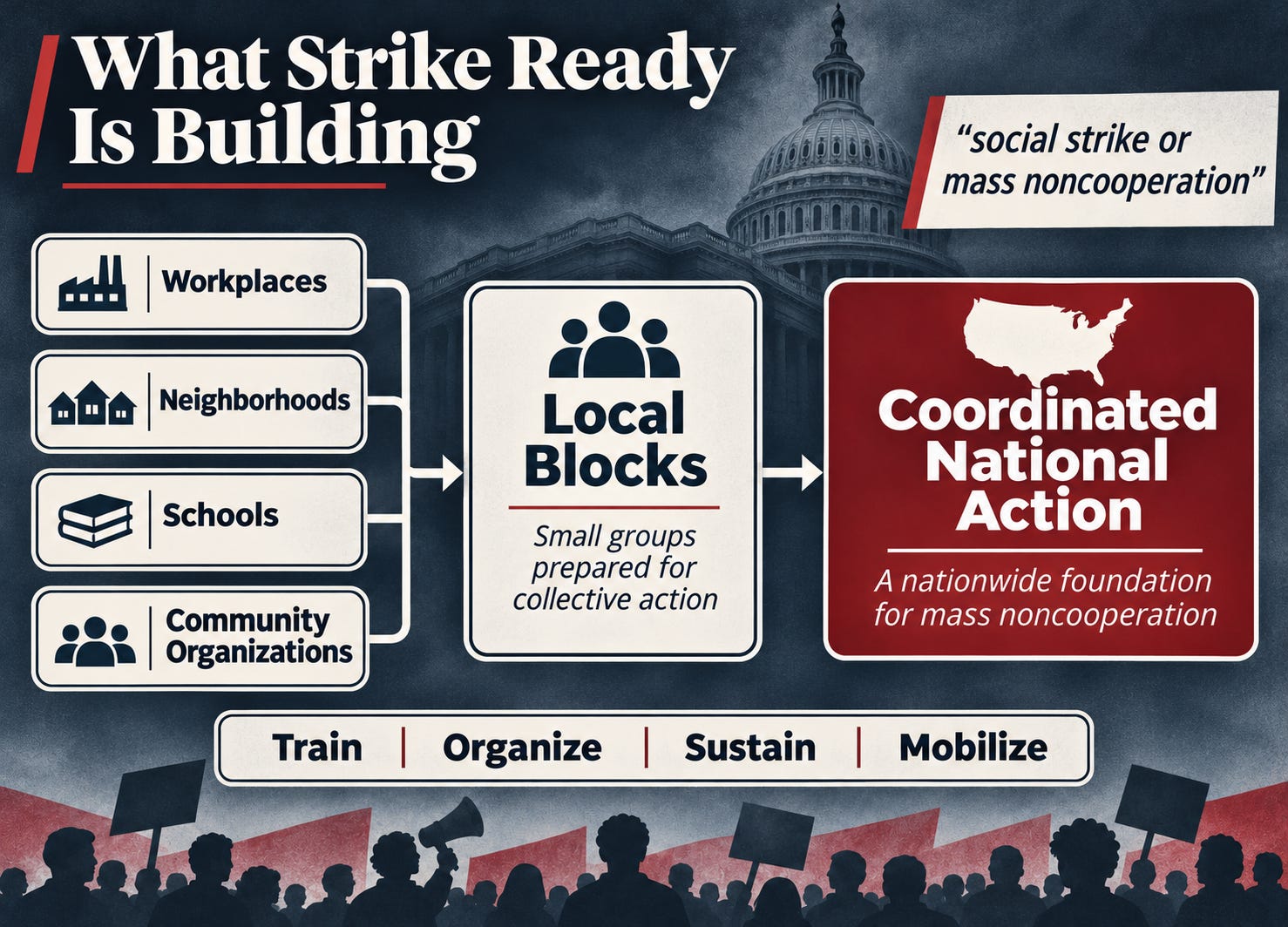
The effort reaches far beyond a single post-election protest. Strike Ready is building local groups in workplaces, neighborhoods, schools and community organizations designed to prepare members for what it explicitly calls a future “social strike or mass noncooperation.” That organizing infrastructure sits inside a considerably larger progressive ecosystem involving a national organizing organization, a nonprofit fiscal sponsor, specialist noncooperation trainers and a coalition spanning hundreds of labor and activist groups.
Preparing for What Comes After Election Day
Strike Ready framed its immediate campaign around the possibility that the Trump administration or its allies could interfere with the midterm results.
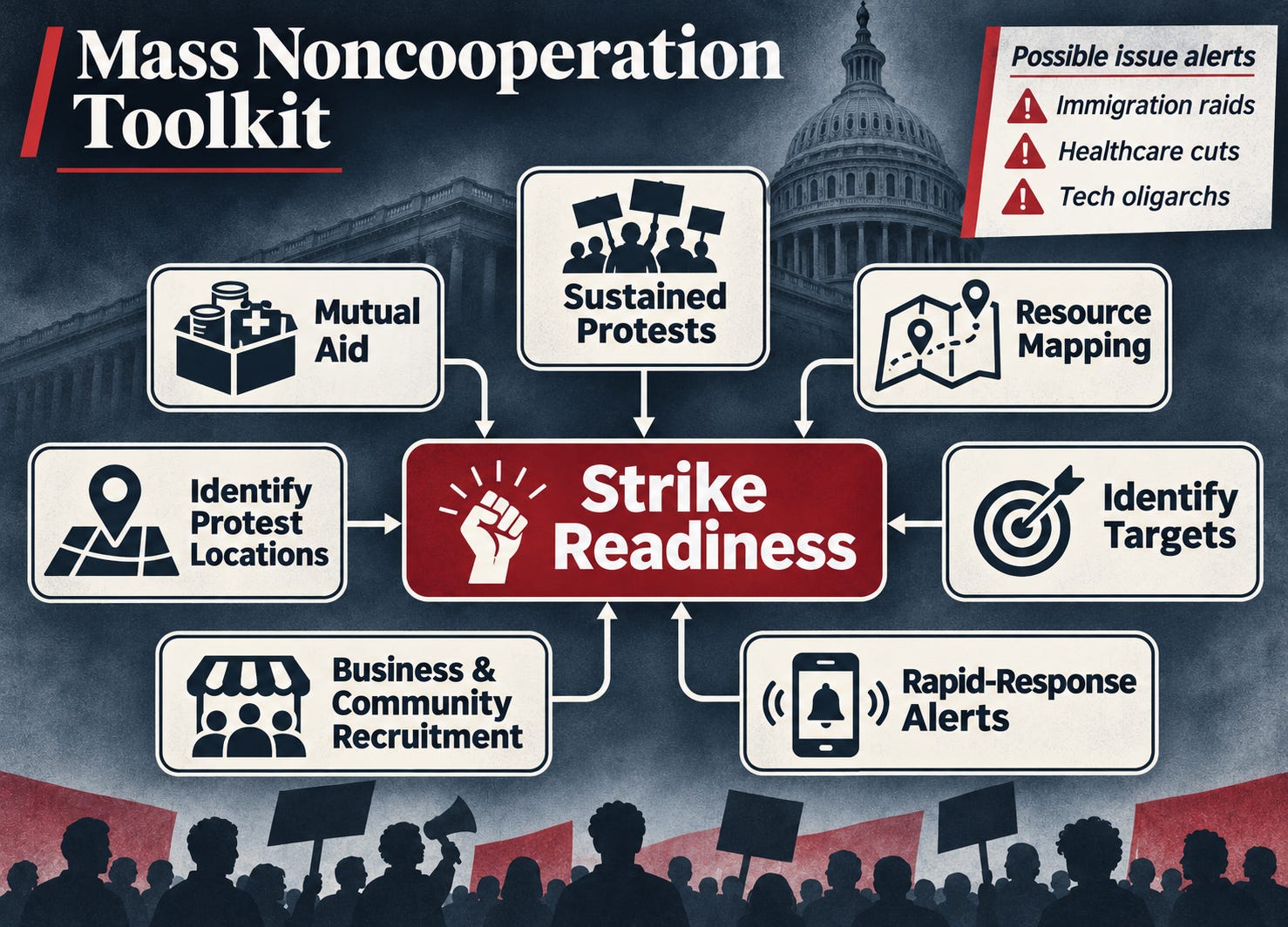
Its published election timeline instructed supporters to create local units before Election Day, train them in strike readiness and integrate them with existing organizing efforts. After the election, members are told to remain prepared to act “all the way through January” if there are attempts to sabotage the results.
But what Strike Ready has been constructing is broader than an election-monitoring operation. The organization asks supporters to form local chapters called “Blocks.” According to its own description, Blocks are geographically based groups of people preparing their workplaces, neighborhoods, community organizations or schools for collective action.
Starting one, it says, constitutes a commitment to organizing others for preparatory actions toward a “social strike or mass noncooperation.”
Strike Ready describes each Block as a foundation from which organizers build their network, plans and resources in advance, so they are prepared when the political “weather” is right for a strike. Collectively, the organization says, Blocks across the country form a coordinated national foundation of people prepared to strike. Despite Tuesday’s Democratic sweep, the organization is still promoting a November 5 “Power Up” training.
The 30-minute session promises instruction in sustaining demonstrations after Election Day, including mapping resources, organizing mutual aid and identifying locations and “targets” for action. Participants are told to prepare for the possibility of sustaining protests for days or weeks. Additional 90-minute Community Strike Readiness workshops are currently listed by Freedom Trainers for November 9 and November 16.
The Infrastructure Behind Strike Ready
Strike Ready Corps is not an independent nonprofit. It is a program of Grassroots Democracy, which describes itself as a year-round organizing effort aimed at building local leadership and grassroots power. Grassroots Democracy, in turn, states that it is fiscally sponsored by the Center for Empowered Politics Education Fund, a 501(c)(3). That places Strike Ready within a broader organizational infrastructure.
The related Center for Empowered Politics says it builds “movement ecosystem(s)” of grassroots organizations and provides infrastructure, leadership pipelines, political education and organizational support. It describes its approach as drawing from “multiple strands of radical traditions” while seeking to expand grassroots and electoral power.
The organizational chain is therefore relatively straightforward:
Strike Ready Corps → Grassroots Democracy → Center for Empowered Politics Education Fund.
But the network also extends sideways into organizations providing tactical training and national coalition capacity.
Training for Mass Noncooperation
One of the groups providing Strike Ready training is Freedom Trainers, a network focused on nonviolent resistance and strategic noncooperation.
Its upcoming Strike Ready workshops promise practical preparation for moments “when collective action escalates.” Participants are taught the basics of strike readiness, methods for sustaining strategic action and historical examples of strikes confronting authoritarian governments.
The goal is not simply to mobilize a demonstration after something happens. It is to create local structures capable of acting when organizers determine circumstances require escalation.
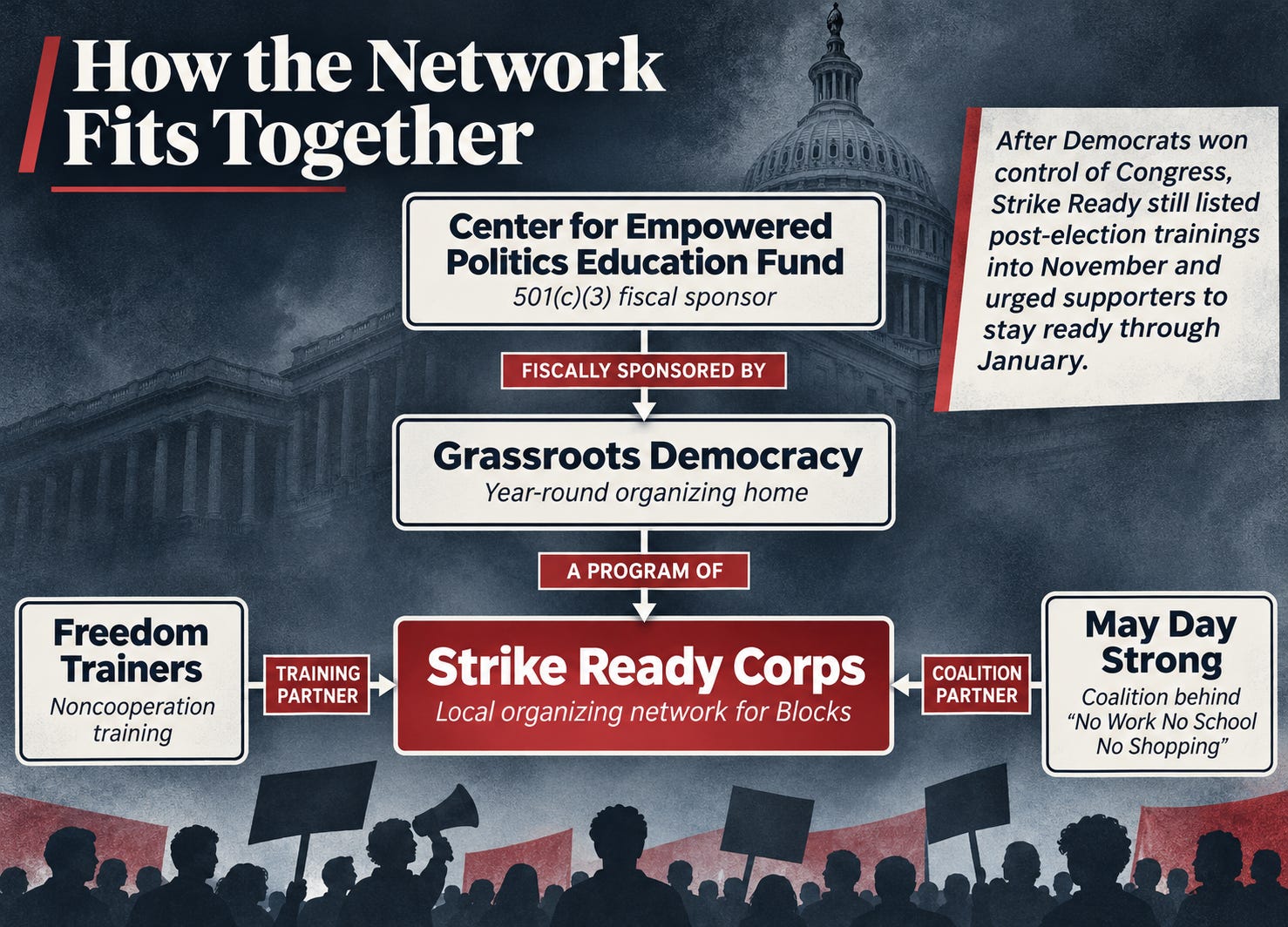
Another partner, May Day Strong, illustrates the potential scale of that approach.
The coalition says millions participated in its May 1 campaign involving “no work, no school, no shopping.” Ahead of the midterms, its election pledge called on supporters to get trained, recruit neighborhood businesses and organizations, pressure corporations and participate in protests if organizers believed the election was being sabotaged.
Its most explicit commitment states:
“No free and fair elections means ‘No Work No School No Shopping.’”
But the pledge also contains a second track that applies regardless of who wins. Participants are told that if there is a new Congress, they should be prepared to pressure lawmakers over the coalition’s economic agenda.
Built to Outlast the Election
The Democratic sweep means the immediate political environment is different from the scenario around which much of Strike Ready’s election-defense messaging was constructed. Strike Ready has not said that its strike trigger has been met. Its own timeline conditions post-election action on attempts to sabotage the results. But the organization also explicitly presents the infrastructure it is creating as useful beyond the election.
Its homepage says participants who join the network will receive rapid-response alerts involving immigration raids, healthcare cuts, “tech oligarchs” and other political fights. Its Blocks are meant to remain organized, build resources in advance and connect with similar groups around the country.
Whatever happens in the immediate post-election period, Strike Ready’s own materials make clear that the infrastructure is intended to outlast the midterms, leaving behind local activist units trained for coordinated mass noncooperation in future political fights.