

FBI Captures Fugitive Behind $547 Million Medicare Fraud Scheme
The alleged architect of a $547 million Medicare fraud scheme evaded deportation and capture for years while building political and charitable ties before his arrest in the Middle East


Khalid Ahmed Satary spent more than three years on the run, most of it believed to be in Dubai, after skipping a federal court date in Louisiana. On July 20, regional partners in the Middle East finally caught up with him. The FBI says he was carrying a passport under a fake Mexican identity that wasn’t his own.
It’s the third capture in five weeks from the FBI’s new “Most Wanted Fraudsters” list, which added Satary on June 23. FBI Director Kash Patel credited the pace to “great work and coordination from the interagency and our overseas partners.” Satary, 54, was flown to Washington Dulles International Airport and made his first court appearance in the Eastern District of Virginia on July 21, facing charges that carry a maximum of 20 years in prison.


A $547 Million Scheme
The case against him is substantial. Federal prosecutors say that between 2016 and 2019, Satary ran a network of diagnostic labs — Performance Laboratories in Oklahoma, Lazarus Services in Louisiana, and Clio Labs in Georgia — that fraudulently billed Medicare more than $547 million for cancer genetic tests elderly and disabled patients didn’t need. Telemarketers and “health fairs” fed patients into the pipeline; doctors who’d never examined them signed off on the orders in exchange for kickbacks, according to the 2019 indictment. It was one piece of a much larger sweep that year, in which the Justice Department charged 35 people across five federal districts with more than $2.1 billion in fraudulent genetic-testing billing — among the largest health care fraud actions the department has ever brought.


Two Decades Ahead of the System
What stands out about Satary’s case isn’t only the dollar figure. It’s how long the government’s own machinery failed to catch up with him.
He was already a convicted felon by the time the genetic-testing scheme began. In 2003, federal prosecutors identified him as the ringleader of a CD and cassette piracy operation run out of the Atlanta area and Macon, Georgia, and he served roughly three years in prison. That conviction triggered a deportation order the government never enforced. Satary spent the years that followed building a chain of Georgia lab companies out of an office park in Lawrenceville — most prominently Confirmatrix Laboratory, which a 2013 federal billing study found was charging Medicare more than three times the national average per patient before FBI agents raided it and the company collapsed into bankruptcy in late 2016.
By the time he was indicted in 2019, Satary was released on bond with one condition attached: stay out of health care. Prosecutors say he didn’t. While on bond, he allegedly conspired with Houston-area labs to keep the fraudulent billing running. In December 2022, he skipped a scheduled court date in New Orleans. A federal judge issued a warrant. Satary was already gone.
Outside the Lab Business
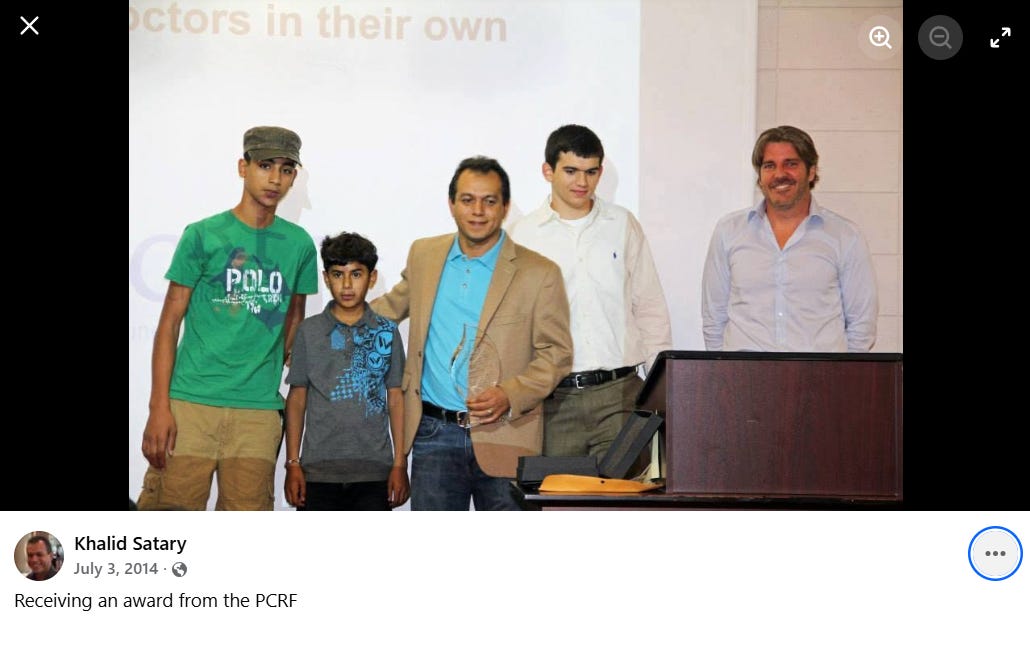
Along the way, he’d built a public profile well outside the lab business. In 2014, then-Rep. Jack Kingston returned roughly $80,000 in Senate campaign contributions tied to Satary and his companies after Atlanta reporters surfaced his 2003 conviction; Kingston said he hadn’t known who Satary was. Tax filings show Satary also gave $312,870 in 2013 to the Palestine Children’s Relief Fund — and, per a photo he later posted to Facebook, was given an award on stage for it the following year.

The gift is worth a mention mainly for what it says about the charity’s own history: PCRF’s founding-era backers included the Holy Land Foundation, designated a Hamas financier by the U.S. Treasury in 2001, and the group has faced recurring questions about similar associations since. Whether Satary kept giving once the Medicare scheme allegedly began in 2016 isn’t something the public record can answer — PCRF, like most nonprofits, doesn’t disclose current donor names.
Part of a Bigger Sweep
Satary’s capture caps a fast start for the FBI’s new fugitive list. Herb Kimble, wanted in a $1.2 billion telemedicine fraud scheme, was caught in the Philippines in June, just four days after the list launched. Officials say Satary’s return marks the 27th high-value fugitive brought back to the U.S. from overseas since June, part of a broader push under the Justice Department’s new fraud task force. He has not yet entered a plea.
It's truly a shame for this man that his name is Khalid. If he had a good white American name, Trump would have already pardoned him and put him in his cabinet. That's an amount of fraud that would even impress a billionaire.