


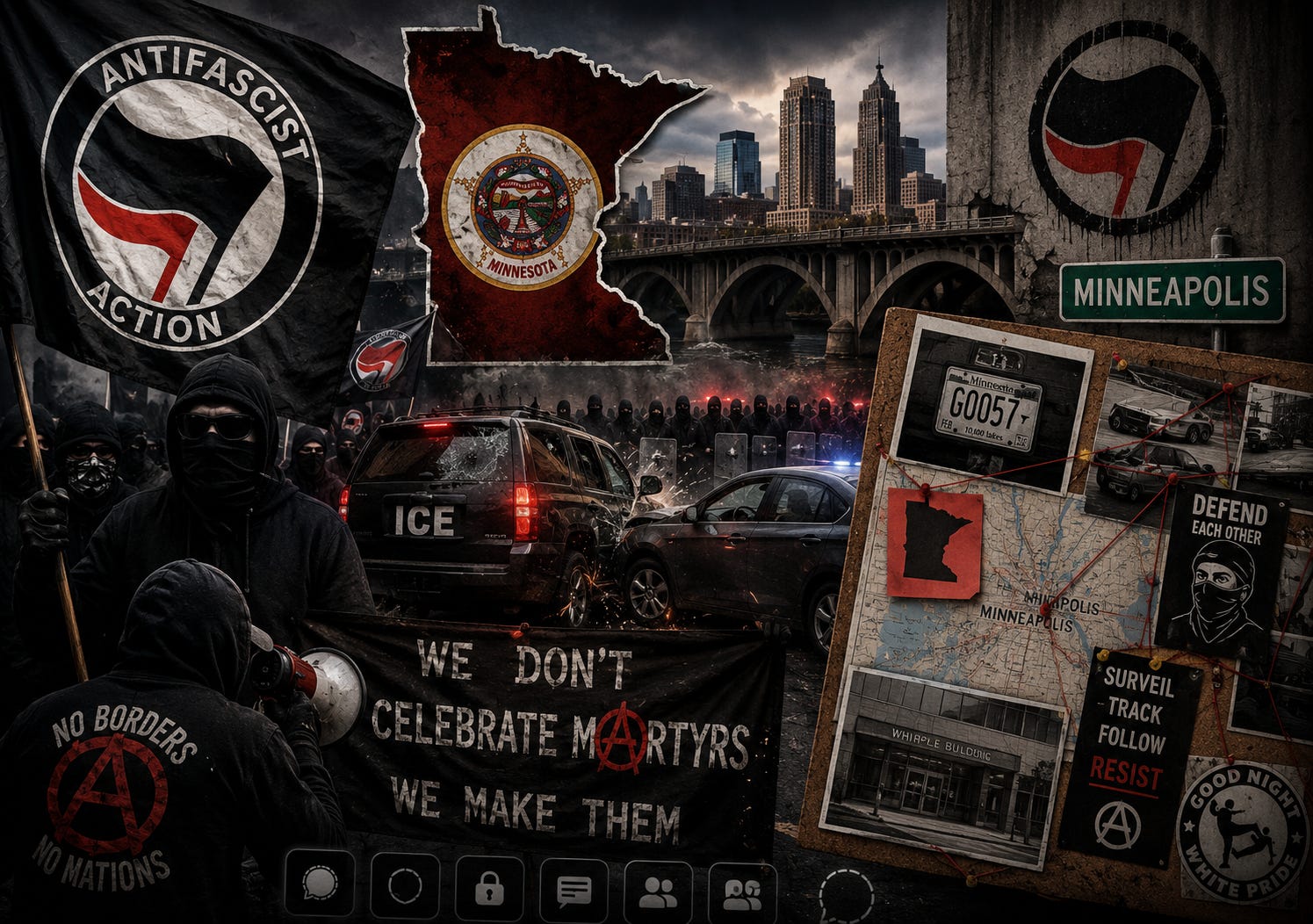
Federal prosecutors in Minnesota indicted fifteen members and associates of Direct Action Minnesota (DAMN), a Minneapolis-based organization with ties to Antifa groups, on June 16, 2026, marking one of the most comprehensive federal crackdowns on anti-ICE resistance networks to date. The charges, which include conspiracy to impede federal officers, interstate stalking, assault on federal agents, and destruction of government property, stem from an eight-month campaign in which defendants allegedly followed immigration agents to their homes across state lines, rammed government vehicles on highways, maintained searchable databases of federal license plates, and conducted a nationwide “Anarchist Speaking Tour” teaching tactics to forcibly obstruct immigration enforcement.
What sets this case apart: defendants weren’t just protesting—according to a 94-page indictment, they built a sophisticated intelligence apparatus using encrypted Signal chats, vehicle tracking databases, and rapid-response networks that prosecutors say crossed the line from First Amendment activity into organized criminal conspiracy. The arrests come as part of National Security Presidential Memorandum 7, a White House initiative targeting what it describes as “sophisticated, organized campaigns of targeted intimidation, radicalization, threats, and violence” under the banner of anti-fascism.
The Intelligence Operation: Databases, License Plates, and “Whipple Watch”
At the heart of DAMN’s operations was a surveillance infrastructure that prosecutors describe as far more sophisticated than typical protest activity. Members maintained databases of federal immigration and law enforcement vehicles, including license plate numbers, vehicle descriptions, and identifying information about when and where vehicles were spotted. The indictment details a Signal group chat called “Whipple Watch”—named after the Bishop Henry Whipple Federal Building in Minneapolis, where ICE is headquartered—that facilitated real-time identification and tracking of federal vehicles.
According to court documents, the database included detailed intelligence: whether a vehicle had been identified as belonging to federal law enforcement, when it was last seen, how many times it appeared, what activities it was engaged in, whether it was part of a caravan, and if federal agents with tactical gear were observed inside. This information, prosecutors allege, helped DAMN members “determine how aggressive the response to that particular vehicle should be.”


The database operation extended beyond Minneapolis. A similar effort in the Pacific Northwest, documented by The Intercept in January 2026, catalogued more than 600 license plates of vehicles used by immigration authorities. That database was hosted on the InterPlanetary File System (IPFS), a decentralized platform activists chose specifically to avoid centralized websites vulnerable to subpoenas and takedown orders. The Minnesota indictment references collaboration with a data collection group called “Defrost,” which maintained a publicly searchable website of ICE vehicle plates.
Isaac Sant, one of the fifteen defendants, explained the operation during the April 2026 Anarchist Speaking Tour: “What we do is... we go down to Whipple building and hang out there all day and photograph every ICE vehicle that’s coming in and out... We maintain a searchable database in conjunction with data collection group called Defrost that’s publicly searchable on a website.”
From Surveillance to Confrontation: “Commuting” and Interstate Stalking
The indictment describes a tactic called “commuting”—identifying, following, surveilling, harassing, and confronting federal immigration enforcement to prevent them from performing their duties. DAMN members, the indictment alleges, would follow federal officers from the Whipple Building to their homes and other locations, often working with “co-pilots” who communicated with dispatchers in real-time.
On May 4, defendant Isaac Sant allegedly followed a federal immigration officer from the Whipple Building in Minneapolis to Hudson, Wisconsin—a journey of approximately 30 miles across state lines. St. Croix County deputies stopped Sant’s Hyundai Sonata in Wisconsin and identified him.
More aggressively, on May 18, defendant Natasha Rakotz allegedly followed a federal immigration officer from the Whipple Building in her Honda Civic. According to prosecutors, Rakotz “brake checked” the officer and “side swiped” the officer’s vehicle at the intersection of Minnesota State Highway 55 and Highway 5, causing a collision. The indictment includes photographic evidence of Rakotz’s vehicle ramming the government-issued vehicle.
On May 15, defendant William Morgan allegedly showed up at a scene where Homeland Security Investigations agents were conducting interviews at 28th and Bloomington. Morgan, according to prosecutors, approached one of the agents and knocked the agent’s notes out of his hand, then kicked the government-issued vehicle, causing dents.
Hard and Soft Blockades: Shutting Down Federal Operations
DAMN members organized and participated in direct actions at the Whipple Building on January 23 and March 1, 2026, deploying what prosecutors describe as “hard” and “soft” blockades. Hard blockades used vehicles, trailers, Czech hedgehogs (metal obstacles designed to stop vehicles), and debris to obstruct roads. Soft blockades involved protesters wielding homemade shields constructed from plastic, wood, and metal to physically resist law enforcement.

During the January 23 action, DAMN members deployed a trailer that was flipped to successfully block access to the building. On March 1, the operation expanded with four components: an above-ground march led by Indigenous sundancers at one gate, and three deployment teams designed to shut down other points of egress using shields and “tank busters”—Czech hedgehogs similar to D-Day beach obstacles.
Cameron Kennedy described the March 1 operation during the Anarchist Speaking Tour: “I was on deploy 2 or deploy 3 and I had a 10-foot U-Haul box truck and a 30-foot trailer that I was going to use to block one of the entrances.”

The Anarchist Speaking Tour: Exporting Minnesota’s Model
In April 2026, DAMN members took their tactics on the road, conducting what they called the “Anarchist Speaking Tour” with events in Chicago, Ann Arbor, and Seattle. The tour, promoted by the anarchist publication CrimethInc as “Breaking the ICE: Lessons from the Resistance in Minnesota,” featured three concurrent groups covering the Midwest, East Coast, and West Coast for a total of two dozen events.
On April 8 in Ann Arbor, Michigan, defendants Callum Robinet and William Morgan participated in the tour. Robinet told participants: “So this is an anarchist speaking tour. We’re all anarchists.”
On April 18 in Seattle, Washington, defendants Isaac Sant, Cameron Kennedy, and William Morgan presented together. Kennedy described the history of violent resistance in Minneapolis, telling the audience that the looting and burning of the Minneapolis Police Department’s Third Precinct during the George Floyd uprising was “the happiest moment of my life.”
Kennedy explained DAMN’s January 23 blockade operation: “There were two other deployment teams—those deployment teams had trailers that they had bought off of Facebook Marketplace for really cheap and they essentially tried to blockade the other entrances simultaneously... One of those trailers was deployed and flipped and successfully shut access.”
Sant described himself as part of “an anarchist, revolutionary organization... called Blackcat,” referring to the Black Cat Workers Collective, identified in the indictment as an Antifa affinity group. The collective’s Facebook page describes it as “a class struggle anarchist organization committed to workplace struggle, housing justice, community self defense, internationalism, and revolution.”


“You Will Never Win with Non-Violence Alone”
The indictment highlights defendants’ explicit rejection of peaceful protest tactics. On February 5, 2026, defendant Cameron Kennedy posted on Facebook: “I swear I’m going to lose my f*ing mind if I see that ‘if 3.5% of the population is committed to peaceful revolution, they win’ bullst... I want to make this as clear as I can: YOU WILL NEVER WIN WITH NON-VIOLENCE ALONE. Ever. No one has. No one will. You absolutely need militants to win.”
Defendant Kyle Wagner, who was arrested on February 5 wearing a sweatshirt that read “I’m Antifa!” on the front, posted a video on January 24 while wearing a bulletproof vest. In the video, Wagner stated:
“We’re not talking about peaceful protests anymore. We’re not talking about having polite conversations anymore... This is exactly what I said was going to fing come when we didn’t fing go march on fing Whipple with guns... Get your fing guns and stop these f***ing people.”
Wagner faces separate charges of cyberstalking and interstate communications after he allegedly doxxed a Michigan resident who had pro-ICE views, posting the individual’s personal information along with threatening messages.
National Security Presidential Memorandum 7: The Broader Context
The DAMN indictment is part of a broader federal initiative under National Security Presidential Memorandum 7 (NSPM-7), issued in September 2025. The memorandum directs the National Joint Terrorism Task Force to investigate, prosecute, and dismantle networks engaged in political violence.
NSPM-7 specifically identifies “anti-fascist” movements as coordinating “sophisticated, organized campaigns” that begin by “isolating and dehumanizing specific targets,” then escalate to “organized doxing” and violent assault. The memorandum states: “This ‘anti-fascist’ lie has become the organizing rallying cry used by domestic terrorists to wage a violent assault against democratic institutions, constitutional rights, and fundamental American liberties.”
Acting Attorney General Todd Blanche stated after the DAMN indictment: “These defendants, which included members of Antifa groups, engaged in an unrelenting campaign of harassment and violence targeting federal and local law enforcement... These arrests demonstrate the Department’s commitment to law and order and stopping organized political violence in Minneapolis and beyond.”
The Defendants and Their Aliases
The fifteen defendants named in the indictment are charged with various combinations of conspiracy to impede or injure a federal officer (maximum six years), interstate stalking, assault on a federal officer, solicitation to commit a crime of violence, interstate threats, and destruction of government property. Many used aliases in their organizing work:
Isaac Auman Sant (aliases: Isaac Dalto, Ike)
Cameron Kennedy (aliases: Cam, Olive Knite, Knite)
Kyle Wagner (alias: Kaos)
Callum Robinet (aliases: Juliet K, Juliet, Cal)
William Morgan (aliases: Willow, Willow Tree)
Natasha Rakotz (alias: Anuran)
 U.S. Department of Justice@TheJusticeDeptImage of Natasha Rakotz trying to ram her Honda Civic into a federal immigration officer's government-issued vehicle and Antifa patches recovered by law enforcement at Wagner's residence.
 10:30 PM · Jun 16, 2026 · 9.45K Views11 Replies · 35 Reposts · 218 Likes
Hannah Margaret Van De Water Davis (aliases: Gabriel Van De Water, Nube)
Treasure Cay Thoreson (alias: Schatzi)
Nathan Junho Kim (alias: Moon Bear)
Douglas Misterek (aliases: Doug, D Munny Big Dog Orf Orf)
Dustin Scott Beisell (alias: Sparky)
Brian Stillwell Apland (alias: Tiny)
Erik Davis (alias: Errico)
Emmett James Doyle (alias: Plotnikov)
Alec Stewart (alias: Mac)
Twelve defendants were arrested in a coordinated operation by Homeland Security Investigations on June 16. Wagner was already in federal custody on separate charges, and two defendants remained at large as of the announcement.
Bottom Line
The DAMN indictment represents one of the most detailed federal efforts to dismantle what prosecutors characterize as organized resistance infrastructure targeting immigration enforcement. By documenting encrypted communications, database operations, cross-state surveillance, and a nationwide training tour, the indictment portrays not spontaneous protest but a coordinated network with operational security protocols, specialized roles, and strategic planning.
The case signals a new phase in federal law enforcement’s approach to anti-ICE activism: treating organized resistance networks not as protesters exercising First Amendment rights, but as criminal conspiracies engaged in domestic terrorism.
Anyone who' s actually been watching the news knew that there was nothing spontaneous about all of this the entire time. Keep these investigations going, these groups are seeking nothing short of the destruction of America as we know it.