



A new Federal Judicial Center study, included in the October 21 agenda of the federal judiciary’s Advisory Committee on Civil Rules, identifies foreign investment firms, litigation financing companies, a Yale University legal clinic, a teachers’ union and advocacy organizations among entities disclosed as funding lawsuits in American federal courts.
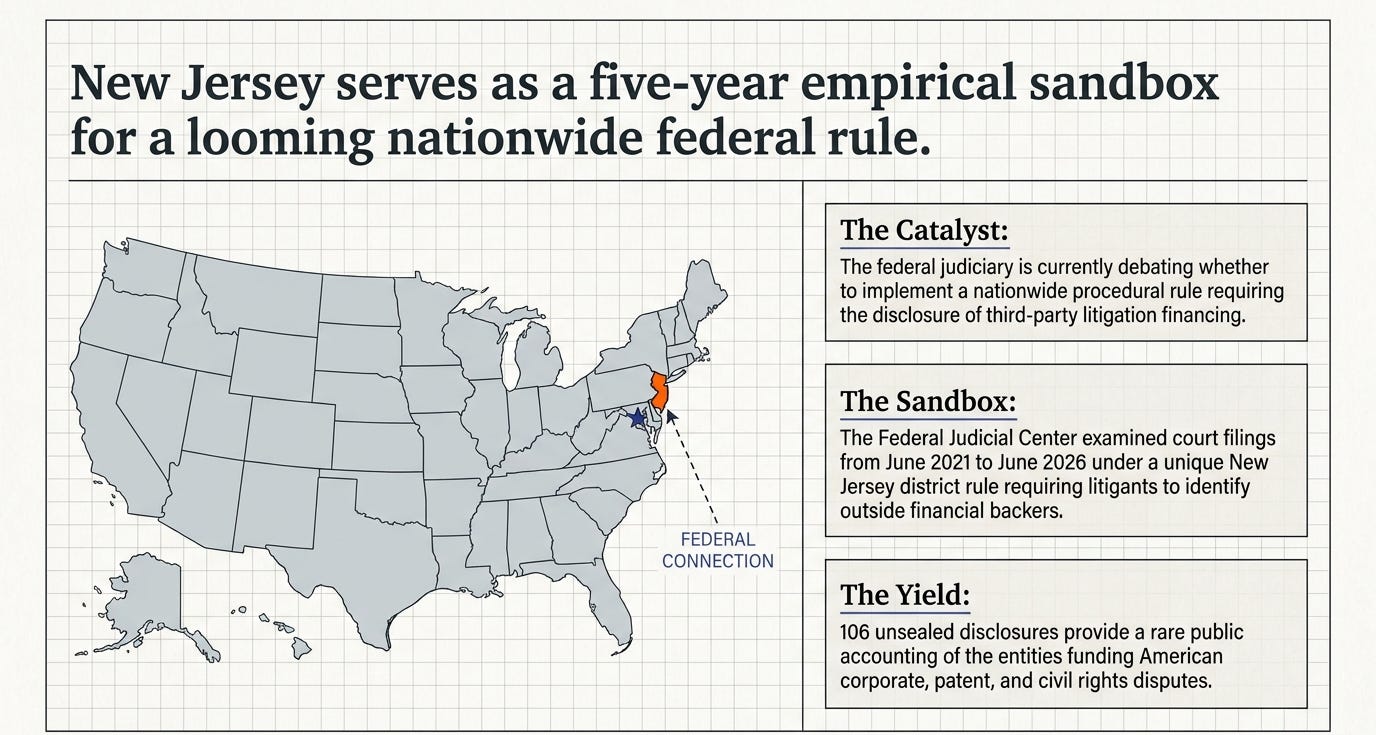
The September 2026 study, titled Third-Party Funding Disclosures in the District of New Jersey, June 2021–June 2026, examined five years of court filings under a New Jersey rule requiring litigants to identify outside parties providing certain forms of financial support for their cases.
Researchers identified 104 civil cases with positive third-party funding disclosures, along with three additional disclosures filed on the master docket of the Johnson & Johnson talcum powder multidistrict litigation. After excluding one sealed disclosure, researchers examined 106 disclosures.
The findings provide a rare public accounting of who helps finance litigation, including lawsuits involving major American corporations, patent disputes, civil rights claims and challenges involving government agencies.
The report arrives as federal judges consider whether similar disclosure requirements should be adopted nationwide, potentially bringing greater transparency to financial arrangements that are not routinely disclosed in federal courts.
Foreign Investment Firms Named in American Lawsuits
Among the most notable findings are investment funds and financial vehicles formed outside the United States. The study’s appendix of disclosed funders identifies British litigation financier Augusta Ventures Ltd. in OOVEE Ltd. v. S3D Interactive, a lawsuit listed among the report’s 2026 disclosures.
Another 2026 disclosure, involving Pogona LLC v. Merck Sharp & Dohme, identifies a subsidiary of Burford Capital Limited formed in Guernsey, a British Crown Dependency used as a jurisdiction for international investment structures. An earlier disclosure identifies Canada’s Mossco Capital Inc. in Guy A. Shaked Investments LLC v. Ontel Products Corp.
Beyond these overseas entities, the study names major litigation financiers including Omni Bridgeway, Longford Capital, Parabellum Capital, Bench Walk Advisors and Legalist.
The Federal Judicial Center highlighted the international dimension of the findings, noting that funders formed in the United Kingdom and Canada appeared among the reviewed disclosures.
Researchers also emphasized the complexity of litigation financing structures, which can involve subsidiaries, separate investment funds and special-purpose vehicles established to finance particular claims or portfolios of lawsuits.
A Litigation Financier Behind Dozens of Lawsuits Against American Companies
One of the study’s largest concentrations of funding disclosures involved Atlas Litigation Support LLC, identified alongside Parabellum Capital LLC, in lawsuits brought by Atlas Data Privacy Corporation.
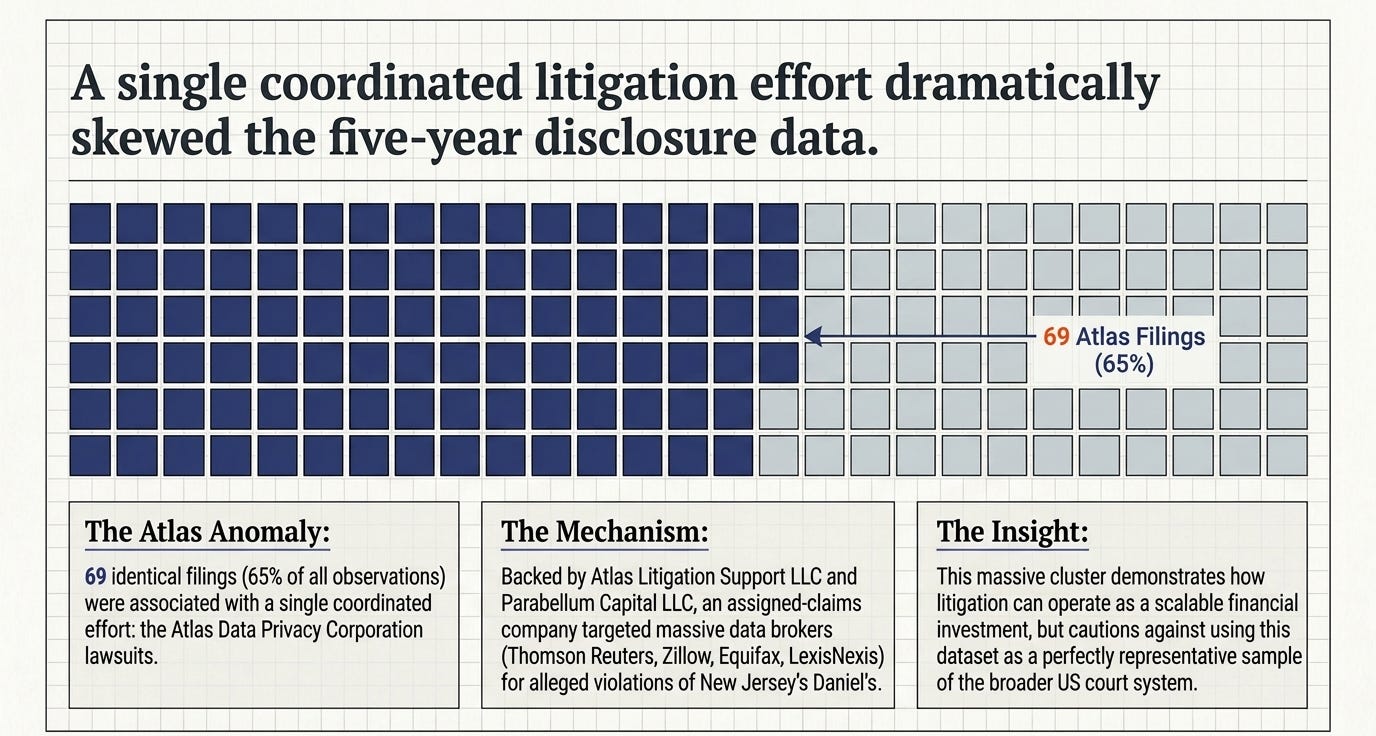
The underlying cases concerned alleged violations of New Jersey’s Daniel’s Law, legislation designed to protect certain public officials, including judges and law enforcement personnel, from disclosure of their residential information.
The litigation targeted companies including Thomson Reuters, Zillow, TransUnion, Equifax, LexisNexis and Spokeo, among others. According to the Federal Judicial Center, 69 of the disclosures reviewed were identical filings associated with related Daniel’s Law litigation.
These represented approximately 65 percent of the study’s 106 observations, demonstrating how a single coordinated litigation effort can account for a substantial share of the recorded funding activity.
The arrangement also illustrates how litigation can operate as a financial investment rather than simply as a dispute between the parties formally identified in a lawsuit. In the Atlas cases, an outside financial backer supported litigation brought through a company pursuing assigned privacy-related claims.
Yale Law School, Teachers’ Union and Advocacy Organizations Also Identified
Not all the disclosed funders were investment companies seeking financial returns from successful lawsuits. The study identifies the Yale Law School Media Freedom and Information Access Clinic as a funder in Morrill v. Fulop, litigation involving journalist Aaron Morrill and Jersey City officials.
The lawsuit, filed in December 2023, concerned allegations that municipal officials retaliated against a local news organization and excluded it from certain government communications. Yale’s clinic participated in representing the plaintiffs, alongside local counsel Weissman & Mintz.
The report also identifies the Firearms Policy Foundation in Rachlin v. Baumann, a case involving constitutional litigation. Unlike conventional litigation investment firms, the researchers indicated that these organizations appeared to anticipate reimbursement from potential court-awarded attorney fees rather than receiving an investment interest in the underlying legal claims.
Another disclosure involved Newark Teachers Union Local 481, which supplied an initial $6,000 legal retainer, consisting of $2,000 for each of three individual plaintiffs, in litigation involving Newark’s Board of Education.
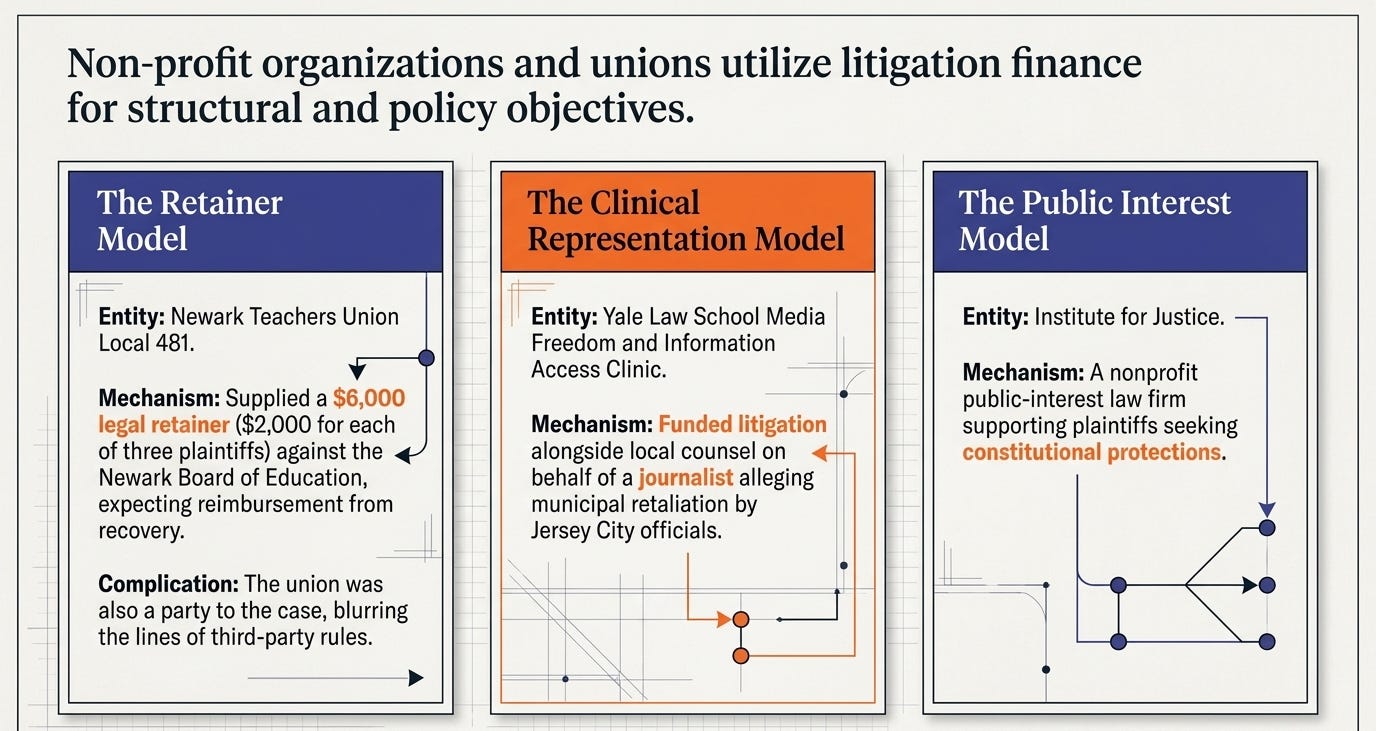
The union expected reimbursement from any settlement or recovery. The study noted that the union was itself a party to the case, raising questions about whether the arrangement technically fell within New Jersey’s third-party disclosure rule.
The Institute for Justice, a nonprofit public-interest law firm, was also identified as supporting plaintiffs in Lovaglio v. Baston, litigation seeking constitutional protections.
These examples demonstrate that third-party litigation funding disclosures can encompass substantially different arrangements, ranging from profit-oriented investment funds to organizations supporting cases for legal or policy objectives.
Who Actually Controls the Lawsuits?
One of the most consequential questions surrounding litigation finance is whether outside funders merely supply money or exercise authority over the lawsuits themselves. New Jersey’s disclosure rule specifically requires parties to report whether a financier’s approval is necessary for litigation or settlement decisions.
The Federal Judicial Center found that most disclosed funders did not possess such approval rights. However, several exceptions emerged. In Rachlin v. Baumann, the Firearms Policy Foundation was disclosed as having approval authority over litigation decisions.
In another case, Eastern Appliances Inc. v. Brother Appliances, Frontier Investment Group LLC, a business counterparty seeking to protect its commercial interests, was disclosed as having approval rights over litigation and settlement decisions.
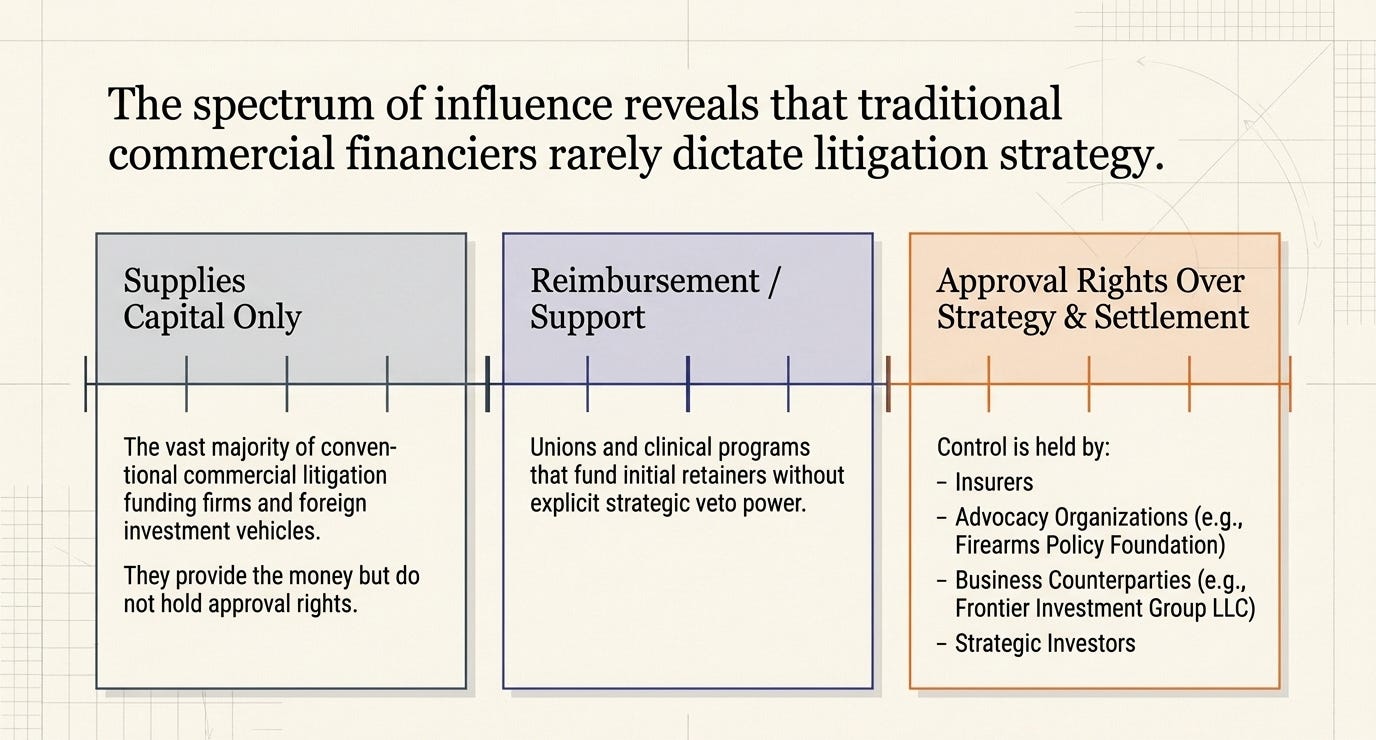
The study also identified a more complicated arrangement in Sandoz Inc. v. United Therapeutics, involving RareGen and two financing entities. According to the report, one of RareGen’s outside backers was disclosed as controlling the litigation, while RareGen itself was not entitled to proceeds or responsible for financial liabilities under the arrangement.
Separately, an October 2026 Securities and Exchange Commission filing by Liquidia provides additional financial details concerning that litigation.
Earlier company disclosures identified a $10 million litigation-financing commitment from Henderson SPV LLC in exchange for rights to proceeds from the case.
Settlement-related agreements signed in October obligated Liquidia entities to pay $19.05 million to Henderson and $19.45 million to PBM to satisfy their respective economic rights. The obligations were subject to the terms and conditions of the agreements.
The amounts illustrate the potentially substantial financial interests outside parties can hold in American legal disputes. They should not, however, be interpreted as the financiers’ net profits, which cannot be determined from those payment figures alone.
Federal Judges Weigh Nationwide Disclosure Requirements
The study was commissioned to inform discussions by the Advisory Committee on Civil Rules over whether the federal court system should adopt a nationwide rule governing litigation finance disclosures. New Jersey introduced its local requirement in June 2021, obligating parties receiving certain non-recourse funding to identify the source, describe the funder’s financial interest and disclose any approval authority over litigation decisions.
According to the Federal Judicial Center, there is currently no federal statute or nationwide procedural rule generally requiring disclosure of third-party financing in civil lawsuits, although individual judges and some courts have adopted their own requirements. The question has attracted growing attention as litigation funding has developed into a significant commercial financing industry.
Supporters of broader disclosure argue that judges and opposing litigants should be informed when outside investors have financial interests in lawsuits, particularly where questions of conflicts of interest, settlement authority or concealed beneficial ownership might arise.
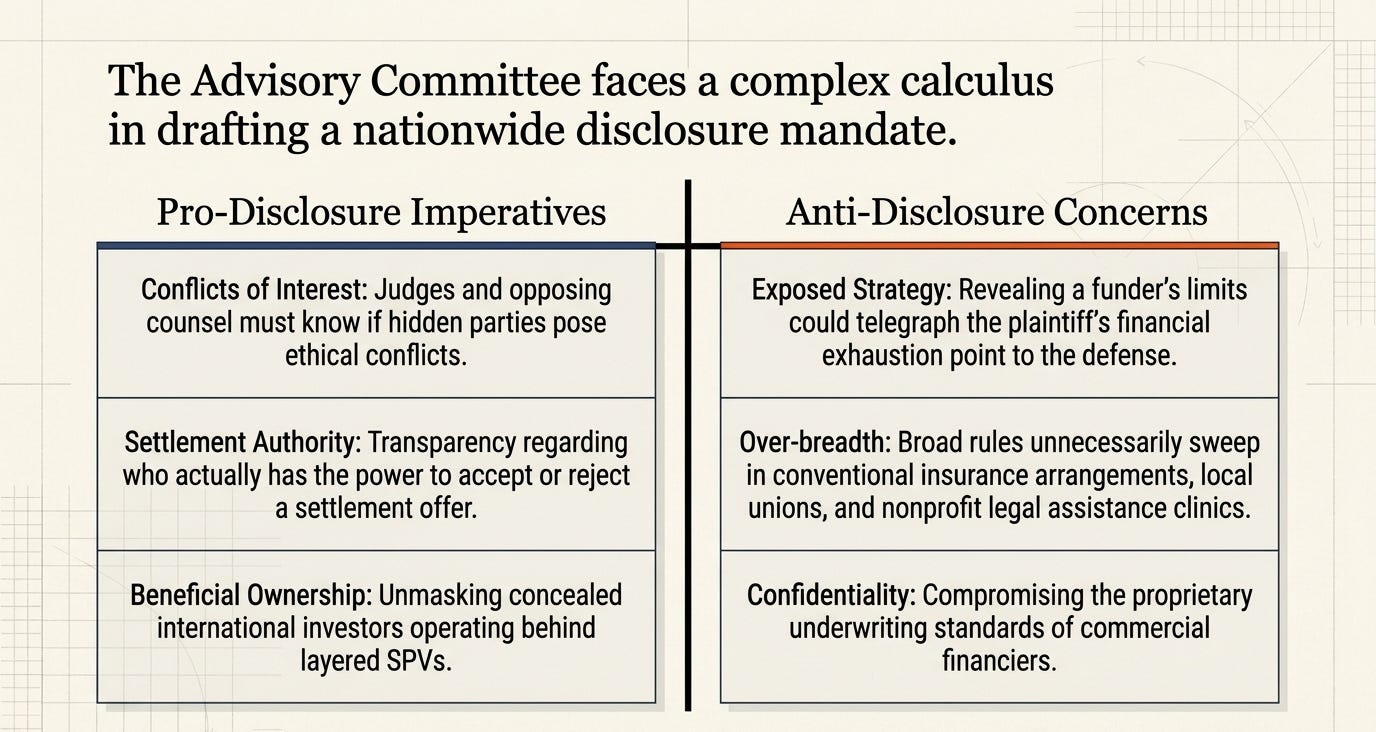
Opponents have raised concerns that broad disclosure requirements could expose sensitive litigation strategies, compromise confidentiality or unnecessarily sweep in conventional insurance arrangements and nonprofit legal assistance.
The Federal Judicial Center’s findings also highlight the limits of the available evidence. Researchers estimated that positive funding disclosures occurred in approximately one out of every 1,000 civil cases commenced in New Jersey during the study period. Moreover, approximately two-thirds of the reviewed disclosures were concentrated in related Daniel’s Law lawsuits, making broad conclusions about the national prevalence of third-party financing especially difficult.
Nevertheless, the study provides a detailed picture of the different interests operating behind American litigation, from international investment vehicles and specialized financial firms to universities, unions and organizations pursuing broader legal objectives.
As federal judges consider expanding transparency requirements nationwide, the findings raise questions about who pays for American lawsuits, who stands to benefit from their outcomes and, in certain cases, who exercises authority over litigation decisions.