

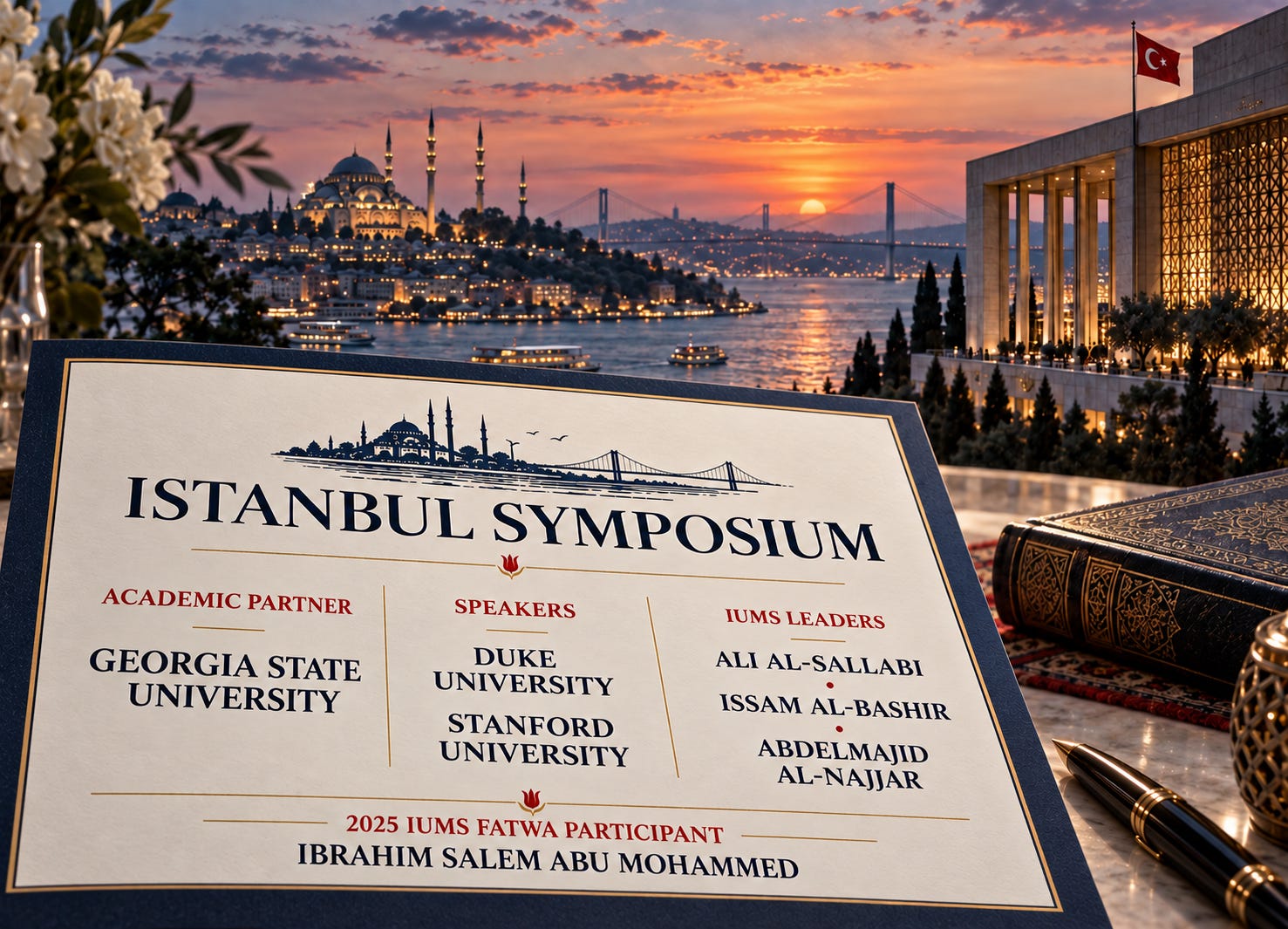
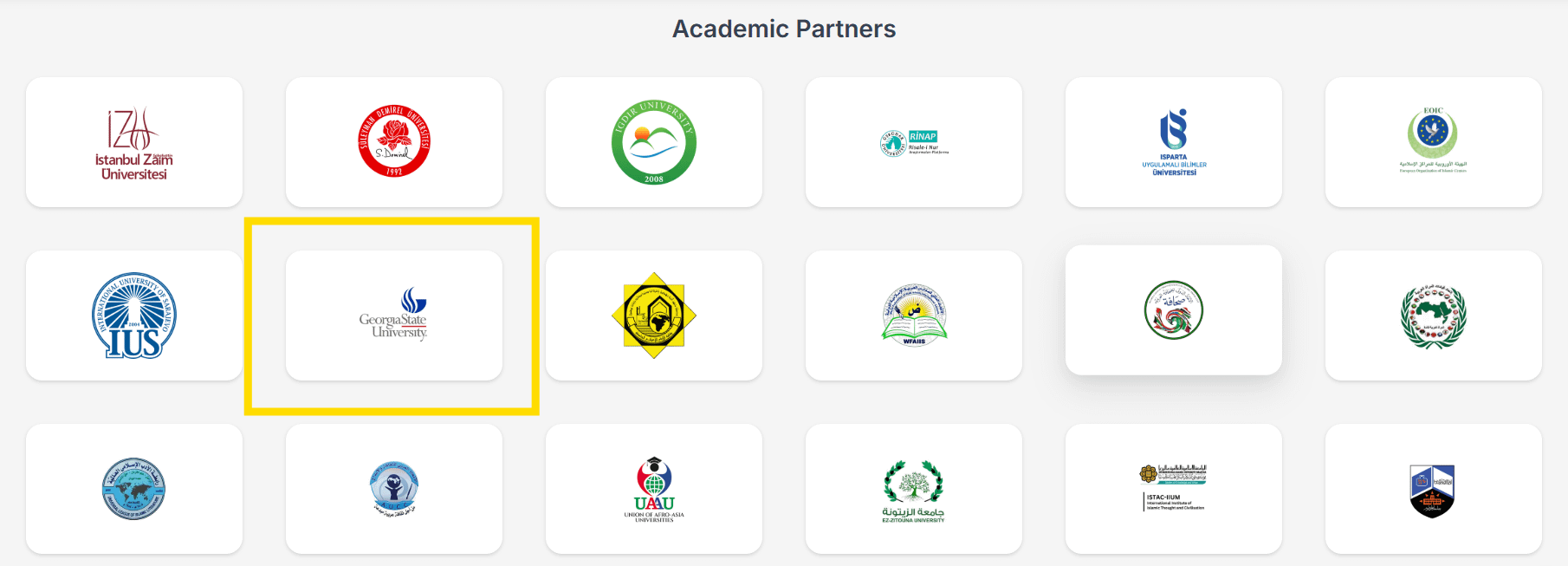
A religious conference scheduled for October 4–6 in Istanbul is bringing together professors from several American universities, senior Turkish officials and leaders of the International Union of Muslim Scholars, the Muslim Brotherhood’s transnational scholarly authority. The symposium lists Georgia State University as an academic partner.
Organized by the Istanbul Foundation for Science and Culture, the 13th International Bediüzzaman Symposium is titled “Qur’anic Solutions to Global Crises.” Its advertised opening speakers include Vice President Cevdet Yılmaz, Turkey’s religious affairs chief Safi Arpaguş and President Recep Tayyip Erdoğan’s son Bilal Erdoğan. Turkish government agencies are among the listed supporters, while state broadcaster TRT and Anadolu Agency are named as official media sponsors.
Georgia State and American Speakers
Georgia State University appears under “Academic Partners” on the conference’s supporters page and in the organizer’s list of supporting universities. The speaker roster separately identifies Serdar Aydın with Georgia State; the university’s own site identifies a Serdar Aydin as a clinical assistant professor in its Institute of Health Administration. The conference does not explain what Georgia State’s partnership involves, whether it includes funding, or who at the university approved it.
The live roster contains 16 speakers from the United States. They include Duke professors Mustafa Tuna and Mona Hassan, Stanford School of Medicine professor Rania Awaad, Georgetown professor Salih Sayılgan, a Brown University doctoral candidate and a scholar listed with CUNY and Istanbul’s Ibn Haldun University. Duke confirms Tuna’s appointment; its profile identifies Hassan as an associate professor. Stanford likewise identifies Awaad as a clinical professor.
Those faculty affiliations establish the participation of individual scholars. Georgia State’s appearance under Academic Partners is a separate claim made by the organizer. Neither listing shows that Duke, Stanford, Georgetown or the other universities endorse the views of fellow speakers.
Turkish State Support
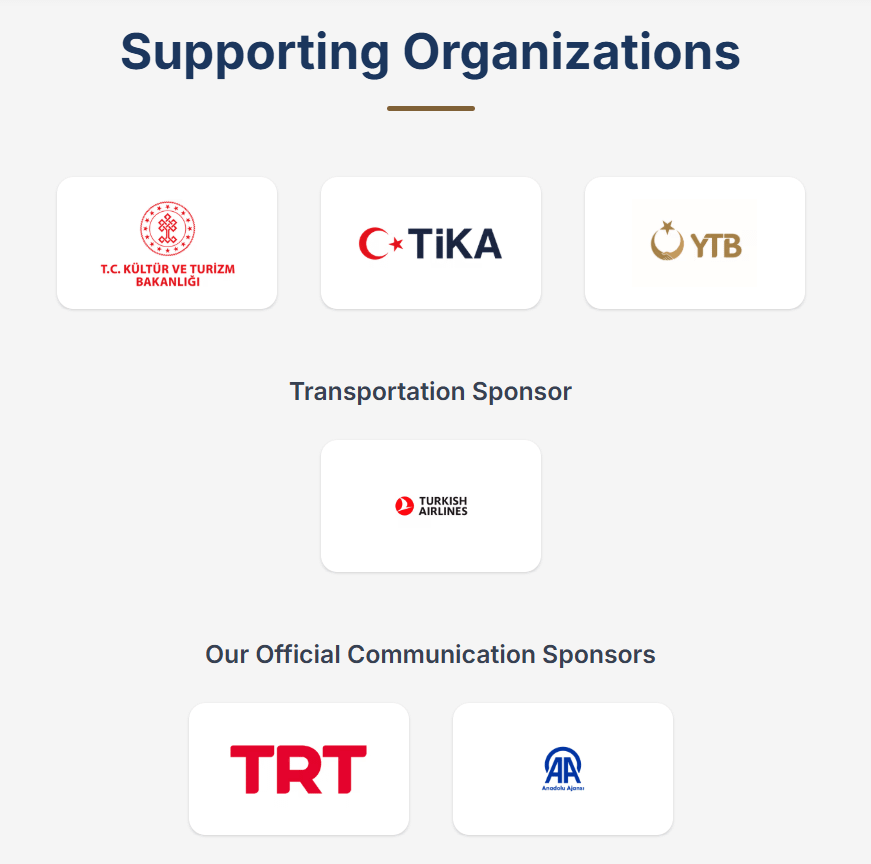
The conference’s supporters page names Turkey’s Ministry of Culture and Tourism, the Turkish Cooperation and Coordination Agency, known as TİKA, and the Presidency for Turks Abroad and Related Communities, known as YTB, as supporting organizations. It lists Turkish Airlines as its transportation sponsor and TRT and Anadolu Agency as its “official communication sponsors.”
The Turkish government has a substantial presence on the conference program and supporter list for a “private” event. Diyanet, Turkey’s government religious authority, is represented by its president among the advertised opening speakers. Bilal Erdoğan chairs the board of trustees of the İlim Yayma Foundation, according to Turkey’s Education Ministry. The roster also includes Syria’s religious endowments minister and a former Sudanese foreign minister.
Muslim Brotherhood’s Transnational Scholarly Authority
Three advertised participants hold leadership positions in the Muslim Brotherhood’s IUMS: Libyan scholar Ali al-Sallabi, Sudanese cleric Issam al-Bashir and Tunisian scholar Abdelmajid al-Najjar. The union’s own account of a 2024 leadership meeting identifies al-Sallabi as secretary-general and the other two as vice presidents.
IUMS was founded by Yusuf al-Qaradawi, long regarded as a spiritual leader of the Muslim Brotherhood. A George Washington University Program on Extremism study describes the union as giving religious legitimacy to Hamas’s actions after October 7, 2023, and issuing calls for jihad. IUMS describes itself as an independent organization bringing together scholars from different schools and orientations. The U.S. State Department has described it as widely viewed in the press and academia as affiliated with the Muslim Brotherhood.
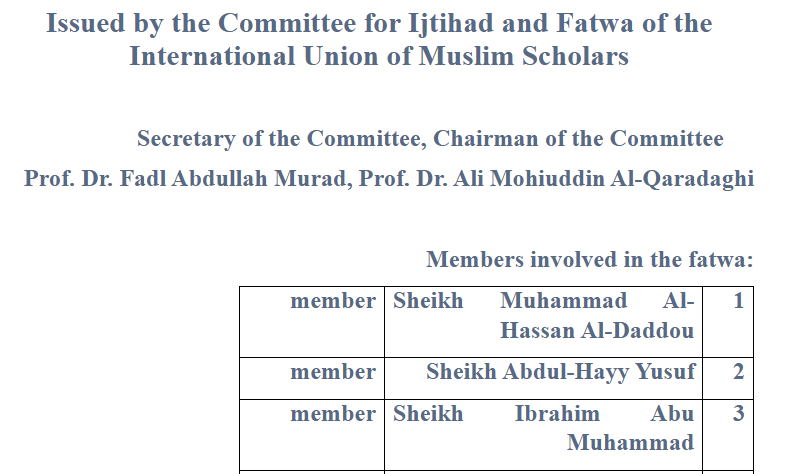
The speaker roster also lists Prof. Dr. İbrahim Salim, the Mufti of Australia. An Arabic interview gives his full name as Ibrahim Salem Abu Mohammed. The IUMS’s original Arabic document names Ibrahim Abu Mohammed among the members participating in its March 2025 fatwa.
The ruling signed by Salim declares jihad against Israel an individual religious obligation for every capable Muslim. It calls for military intervention, supplying fighters with weapons, military expertise and intelligence, and financial contributions from capable Muslims and/or Muslim countries. It says wealthy Muslims should use their own money to equip fighters and urges support for the “resistance.”
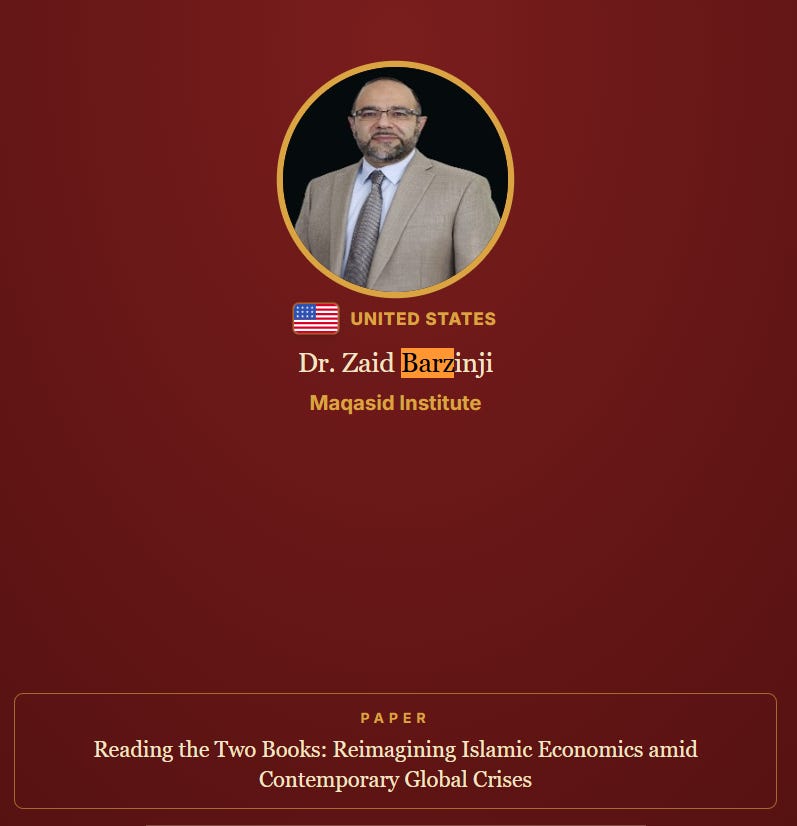
One U.S.-listed speaker, Zaid Barzinji, provides another link to IUMS. The conference identifies him with the Maqasid Institute; the institute’s biography calls him its president and an IUMS foundaing and board member. A family memorial volume identifies him as the son of Jamal Barzinji, one of three Iraqi Kurds whom a George Washington University study identifies as builders of early Muslim Brotherhood-linked organizations in the United States. The symposium lists the Maqasid Institute as an academic partner and another of its researchers, Ildus Rafikov, as a U.S.-labeled speaker.
Additional Speakers With Terror Links
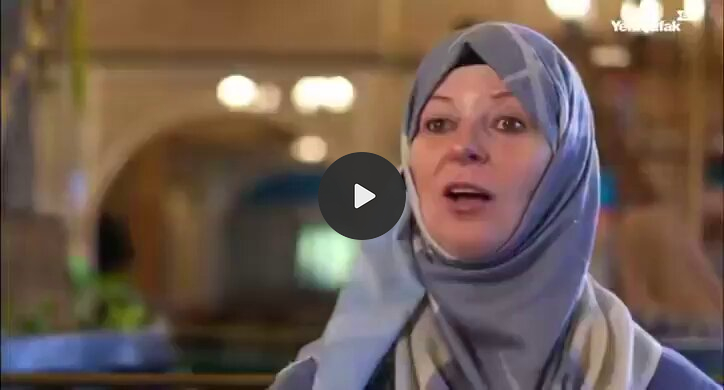
The roster includes British journalist Lauren Booth, who reportedly received a Palestinian diplomatic passport from Hamas leader Ismail Haniyeh during a 2008 visit to Gaza and received diplomatic status from Hamas. In an interview with Turkish media later reported in Britain, Booth called October 7 a “legendary day in the Ummah’s history.”

Turkish speaker İhsan Şenocak reported attending a 2024 scholars’ gathering in Doha where Haniyeh addressed participants. The conference also lists former Moroccan prime minister Saad Dine El Othmani, whose political party said it invited Haniyeh and a Hamas delegation to Morocco in 2021.
Al-Sallabi has a different, historical connection. Testimony submitted to a U.S. House committee in 2018 described him as a political party leader alongside Abdelhakim Belhaj, a former leader of the Libyan Islamic Fighting Group. The United States revoked the LIFG’s Foreign Terrorist Organization designation in 2015.
The conference brings these figures into the same advertised program as U.S. academics and Turkish officials. Its published materials document the speakers, partner labels and state support. They leave the terms of Georgia State’s partnership and the extent of each supporter’s contribution unstated.