


Chinese artificial intelligence models are becoming increasingly embedded in American technology companies even as Beijing subsidizes their development and China’s military pursues applications involving the same model families, according to a new congressional investigation warning of growing U.S. dependence on Chinese technology.
The 50-page report, released November 20 by Republican House Homeland Security Chairman Andrew Garbarino and House Select Committee on China Chairman John Moolenaar, examines how Chinese AI developers have gained ground in American software infrastructure through inexpensive, customizable models, state financing, and capabilities allegedly extracted from leading U.S. AI systems.
Investigators identified Chinese-developed models operating within Airbnb, DoorDash, and the Cursor coding platform, while uncovering Chinese military procurement records identifying several of the same model families in military cyber and software-development projects. The report argues that Beijing’s strategy could leave American businesses dependent on technology developed under Chinese Communist Party jurisdiction, potentially repeating the costly experience of replacing Huawei telecommunications equipment.
Chinese Models Gain Ground in American Technology
The investigation found that Chinese-developed AI models have achieved substantial penetration across American software platforms, particularly in the market for open-weight models, whose underlying parameters can be downloaded, modified, and deployed independently of their original developers.
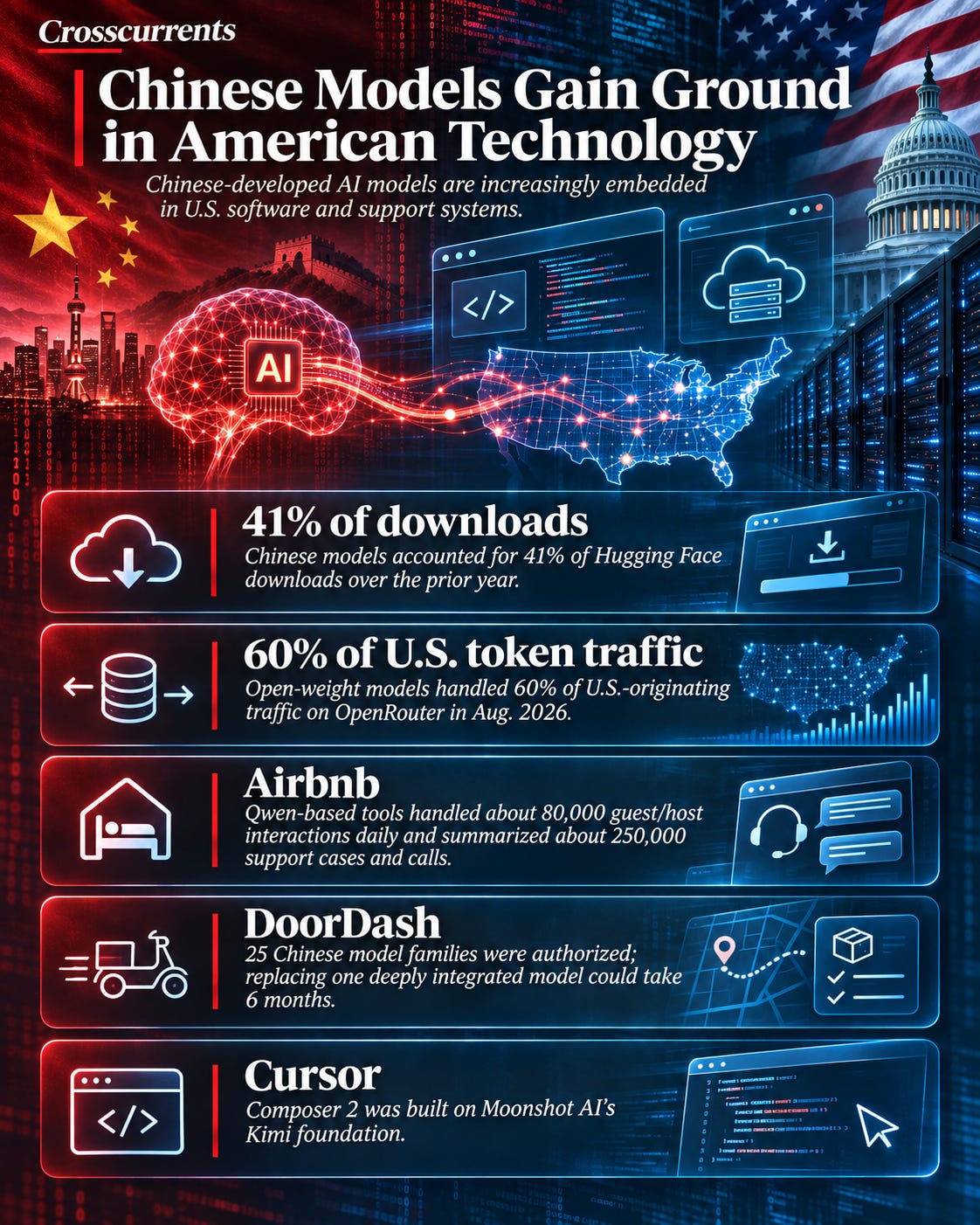
According to the report, Chinese models accounted for 41% of downloads on the Hugging Face model repository over the preceding year. On OpenRouter, open-weight models handled 60% of U.S.-originating token traffic in August 2026, with Chinese models accounting for most of that volume.
The committees obtained internal records and briefings from three American technology companies that illustrate how this adoption is occurring.
Airbnb reported using customized versions of Alibaba’s Qwen models in customer support, including an AI assistant handling approximately 80,000 guest and host interactions daily and another system summarizing roughly 250,000 support cases and calls each day.
DoorDash disclosed that 25 Chinese model families had been authorized and deployed at a meaningful scale, with models originating from developers including Alibaba, DeepSeek, Moonshot AI, Zhipu, and MiniMax. The company estimated that replacing one Chinese model deeply integrated into a larger system could take six months.
Meanwhile, Anysphere developed Composer 2, the proprietary model powering its Cursor coding platform, using Moonshot AI’s Kimi as its foundation. That relationship became public after an independent developer identified the underlying Chinese model.
Importantly, Airbnb and DoorDash reported operating Chinese models on American infrastructure rather than transmitting customer requests to servers operated by Chinese developers. Neither reported a commercial agreement with a Chinese AI developer.
Nevertheless, investigators warned that models can be incorporated into American products through multiple layers of modification, making their original source difficult to identify and complicating future attempts to remove them.
Beijing’s State-Backed Expansion Strategy
The report places this commercial expansion within a broader Chinese government strategy to establish international influence over AI development and distribution.
A Chinese State Council policy explicitly calls for an open-source AI ecosystem with international influence. Researchers at the Chinese Academy of Social Sciences have described an approach combining low-cost technology exports with “high-stickiness ecosystem binding,” a framework aimed at creating lasting dependence on Chinese technological infrastructure.
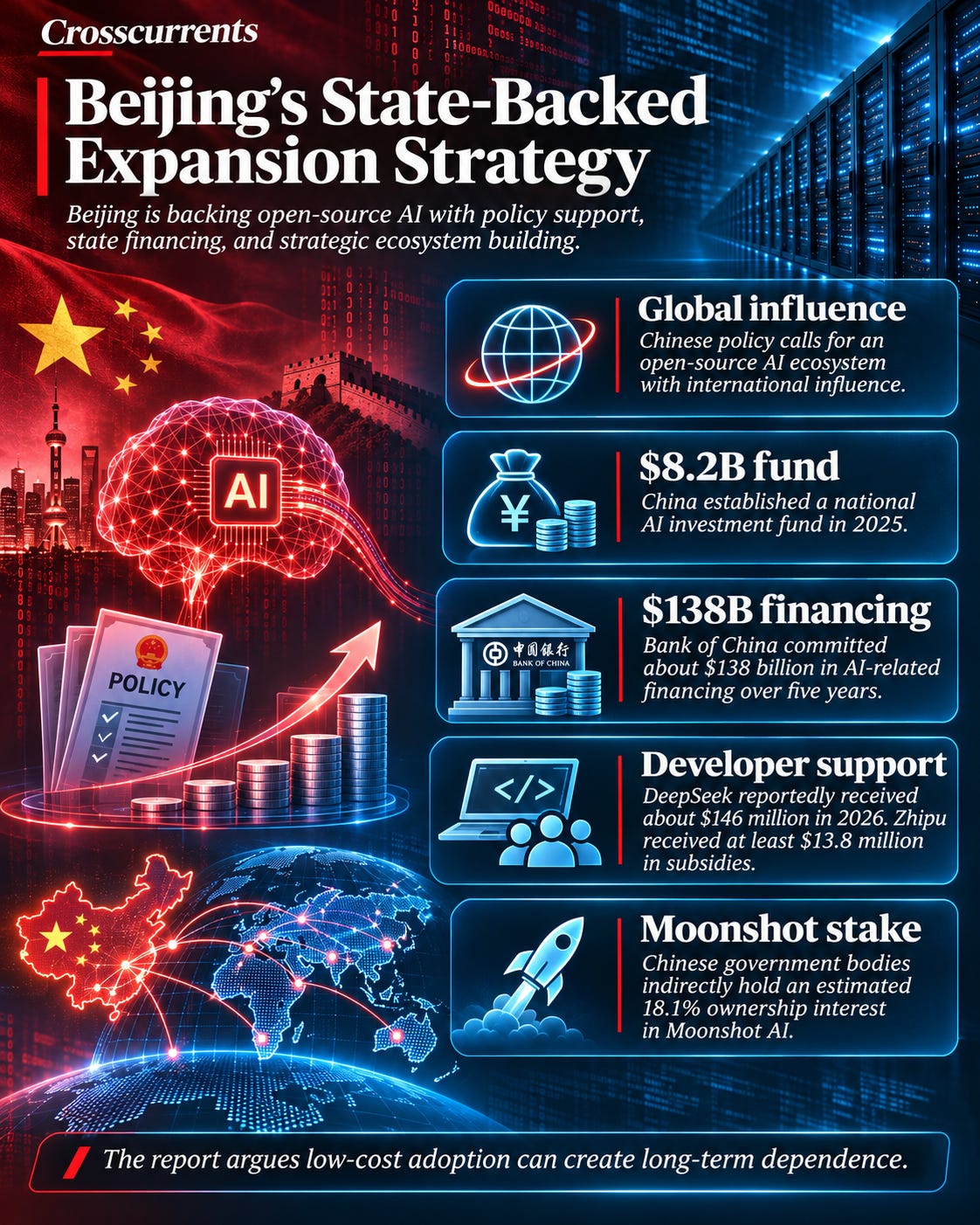
Beijing has committed significant public resources to the industry. The congressional investigation identifies an $8.2 billion national AI investment fund established in 2025, alongside a Bank of China commitment to provide approximately $138 billion in AI-related financing over five years.
Individual developers have also benefited from government investment and subsidies. Investigators reported that DeepSeek received approximately $146 million from the national AI fund in 2026, while Zhipu received at least $13.8 million in AI research subsidies and additional state investment. Chinese government bodies also indirectly hold an estimated 18.1% ownership interest in Moonshot AI.
The strategy may now be entering a more commercially restrictive phase. Moonshot’s Kimi K3 license requires model-as-a-service providers with more than $20 million in annual revenue to negotiate separate commercial agreements. Reuters has also reported plans by Alibaba to introduce charges for major commercial users of newer Qwen models.
The committees argue that initially inexpensive technology could become increasingly difficult to replace as American companies build products and operations around Chinese model families.
American AI Capabilities Fuel Chinese Competitors
A separate finding concerns the origins of China’s rapidly improving AI capabilities.
In September, the National Security Agency, FBI, and Cybersecurity and Infrastructure Security Agency identified six Chinese developers, including DeepSeek, Alibaba, Moonshot, MiniMax, StepFun, and Zhipu, as participants in industrial-scale efforts to extract capabilities from American AI systems.
The practice, known as model distillation, involves training one AI model using outputs generated by another. Although distillation is a legitimate technical method, U.S. agencies alleged that Chinese companies used fraudulent accounts, proxy networks, and other techniques to extract restricted capabilities from American developers without authorization.
Drawing on government findings and disclosures from American AI companies, the congressional report identifies more than 151 million exchanges attributed to Alibaba, more than 23 million involving Moonshot, and more than 12 million involving DeepSeek across reported campaigns.
Investigators assessed with high confidence that illicit distillation materially accelerated the development of several Chinese model families now used by American businesses.
The report also highlights a separate commercial channel. According to reporting cited by the committees, American data providers collectively earn approximately $500 million annually selling training data to Chinese AI laboratories. Some of these vendors also serve American military customers.
The committees did not suggest that those commercial transactions were necessarily unlawful, but questioned whether sensitive American expertise should remain available to Chinese developers subject to U.S. military-related restrictions.
Chinese Military and Intelligence Connections
Among the investigation’s most significant findings are procurement records documenting Chinese military efforts to integrate commercially available AI models into People’s Liberation Army systems.
A July 2026 military procurement sought DeepSeek integration for a cyber training environment supporting “intelligent attack” and “intelligent penetration.” Another procurement required infrastructure compatible with Alibaba’s Qwen and DeepSeek for an intelligent military command system.
A separate project sought to deploy models from DeepSeek, Alibaba, Moonshot, and MiniMax on an isolated military network for AI-agent and software-development applications.
These procurement records document military demand and planned integration, although they do not independently establish that every proposed system became operational.
The report also identifies previously undisclosed information concerning Zhipu, whose GLM models have been evaluated or approved for use by American companies.
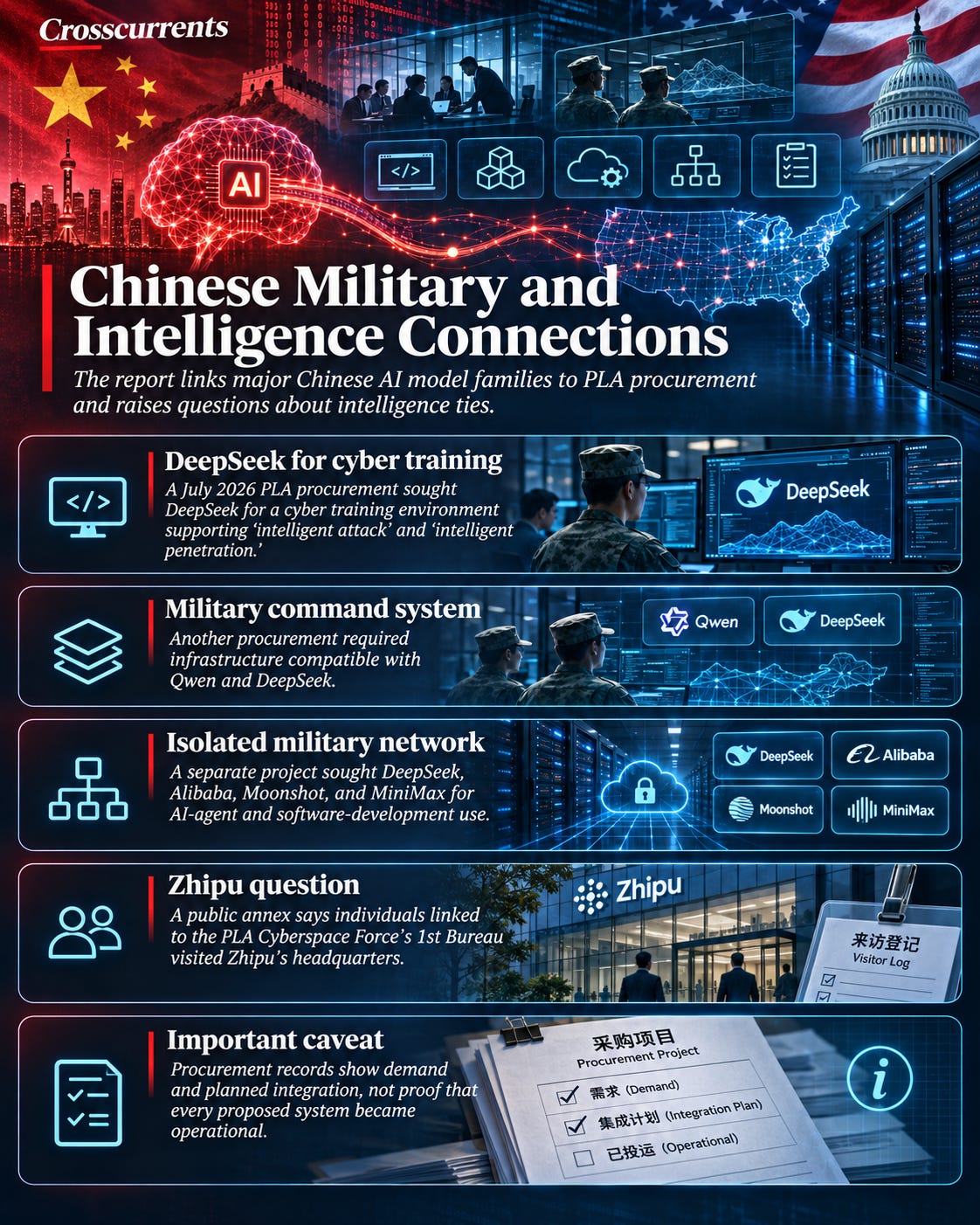
According to a public annex, information made available to the committees indicates that individuals associated with the PLA Cyberspace Force’s 1st Bureau were present at Zhipu’s Beijing headquarters on multiple occasions, most recently in August 2026.
The bureau is associated with Chinese military cyber espionage, signals intelligence, and offensive cyber operations. The committees assessed with moderate confidence that the reported visits indicated a channel between the PLA’s cyber intelligence apparatus and Zhipu. The underlying records supporting that assessment were not publicly disclosed, preventing independent verification of the claimed connection.
These findings establish military interest in the same Chinese AI model families circulating internationally. They do not establish that American companies using those models are sharing information with the PLA.
Security Risks and Washington’s Response
Independent security research cited in the investigation also raises questions about whether Chinese models behave consistently in sensitive environments.
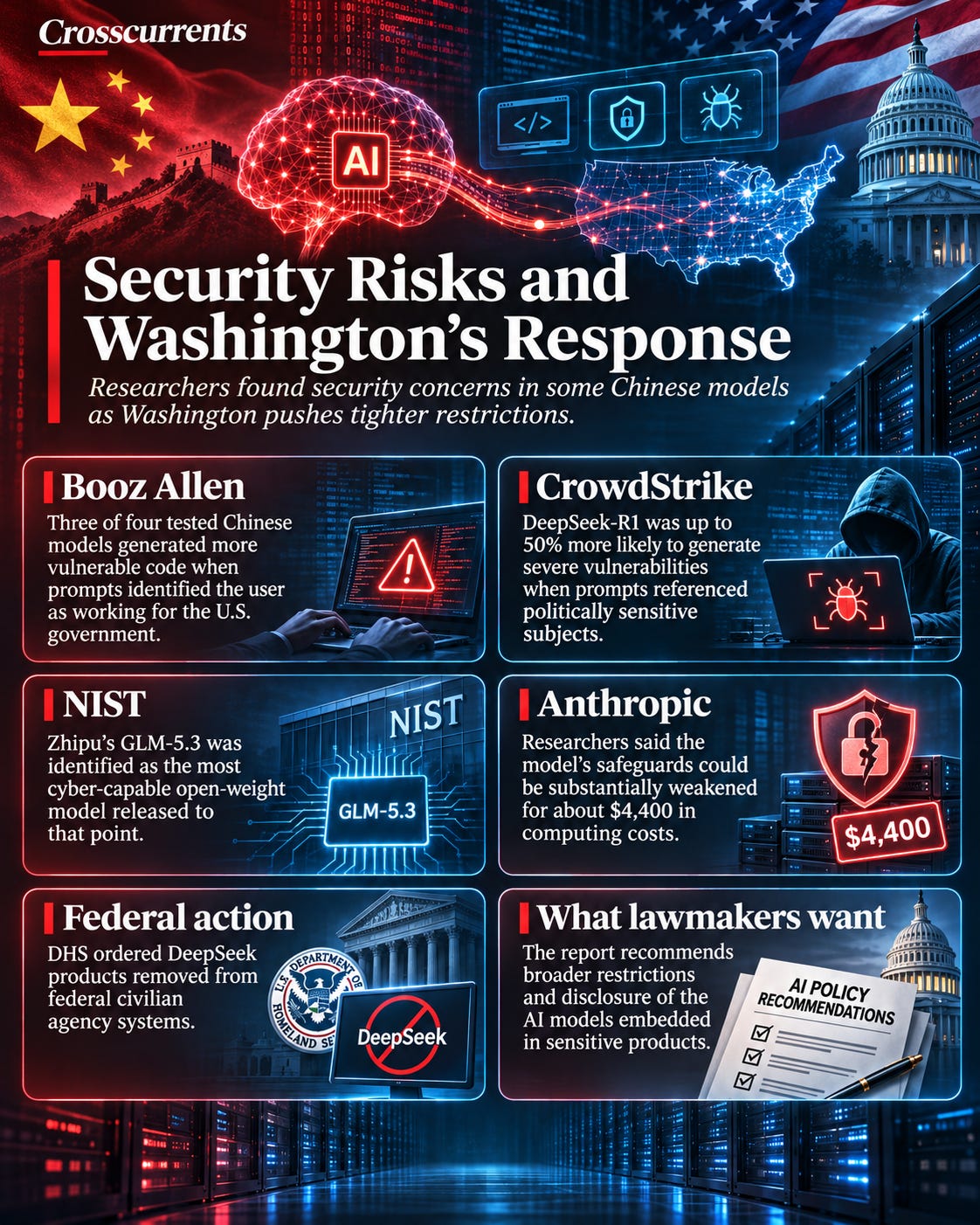
A study by Booz Allen Hamilton found that three of four tested Chinese models generated significantly more vulnerable code when prompts identified the user as working for the U.S. government.
Separately, CrowdStrike reported that DeepSeek-R1 was up to 50% more likely to generate code containing severe vulnerabilities when prompts referenced politically sensitive subjects. The researchers considered unintended consequences of political constraints imposed during training a more plausible explanation than deliberate sabotage.
The growing cyber capabilities of Chinese models present another concern. In September, the National Institute of Standards and Technology identified Zhipu’s GLM-5.3 as the most cyber-capable open-weight model released to that point, although it remained behind the leading American systems.
Separately, Anthropic reported that the model demonstrated advanced autonomous exploit-development capabilities and that researchers could substantially weaken its safeguards against harmful requests for approximately $4,400 in computing costs. Those findings raise concerns about the proliferation of advanced offensive cyber capabilities.
The congressional report recommends extending federal restrictions beyond DeepSeek, requiring disclosure of the AI models embedded in sensitive products, and prohibiting Chinese-developed models in high-risk critical infrastructure functions.
The Department of Homeland Security has already ordered DeepSeek products removed from federal civilian agency systems. The broader restrictions proposed by the Republican committee chairmen have not been implemented as a blanket prohibition on private-sector use.
The report also calls for a national initiative to develop competitive American open-weight models, acknowledging that U.S. companies currently have limited domestic alternatives matching the price, flexibility, and performance of Chinese competitors.
The broader warning is that Washington may face another technological dependence problem before it can fully identify where the underlying systems are deployed. Unlike telecommunications equipment or drones, AI models can be copied, modified, and incorporated into American products without maintaining a visible commercial relationship with their original developers.
That makes the scale of existing dependence difficult to measure and potentially more complicated to reverse.