

How Psychedelics Went From Nixon's Enemy List to Trump's Executive Order
The evidence for treating veteran PTSD has been strong for years. What changed was the political coalition backing it- from tech billionaires to podcast hosts with presidential access.

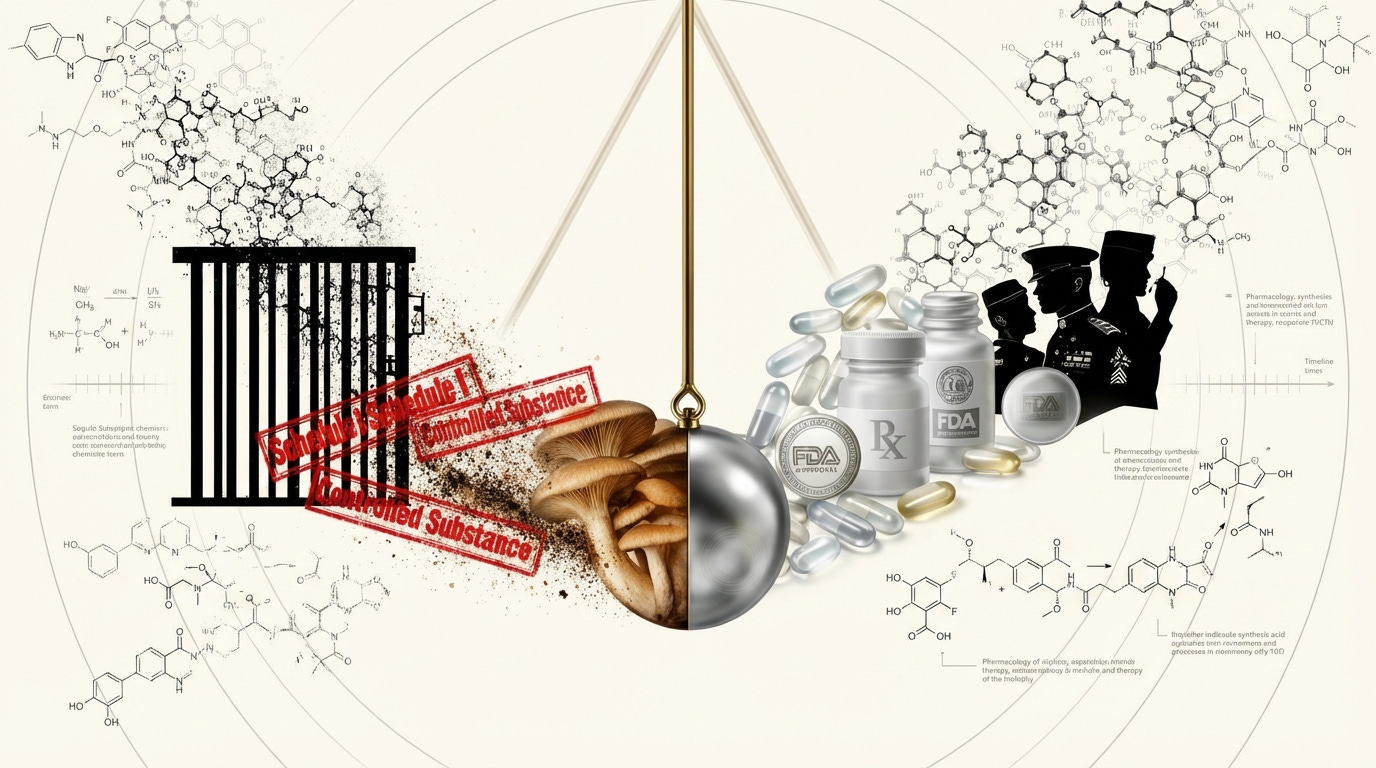
In 1994, sitting in a room with journalist Dan Baum, John Ehrlichman said something he’d been holding for decades. Nixon’s former domestic policy chief explained that the 1970 drug war, the legal architecture that classified LSD, psilocybin, and eventually ibogaine as Schedule I substances with “no currently accepted medical use,” had nothing to do with science. “We knew we couldn’t make it illegal to be either against the war or black,” Ehrlichman admitted, “but by getting the public to associate the hippies with marijuana and blacks with heroin, and then criminalizing both heavily, we could disrupt those communities.”
Last weekend, President Trump signed an executive order directing the FDA to fast-track those same Schedule I psychedelics for medical approval. The mechanism was strikingly informal: podcast host Joe Rogan texted Trump about ibogaine after learning about it from a guest. Trump replied within hours, ”Sounds great. Do you want FDA approval? Let’s do it.”
What’s happening isn’t a vindication of evidence-based drug policy over political manipulation. It’s a reminder that drug scheduling has always operated through political channels, regardless of the direction of travel. The difference now is we can see the machinery in real time, stripped of the bureaucratic facade that once made it look like science.
The Research That Never Stopped Being Promising
In the 1950s and early 1960s, psychedelic research was the most exciting frontier in psychiatry. Researchers at Spring Grove State Hospital, Harvard, and institutions across Canada were studying LSD for alcoholism, depression, and end-of-life anxiety. The Saskatchewan studies on LSD for alcoholism showed significant improvement in outcomes. Spring Grove’s work on terminal cancer patients found that a single LSD session, combined with therapy, could reduce death anxiety that had resisted every other intervention.
Then the drugs escaped the lab. By the mid-1960s, LSD was synonymous with Timothy Leary, campus protests, and the counterculture Nixon was determined to suppress. Research didn’t stop because the science failed, it stopped because the politics changed. The 1970 Controlled Substances Act placed psychedelics in Schedule I, ostensibly because they had “high potential for abuse” and “no currently accepted medical use.” But as Ehrlichman’s confession makes clear, those criteria were applied through a political filter that had little to do with pharmacology.
For decades, the evidence base remained frozen in the 1960s: tantalizing but incomplete. Then, starting in the early 2000s, researchers at Johns Hopkins made what the institution’s own staff called a “risky” decision to resurrect psychedelic research. Their 2006 study showing that psilocybin produced meaningful, lasting positive experiences in healthy participants is often credited with launching the “psychedelic renaissance.” Stanford, Harvard, and UCSF followed, all studying compounds that were still, technically, classified as having no medical value.
The VA has been quietly running psychedelic trials for years, particularly for veterans with treatment-resistant PTSD. The results have been striking enough that researchers keep using words like “dramatic” and “life-changing” in ways that academic caution usually forbids.
What Works for Veterans With PTSD
For special operations veterans, the numbers tell a story that conventional treatments struggle to address. Before the recent Stanford ibogaine study, participating veterans averaged a disability rating of 30.2 on the WHO scale, equivalent to moderate disability affecting daily functioning. One month after ibogaine treatment combined with magnesium, that rating dropped to 5.1, indicating essentially no disability. PTSD symptoms decreased by 88%, depression by 87%, anxiety by 81%.
These aren’t marginal improvements. “Before the treatment, I was living life in a blizzard with zero visibility and a cold, hopeless, listless feeling,” one Arizona veteran with six combat deployments told researchers. “After ibogaine, the storm lifted.”
The therapeutic mechanisms appear tied to neuroplasticity, quite literally rewiring how the brain processes trauma. Stanford researchers found that veterans who improved in executive function after ibogaine treatment showed increases in theta brain waves, associated with learning and cognitive flexibility. Those with reduced PTSD symptoms showed decreased complexity in cortical activity, suggesting a quieting of the heightened stress response that characterizes post-traumatic stress.
Similar patterns emerged in MDMA trials before the FDA’s 2024 rejection: in phase 3 studies, participants receiving MDMA-assisted therapy were twice as likely to lose their PTSD diagnosis compared to placebo groups, with effect sizes (Cohen’s d = 0.91 in the first trial) that would be considered exceptional for any psychiatric treatment. For veterans whose suicide rates have exceeded 6,000 annually for over twenty years—more than twice the rate of non-veterans—treatments that can produce this degree of change this rapidly aren’t just promising. They’re answering a question about survivability.
The VA’s observational study of 86 special operations veterans who received ibogaine followed by 5-MeO-DMT found sustained improvements in PTSD, depression, and anxiety lasting six months after treatment. Importantly, participants also reported significant reductions in suicidal ideation—the outcome that matters most when baseline suicide rates are catastrophic.
The Political Coalition Has Shifted; The Evidence Hasn’t Changed Much
Here’s what makes the current moment historically revealing: the scientific evidence around psychedelics hasn’t fundamentally transformed in the past five years. What’s changed is the political coalition backing them.
Peter Thiel has invested heavily in psychedelic pharmaceutical companies—Compass Pathways working on psilocybin, AtaiBeckley on various hallucinogens. When Trump’s executive order was announced, both companies’ stocks spiked. Texas committed $50 million to ibogaine clinical trials in March 2026. The Mercer Family Foundation, instrumental in Trump’s 2016 election, has donated over $1 million toward psychedelic PTSD treatment for veterans. Former Navy SEAL Marcus Luttrell, whose memoir became the film Lone Survivor, stood behind Trump at the signing ceremony alongside the CEO of Americans for Ibogaine.
This is a different coalition than the one that created Schedule I—but it’s still a coalition defined by political relationships and financial interests rather than by FDA advisory panels systematically reviewing Phase 3 trial data. The scientific review process still exists, but it’s increasingly beside the point. The FDA rejected MDMA for PTSD in August 2024 despite phase 3 trials showing strong efficacy, citing concerns about masking effects and study design. Four months later, an executive order directs the agency to fast-track ibogaine, which hasn’t completed Phase 1 safety trials and faces FDA resistance due to cardiac toxicity concerns.
The pattern here isn’t “politics corrupting science” in one direction and “science correcting politics” in the other. It’s that drug policy has always been shaped by which political coalition controls the levers, with scientific evidence serving as post-hoc justification for decisions made on other grounds.
Why the Official Pathway Wasn’t Enough
The uncomfortable question this raises: If the VA’s psychedelic trials were producing such dramatic results, why did policy change require Joe Rogan’s text message rather than those clinical findings?
The answer suggests something about how institutions actually process evidence versus how we imagine they do. The FDA’s priority review voucher program, designed to accelerate promising treatments, theoretically could have fast-tracked psychedelics years ago based on the mounting clinical data. There were reports that Compass Pathways’ synthetic psilocybin was on the initial voucher list in February, but the White House removed it. The new executive order now explicitly directs the FDA to provide these vouchers for psychedelics with breakthrough therapy designation, sending a signal that the prior resistance was political, not scientific.
This isn’t unique to psychedelics. The history of drug policy is filled with substances whose legal status bore little relationship to their actual pharmacological risk profile. Cannabis remained Schedule I for decades while demonstrably more dangerous substances sat in lower schedules. The rescheduling of marijuana is happening now not because new research revealed it was safe, that research existed for years, but because the political coalition supporting legalization finally gained enough power.
The current psychedelic push follows the same pattern in reverse: a political coalition with access to executive power can move policy faster than any amount of clinical evidence flowing through official channels. Rogan’s podcast reaches millions; his text reached the president. That’s a more efficient pathway than publishing in Nature Medicine, however rigorous the methodology.
Whenever in doubt, follow the money. Science hugely suffers in that respect. And when politicians are involved, also follow reelectability. Which in turn is also about access to money,... and power of course!
There are so many things ignored in medical field that are not in the interest of the people/patients.
I'm considering writing a piece about Vitamin C for example. Just to name one of many.
Great piece!
Politics has set back legitimate scientific research decades in regards to these drugs. It's more than about time we lifted these research restrictions.