


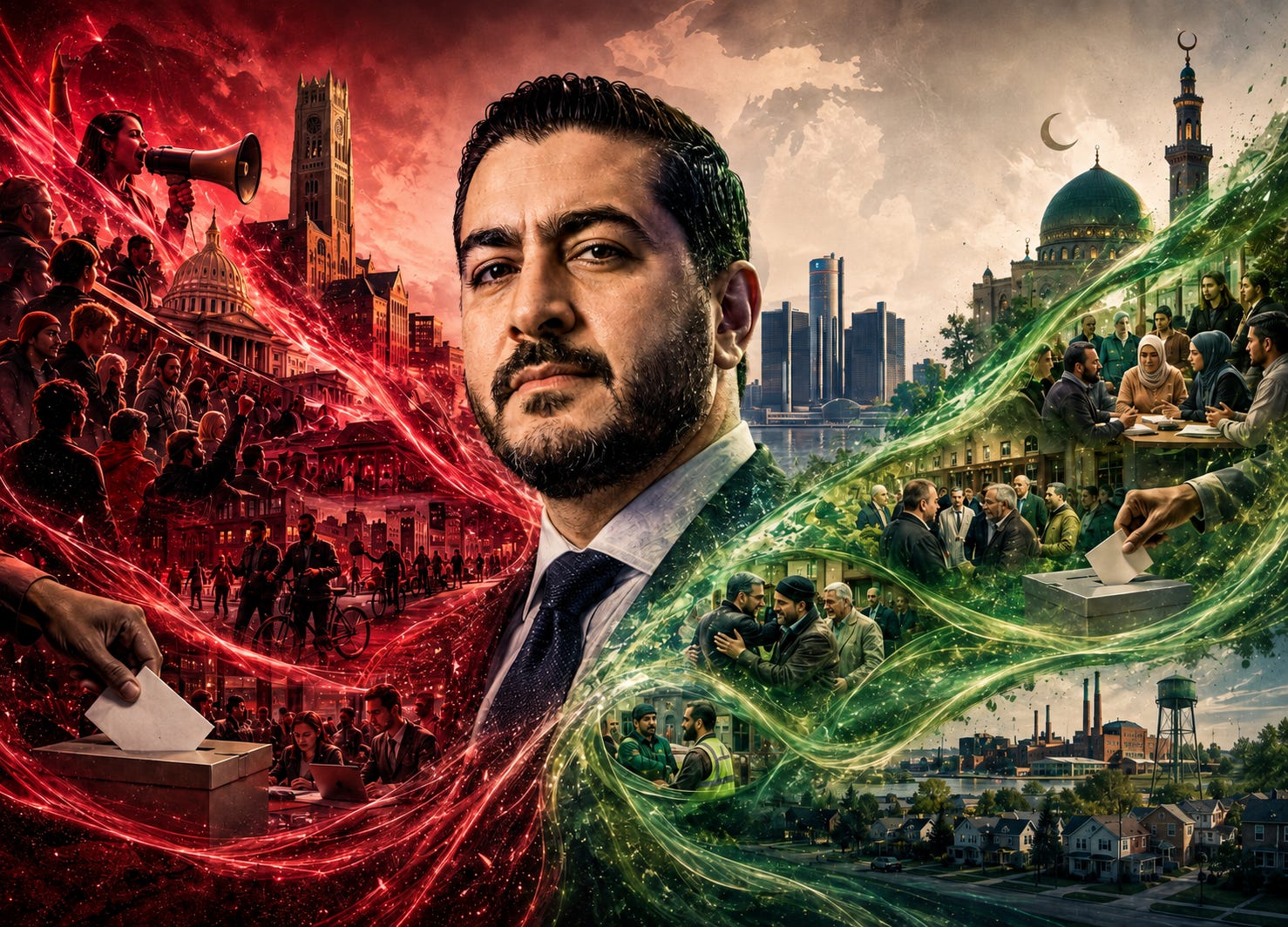
On the night of August 4, 2026, Abdul El-Sayed narrowly defeated Rep. Haley Stevens in Michigan’s Democratic Senate primary — becoming the first Muslim ever nominated by a major American party for the U.S. Senate. He overcame enormous sums of spending against him, a late endorsement of Stevens by Gov. Gretchen Whitmer, and the alignment of nearly the entire state Democratic establishment. Most coverage has framed the result as a far-left, progressive upset.
This reading is incomplete. What happened in Michigan was the convergence of two political movements that had spent the previous decade building separate but increasingly complementary infrastructures: a far-left, Bernie Sanders-style progressive base and a Muslim political organizing network centered in Dearborn. Arguably, neither could have delivered a Senate nomination alone. Together, they did. El-Sayed didn’t cause the confluence. He is it.
Wing One: The Muslim Dearborn Base
The first current began on the factory floor in the early 20th century. In January 1914, Henry Ford announced the $5-a-day wage at his Highland Park plant, and Lebanese Muslims from the Bekaa Valley settled Dearborn’s Southend to work the Rouge Complex. The 1965 Hart-Celler Immigration Act abolished national-origin quotas and installed family reunification as the dominant admission category, growing the U.S. Muslim population from roughly 150,000 in 1965 to approximately three million today. The Lebanese Civil War (1975–1990) drove Shia refugees into Dearborn; a peak wave of Yemenis settled Hamtramck’s Polish neighborhoods; the 1991 Gulf War and the 2003 Iraq War produced 19,490 Iraqi refugees placed in Michigan by federally contracted resettlement agencies.
The political payoff arrived on a fixed schedule. In 2013, Hamtramck became the first Muslim-majority city in the United States; in 2015 it elected the first Muslim-majority city council; by 2022 the council and mayor were entirely Muslim-American. In 2018, Rashida Tlaib — a Democratic Socialists of America member endorsed by Justice Democrats — won Michigan’s 13th Congressional District. In 2020, Abraham Aiyash, a Yemeni-American from Hamtramck, won a Michigan House seat with 89.7 percent of the general vote; by 2023 he was House majority floor leader. In 2021, Abdullah Hammoud became Dearborn’s first Arab-American mayor.
Then came the Uncommitted movement, launched in late 2023 to pressure the Biden administration over its Gaza policy. In Michigan’s February 2024 Democratic presidential primary, more than 100,000 votes went to “Uncommitted.” That November, Kamala Harris’ share of the Dearborn vote collapsed from Biden’s 69 percent in 2020 to 36 percent. Trump carried Michigan.
Wing Two: The Far-Left Squad Machine
The second current is much younger and runs from a college-town uprising. On March 8, 2016, Bernie Sanders won the Michigan Democratic presidential primary 49.7 to 48.3 — despite trailing Hillary Clinton in polling by an average of 21.4 points. It was the largest polling miss of the modern primary era. Sanders swept independents 71–28, dominated Washtenaw, Ingham, and Kalamazoo counties, and turned Michigan into what FiveThirtyEight called a “major turning point.”
The infrastructure followed immediately. Kelly Collison — who had founded Michigan for Bernie in 2015 — and Sam Pernick of the Michigan Young Democrats founded Michigan for Revolution (M4R) to organize former Sanders voters inside the state party. By the February 2017 Michigan Democratic Party convention at Cobo Center, M4R had built 18 chapters, signed up more than 1,000 new party members, captured the chairmanship of the MDP Progressive Caucus, and placed more than 40 members on the state central committee.
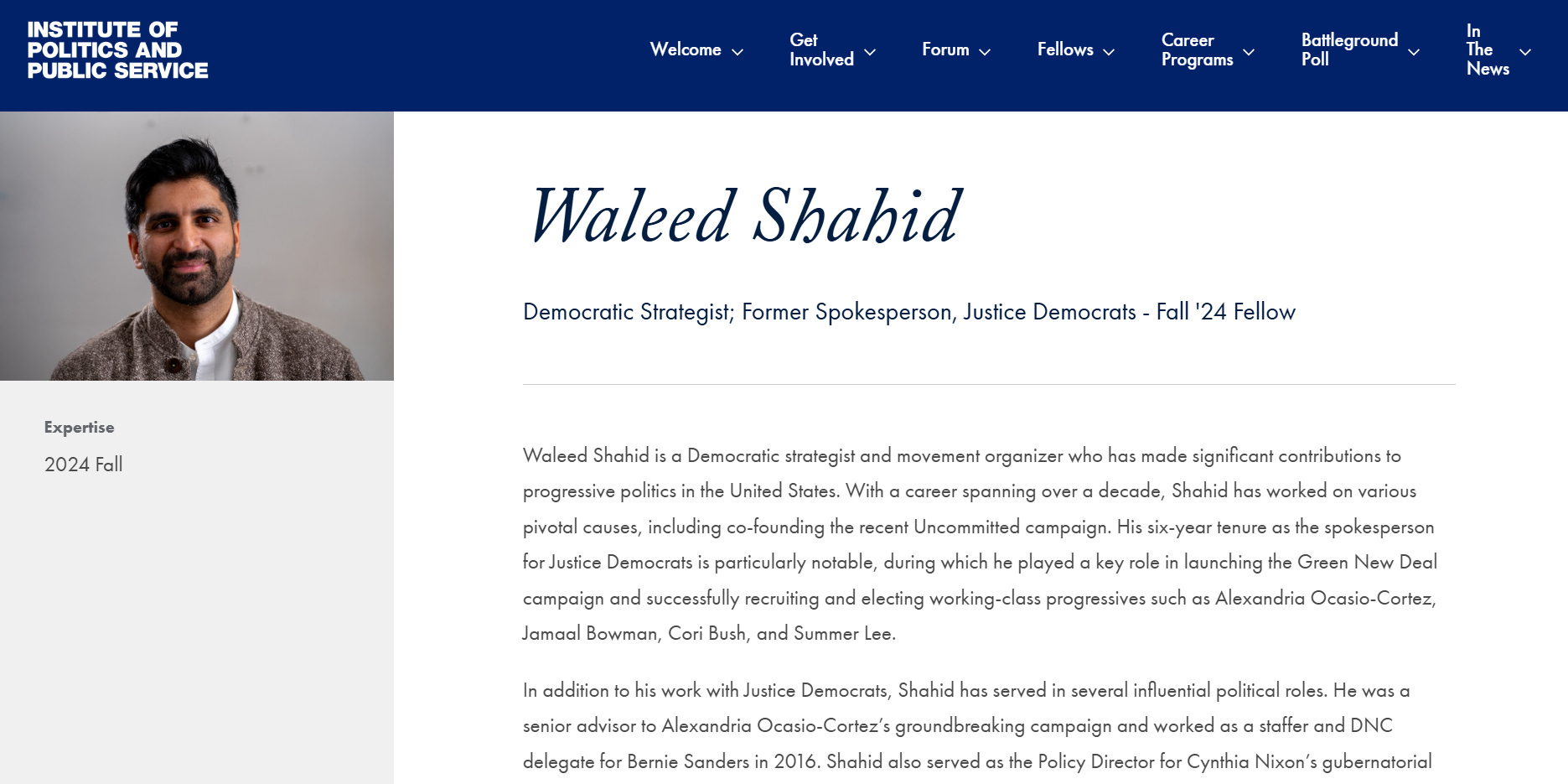
The same year in Washington, former Sanders staff founded Justice Democrats — the recruiting apparatus that would elect Alexandria Ocasio-Cortez, Cori Bush, and Jamaal Bowman. Its communications director was Waleed Shahid, a Pakistani-Muslim organizer from Arlington, Virginia.
Metro Detroit’s Democratic Socialists of America chapter, which had fallen below 700 members in 2023, has nearly doubled to 1,400 members and set a public target of 3,000 by the end of 2028. In November 2025, DSA members Denzel McCampbell and Gabriela Santiago-Romero won two Detroit City Council seats. In February 2026, the Michigan Working Families Party announced a coordinated statewide slate under state director Branden Snyder — the former founder of Detroit Action — telling Michigan Advance the WFP was executing a “10-year plan to co-govern” modeled on the New York coalition that had just elected Zohran Mamdani.
The Man Who Is Both
El-Sayed’s biography reads like the two currents braided into a single person. He was born October 31, 1984, in Rochester Hills — the Detroit suburb where the Islamic Association of Greater Detroit, had been founded six years earlier by thirty immigrant families. His father Mohamed had arrived from Egypt in 1978 on a Wayne State University engineering fellowship — the Hart-Celler pathway in one biography.
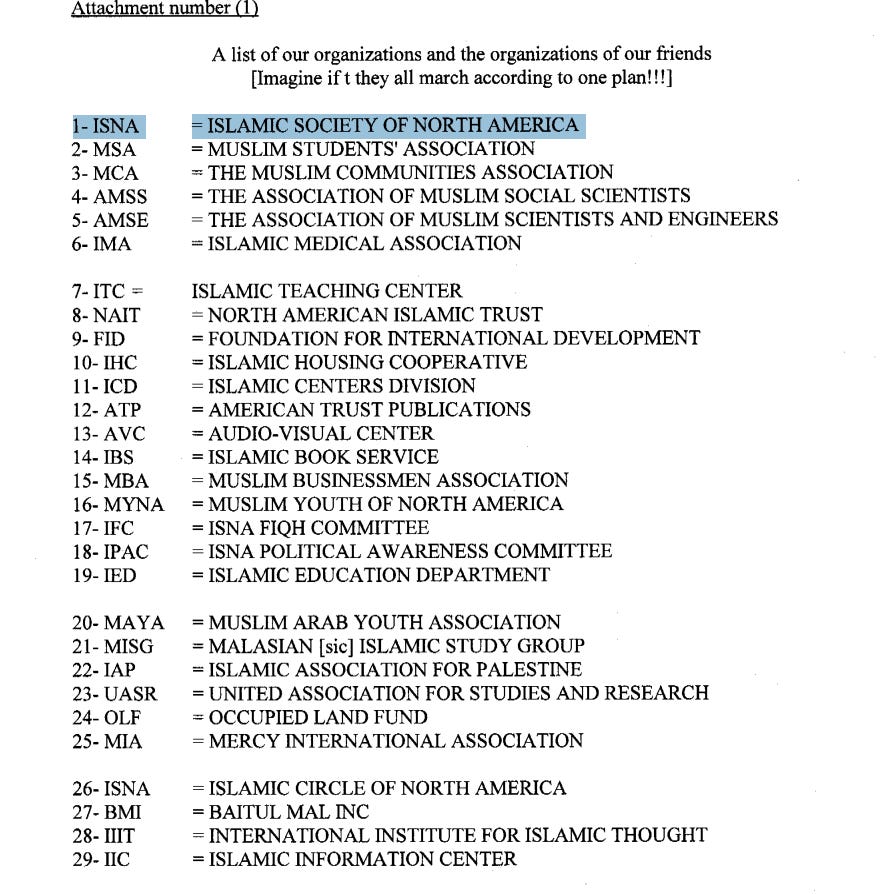
At the University of Michigan, El-Sayed served as vice president of the campus Muslim Students Association. (MSA). The MSA was allegedly founded by members of the Muslim Brotherhood and was among the organizations listed in a 1991 internal memorandum written by a Muslim Brotherhood member and later introduced as evidence during the Holy Land Foundation prosecution. He described the role himself in a 2012 Nation piece: “MSA of Michigan was many times named student organization of the year… we were normally at the lead of issues concerning minority student groups and religious organizations on campus.” He then married into the Tayeb family.

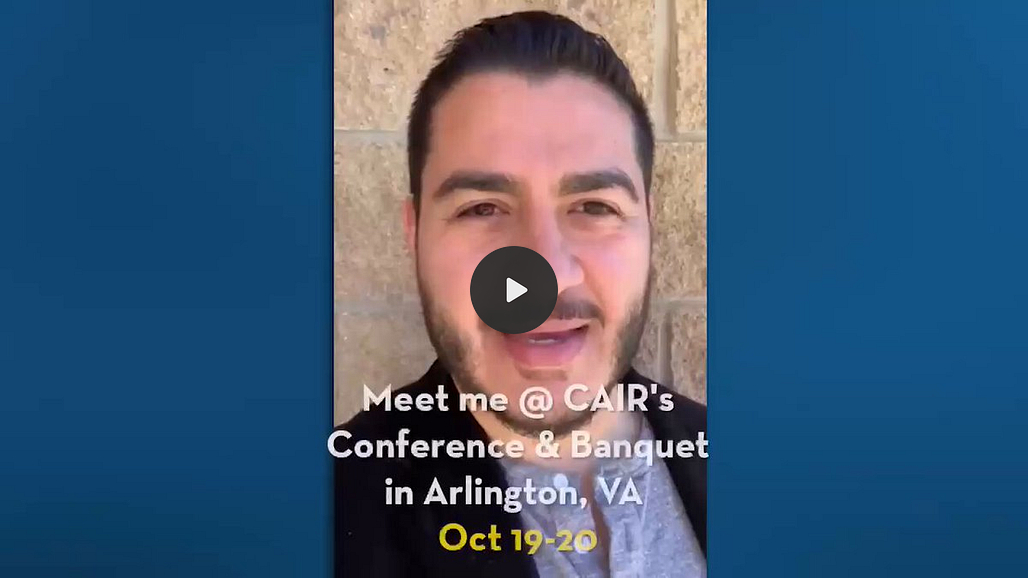
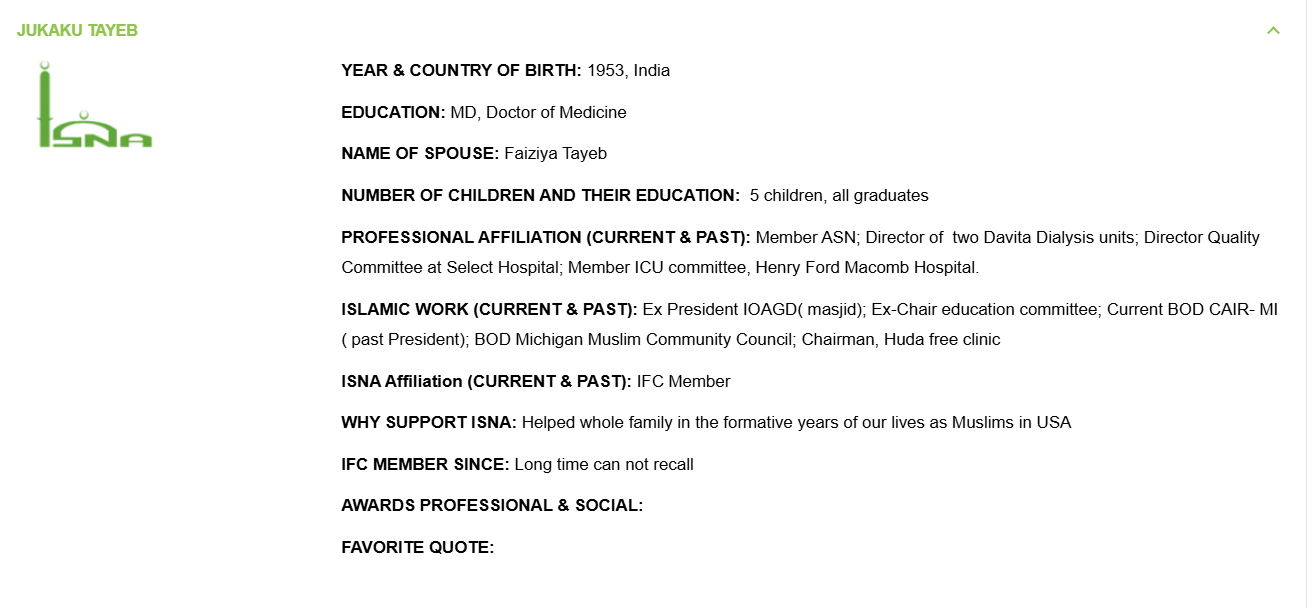
His father-in-law, Jukaku Tayeb, self-identifies on the Islamic Society of North America’s own website as an ISNA Founders Committee member, past president of CAIR-Michigan, current CAIR-Michigan board member, board member of the Michigan Muslim Community Council, chairman of the HUDA Free Clinic, and past president of the Islamic Association of Greater Detroit — the Rochester Hills mosque whose co-founder, Dr. Ghaus Malik, currently chairs ISNA’s Founders Committee.
These organizations are nor trivial. ISNA is listed in the 1991 Muslim Brotherhood “Explanatory Memorandum” as one of “our organizations,” a document outlining a long-term strategy of influence in North America of “civizational jihad.” The United Arab Emirates placed CAIR on a list of designated terrorist organizations in 2014. In 2025, the governors of Texas and Florida issued their own state-level designations, which CAIR challenged in federal court. In the Holy Land Foundation trial, the largest terror-financing trial in U.S. history, federal prosecutors named both ISNA and CAIR as unindicted co-conspirators linked to the U.S. Muslim Brotherhood network that supported Hamas.
In August 2015, Detroit Mayor Mike Duggan appointed El-Sayed — then thirty and with no elected experience — executive director of the Detroit Health Department, providing the establishment-Democratic credential. In 2018, he ran for governor. Sanders endorsed him. Alexandria Ocasio-Cortez endorsed him. Linda Sarsour headlined the #MyMuslimVote rally in Dearborn. It was the first documented moment the two wings shared a stage. In 2019, El-Sayed headlined a $10,000 fundraiser for Detroit DSA — where organizers called him “a longtime friend” and he was photographed alongside Tlaib behind a banner depicting a hand marked “DSA” choking a snake marked “capitalism.” He also insists — accurately — that he is “not technically or practically DSA.” Both statements are true.
The Convergence
By the primary’s closing week, everything each wing had built for a decade was running in the same seventy-two hours. Bernie Sanders and Alexandria Ocasio-Cortez barnstormed the state with El-Sayed; the full congressional Squad endorsed him; DSA volunteers who covered their red shirts with green ones to knock doors more comfortably worked the ground game. On July 24 — the same Friday — CAIR Executive Director Nihad Awad delivered the sermon at the IONA mosque in Warren, praising “mosques renting buses to take people to the polls,” while Imam Hassan Qazwini urged congregants at his Islamic Institute of America in Dearborn Heights to treat voting as a religious duty against the “pro-Israel lobby.”
The Fighting for Michigan super PAC supporting El-Sayed collected $200,000 — nearly half its total — from his father-in-law. On August 4, El-Sayed won. The same night, Sunrise Movement co-founder William Lawrence took Michigan’s 7th District primary; Working Families Party endorsee Donavan McKinney, a DSA member, advanced in the 13th.
What Comes Next
El-Sayed now faces former Republican Rep. Mike Rogers in November, in a race that could decide control of the U.S. Senate. But the more consequential outcome has already occurred. A coalition that was theoretical five years ago — a college-town Sanders base and a Ford-era mosque geography, running the same slate under the same infrastructure — is now field-tested.
Michigan will be studied by organizers in New Jersey, Illinois, and Minnesota, where similar demographic and ideological currents run in parallel. The story on August 4 was not that a progressive won a primary. It was that the two rivers merged.