

How the Soros Family's Open Society Helped Build the Quincy Institute
Tax filings and lobbying records reveal a personnel and funding pipeline connecting Open Society's advocacy arm to the influential, Iran-linked foreign policy organization

The Quincy Institute for Responsible Statecraft—whose co-founder is now allegedly under State Department review over decades of Iran-related advocacy—has become one of Washington's most influential foreign policy voices since its December 2019 launch, pushing appeasement toward Iran and other U.S. adversaries, opposing American arms sales, and shaping congressional action on war powers.
Scrutiny of Quincy has intensified since the launch of Operation Epic Fury, renewing attention to the think tank’s rapid rise and the network that helped establish it.
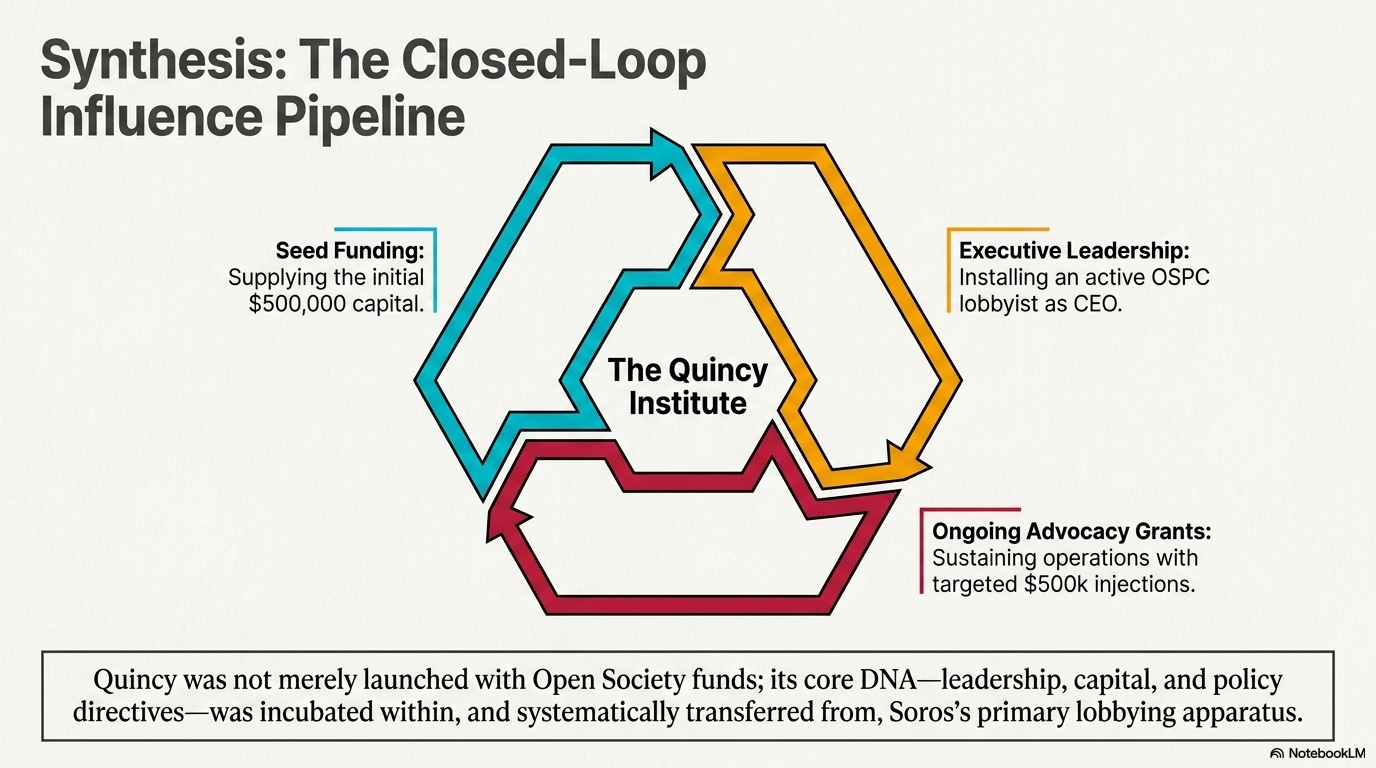
Public records show the think tank was built with sustained support from George Soros’s lobbying operation. Soros's Open Society Foundations helped finance Quincy's launch, and its lobbying arm — the Open Society Policy Center — supplied the think tank's first CEO from its own registered lobbyists and later awarded Quincy a $500,000 grant for policy advocacy, according to IRS filings.
The pipeline runs through Lora Lumpe. In late 2019, Lumpe was lobbying Congress on behalf of OSPC on military spending, arms exports, and presidential war powers. Four months later, she became Quincy’s first CEO — leading a Washington institution working many of the same issues.
From Lobbyist to CEO
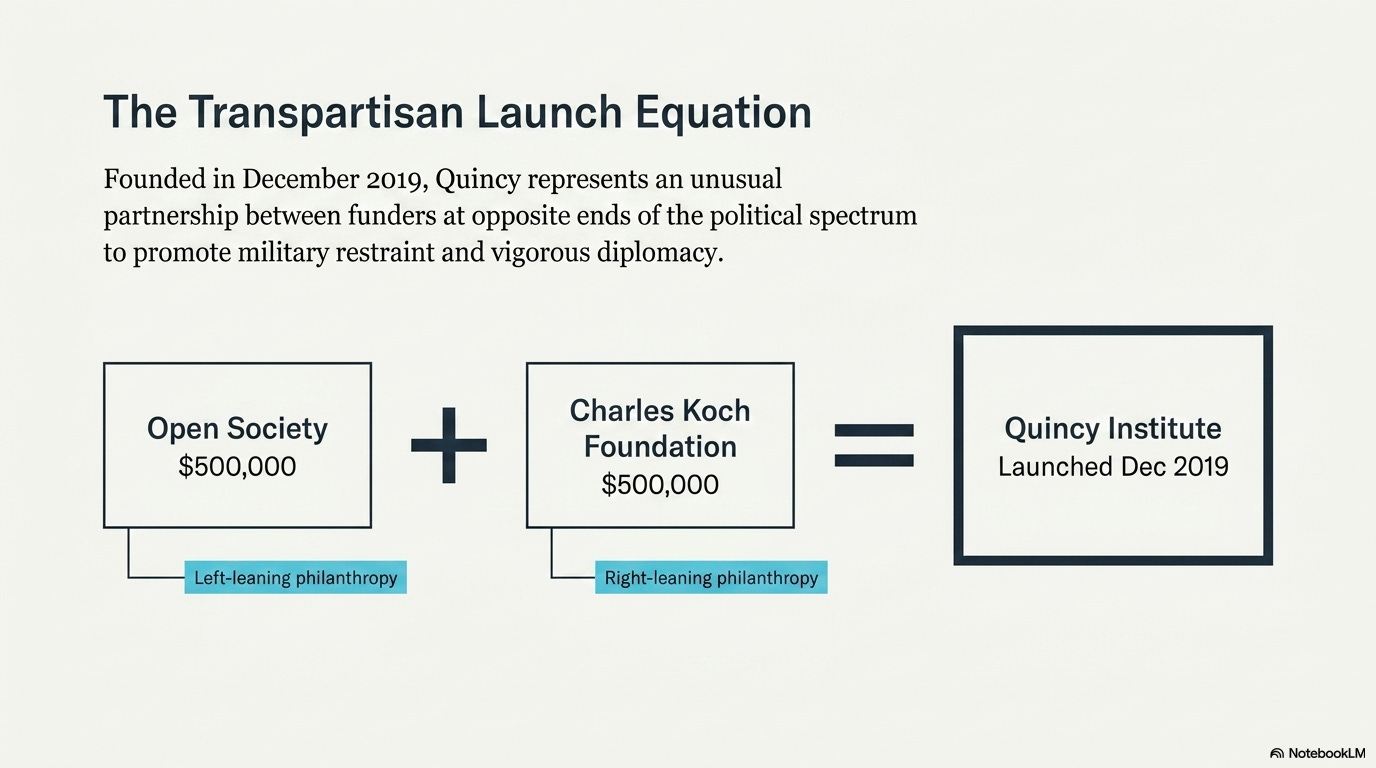
That field was where Quincy positioned itself. The think tank launched in December 2019 with approximately half a million dollars each from Open Society and the Charles Koch Foundation — a transpartisan pairing meant to promote “military restraint” and diplomacy over “endless war.”
Three months after launch, Quincy named Lumpe its first chief executive officer. “Lora has a decades’ long track record of effectively moving the conversation on U.S. militarism and war toward diplomacy and peaceful solutions,” Suzanne DiMaggio, chairman of Quincy’s board, said in the announcement. Lumpe left OSPC in April 2020 to take the position.
The transition placed an Open Society lobbyist with direct experience on war powers, arms sales, and defense appropriations at the head of a new institution built to reshape debate on those same subjects. That leadership continues to inform Quincy’s public output—including the recent “$7,000 claim for pro-Israel content” and “IDF-U.S. military merger” claims about American aid to Israel that circulated widely on social media and were traced back to Quincy analysis.


The Advocacy Grant
Open Society’s role did not end with Lumpe’s departure. In 2021, OSPC’s Form 990 filing documented a $500,000 grant to the Quincy Institute for “support policy advocacy.”
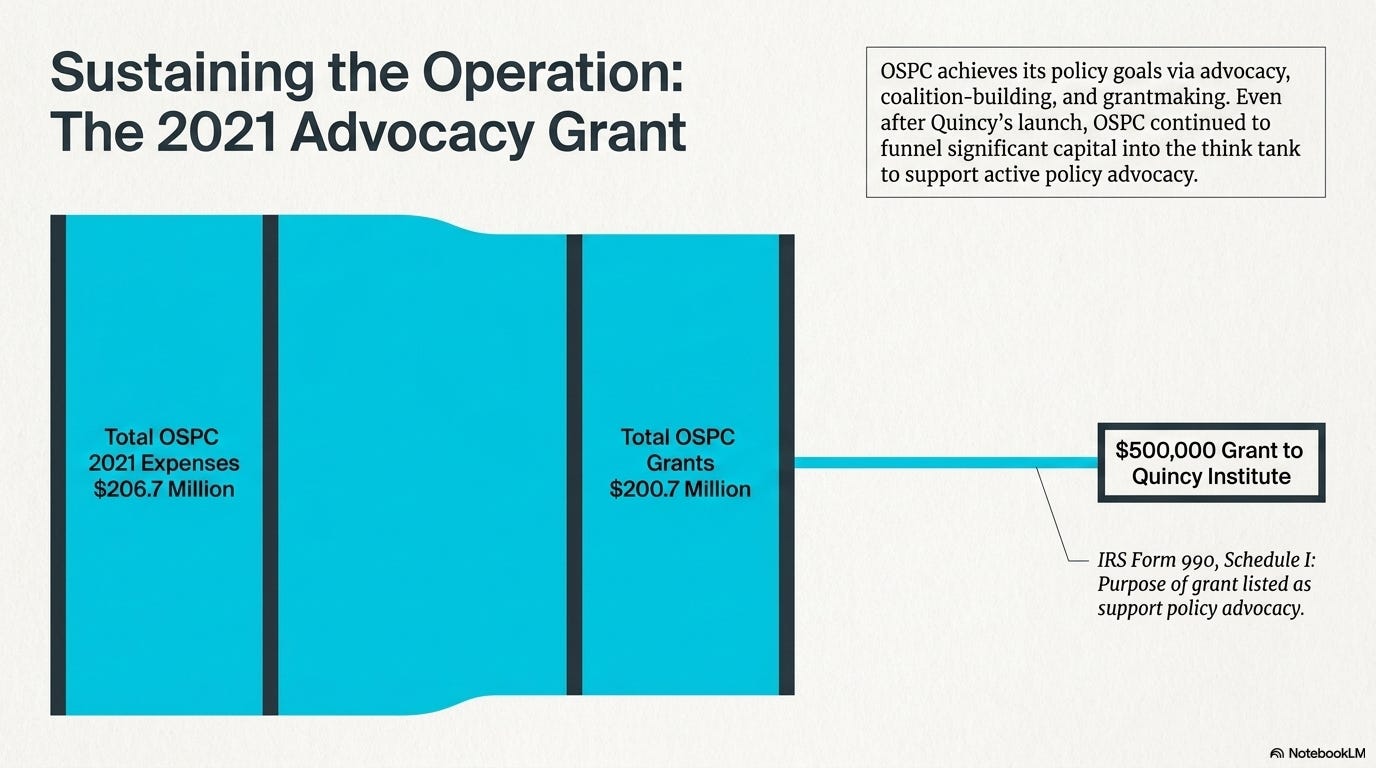
The grant appeared in a year when OSPC reported $206.7 million in total expenses and made grants totaling $200.7 million. Its program description listed “military assistance & export control” among its domestic policy priorities — the same subject area Lumpe had lobbied on in 2019.
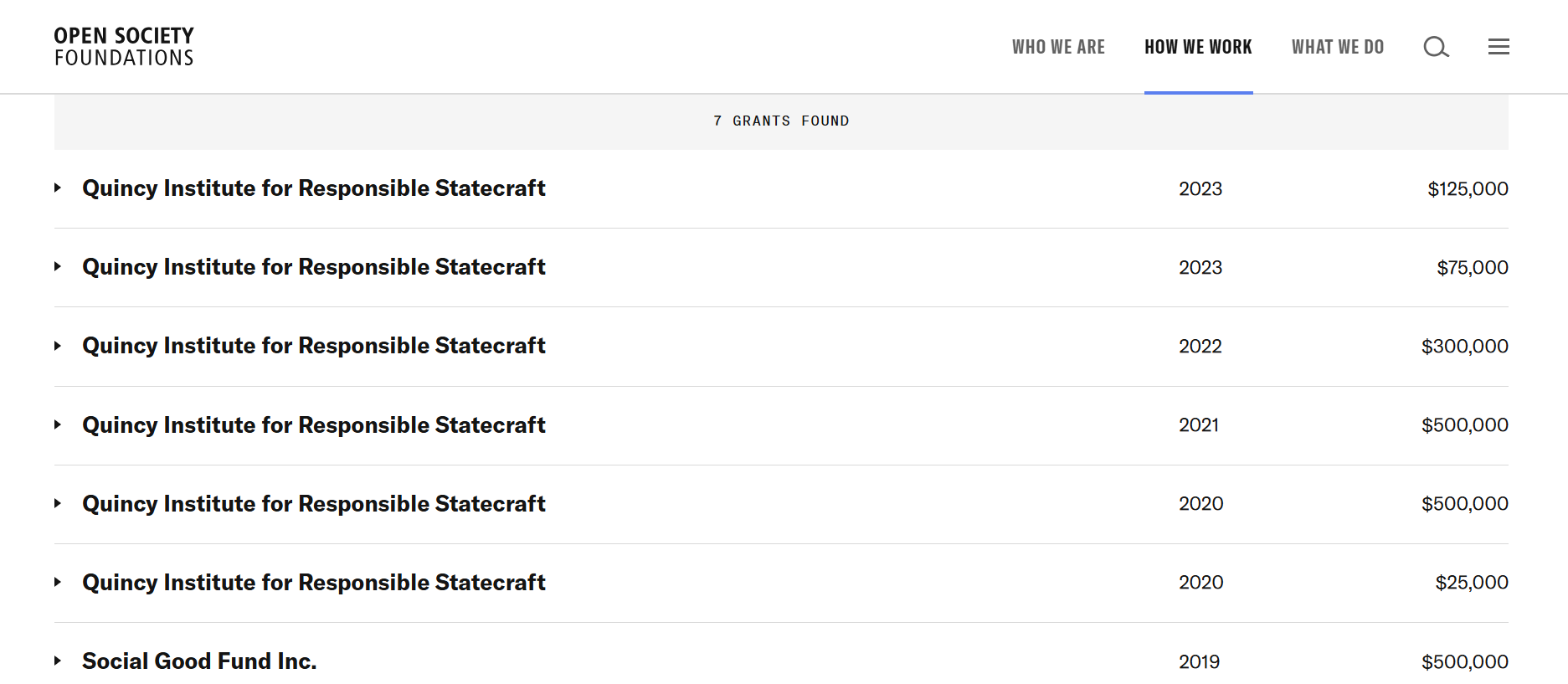
The Open Society Foundations online grant portal shows that it has funded Quincy to the tune of $1,525,000 between 2019 and 2023.
The Parsi Paper Trail
The Iran connection runs through Trita Parsi—Quincy’s co-founder and executive vice president—who is reportedly under State Department review, which is weighing whether to revoke his green card and deport him over his decades of Iran-related advocacy and potential coordination with the regime.
Before helping launch Quincy, Parsi founded and led the National Iranian American Council. When NIAC sued a blogger for defamation in 2008 over articles calling it an Iran lobby, the case collapsed—and Judge John Bates, a Bush appointee, wrote that Parsi’s occasional balanced statements were “not inconsistent with the idea that he was first and foremost an advocate for the regime.”
The discovery process pried thousands of internal records into the public docket. They tell their own story. A 2003 memo first reported by Foreign Policy shows Parsi pitching “the creation of an Iranian-American lobby“ modeled on AIPAC—and naming himself as its executive director. A 1999 paper Parsi co-authored with a Tehran-based consultant argued for the same project, footnoted with interviews of officials from Iran’s Foreign Ministry. And a December 2002 email shows Parsi handing a Washington lobbyist the contact details for Mohammad Javad Zarif, then Iran’s ambassador to the United Nations and later the regime’s foreign minister.


Parsi has consistently denied that NIAC worked on behalf of the Iranian government. He remains executive vice president of the Quincy Institute.
A Continuing Portfolio
The subjects Lumpe lobbied on at OSPC in 2019 remained central to Quincy’s work after she took over. The think tank advocated for congressional action on Yemen war powers and criticized executive war-making. It has produced research on Pentagon spending, arms sales oversight, and military assistance policy in the Middle East.
Quincy registered under the Lobbying Disclosure Act and has reported federal lobbying activity, though at a fraction of OSPC’s scale.
Separate, But Connected
OSPC did not fold when Quincy launched. The organization—now operating publicly under the Open Society Action Fund branding — reported $257 million in revenue and $246 million in expenses for fiscal year 2023, its most recent Form 990 filing. It remains a 501(c)(4) social welfare organization permitted to engage in unlimited lobbying. Quincy is a separate 501(c)(3).
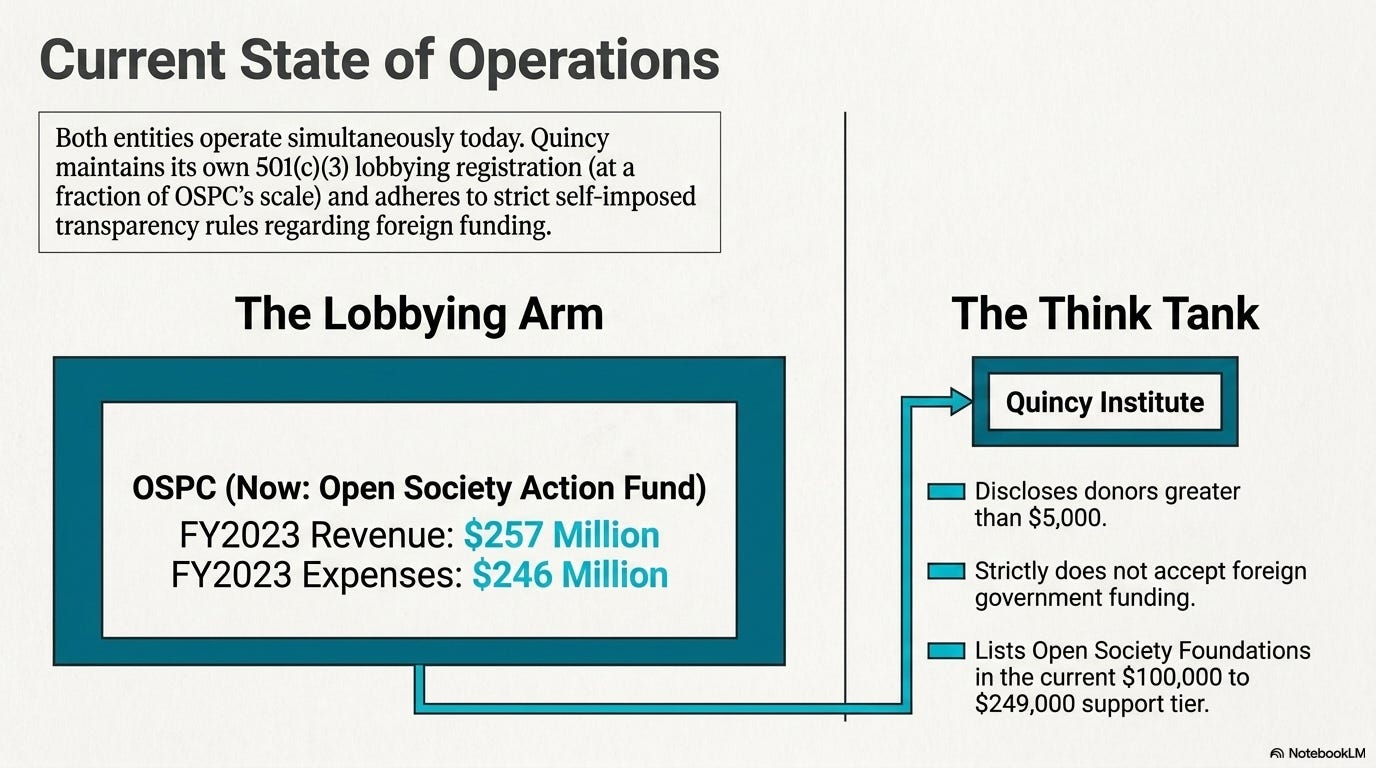
The two organizations operate in parallel. Quincy’s transparency page states it “does not accept funding from foreign governments” and discloses all donors of $5,000 and above.
What the Filings Show
Public records do not reveal how deliberately the pipeline was built. Grant agreements, internal approval memoranda, and communications surrounding Lumpe’s recruitment remain unavailable.
What the tax returns and lobbying disclosures do show, however, is that Soros’s lobbying arm helped finance Quincy’s launch, supplied its first chief executive from its own registered lobbyists, and continued funding its advocacy work in the years that followed — a documented pipeline of personnel and money from a major lobbying operation to one of Washington’s most influential foreign policy institutions.