


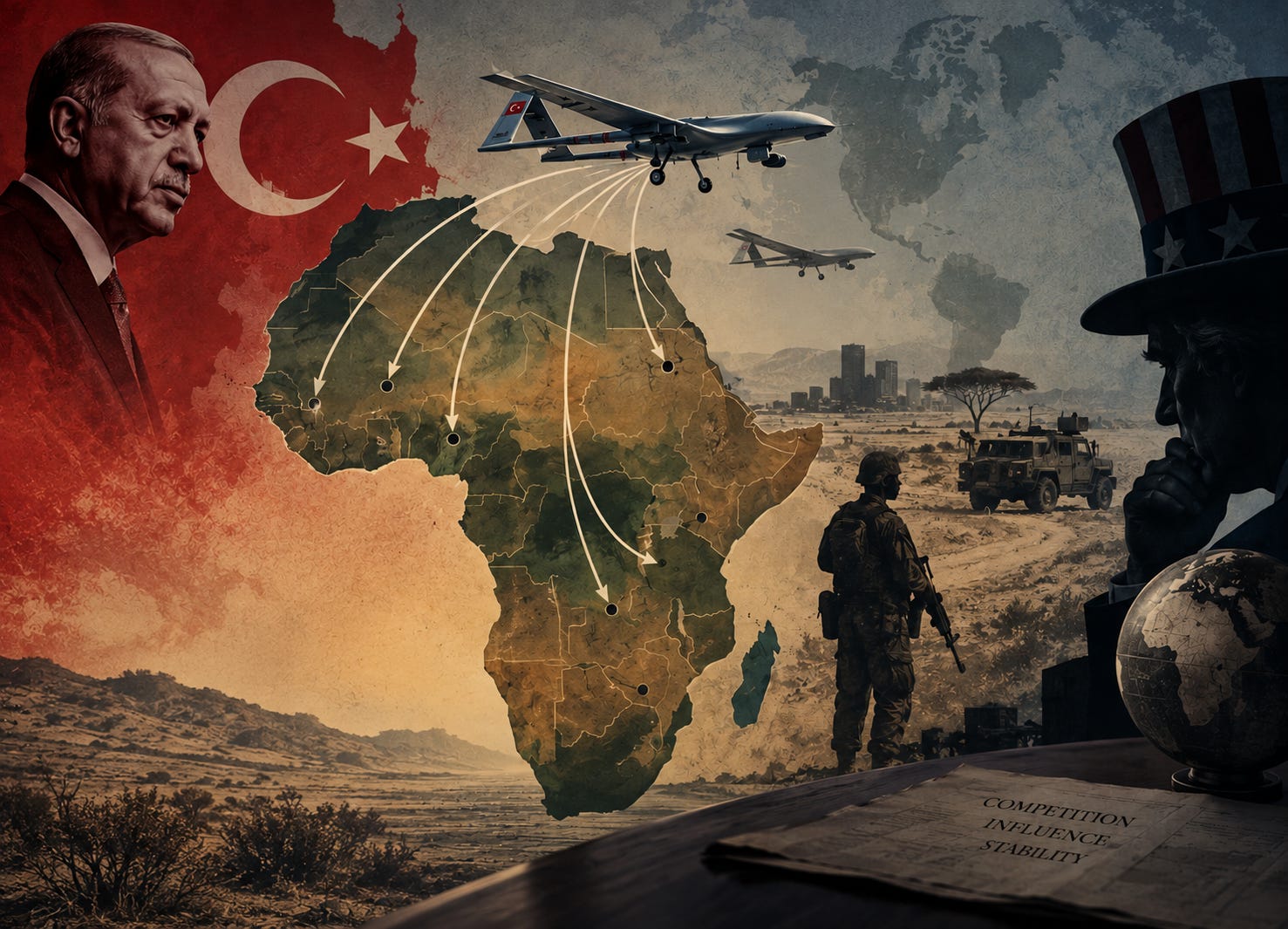
Turkey’s growing presence in Africa is usually discussed in terms of drones, military partnerships and President Recep Tayyip Erdoğan’s effort to expand Ankara’s geopolitical reach. A new study suggests another force is driving that expansion: Turkey’s defense industry increasingly needs foreign customers simply to sustain itself.
Published September 14 by the German Institute for International and Security Affairs, or SWP, the report finds that Turkey’s rapid defense buildup has created an industrial ecosystem that domestic military procurement alone can no longer absorb. Africa has consequently become an important market for keeping production lines active, expanding major defense companies and opening export channels for smaller manufacturers.
For the United States, the findings offer a window into how a NATO ally with an increasingly independent foreign policy is building military relationships in countries where Washington also competes for influence.
From Import Dependence to Export Dependence
Turkey spent decades trying to reduce its reliance on foreign weapons. The effort accelerated under Erdoğan’s Justice and Development Party. According to SWP, the number of Turkish defense companies rose from just 56 in 2002 to roughly 1,500 by 2020. By 2026, the industry included nearly 4,500 small and medium-sized enterprises, while the number of defense projects had climbed from 62 in 2002 to more than 1,000 by 2024.
That expansion reduced Turkey’s reliance on foreign suppliers but created another problem. The country’s military could not absorb all the competing platforms and production capacity.
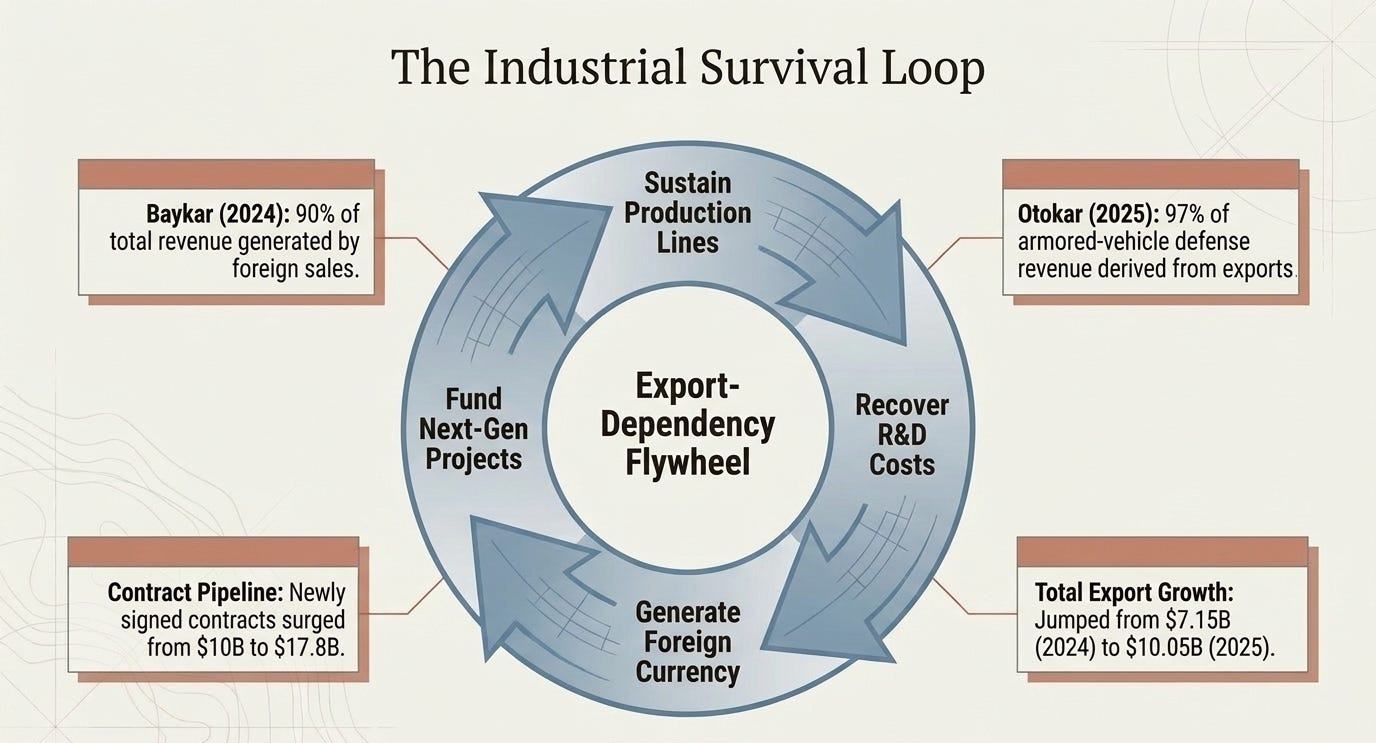
Exports increasingly became necessary to sustain production lines, recover research and development costs and generate foreign currency, according to the report. In 2025, exports accounted for 97 percent of armored-vehicle manufacturer Otokar’s defense revenue, while foreign sales generated 90 percent of Baykar’s revenue in 2024.
Overall Turkish defense exports jumped from $7.15 billion in 2024 to $10.05 billion in 2025, while newly signed contracts increased from $10 billion to $17.8 billion during the same period.
Why Africa Matters
Africa represents a relatively small share of global military spending, but SWP finds that it performs several important functions for Turkish manufacturers.
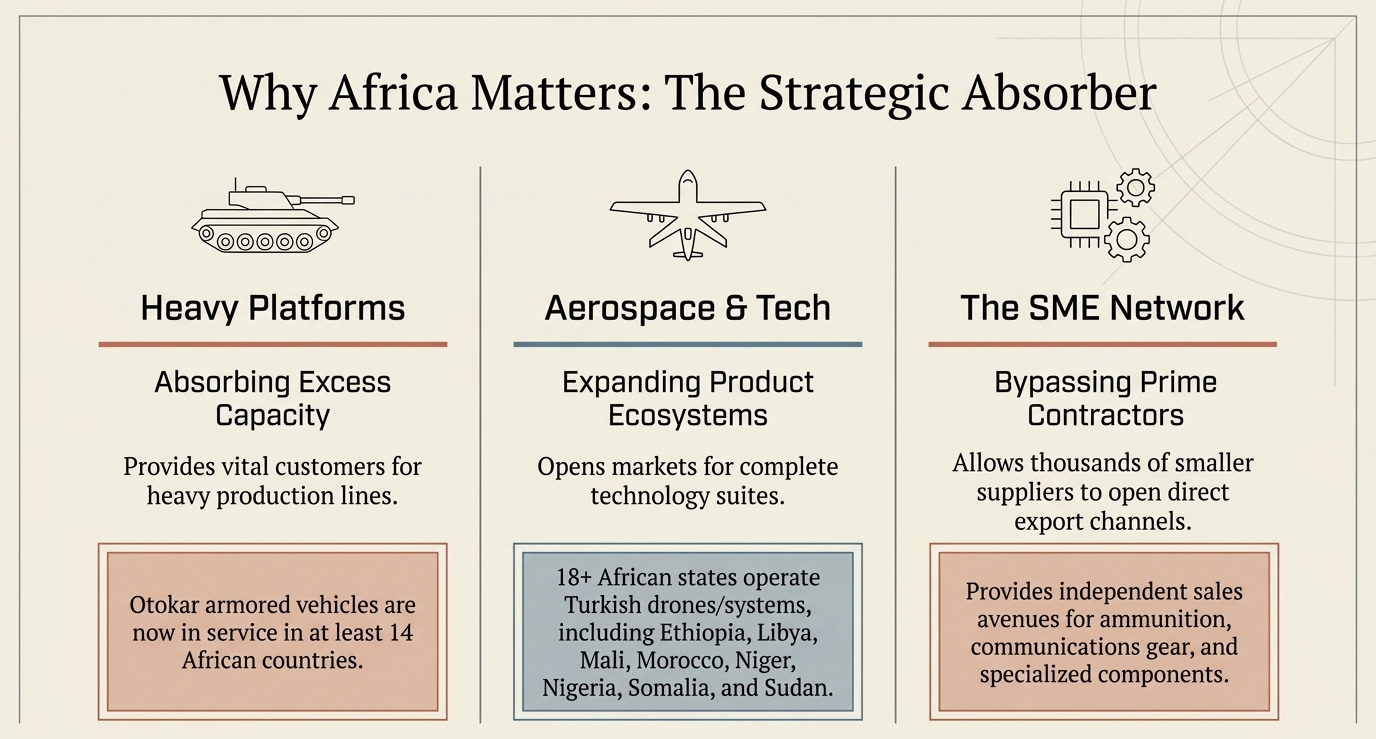
Armored-vehicle companies gain customers for production capacity that Turkey’s military cannot absorb. Aerospace and electronics companies gain additional markets for their expanding product lines. Smaller suppliers can sell ammunition, communications equipment, components and other systems without relying entirely on Turkey’s largest contractors.
The result has been a rapid increase in Ankara’s market share. According to SIPRI data cited by the report, Turkey increased its share of major-arms transfers to sub-Saharan Africa from 6.3 percent in 2019-2023 to 11 percent in 2021-2025, overtaking France to become the region’s third-largest supplier behind China and Russia.
Otokar vehicles are now in service in at least 14 African countries. Approximately 18 African states have reportedly received Turkish drones or related systems, including Ethiopia, Libya, Mali, Morocco, Niger, Nigeria, Somalia and Sudan. Those sales often extend beyond the aircraft themselves to ground stations, communications equipment, precision munitions, software, training and maintenance.
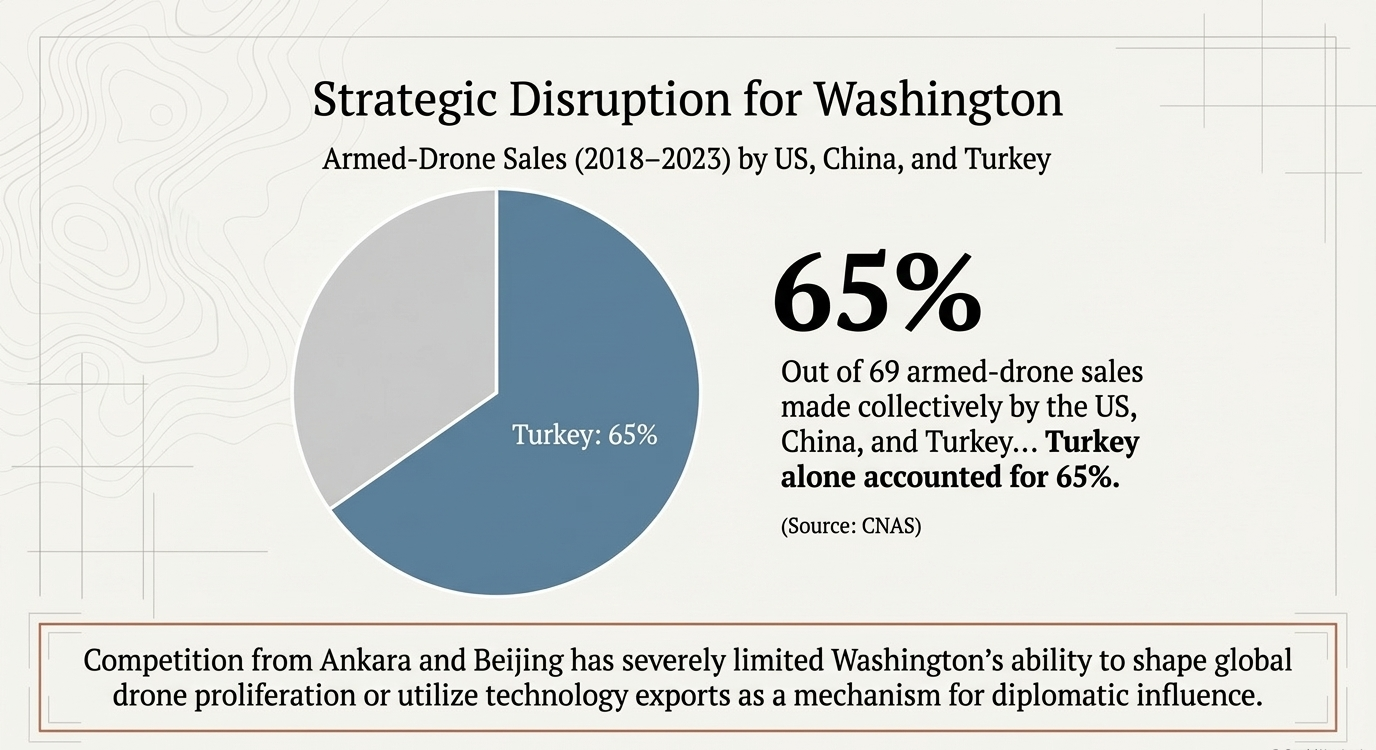
That expansion has implications for Washington. A dataset from the Center for a New American Security found that between 2018 and September 2023, Turkey accounted for 65 percent of the 69 armed-drone sales made collectively by Turkey, China and the United States. CNAS concluded that competition from Turkey and China has limited Washington’s ability to shape drone proliferation and use drone exports as a source of diplomatic influence.
Turkish Weapons in Sudan’s Civil War
The risks described by SWP are especially visible in Sudan, which the report calls the “most sensitive case” for Turkey’s problems with end-use control.
Sudan has been engulfed in civil war since April 2023 between the Sudanese Armed Forces, or SAF, and the paramilitary Rapid Support Forces, or RSF. The war has displaced roughly 14 million people, while nearly 20 million face hunger.
Turkish weapons are being used in the conflict.
Amnesty documented numerous recently manufactured Turkish weapons in Sudan and found that Sarsılmaz, one of Turkey’s largest firearms manufacturers, supplied small arms to the SAF.
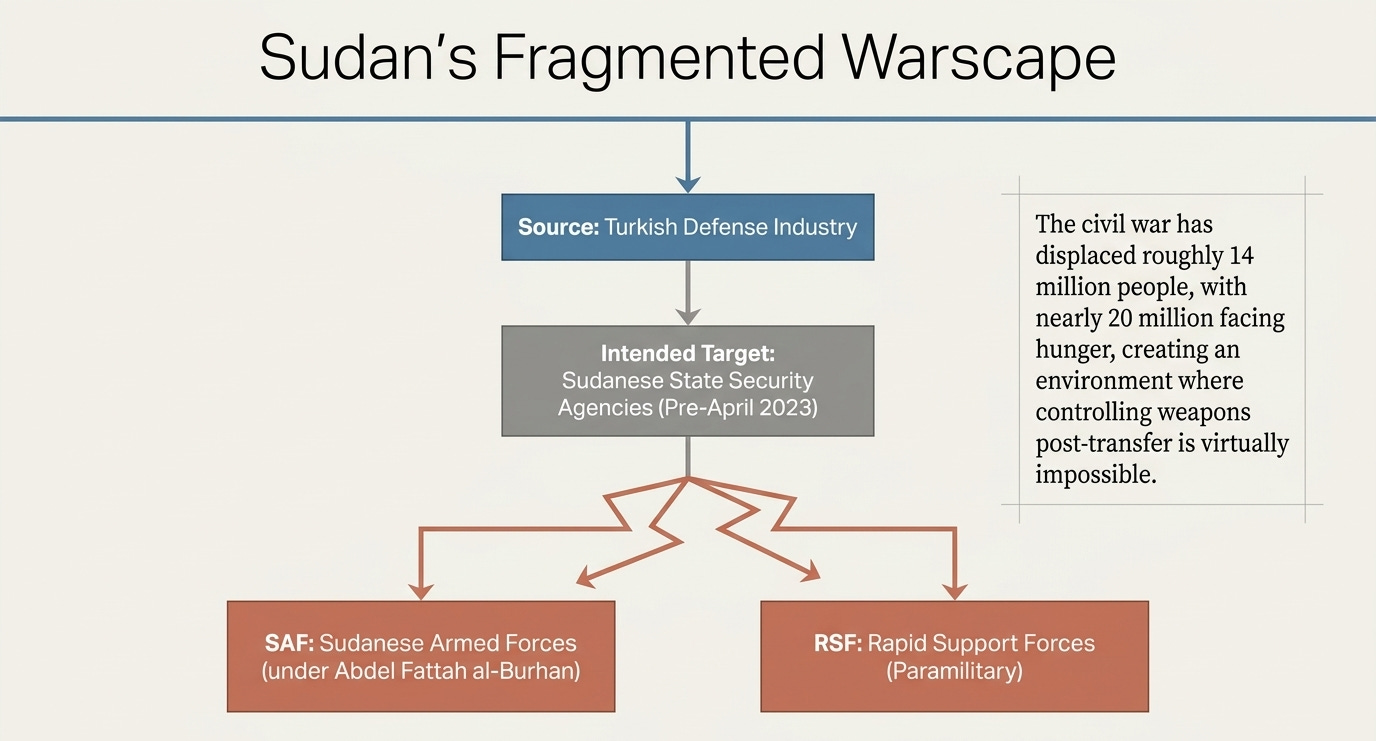
Some documented transfers occurred shortly before the current war. Sarsılmaz told Amnesty that its exports were intended for Sudanese state security agencies before the conflict began. Amnesty nevertheless documented the company’s rifles with the security personnel of SAF commander Abdel Fattah al-Burhan during the war.
Other Turkish-made weapons have also appeared in RSF hands. Amnesty documented an RSF fighter carrying a Turkish BRG 55 rifle in Darfur in 2024 and found Turkish hunting rifles and shotguns circulating among multiple parties to the conflict. The evidence illustrates the difficulty exporters can face controlling weapons after they enter a fragmented war zone.
More Than a Weapons Sale
The larger finding of the SWP study is that Turkish arms exports are becoming structurally important to the industry itself. Africa gives Turkish manufacturers customers, keeps factories operating and allows companies to spread into markets that domestic procurement alone cannot sustain. Those exports can also create longer-term relationships through training, maintenance, ammunition, electronics and technical support.
Turkey has signed more than 25 defense-industry cooperation agreements with African countries, helping transform the continent from what SWP describes as an opportunistic export destination into a more stable market for its defense industry.
For Washington, that makes Turkey’s expansion more significant than another country simply selling weapons abroad.
Ankara has built a defense industry whose continued growth increasingly depends on foreign demand. As Turkish weapons spread across Africa, they increasingly bring training, maintenance, electronics and other long-term defense relationships with them. The competition is therefore not only about who sells the next drone. It is also about who builds the military relationships that remain after the sale.