


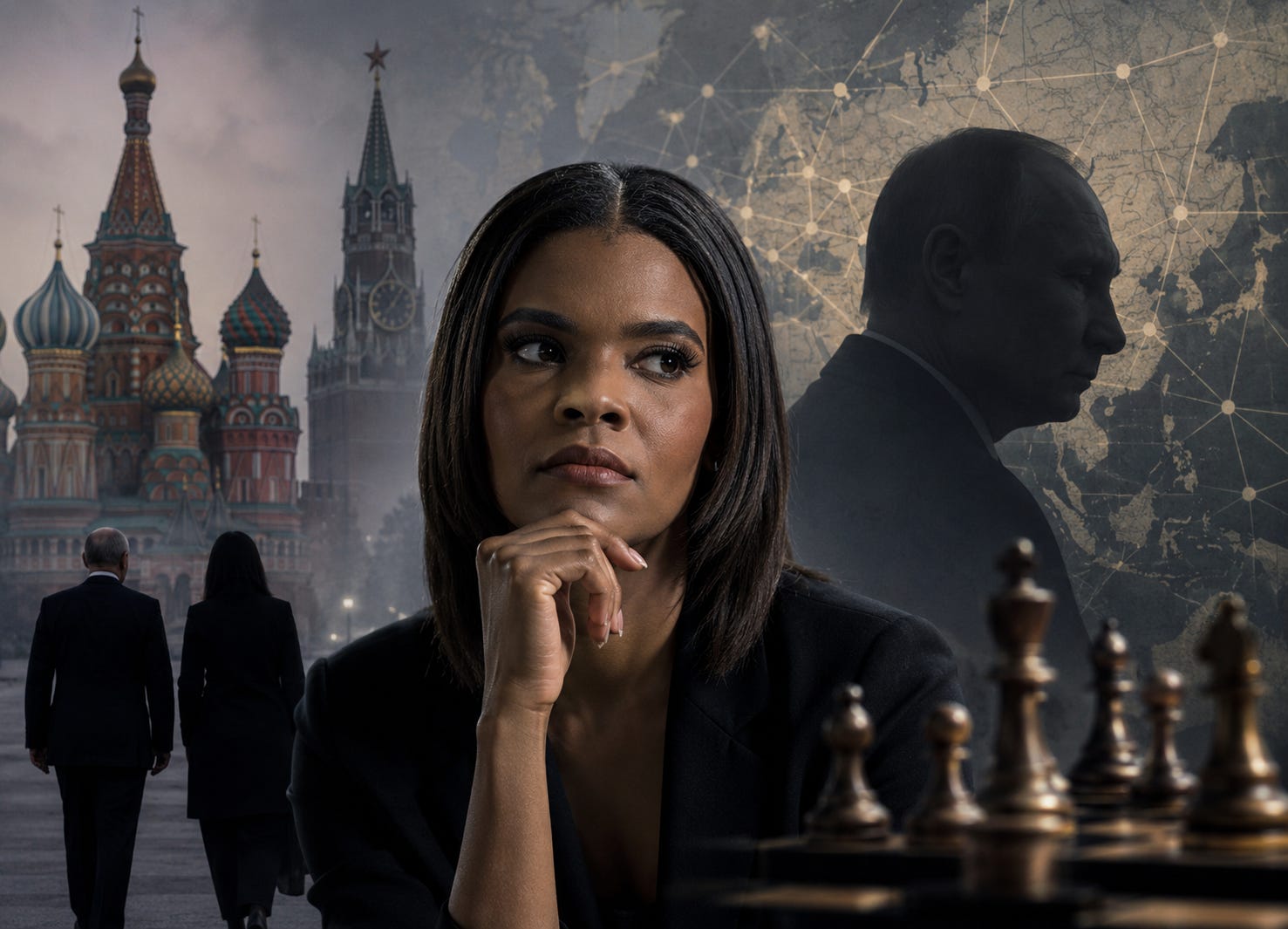
Candace Owens didn’t need to announce she was moving to Russia for national security researcher Ryan Mauro to recognize the warning signs. The conservative influencer initially billed her June 2026 trip as a family vacation—cathedral visits, tourist photos, her husband’s “fishing” trips to Russia. That cover story collapsed when Mauro revealed she was actually a scheduled speaker at the St. Petersburg International Economic Forum, Russia’s state-managed answer to Davos.
In a thread that drew immediate attention, Mauro asked whether Putin would award Owens the Order of Friendship at the forum—Russia’s medal for foreigners who strengthen ties with the Kremlin. Whether his hunch proves correct or not, the pattern was unmistakable: Russia’s economy shrank 0.2 percent in early 2026, yet the Kremlin positioned an American mother’s Moscow vacation as evidence the West has been lying about Russian decline and potentially laid groundwork for permanent relocation of a Western influencer with 35 million followers.
The Researcher Who Connected the Dots
Before Owens departed, she told her audience she planned to tour Russian Orthodox cathedrals with her husband George Farmer, who she claimed “regularly travels to Russia to go fishing.” She added she “might” arrange a meeting with Russian philosopher Alexander Dugin, the neo-Eurasianist ideologue known as “Putin’s brain.”
Mauro, president of the Mauro Institute specializing in counter-extremism, exposed the deception by publishing screenshots showing Owens as a scheduled SPIEF panelist. His investigation raised a more alarming question: was this trip reconnaissance for permanent relocation? The forum—which once hosted Angela Merkel, Emmanuel Macron, and Goldman Sachs executives—has transformed into what analysts call a showcase for “anti-vaxxers and conspiracy theorists” since Russia’s 2022 Ukraine invasion.

The Propaganda Value of an Influencer
Russia doesn’t invite personalities like Owens for their business acumen or diplomatic gravitas. It invites them for translation — the ability to render Kremlin talking points in the language of American cultural grievance.
Owens delivered exactly that. She posted from Moscow’s Red Square that the city was “incredibly beautiful and orderly,” contradicting “media descriptions.” She reportedly posted that gas and groceries are cheaper in Russia and accused Western media of lying. At SPIEF, she questioned U.S. support for Ukraine, telling reporters “Americans are getting tired of funding and not knowing where the money is going.” Russian state media amplified every statement.
Mauro later documented Owens appearing on Russian propaganda television preaching that following Russia’s spiritual example “is America’s only salvation.”


The Residency Pathway Russia Built
The “family vacation” framing obscures the infrastructure Russia has built to convert cultural tourism into permanent relocation. In August 2024, Vladimir Putin signed a decree creating a pathway for foreigners who embrace “traditional Russian spiritual and moral values, ” those opposing what Moscow calls the “destructive neoliberal ideological agenda” of the West.
Eligible applicants receive single-entry visas, enter Russia, then apply for temporary residence without quota restrictions and without demonstrating Russian language proficiency, knowledge of Russian history, or understanding of Russian law. The United States appears on the approved list. By September 2024, Russia’s government published a roster of 52 countries deemed to be pursuing that “destructive agenda”—including every NATO member and democratic U.S. ally.
At SPIEF, Russian architect Anton Glikin revealed he’s designing a settlement in Nizhny Novgorod for 450 Western immigrants arriving under the “shared values visa.” This isn’t abstract policy, it’s operational infrastructure potentially suited to figures like Owens.
The Justice Department’s Warning
Russia’s influence ecosystem doesn’t require formal coordination with every personality it amplifies. In September 2024, the Justice Department seized 32 internet domains used in Kremlin-directed foreign malign influence campaigns designed to “reduce international support for Ukraine, bolster pro-Russian policies and interests, and influence voters in U.S. and foreign elections.”
Attorney General Merrick Garland stated the operations were directed by Putin’s inner circle, including First Deputy Chief of Staff Sergei Kiriyenko. The campaigns used cybersquatted domains mimicking legitimate news outlets, AI-generated content, fake social media profiles, and paid influencers worldwide—all designed to appear organic rather than state-sponsored.
An influencer like Owens doesn’t need direct instructions to be valuable in this ecosystem. She only needs to supply content Russian media can quote—an American Christian mother praising Moscow’s order while questioning why Washington funds Kyiv’s defense.
The Economic Reality Behind the Instagram Feed
Owens’s claims about Russian affordability collapse under scrutiny. While individual items may cost less in rubles, average annual wages tell the real story: approximately $65,000 in the United States versus roughly $12,000 in Russia, according to data cited by The Kyiv Independent. Local purchasing power remains far higher in America.
The trick isn’t showing a fake Russia — Moscow’s cathedrals are real, its metro is genuinely impressive. The trick is presenting curated Russia as the whole picture while asking American audiences to compare it against their own country’s worst headlines.

Why This Matters for American Security
As Voz journalist Park MacDougald analyzed, SPIEF functions as “a hotspot of the dirtiest Russian intelligence activities.” Putin uses it to project narratives of Russian resilience and multipolarity. That a Western influencer with 35 million followers appears as a speaker—presented as “independent” and “critical of the establishment”—provides enormous legitimizing value for Moscow.
The strategic objective isn’t necessarily Owens moving to Moscow permanently. It’s moving Russia in the imagination of her audience from enemy to potential refuge, from dictatorship threatening NATO allies to sanctuary from American “wokeness.”
That perceptual shift serves Russian foreign policy objectives. A population skeptical of defending Ukraine is a population that questions the entire post-World War II American security architecture. A population romanticizing authoritarian “order” is a population vulnerable to democratic backsliding at home.
The Broader Pattern
Owens joined a roster of Western personalities at SPIEF 2026 that CNN documented as including Steven Seagal, former UN inspector Scott Ritter (convicted of sexually harassing a minor), and Andrew Tate (self-described misogynist facing human trafficking charges).
Elizaveta Osetinskaya, founder of exiled Russian outlet The Bell, recalled meeting with Google parent company Alphabet CEO Eric Schmidt at SPIEF in 2009. By 2026, those seats were filled by Taliban and North Korean delegations.
The transformation reveals something important: Russia can no longer attract legitimate Western business or political engagement. What it can attract are voices willing to launder authoritarian governance as “traditional values” and American audiences exhausted enough to listen.
That’s the danger Mauro identified. Not necessarily that Candace Owens will relocate to Moscow, but that her trip normalized the emotional premise of doing so and demonstrated to the Kremlin that woke right American influencers with massive platforms can be recruited to amplify Russian narratives while maintaining plausible deniability. That playbook threatens American democratic institutions far more than any individual relocation ever could.