



When the Department of War ordered 30 American universities to conduct immediate reviews of their foreign partnerships this week, the names that drew attention were predictable: Harvard, MIT, New York University, Johns Hopkins and the University of California, Berkeley. But the more revealing part of the Pentagon’s announcement may have been a three-word phrase buried in its explanation: “rebranded Confucius Institutes.”
The universities must examine active institutional ties and collaborations with foreign entities identified under Section 1286 of the 2019 National Defense Authorization Act, as well as organizations associated with rebranded Confucius Institutes. They have until Aug. 31 to report their findings and mitigation efforts, with future federal research funding potentially at stake.
The Pentagon has not publicly explained what it considers a rebranded Confucius Institute or identified which relationship prompted the selection of each individual university. But a Crosscurrents review of federal and university records shows that, at some of the schools, closing a Confucius Institute did not end the underlying relationship with its Chinese university partner. At others, universities on the audit list maintain or recently documented academic relationships with Chinese institutions that now appear on the Pentagon’s Section 1286 list.
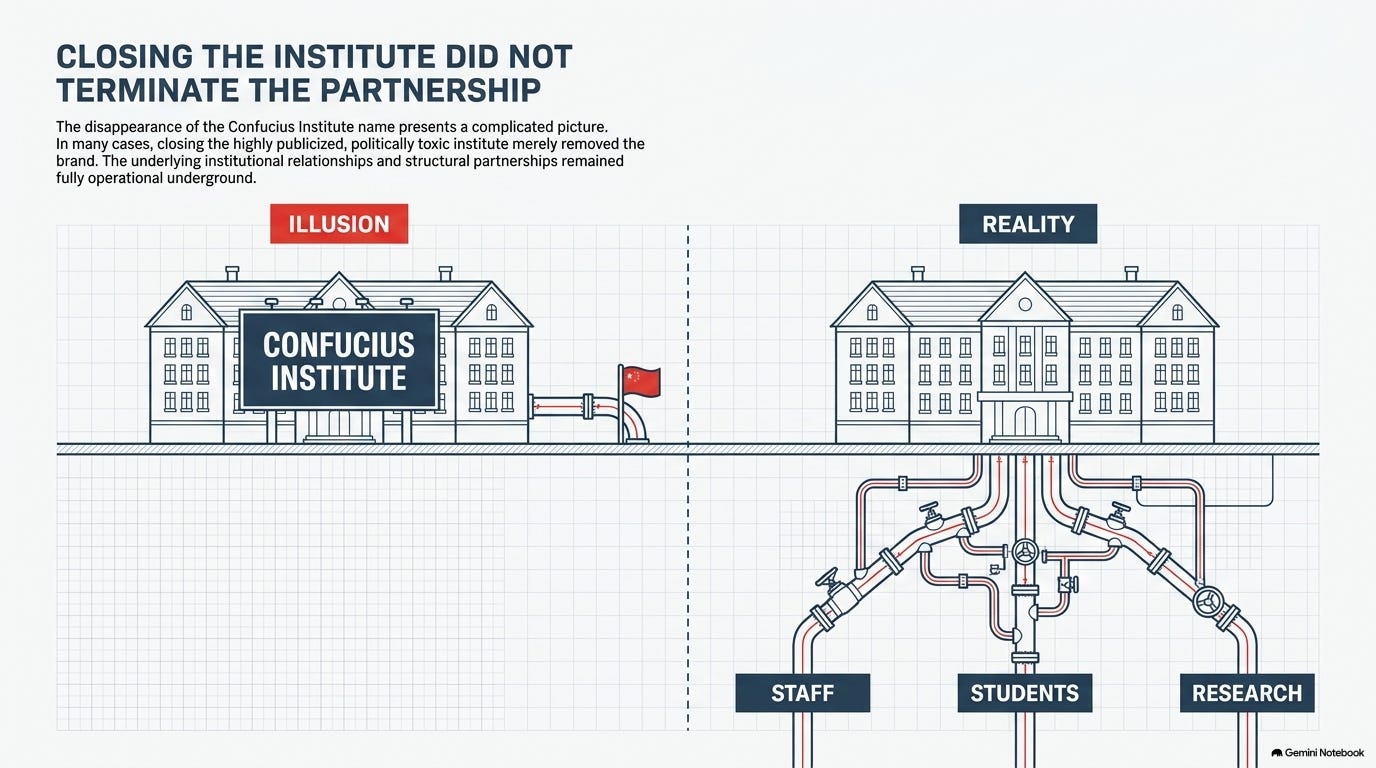
The Pentagon describes Section 1286 as a federal restricted-party list targeting unwanted foreign influence on Department-funded research and says the listed entities have been confirmed as engaging in activities that threaten U.S. national-security interests. Beginning in fiscal year 2026, Pentagon funds cannot support fundamental research involving collaboration with a listed entity. The picture that emerges is more complicated than the disappearance of the Confucius Institute name. In some cases, the sign came down. The partnership remained.
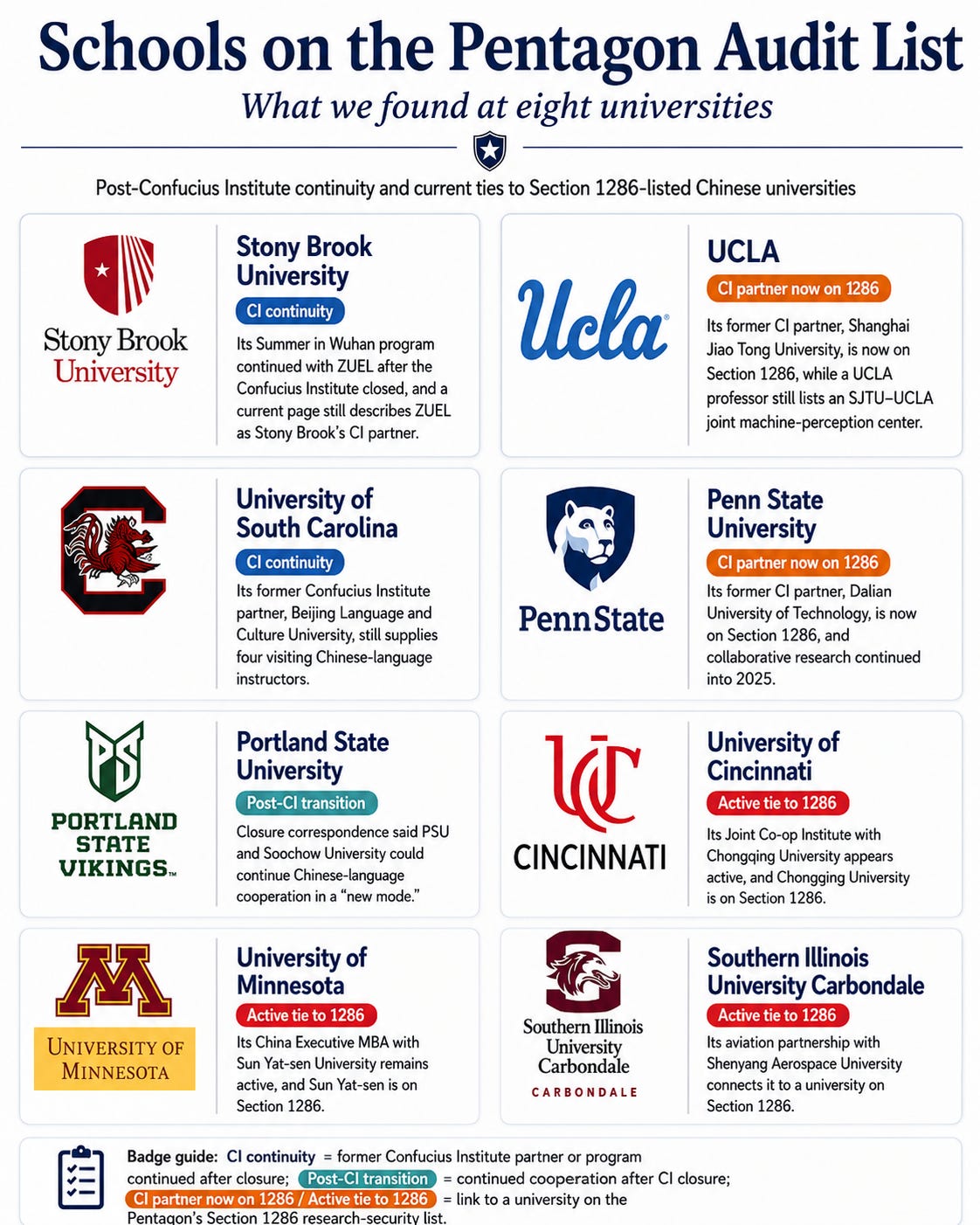
The Wuhan Program That Survived the Confucius Institute
Stony Brook University offers one of the clearest examples. Its Confucius Institute was established in 2008 as a partnership between Stony Brook and China’s Hanban, while also maintaining a relationship with Zhongnan University of Economics and Law, or ZUEL, in Wuhan, according to a 2015 university document.
In 2016, Stony Brook promoted a month-long study-abroad program in Wuhan that the university said was organized by International Academic Programs and the Confucius Institute. Students met counterparts at ZUEL, while participants also received funding from the Chinese government, according to a university profile. The Confucius Institute later closed. The Wuhan program did not disappear.
Stony Brook’s current study-abroad page continues to advertise “Summer in Wuhan.” It says participants receive a scholarship from and are hosted by ZUEL. More remarkably, the university still describes ZUEL as the “partner university of SBU’s Confucius Institute.” The continuity is unusually direct.
Before the institute closed, Stony Brook’s Confucius Institute helped organize the Wuhan program involving ZUEL. Years after the institute disappeared, the university still advertises the program with the same Chinese institution, while its own webpage continues to identify ZUEL through the old Confucius Institute relationship.
That does not establish that the Pentagon considers the Wuhan program a “rebranded Confucius Institute,” nor has the department publicly identified ZUEL as the reason Stony Brook was selected for audit. It does show why simply counting how many Confucius Institutes formally closed can miss what happened afterward.
The Chinese Partner Stayed at South Carolina
The University of South Carolina presents another form of continuity.
As recently as May 2020, USC described its Confucius Institute as a collaboration among the university’s College of Arts and Sciences, Beijing Language and Culture University, or BLCU, and the Chinese Ministry of Education.
In February 2021, USC’s Board of Trustees approved termination of the Confucius Institute. Board records said the recommendation reflected changes in university priorities and strategic direction. But USC’s relationship with BLCU did not disappear from its academic programming. A current USC international-business page says its Chinese-language faculty is “normally” reinforced by four visiting instructors from Beijing Language and Culture University.
That is noteworthy because providing Chinese-language instructors was historically one of the functions of the Confucius Institute system. A Government Accountability Office review found that Hanban and American universities jointly funded the institutes, while Confucius Institute arrangements commonly included Chinese teachers and other instructional support.
The public record reviewed by Crosscurrents does not establish who currently selects or pays the BLCU instructors, or whether their present arrangement is administratively descended from USC’s former Confucius Institute.
What can be established is narrower: the Chinese university that participated in USC’s former Confucius Institute continues to be identified on a current university webpage as a source of visiting Chinese-language instructors.
Washington Already Knew the Partnerships Survived
The phenomenon is much broader than Stony Brook or South Carolina. In 2023, the GAO surveyed 74 American institutions that had closed Confucius Institutes. Forty-three of the 74 said they still maintained a partnership with the same Chinese institution associated with their former Confucius Institute. Twenty of those schools described the relationship as diminished or dormant, particularly because of the COVID-19 pandemic.
Nine institutions told GAO they were still receiving support for Chinese-language, cultural or academic programs from their former Chinese Confucius Institute partner. That support included visiting or exchange scholars, Chinese-language staff, language tutors and joint or dual-degree programs. GAO also noted that some partnerships predated the Confucius Institutes themselves and continued after their closure.
In other words, three years before the Pentagon used the phrase “rebranded Confucius Institutes,” a federal investigation had already documented that shutting down the institutes often did not mean severing ties with the Chinese universities behind them. The Confucius Institute network largely disappeared as a brand. The underlying university relationships did not universally disappear with it.
The Other Half of the Pentagon’s Audit
The Pentagon’s Aug. 17 announcement points to a second category of relationships that may be even more consequential for research security. Its audits also target active collaborations involving foreign institutions appearing on the Section 1286 list. The Pentagon says the list identifies foreign entities it has confirmed as engaging in activities threatening U.S. national-security interests. Effective in fiscal year 2026, Pentagon money cannot be used for fundamental research involving collaboration with those institutions, including research using their equipment.
Several universities among the 30 now being audited have publicly documented academic relationships with universities on that list. The University of Cincinnati, for example, currently operates a Joint Co-op Institute with Chongqing University. Cincinnati says students receive degrees from both institutions, while the partnership also serves as a platform for increased faculty research cooperation. Its current program pages say approximately 450 students are enrolled. Chongqing University appears on the Pentagon’s Section 1286 list.
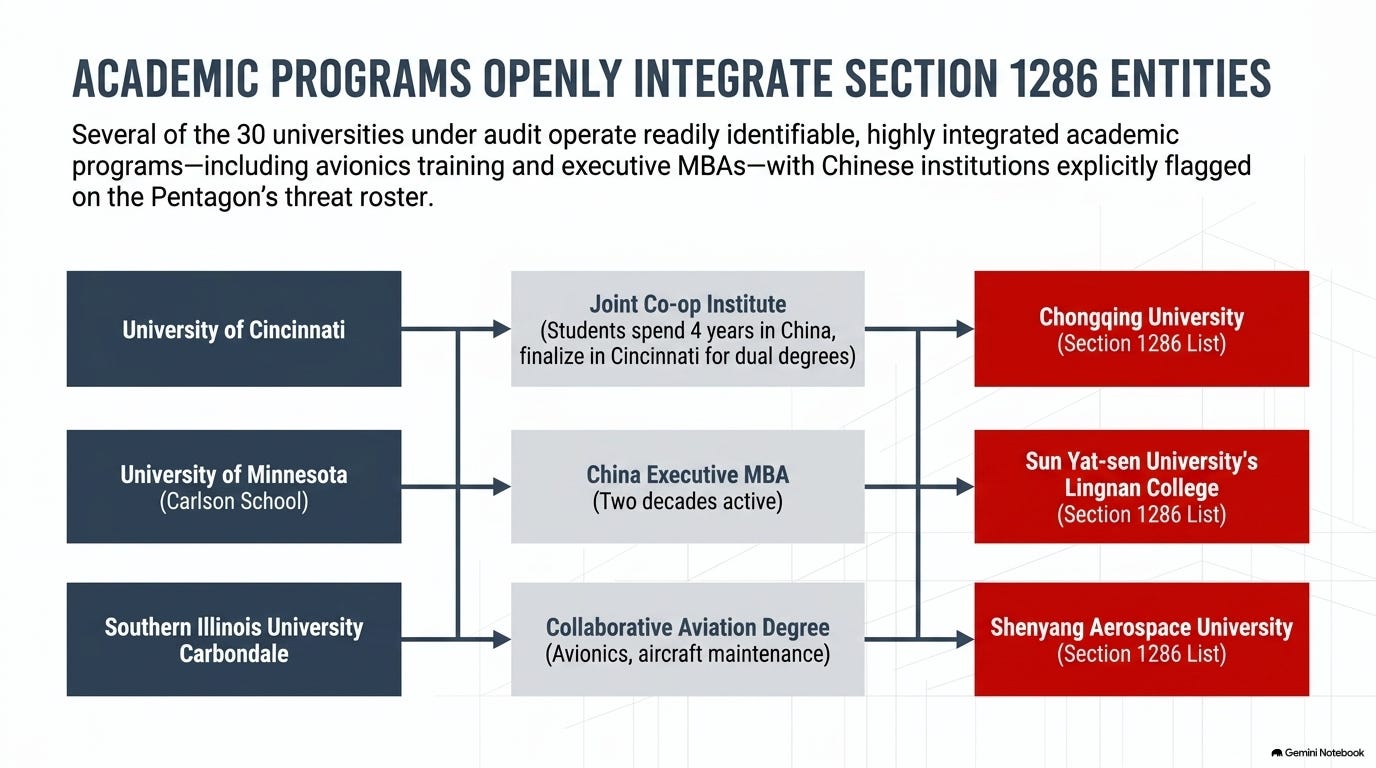
At the University of Minnesota, a live Carlson School page advertises an Executive MBA in China offered in partnership with Lingnan College at Sun Yat-sen University in Guangzhou. Sun Yat-sen University is also on Section 1286.
Southern Illinois University Carbondale provides another example, although the public documentation available for that program is older. In 2019, SIU announced a collaborative aviation degree program with Shenyang Aerospace University, involving jointly designed coursework, degrees from both universities and a faculty exchange component. SIU had previously announced an articulation agreement focused on avionics and aircraft maintenance. Shenyang Aerospace University now appears on Section 1286.
The available public records reviewed for this article do not establish whether the SIU program remains operational in 2026. Its documented relationship nevertheless provides another potential point of relevance to the Pentagon’s audit, without establishing that it was the reason SIU was selected.
When a Former Confucius Partner Lands on the Pentagon List
At UCLA, the two strands of the story intersect. UCLA records show that its former Confucius Institute worked with Shanghai Jiao Tong University. A 2014 UCLA page identified the institute’s associate director as coming from Shanghai Jiao Tong, while former Chancellor Gene Block described a program bringing graduate students from the university to Los Angeles through the Confucius Institute. (UCLA) Shanghai Jiao Tong University is now on the Pentagon’s Section 1286 list.
And UCLA’s relationship with Shanghai Jiao Tong has extended beyond Chinese-language or cultural programming. In a June 30, 2025 CV, UCLA computer scientist Demetri Terzopoulos listed himself as co-director of the SJTU-UCLA Joint Center for Machine Perception and Inference, a position he dated from June 2018 to “present” at the time the CV was prepared. Because that CV is dated 2025, Crosscurrents cannot establish from the document alone that the center remains operational in August 2026.
Still, the historical overlap is notable: the Chinese university involved in UCLA’s former Confucius Institute is now itself on the Pentagon’s research-security list, while a UCLA professor was still listing a joint machine-perception center with it in 2025. There is no public evidence that the center caused UCLA to appear among the 30 universities, and the existence of the partnership does not establish that prohibited Pentagon-funded research occurred through it.
Penn State shows a similar pattern. Its former Confucius Institute relationship involved Dalian University of Technology, and Penn State records also document the creation of a separate Joint Center for Energy Research with Dalian covering collaborative research in energy science and technology. Dalian University of Technology now appears on Section 1286.
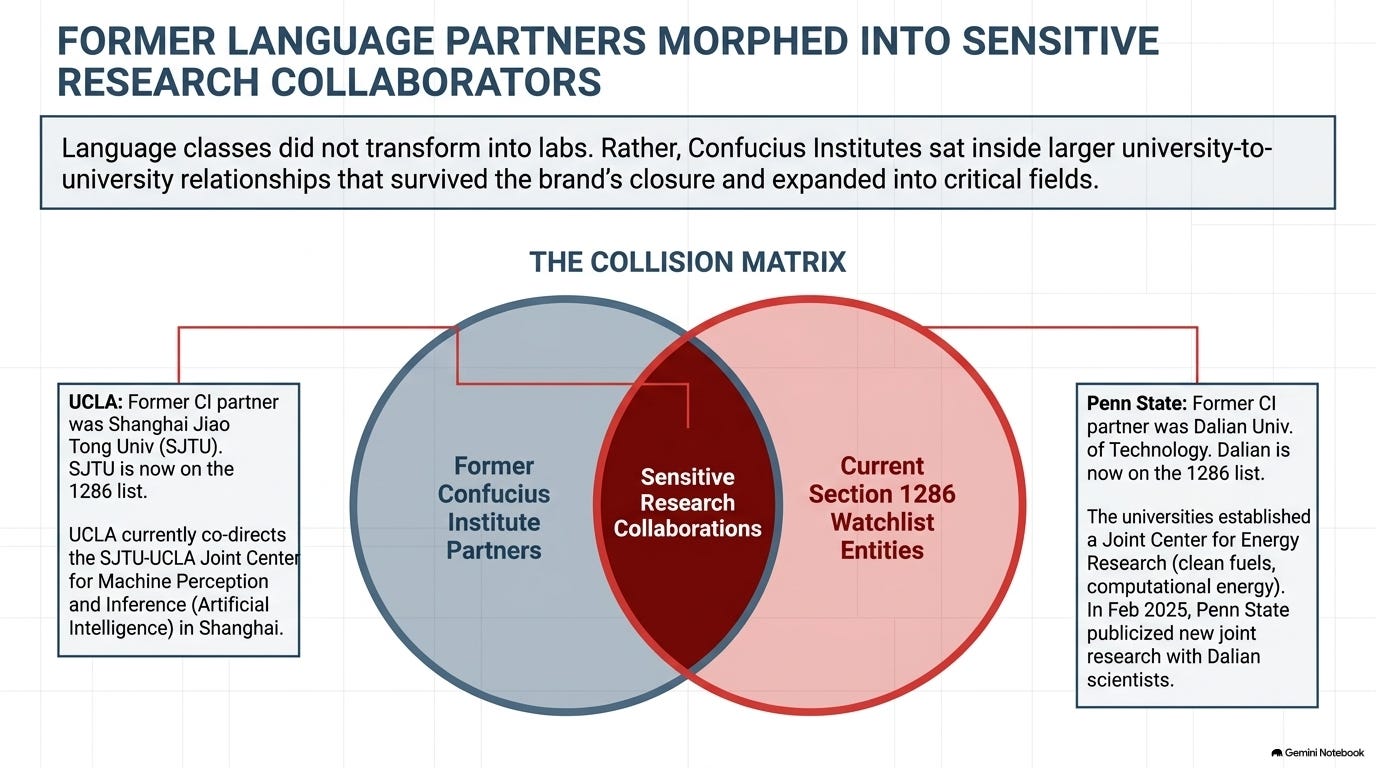
More recent evidence shows that the universities’ researchers continued to collaborate after the Confucius Institute era. In February 2025, Penn State reported on research co-led by scientists at Penn State and Dalian University of Technology. The article said the work was supported by Chinese funding sources and quoted the Dalian corresponding author expressing interest in additional work with Penn State.The point is not that Confucius Institute language programs transformed into sensitive research laboratories. They did not.
It is that Confucius Institutes frequently existed within larger university-to-university relationships, and some of the same Chinese institutional partners remained connected to American universities after the politically controversial Confucius Institute brand disappeared.
Portland State Was Told Cooperation Could Continue in a “New Mode”
Portland State University provides another revealing glimpse of the transition. Its Confucius Institute partnered with Soochow University. According to correspondence published by the National Association of Scholars, Chinese International Education Foundation President Yang Wei responded to Portland State’s closure by expressing hope that PSU and Soochow could continue cooperating in Chinese-language teaching in a “new mode.” (NAS)
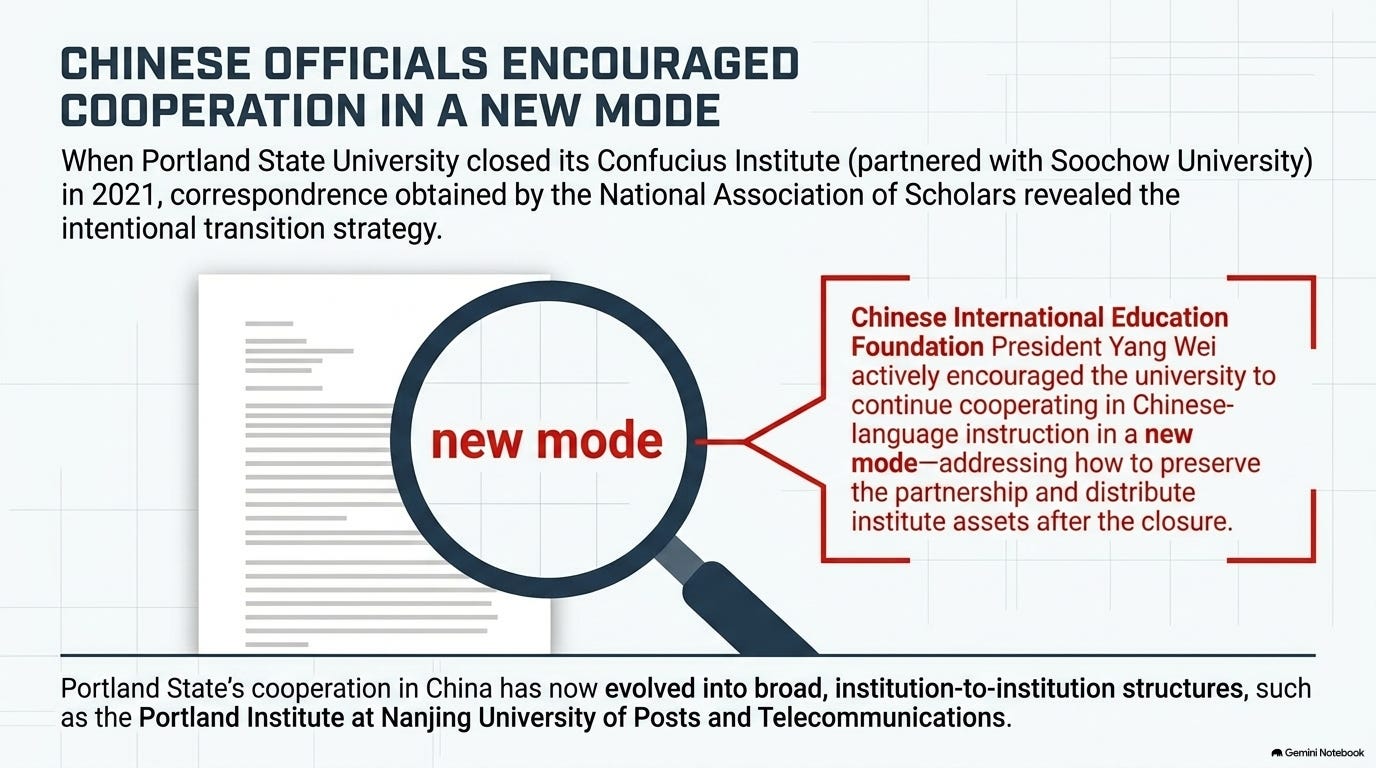
NAS is an advocacy organization, and Crosscurrents has not independently obtained the underlying correspondence. The claim should therefore be understood as NAS’s account of the documents it reviewed. The wording is nonetheless particularly relevant now that the Pentagon is explicitly directing universities to examine organizations associated with “rebranded Confucius Institutes.”
Portland State today also maintains substantial academic programs with other Chinese institutions. Its engineering college lists current dual-degree partnerships, including the Portland Institute at Nanjing University of Posts and Telecommunications. PSU describes that program as involving telecommunications and electronics degrees and graduate study, while another university page calls the relationship a “deep and integrated collaboration.”
Nanjing University of Posts and Telecommunications was not Portland State’s former Confucius Institute partner, and the Portland Institute should not be characterized as a renamed Confucius Institute on the evidence reviewed here. Instead, Portland State illustrates the broader transformation: one China-linked institutional structure closed while extensive academic cooperation with Chinese universities continued through other channels.
Why These 30?
That may ultimately be the more important question raised by the Pentagon’s announcement. The first wave of coverage understandably focused on prestigious universities. But a list containing Harvard and MIT alongside Bryant University, Southern Illinois University Carbondale, Portland State University and other less obvious institutions suggests the department was not simply assembling a roster of elite research schools.
The Pentagon says the institutions received notifications concerning “active institutional ties and collaborations” involving Section 1286 entities and organizations associated with rebranded Confucius Institutes. The universities were directed to audit identified collaborations, assess the exposure of sensitive or export-controlled research and implement mitigation measures, including terminating problematic partnerships where necessary.
The public record offers clues as to the kinds of relationships that may warrant scrutiny, although it does not reveal the Pentagon’s institution-by-institution reasoning. At Stony Brook, a program once organized in part by its Confucius Institute continues with the same Chinese university partner. At South Carolina, a current webpage says its Chinese-language faculty is normally supplemented by visiting instructors from the former Confucius Institute’s Chinese university partner.
At UCLA and Penn State, Chinese universities involved in their former Confucius Institute relationships now appear on the Pentagon’s Section 1286 list, while other academic collaborations with those institutions continued after the CI era.
At Cincinnati, a current joint engineering institute involves a Section 1286-listed university. Minnesota maintains a live webpage advertising an MBA partnership with another. SIU has documented an aviation program with a third. None of those facts establishes why the Pentagon selected a particular American university, nor does inclusion among the 30 establish wrongdoing.
But collectively, the records demonstrate something that the disappearance of Confucius Institute signs could obscure. Years ago, American universities closed a highly visible network of Chinese government-backed institutes. The Pentagon is now looking at what remained after the signs came down.