


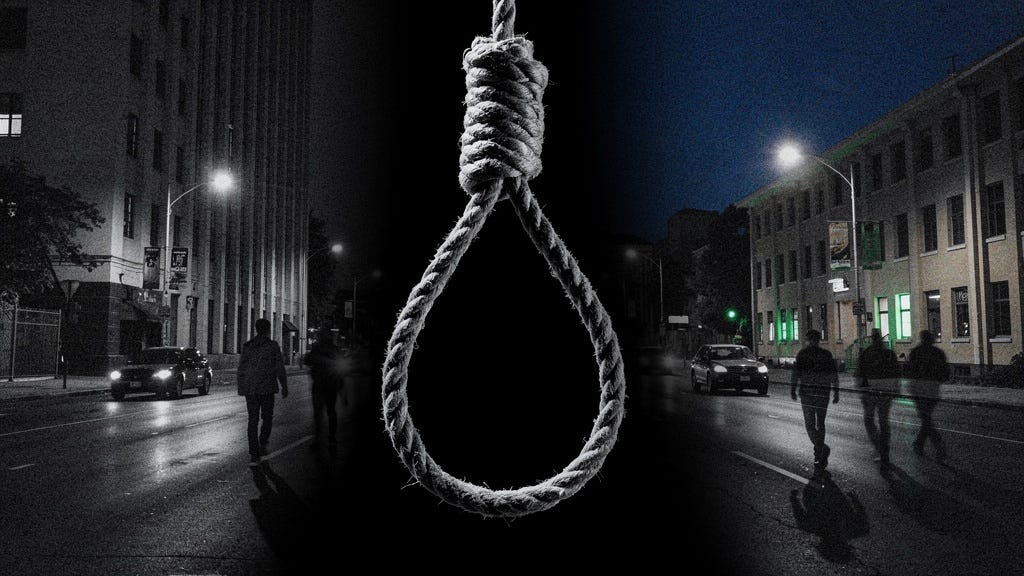
A new report documents an unprecedented surge in state executions around the same period Iran killed thousands of protesters in the streets. Together, they reveal the hydraulic logic of authoritarian violence.
In January 2026, security forces in Iran killed thousands of people in the streets during nationwide protests. The exact number remains contested- the government admits to 3,117 deaths, medical networks estimate over 30,000, while Opposition Media, Iran International Cited leaked documents suggesting a death toll exceeding 36,500. . Eyewitnesses described bodies transported in ice-cream trucks, mass burials in graveyards, and forensic facilities so overwhelmed they turned corpses away. The Iranian government shut down the internet on January 8th to conceal the scale of the killing.
What received far less attention is what happened quietly, behind prison walls, throughout the entire preceding year.
According to data compiled by Iran Human Rights (IHRNGO) and ECPM, Iranian authorities executed at least 1,639 people in 2025- a 68% increase over 2024 and the highest annual total recorded since 1989. That’s an average of four to five executions every single day, all year long. And critically: 93% of these executions were never publicly announced. Only 113 of the 1,639 killings were acknowledged by official sources.
I’ve been trying to understand how these two phenomena, the street massacres and the hidden execution surge, fit together in a deeper way. The answer reveals something important about how regimes in crisis deploy violence: not randomly, but hydraulically, with different types of killing serving distinct strategic functions.
The Quiet Machine
The execution data shows extraordinary precision in who gets killed behind closed doors. Nearly half of those executed in 2025, 795 people, were convicted of drug-related offenses. Another 747 died under qisas laws (retribution-in-kind for murder). Security-related charges accounted for 57 executions: protesters, political prisoners, accused spies, and one person convicted of financial corruption.
But these legal categories obscure the pattern. Iran’s execution apparatus systematically targets the economically marginal and ethnically minoritized. The Baluch people represent somewhere between 2-6% of Iran’s population but accounted for 9% of all executions in 2025. Afghan nationals- foreign workers with minimal legal protection- made up 84 executions, compared to just 16 in 2022.
The drug cases are especially revealing. Of 795 people executed for drug offenses, authorities publicly announced exactly three. The rest died in secret. Many were subsistence smugglers working the mountainous borders with Afghanistan and Pakistan, the kind of dangerous, poorly-paid labor people take when they have no alternatives. The report documents brothers Gholamhossein and Ebrahim Khalilifar, executed March 1st. Ahmad Ali Mehripour, killed August 30th. Dozens more names, each representing someone whose poverty made them expendable.
What doesn’t make sense until you look at the procedural details: these weren’t careful judicial processes that happened to result in death sentences. The Revolutionary Courts- which handle national security cases and are staffed by ideologically vetted judges- issued 52% of the death sentences carried out in 2025. These courts routinely rely on confessions extracted under torture, “knowledge of the judge” (elm-e-qazi), or “sworn oaths” (qassameh) rather than material evidence. Due process violations occur not as exceptions but as standard practice, often violating even the Islamic Republic’s own laws.
Two Machines, Different Functions
Here’s the pattern that emerges when you place the street violence and prison executions side by side: the street killings are spectacular, concentrated, and directed at active resistance. The prison executions are hidden, continuous, and directed at structurally vulnerable populations.
January 2026’s massacre served an immediate suppression function. Security forces positioned on rooftops fired rifles at protesters’ heads and torsos. Videos verified by Amnesty International show systematic targeting of crowds. Medical staff reported injuries designed to maim and kill—close-range gunshots, stab wounds to eyes and genitals. One doctor, part of an informal network of 80 medical professionals who documented the violence, told The Guardian: “I am on the verge of a psychological collapse. They’ve mass murdered people. No one can imagine… I saw just blood, blood and blood.”
The executions throughout 2025 served a different purpose: maintaining baseline fear within marginalized communities, demonstrating the state’s continued capacity to kill selectively, and clearing prisons of people the regime considers socially disposable. The secrecy matters—these deaths don’t generate international headlines, but they absolutely register within families, neighborhoods, and ethnic communities who understand the targeting isn’t random.
This explains something otherwise puzzling: why execution rates would increase by 68% during a year when the regime faced mounting crises including economic collapse, renewed protests, and regional military pressure. From a strictly rational calculus, you’d expect a government under siege to minimize controversial actions. Instead, Iran averaged nearly five executions per day.
The logic becomes clearer when you understand these as complementary tools. Street massacres require international bandwidth to conceal, hence the internet shutdown, the mass burials, the refrigerated trucks moving corpses at night. You can only deploy that level of spectacular violence occasionally. Prison executions, by contrast, happen continuously with minimal international attention, especially when 93% aren’t announced. They maintain steady-state terror between the spectacular interventions.
Resistance from Inside
The most surprising element in the report is the scale of internal resistance to executions, even during this period of extreme repression. A movement called “No Death Penalty Tuesdays,” prisoners staging weekly hunger strikes on the day transfers to solitary for execution typically occur, has spread from a single prison to 56 facilities nationwide.
In October 2025, more than 1,500 prisoners on death row for drug offenses in Ghezelhesar Prison staged a six-day strike. Some sewed their mouths shut. They successfully forced authorities to temporarily halt drug-related executions at that facility. This happened while the regime was preparing for the January crackdown. While security forces planned street massacres, prisoners were organizing collective resistance behind walls.
There’s also the “forgiveness movement.” Under Sharia law, families of murder victims can choose forgiveness or accept diya (blood money) instead of execution. In 2025, IHRNGO documented 566 cases where families chose forgiveness. The most prominent involved Goli Kouhkan, a Baluch woman who had been a child bride. A sustained campaign raised 80,000 euros for blood money, and plaintiffs agreed to forgo execution.
But 2025 marked a watershed: for the first time in 11 years, the number of qisas executions (747) exceeded forgiveness cases. The machinery accelerated faster than the resistance could counter it.
What This Means for Transitions
The report arrives at a genuinely uncertain moment. The Islamic Republic has lost legitimacy among most Iranians and faces external military pressure. IHRNGO Director Mahmood Amiry-Moghaddam frames the stakes clearly: if the regime survives, mass executions will likely intensify as authorities reassert control. If political change occurs, the abolition of the death penalty must be central to any transition.
This isn’t abstract moralizing. The report includes a foreword by Nasrin Sotoudeh, one of Iran’s most prominent human rights lawyers, drawing direct parallels to executions following the 1979 revolution. Officials from the previous regime were killed without fair trials in what was presented as revolutionary justice. “The cycle of violence did not end,” Sotoudeh writes, “and the execution machine went on to claim the lives of others, including those who had contributed to the revolution’s victory.”
On April 1st, 2026, three weeks after writing that foreword, Sotoudeh was arrested at her home. As of this writing, she remains held incommunicado.
The execution of protesters resumed on March 19th with three people arrested during January protests. In the following days, authorities killed at least ten more: four protesters and six political prisoners from the People’s Mojahedin Organisation of Iran (PMOI/MEK), the most disproportionately represented political group on death row. Hundreds of detained protesters remain at risk.
Here’s what the international response has been: muted. The UN Office on Drugs and Crime maintains cooperation with Iranian drug-control agencies despite 795 people being executed for drug offenses- a 58% increase over 2024. This cooperation provides political legitimacy to institutions directly involved in the killings. A UN Fact-Finding Mission expert noted that if these executions “form part of a widespread and systemic attack against a civilian population, as a matter of policy, then those responsible—including the judges who impose capital punishment—may be held accountable for crimes against humanity.”
Iran has now demonstrated two functioning death machines: one spectacular and concentrated for moments of acute threat, one hidden and continuous for baseline control. The street massacres received international attention because they couldn’t be fully concealed despite the internet shutdown. The 1,639 executions throughout 2025 happened largely unnoticed, which was precisely the point.
The prisoners organizing hunger strikes understand something the international community apparently doesn’t: these two systems work together. You can’t address one without addressing the other. Breaking the cycle requires more than stopping street violence during protests. It requires dismantling the entire infrastructure of state killing—the one everyone sees and the one almost nobody notices.
Whether anyone is prepared to make that demand is another question entirely.