


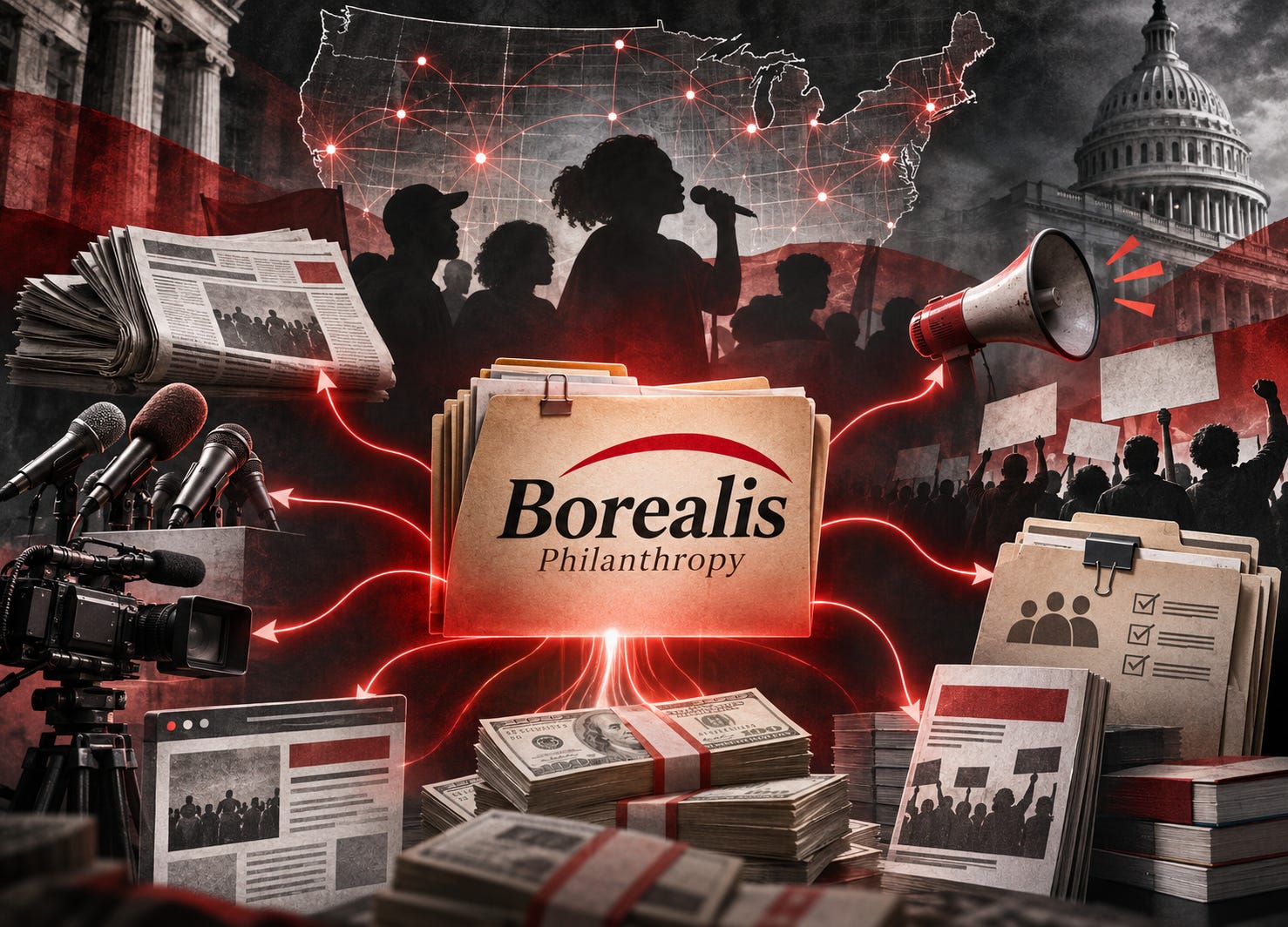
A major philanthropic organization that distributes millions of dollars to American news outlets is openly promoting a strategy to “shape and shift beliefs,” financing journalism alongside political organizing to help social movements advance their agendas.
Borealis Philanthropy, whose journalism initiatives have received support from major foundations, is urging donors to invest in a media ecosystem designed not simply to inform audiences, but to change their understanding of political and social issues and translate those beliefs into organized action.
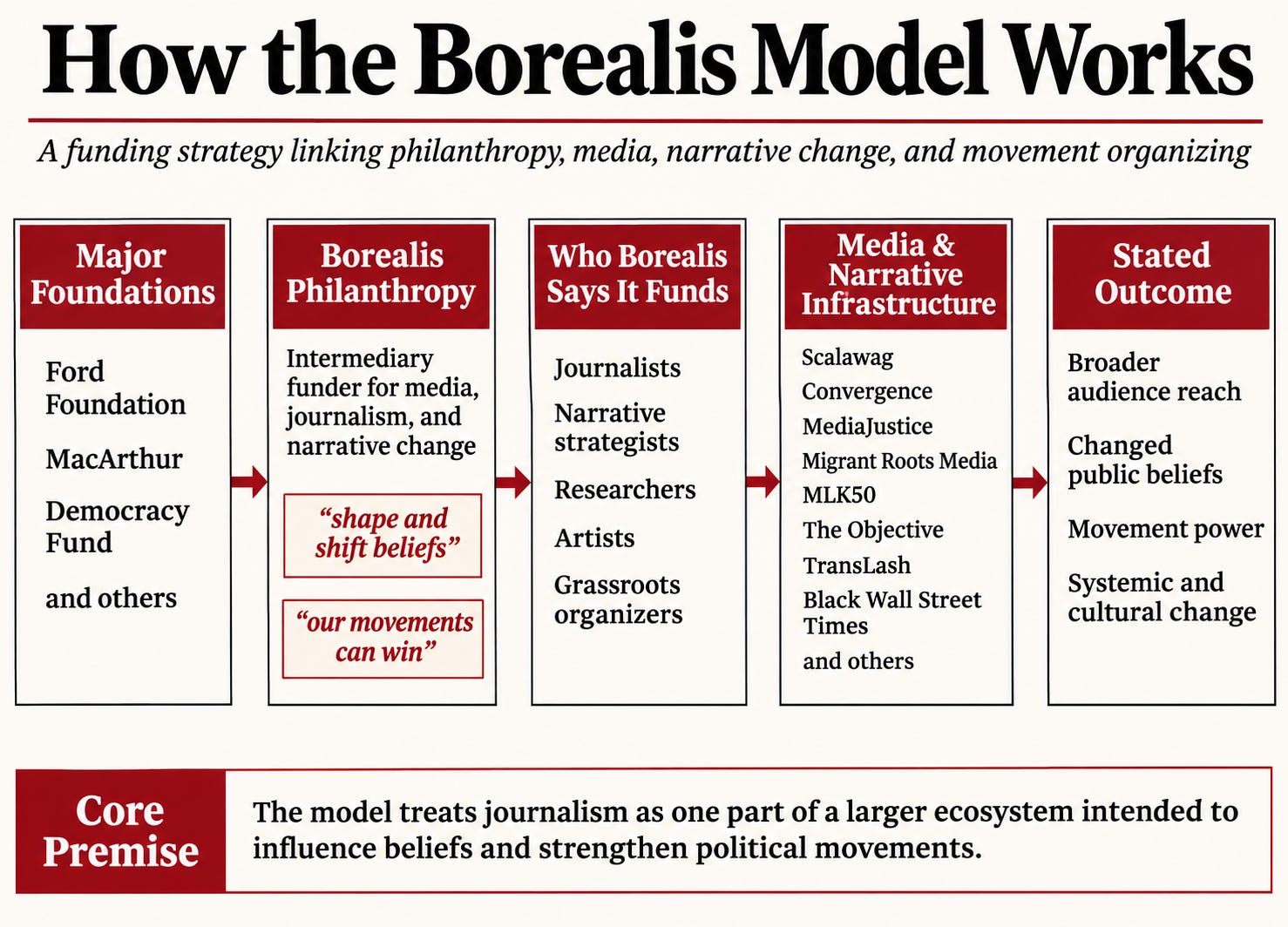
In a November 4 statement, Borealis described using research, culture and language to “shape and shift beliefs” and called for coordinated investments in journalists, narrative strategists, researchers, artists and grassroots organizers. Its stated objective includes bringing movement narratives to wider audiences and turning changed beliefs into catalysts for “systemic and cultural change.”
The organization has invested more than $24 million in media, journalism and narrative change. Among its beneficiaries are publications advocating police and prison abolition, socialist governing power and journalism explicitly intended to advance political movements.
The strategy raises questions about the boundary between independent journalism and political advocacy when a major funding intermediary openly identifies public persuasion and movement-building as objectives of its media investments.
A Strategy to Change What the Public Believes
Borealis’s own description of its journalism program establishes that its ambitions extend beyond supporting the financial survival of newsrooms.
The organization says local storytelling can “reshape the public imagination” and that supporting media organizations helps ensure “our movements can win.”
The November 4 statement explains how Borealis believes such influence can translate into political change. It argues that storytelling can challenge what people have learned to accept, alter expectations of institutions and encourage collective action.
The statement quotes racial-justice strategist Rashad Robinson describing narrative as a tool for changing “the floor on what’s acceptable and the ceiling on what’s possible.”
Borealis urges other philanthropists to finance this process over the long term. Its proposed model combines research, cultural production, media amplification and grassroots organizing, with journalism helping distribute narratives that organizers can translate into broader social and political demands.
Rather than treating journalism solely as an independent public-information service, the organization explicitly places media within a larger strategy of changing beliefs and strengthening movements. Borealis presents this approach as advancing racial equity and an inclusive, multiracial democracy.
Political Organizers Help Shape the Strategy
The November 4 statement credits three political figures with providing insights on sustaining political power through research, narrative and organizing.
Maurice Mitchell is national director of the Working Families Party, which supports progressive electoral candidates and organizing. He was previously involved in the Movement for Black Lives.
LaTosha Brown co-founded Black Voters Matter, which works to strengthen Black political participation through civic engagement and voter mobilization.
Cornell Belcher founded brilliant corners Research & Strategies, a Democratic polling and political consulting firm. His work has included polling for the Democratic National Committee and Barack Obama’s presidential campaigns.
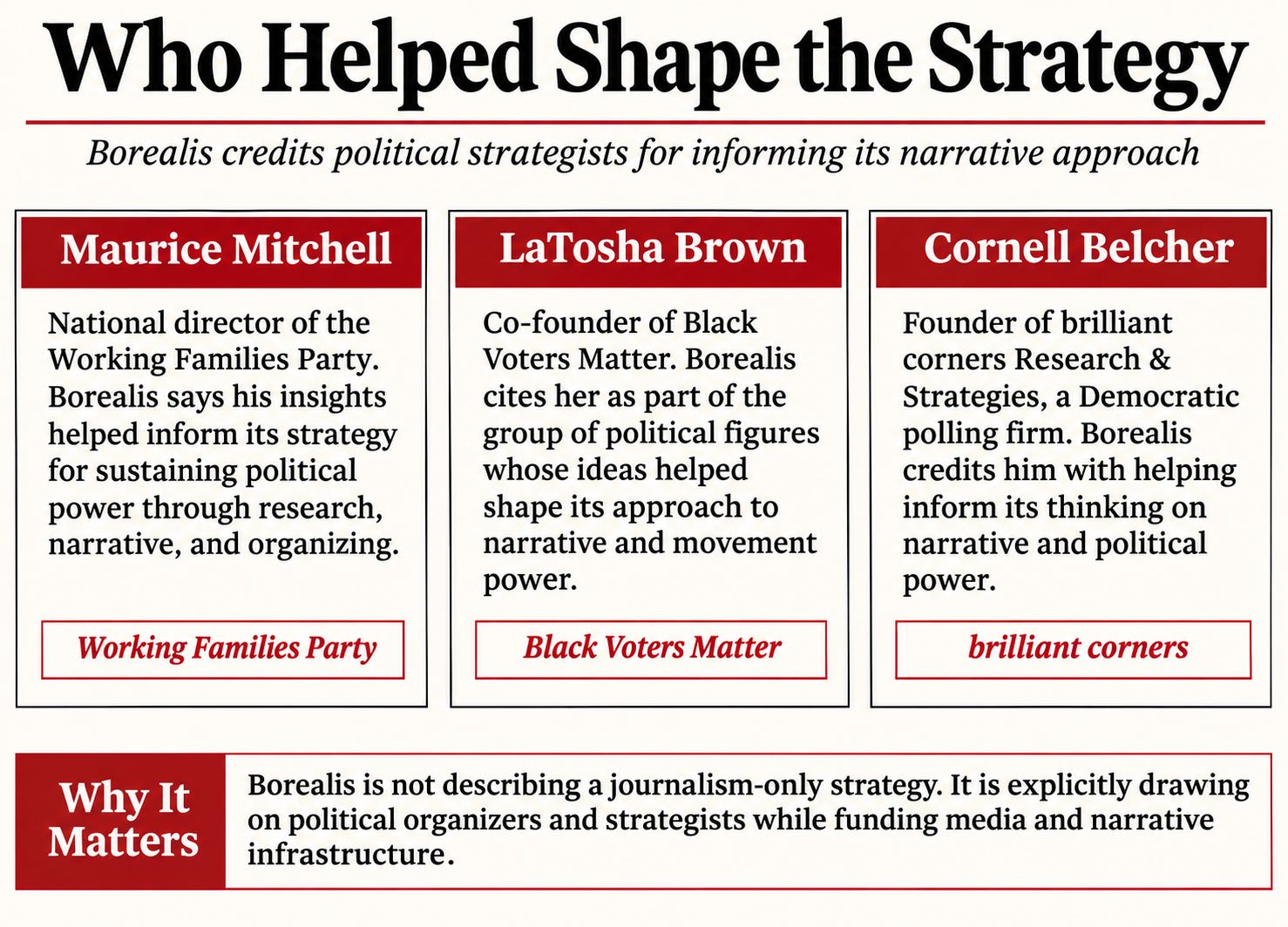
Borealis says insights from these figures have helped shape its narrative strategy and investments. Their involvement is notable because the discussion concerns sustaining political power, not simply newsroom economics or journalistic standards.
The organization does not establish that these figures direct individual newsrooms. It does, however, expressly connect the thinking of political strategists to its broader narrative investments.
Major Foundations Finance the Media Infrastructure
The strategy operates through an established philanthropic funding network.
Borealis’s Racial Equity in Journalism Fund distributed $4.27 million to 57 organizations in 2024. Another $4.33 million went to 56 organizations in 2025.
Its original institutional backers included Ford Foundation, Democracy Fund, Google News Initiative, Craig Newmark Philanthropies and the News Integrity Initiative.
MacArthur Foundation’s grant records list $11.49 million in awards to Borealis between 2018 and 2026, including a three-year, $4 million local-news grant awarded in 2026.
The journalism fund supports conventional newsrooms alongside explicitly movement-oriented publications and organizations. Borealis acknowledges that its portfolio extends from traditional journalism to movement journalism, publishers, field builders and community organizations.
Several recipients openly describe their media work in ideological and political terms.
Selected Borealis-Linked Media Outlets
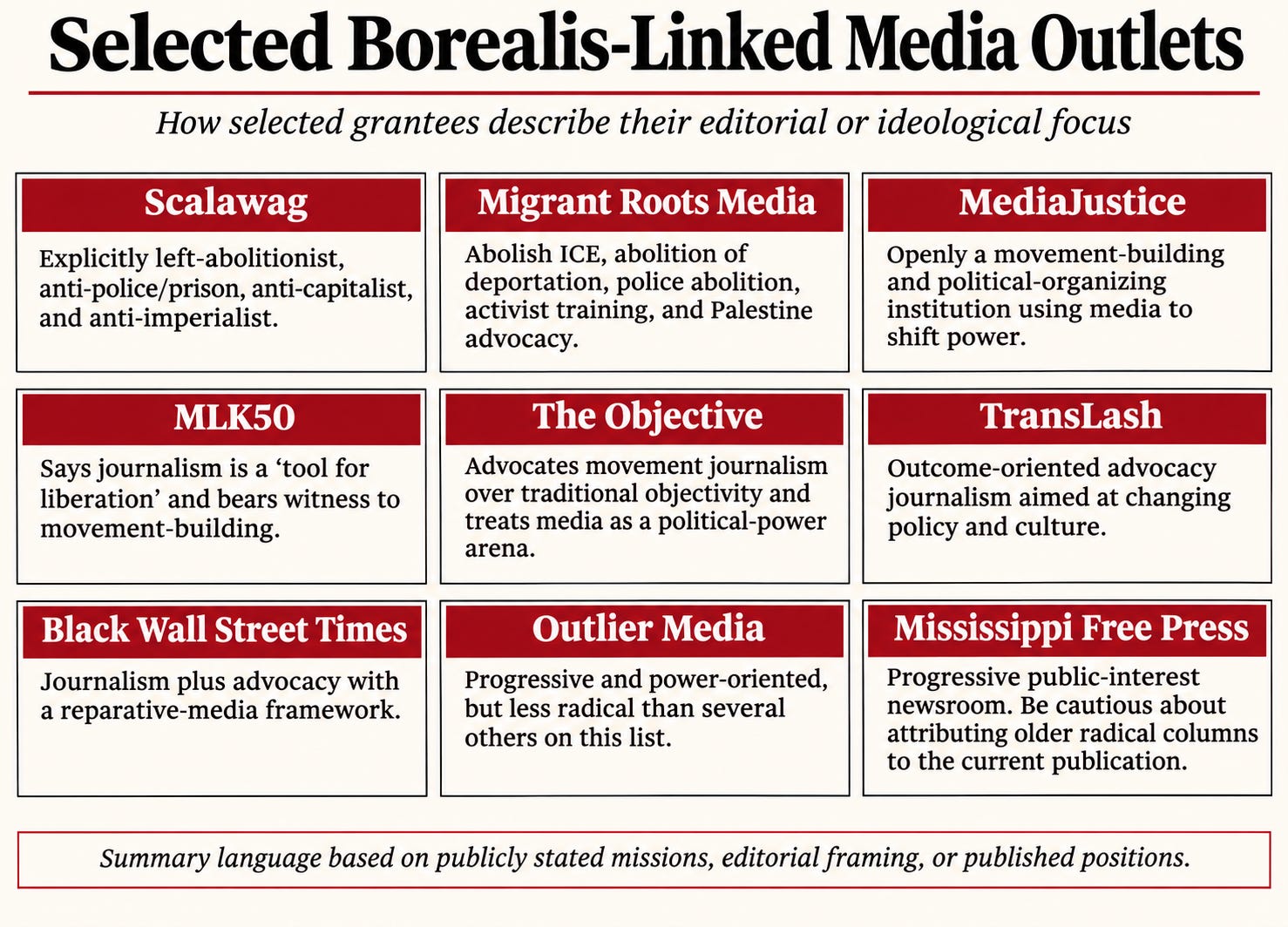
Scalawag, a Borealis grantee, identifies as a “Left Abolitionist publication” dedicated to ending the global prison-industrial complex.
In a 2022 editorial guide, its editors called for media that rejects the need for police to exist. Co-executive director Da’Shaun Harrison publicly identifies as an anarcho-communist and describes their work as movement media and narrative strategy.
Convergence Magazine, another recipient, explicitly calls itself a publication for “radical insights.” Its mission advocates dismantling racial capitalism and building a governing majority involving grassroots movements, organized labor, socialists and progressives.
The publication’s advisory board includes Working Families Party director Maurice Mitchell, whom Borealis also credits with informing its strategy. Its editorial board includes Max Elbaum, who participated in the New Communist Movement of the 1970s and 1980s and authored a history of that movement titled Revolution in the Air.
MediaJustice, also listed among Borealis’s grantees, describes itself as an organization that builds power against corporate and governmental control of media and technology. Its activities include political education, organizing and connecting movements challenging corporate power.
Migrant Roots Media has published arguments advocating the abolition of immigration enforcement and deportations. One 2019 article argued that abolishing ICE should mean eliminating deportation rather than transferring enforcement responsibilities elsewhere.
MLK50: Justice Through Journalism states in its institutional materials that “journalism is a tool for liberation” and describes its mission as reporting on poverty, power and policy while bearing witness to movement-making.
The Objective has published a commentary series promoting movement journalism as reporting that serves social transformation. Contributor Lewis Raven Wallace describes it as distinct from conventional journalism because it openly seeks to advance change.
Other Borealis recipients include TransLash, which connects its storytelling to legal and policy change, and Black Wall Street Times, which identifies journalism, advocacy and community empowerment as overlapping parts of its mission.
The positions differ across organizations. Nevertheless, these examples show that a portion of Borealis’s journalism funding reaches institutions that expressly combine publishing with political or social-movement objectives.
Media Outlets Organizing Together
The relationship between journalism and political organizing extends beyond individual publications.
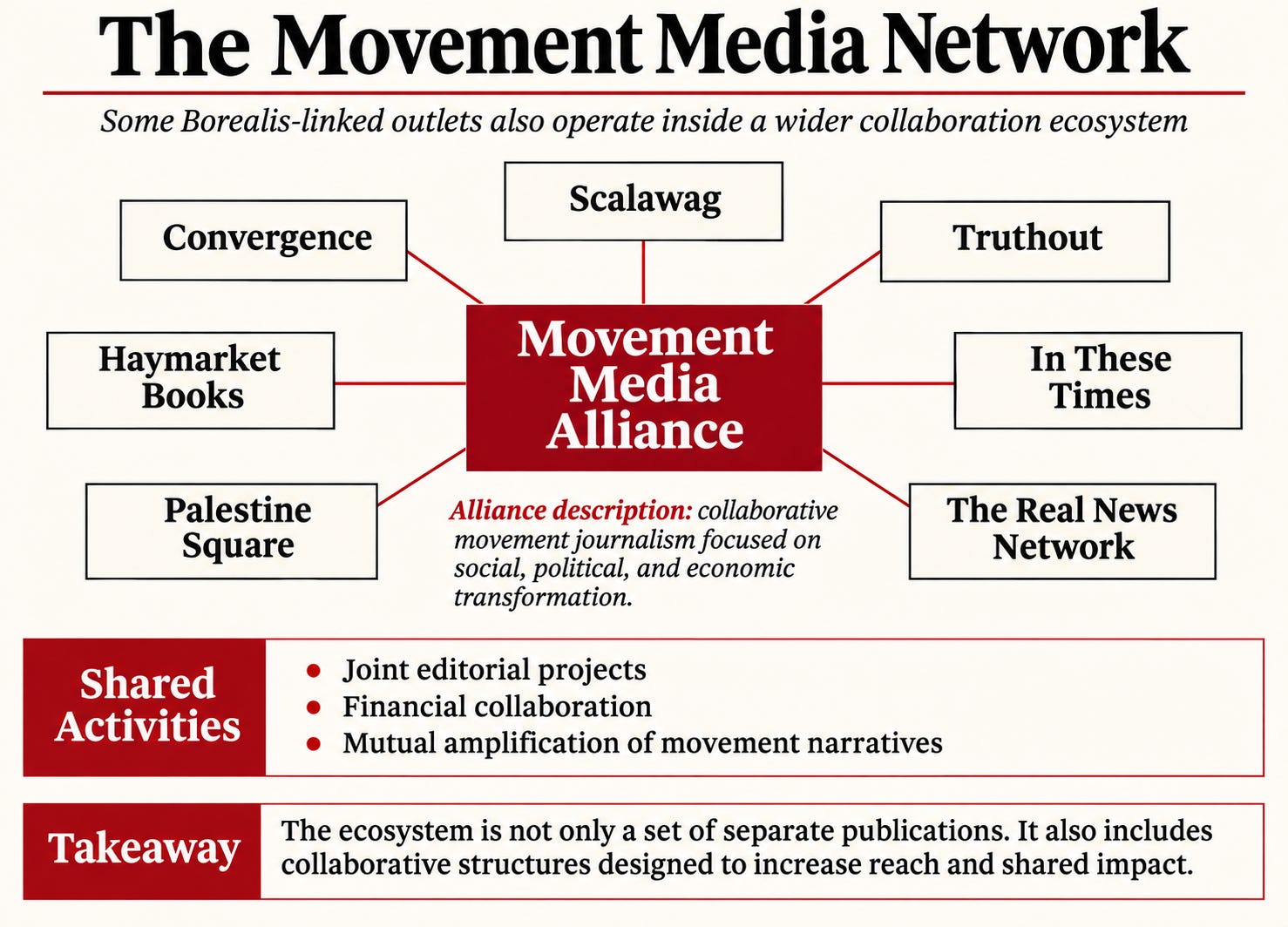
Convergence and Scalawag are members of the Movement Media Alliance, a coalition that includes Truthout, In These Times, The Real News Network, Palestine Square and Haymarket Books.
The alliance’s founding announcement defines movement journalism as reporting conducted in the service of social, political and economic transformation. It describes collaboration among outlets to amplify their impact, support one another financially and strengthen social movements.
The same coalition also developed Media Against Apartheid and Displacement, a collaborative media project focused on Israel and Palestine. Its founding announcement describes participating outlets coordinating coverage, sharing reporting and amplifying narratives concerning the conflict and Palestinian liberation.
These collaborations illustrate how movement-oriented outlets can operate collectively rather than solely as independent publications competing for audiences.
Journalism as Political Infrastructure
Borealis’s November 4 statement brings these elements together.
The organization is not merely describing a program to preserve local journalism. It is explicitly encouraging donors to support a broader ecosystem in which media, research, cultural production and organizing reinforce one another to change public beliefs and advance social movements.
Its own funding portfolio includes publications promoting abolitionist and socialist objectives, while political strategists help inform its broader narrative investments and some recipients collaborate through movement-media networks.
Borealis describes this as strengthening democracy and challenging inequality. The resulting question is how distinctly journalism and political advocacy operate when media funding is incorporated into an explicit strategy for movement power.
The organization’s stated ambition is not limited to delivering information. It is to help shape what audiences believe, influence what they consider possible and support the movements seeking to turn those beliefs into systemic change.