


An immigration judge has ruled that Salah Sarsour, president of Wisconsin’s largest mosque and a national board member of American Muslims for Palestine, can be deported from the United States, bringing renewed attention to decades-old allegations linking the Palestinian activist to Hamas fundraising and operatives.
Immigration Judge Jayme Salinardi ruled on September 30 that Sarsour is deportable, according to his legal team. The ruling relied in part on a determination by Secretary of State Marco Rubio that Sarsour’s presence in the United States could have potentially serious adverse foreign-policy consequences.
The ruling does not mean Sarsour will immediately be deported. His case will proceed to questions over whether he qualifies for relief from removal, while his lawyers are separately pursuing constitutional claims in federal court. The immigration judge also rejected government allegations that Sarsour lied on his green-card application and that he improperly registered to vote. But the decision places renewed scrutiny on a history extending well beyond Sarsour’s current role as president of the Islamic Society of Milwaukee.
Israeli Convictions and Weapons Charge
Federal court records confirm that Sarsour was convicted twice by an Israeli military court before settling permanently in the United States. According to a June federal court order, the Ramallah Military Court convicted Sarsour in 1989 of throwing a Molotov cocktail and stones at Israeli soldiers. In 1995, the same court convicted him of attempting to possess weapons and ammunition.

The American government, however, had known about the Israeli cases for decades. The June federal court ruling noted that U.S. authorities considered information concerning the convictions during immigration or naturalization reviews in 2000, 2008, 2010 and 2019.
The FBI Memo and Hamas Fundraising Allegations
More serious allegations concerning Sarsour appear in FBI material prepared during the federal investigation of the Holy Land Foundation for Relief and Development. The Holy Land Foundation was later convicted in a major U.S. terrorism-financing prosecution involving millions of dollars prosecutors said were provided in support of Hamas.
A 2001 FBI memorandum discussed statements attributed to Sarsour’s brother, Jamil Sarsour, following his arrest by Israeli authorities in 1998. Congressional testimony quoting the FBI report said Jamil provided information regarding his own activities and those of Salah in support of Hamas.
According to the material, Jamil described Salah’s alleged involvement with Hamas and fundraising activities connected to the Holy Land Foundation. The testimony said Jamil told investigators that his brothers Salah and Imad were involved in raising money in the name of the Holy Land Foundation that was actually intended for Hamas.
The same record also described allegations involving a more direct financial channel. Jamil was arrested in Israel in October 1998 for allegedly providing financial and other assistance to Adel Awadallah, a Hamas military operative. At the time, according to the FBI material quoted in congressional testimony, he was carrying more than $66,000, two American passports and a telephone book.
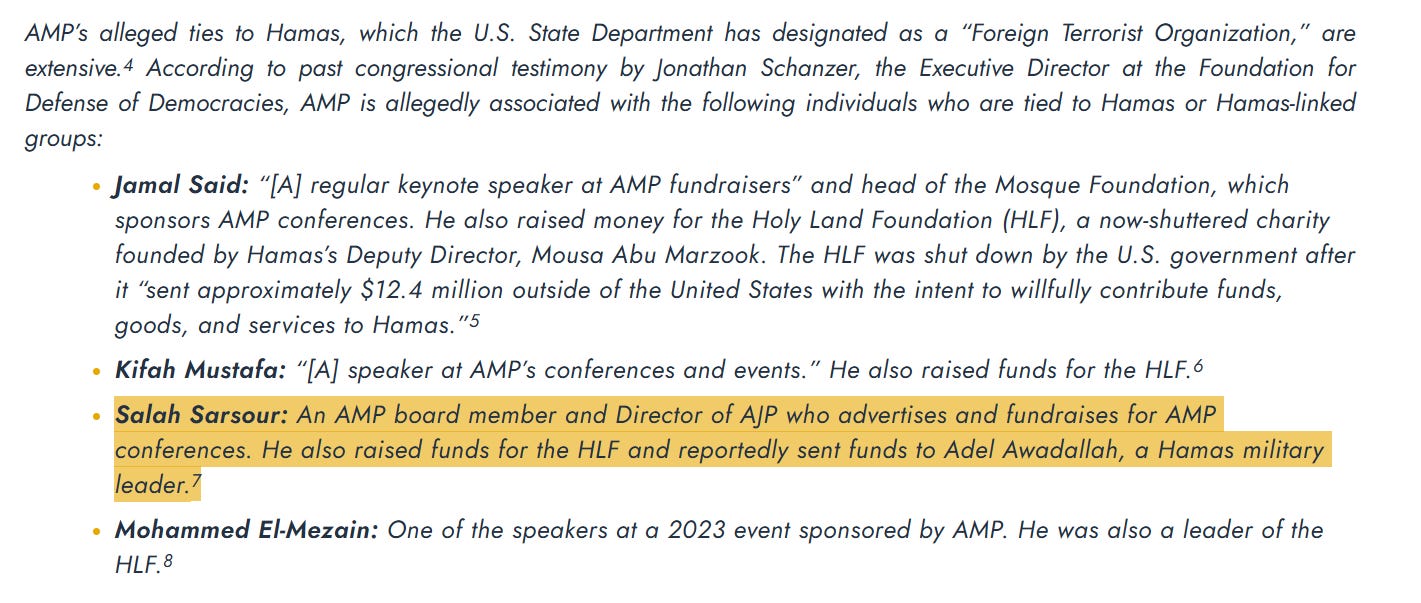
The Senate HELP Committee later summarized the allegations by stating that Sarsour “raised funds for the HLF and reportedly sent funds to Adel Awadallah, a Hamas military leader.” Awadallah was a senior figure in Hamas’s military wing in the West Bank.
A Senior American Muslims for Palestine Figure
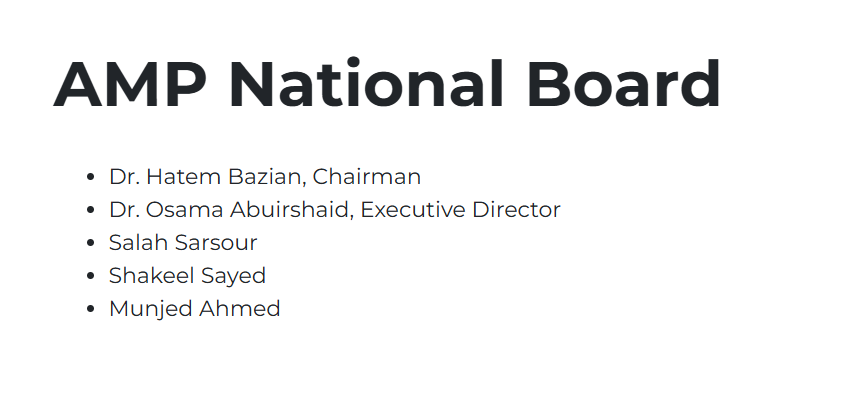
Sarsour later became a senior figure in American Muslims for Palestine (AMP), serving on its national board and playing a role in its conferences and fundraising. That position has attracted growing attention as AMP itself has faced congressional scrutiny.
In March 2025, Senate HELP Committee Chairman Bill Cassidy opened an investigation into AMP and Americans for Justice in Palestine Educational Foundation over their activities on college campuses and alleged historical connections to individuals associated with Hamas-linked organizations.
The committee singled out Sarsour by name, describing him as an AMP board member and AJP director who advertises and fundraises for AMP conferences. Its letter also cited the allegations that Sarsour raised money for the Holy Land Foundation and reportedly sent funds to Awadallah.
Sarsour’s leadership role in AMP also became relevant to the government’s immigration case. A June federal court order describes a memorandum from Rubio asserting that Sarsour’s presence in the United States would undermine U.S. foreign-policy efforts involving antisemitism and support for foreign terrorist organizations.
CAIR Honors Sarsour
Sarsour’s legal battle has simultaneously turned him into a celebrated figure within major American Muslim organizations. The Council on American-Islamic Relations repeatedly called for his release following his March arrest by immigration authorities. After a federal judge ordered him released in June, CAIR portrayed Sarsour as a political prisoner and continued rallying support around his case.
Then, at CAIR’s 2026 national gathering, the organization honored Sarsour with its “Courage Under Fire Award.” CAIR described him as a “freed political prisoner” and Wisconsin Muslim community leader.
The award came despite the publicly available record surrounding Sarsour: two Israeli military convictions, FBI material recounting allegations that Sarsour and members of his family raised funds for Hamas, allegations involving money sent to a Hamas military commander, and his continuing leadership role in an organization that has itself drawn federal scrutiny.
The Deportation Fight Continues
The September 30 ruling does not end Sarsour’s case. His attorneys have said they will appeal, and another immigration judge is expected to oversee proceedings concerning whether Sarsour qualifies for relief that could prevent his removal. The ruling is nevertheless significant.
Salinardi rejected some of the government’s allegations, including the accusation that Sarsour had lied to obtain his green card. But he ultimately concluded that Sarsour was removable under U.S. immigration law.
For a man who has spent more than three decades in the United States, risen to lead Wisconsin’s largest mosque, joined the national leadership of American Muslims for Palestine and recently received a national award from CAIR, the decision marks the most consequential development yet in a controversy that reaches back decades.
And it has brought the record surrounding Salah Sarsour back into focus: the Israeli convictions, the FBI material, the Holy Land Foundation allegations, the allegation that funds were sent to a Hamas military commander, and the organizations that continued to elevate him long after those allegations became public.