


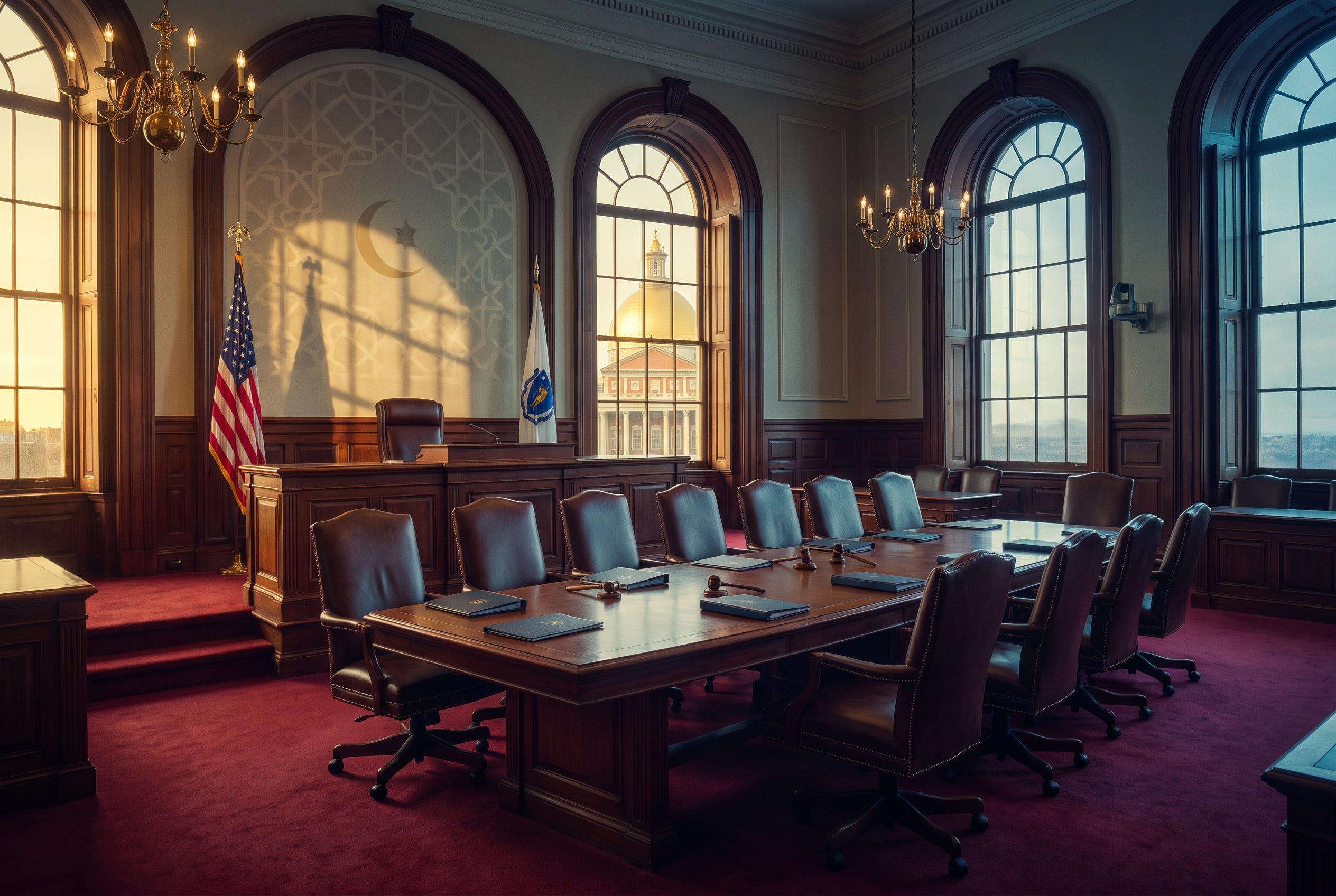
Massachusetts lawmakers are advancing the nation’s first permanent, taxpayer-funded state commission dedicated exclusively to a single religion—Islam—raising constitutional questions and exposing a network of organizations with documented ties to designated terrorist financing operations.
Senate Bill 2134, which cleared initial committees and now sits in the Senate Ways and Means Committee, would establish an 11-member panel of Muslims with authority to recommend co-religionists for government appointments, research “Islamophobia,” and evaluate hate crime statutes for potential amendments. The bill wasn’t merely supported by outside advocacy groups—it was directly co-authored by them.


Who Wrote the Bill
State Senator Jamie Eldridge and Representative Vanna Howard didn’t just consult outside organizations when drafting S.2134. According to Eldridge’s own press release, the sponsors “collaborated with” Jetpac, a political infrastructure organization whose stated mission is to “build American Muslim political infrastructure and increase the community’s influence.”
That collaboration extended to the Council on American-Islamic Relations (CAIR), which hosted a June 10, 2025 lobby day featuring 150 participants and opening remarks from both sponsors.
CAIR was named an unindicted co-conspirator in the 2007 Holy Land Foundation terrorism financing trial, where five HLF leaders were convicted of funneling more than $12 million to Hamas. The Fifth Circuit later ruled the public naming violated the organizations’ due process rights, though the underlying trial evidence remains in the record.
The connection between Jetpac and Senator Eldridge runs deeper than policy collaboration. Jetpac’s current Executive Director, Mohammed Missouri, previously worked on Eldridge’s staff before joining the organization in 2019.
The Network Behind the Commission
Jetpac operates in coordination with CAIR-Massachusetts and the Islamic Center of Boston (Wayland), according to investigative findings reported by the Daily Signal. ICB Wayland’s president, Farah Abbas, publicly endorsed the legislation in Eldridge’s press release.
That same Islamic center allegedly held a fundraising dinner in October 2025 for United Hands Relief, a charity intertwined with Baitulmaal. United Hands Relief’s CEO, Suleiman Alghanem, ran Baitulmaal from 2007 to 2017, and its communications director previously worked there as well, according to his LinkedIn profile and Investigative Project on Terrorism reporting.
Baitulmaal has been accused of ties to Hamas through its membership in the Union of Good, which the U.S. Treasury Department designated in 2008 as a Specially Designated Global Terrorist organization for funneling money to Hamas. An Investigative Project on Terrorism report documented Baitulmaal’s contributions to Gaza-based charities with ties to the Popular Resistance Committees, a terrorist organization designated by Israel in 2006.
Baitulmaal’s current CEO, Mazen Mokhtar, previously served as Executive Director of the Muslim American Society (MAS) from 2013 to 2018. MAS was established in 1993 as the Muslim Brotherhood’s American arm, according to federal court evidence. Mokhtar has been quoted as describing suicide bombings as “an effective method of attacking the enemy and continuing jihad.”


What the Commission Would Do
The bill’s text grants the commission eight specific responsibilities, including the authority to “identify and recommend qualified American Muslims for appointive positions at all levels of government” and “evaluate the commonwealth’s hate crime statutes” to determine “whether any amendments would better protect residents from Islamophobia.”
The 11 commission members—all required to “demonstrate a commitment to the Muslim American community”—would be appointed by Governor Maura Healey, legislative leadership, the attorney general, and other state officials. “No other group in Massachusetts is granted a permanent government body with an official pipeline for placing its people in positions of power,” Amy Mek, founder of the RAIR Foundation, told the Daily Signal.
Constitutional Concerns and the Current Status
In October 2025, a Norfolk Superior Court judge granted a preliminary injunction blocking Catholic statues outside a Quincy public safety building, ruling the display likely violated Article 3 of the Massachusetts Declaration of Rights. That provision states “no subordination of any one sect or denomination to another shall ever be established by law.” The Massachusetts Supreme Judicial Court has since heard arguments in the case, raising questions about whether S.2134’s single-religion commission could withstand similar scrutiny.
Representative Randy Fine (R-FL) criticized the bill on X, writing: “They lecture us about ‘separation of church and state’ while funneling your tax dollars into a Muslim-only DEI commission. No religious group gets preferential treatment with our money. Not now. Not ever.”

The bill received a favorable committee report in November 2025, an “ought to pass” recommendation in January 2026, and currently awaits action in the Senate Ways and Means Committee — the final hurdle before a floor vote.
I guess the separation of church and state is negotiable.