


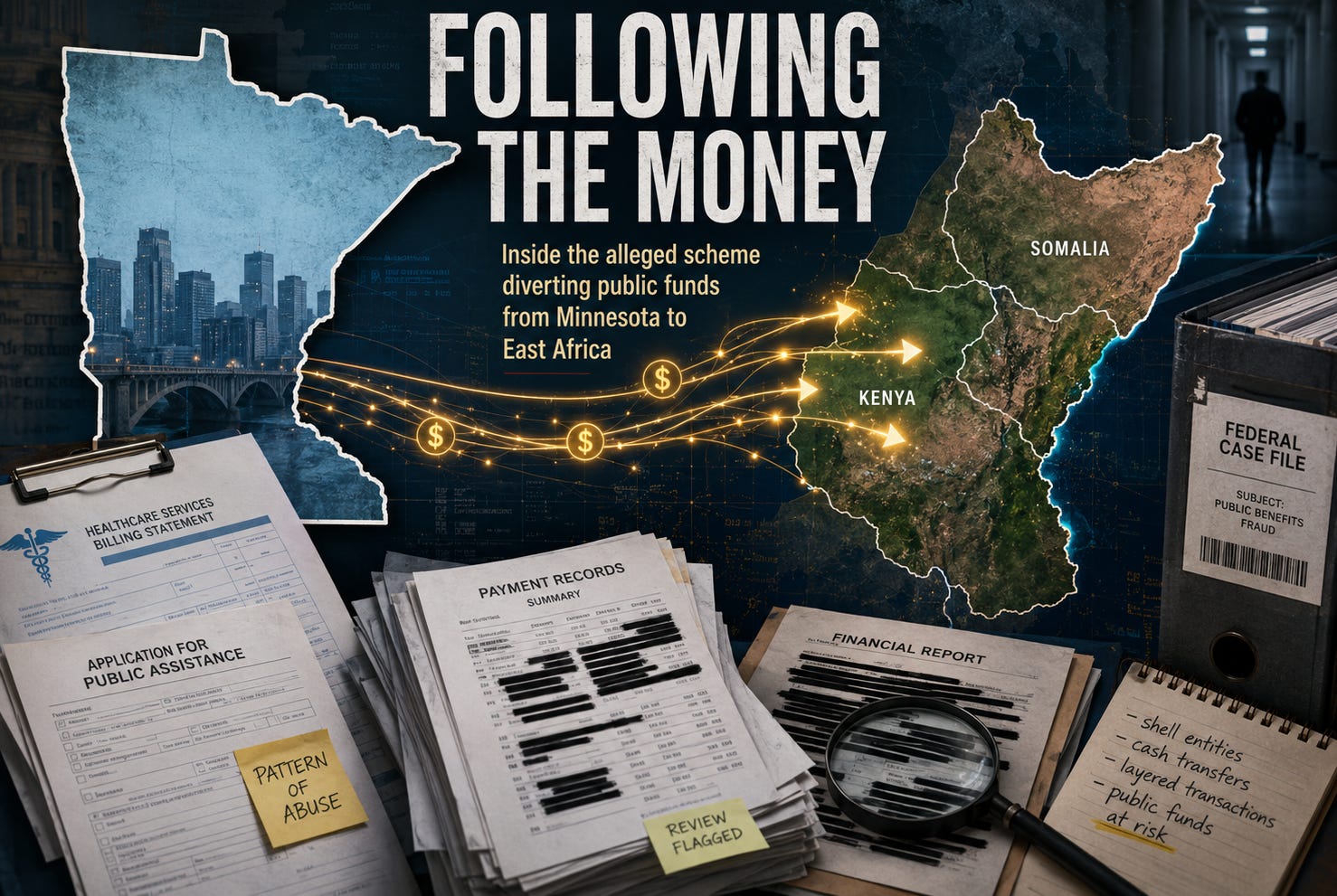
Federal prosecutors charged 15 defendants on May 21 in alleged Medicaid fraud schemes totaling more than $90 million in intended losses, marking Minnesota’s two largest Medicaid fraud cases ever. The indictments targeted alleged fraud in autism services, housing support, and child-care programs — the latest wave in a state already designated a federal fraud “ground zero” by Treasury Secretary Scott Bessent, who announced in January that his department is investigating whether Minnesota welfare money was diverted to al-Shabaab, a U.S.-designated terrorist organization operating in Somalia.
The May 21 indictments came hours before a federal judge sentenced Aimee Bock to nearly 42 years in prison for leading the $250 million Feeding Our Future fraud scheme — the nation’s largest pandemic fraud case — in which stolen child-nutrition funds flowed overseas to Kenya and other countries.
Why Treasury Is Investigating Al-Shabaab Links
The terror-financing question looms over Minnesota’s fraud crisis because documented money trails from earlier prosecutions show millions in stolen public funds flowing to East Africa, and because Minnesota has a proven track record of al-Shabaab material support: federal prosecutors previously convicted two Minnesota women for raising money in Somali communities under false charitable pretenses and sending funds through remittance companies to al-Shabaab members in Somalia from 2008 to 2009.
Law enforcement sources have told investigators that welfare fraud proceeds are flowing through informal money-transfer networks called hawalas — clan-based systems that move money without banks or documentation — and reaching regions in Somalia where al-Shabaab operates. According to City Journal, which conducted an investigation into the Minnesota-Somalia money corridor, a retired Seattle Police detective who spent 14 years on a federal Joint Terrorism Task Force tracked a hawala network that sent $20 million abroad in a single year, with records showing that “all these Somalis sending out money are on DHS benefits.”
A former Minneapolis JTTF official told City Journal that “every scrap of economic activity” sent from Minnesota back to Somalia “benefits Al-Shabaab in some way” because the group taxes or controls commerce in regions where it operates. “For every dollar that is transferred from the Twin Cities back to Somalia, Al-Shabaab is taking a cut of it,” the former official said.
The public record does not yet show criminal charges proving that fraud defendants intended to fund al-Shabaab — a key legal distinction, since terror-financing prosecutions require evidence of intent, not just money flowing into regions where terror groups operate.

The $90 Million Takedown
The May 21 charges include two cases the Justice Department described as the largest Medicaid fraud prosecutions ever brought in Minnesota. The biggest single case alleges that Shamso Ahmed Hassan and Hanaan Mursal Yusuf defrauded Minnesota’s Early Intensive Developmental and Behavioral Intervention program — which pays for autism services — of $46.6 million by paying parents to enroll children regardless of need and billing for services never provided.
Eight defendants were charged with defrauding Housing Stabilization Services, a program meant to help homeless individuals, of approximately $15.7 million. That program grew from $3.3 million in 2020 to $108.8 million by 2024 before Governor Tim Walz shut it down last fall because of rampant fraud.
One defendant, Ahmed Othman Kadar, was charged with defrauding Integrated Community Supports, a disability-services program, after a man who was supposed to be receiving around-the-clock care died unattended in the care of Kadar’s company, Ultimate Home Health.
The Overseas Money Trail From Earlier Cases
The strongest documented link between Minnesota fraud and East Africa comes from the Feeding Our Future prosecution — the same case that culminated in Aimee Bock's 42-year sentence on May 21. In that scheme, convicted defendant Abdiaziz Farah sent millions in stolen child-nutrition funds overseas and bought Kenyan real estate through sham entities, according to federal prosecutors. Farah also purchased land in Mandera, a Kenyan town near the Somalia border, and federal prosecutors charged his brother, Kenyan national Ahmednaji Sheikh, with helping him launder and hide the fraud proceeds abroad.
Money sent to regions where al-Shabaab operates can be taxed, extorted, or controlled by the group even if the sender claims a lawful purpose — but proving a criminal link requires transaction-level evidence connecting fraud proceeds to the terror network.
Bessent’s Investigation and FinCEN Enforcement
Treasury Secretary Scott Bessent announced in January that FinCEN — Treasury’s Financial Crimes Enforcement Network — issued four notices of investigation to money-services businesses in Minnesota and imposed a Geographic Targeting Order requiring banks and money transmitters in Hennepin and Ramsey counties to report outbound foreign transfers of $3,000 or more.
Bessent told reporters that Treasury is “thoroughly investigating the fraud, including funds sent to Somalia through money service businesses” and that “these funds could have potentially been diverted to the terrorist organization al-Shabaab.”
Minnesota’s Proven Al-Shabaab Material-Support History
The al-Shabaab risk is not theoretical. Federal prosecutors secured convictions in 2011 against Amina Farah Ali and Hawo Mohamed Hassan, two Rochester, Minnesota women who raised money in Somali neighborhoods by soliciting funds door-to-door under false pretenses — claiming it was to help the poor — and then transferred funds to al-Shabaab through remittance companies using false recipient names.
Ali hosted a 2008 fundraising teleconference during which a speaker told listeners to support “the mujahidin” rather than help the poor, and in 2009 she told participants to “forget about the other charities” and focus on “the jihad.” Ali directed at least 12 money transfers to al-Shabaab and was sentenced to 20 years in federal prison.
That case proved Minnesota’s role as a fundraising corridor for al-Shabaab more than a decade ago. The investigative question today is whether the state’s current fraud schemes — which dwarf the earlier material-support cases in scale — are feeding into the same remittance corridors.
The hardworking taxpayers of Minnesota should be furious that the Feds had to step in to put a stop to this. State leadership is either 100% incompetent or chose to look the other way in order to buy votes. I bet on the latter.