



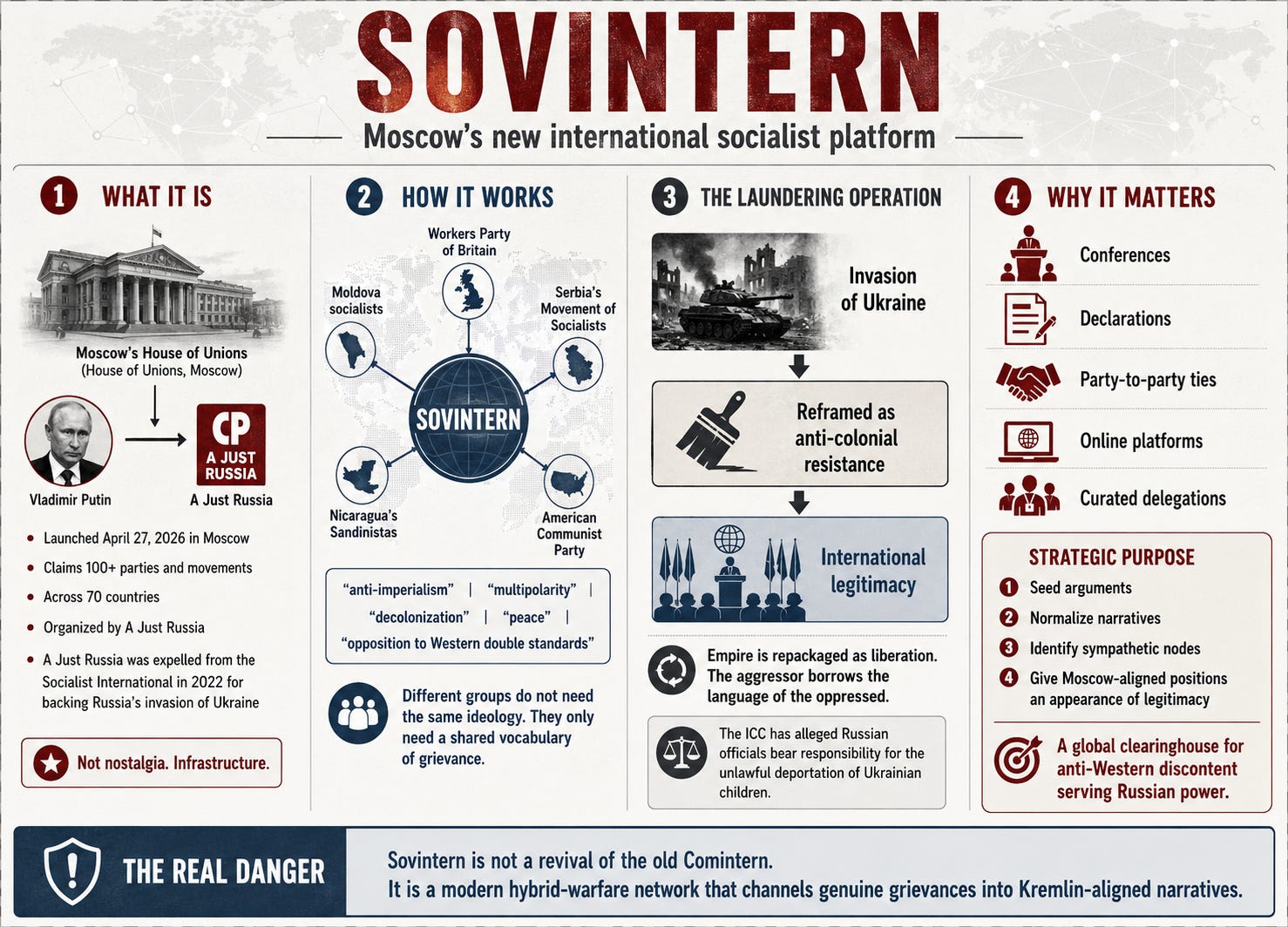
On April 27, 2026, inside Moscow’s House of Unions, Vladimir Putin sent greetings to the inaugural forum of Sovintern, an “international socialist platform” claiming representatives from more than 100 parties and movements across 70 countries.
The event was organized by A Just Russia, a Kremlin-aligned party that four years earlier had been expelled from the Socialist International for supporting Russia’s invasion of Ukraine. Now that same party was building a rival international — one that explicitly endorses Moscow’s “special military operation,” frames the war as anti-colonial resistance, and expresses solidarity with the Russian Federation.
What Sovintern Actually Is
The Robert Lansing Institute describes Sovintern as a project initiated by Sergey Mironov, leader of A Just Russia, under the banner of “Socialism 2.0.” Co-initiators include the Workers Party of Britain, the Party of Socialists of the Republic of Moldova, Serbia’s Movement of Socialists, Nicaragua’s Sandinista National Liberation Front, and the American Communist Party. The institute argues Sovintern should be understood not as an autonomous ideological movement but as a Kremlin-aligned influence platform.


Putin’s greeting was not ceremonial. In it, he emphasized Russia’s efforts to “expand meaningful dialogue among constructive national political forces” and praised participants as “committed to social justice, sovereign development, and traditional spiritual and moral values.”
Modern Russia is not the Soviet Union. Putin does not govern as a revolutionary Marxist. His regime is personalist, nationalist, and imperial, shaped by the security services and increasingly civilizational in its rhetoric. But it understands ideology as infrastructure.

Hybrid Warfare, Ideological Edition
CEPA’s 2025 report on Russian hybrid threats argues that Moscow exploits existing vulnerabilities in Western societies — polarization, inequality, Soviet nostalgia, mistrust of institutions — rather than inventing them from scratch.
Sovintern fits neatly into that pattern. It is not a tank column or bot farm. It is a softer machine: conferences, declarations, party-to-party relationships, online platforms, and curated delegations. The object is not to seize power next year. It is to seed arguments, normalize narratives, identify sympathetic nodes, and give Moscow-aligned positions the appearance of international legitimacy.
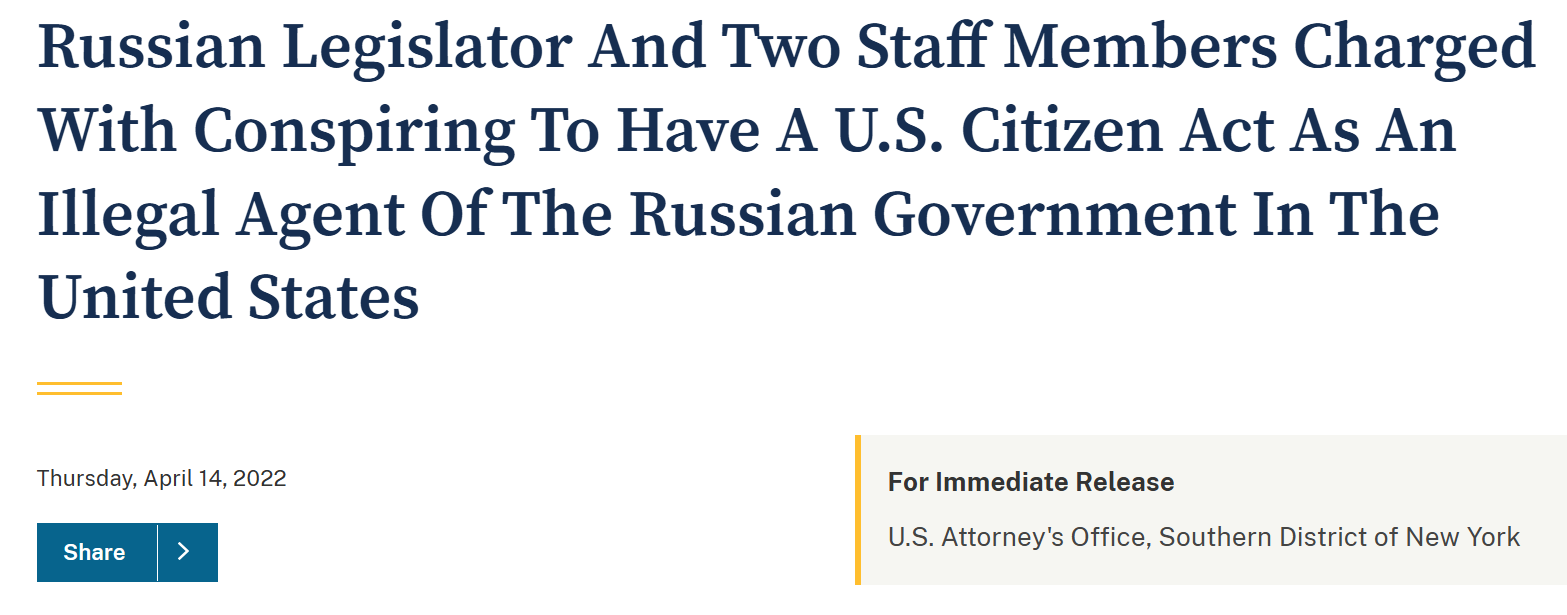
The United States has already seen fragments of this model. In 2022, the Justice Department charged Russian legislator Aleksandr Babakov and two staff members with conspiring to run what prosecutors described as a “global foreign influence and disinformation network” to advance Russian interests. Babakov is also a senior A Just Russia figure associated with the party’s international role.
The Real Danger
The danger is not that socialism returns. Democratic societies can argue about inequality and capitalism without every left-wing movement becoming a Kremlin proxy. Many socialists oppose Russian imperialism. Many left-wing parties have defended Ukraine.
The danger is more precise: Sovintern creates channels through which genuine grievances could be aligned with Russian strategic narratives. A young activist angry about inequality may enter through anti-capitalism and exit with Russian talking points on Ukraine. A postcolonial movement may begin with legitimate critique and find itself excusing Moscow’s imperial war.
The West’s answer cannot be panic or censorship. It has to be clarity: foreign influence transparency, better mapping of party networks, serious attention to ideological laundering, and renewed confidence that democratic civilization can withstand critique without surrendering its institutions.