

Muslims Do "Revere Jesus" — As Someone Who Will Abolish Christianity
Islamic eschatology says Jesus will return to break the Cross, enforce Sharia Law, and submit to another leader, in sharp contrast to Christianity.

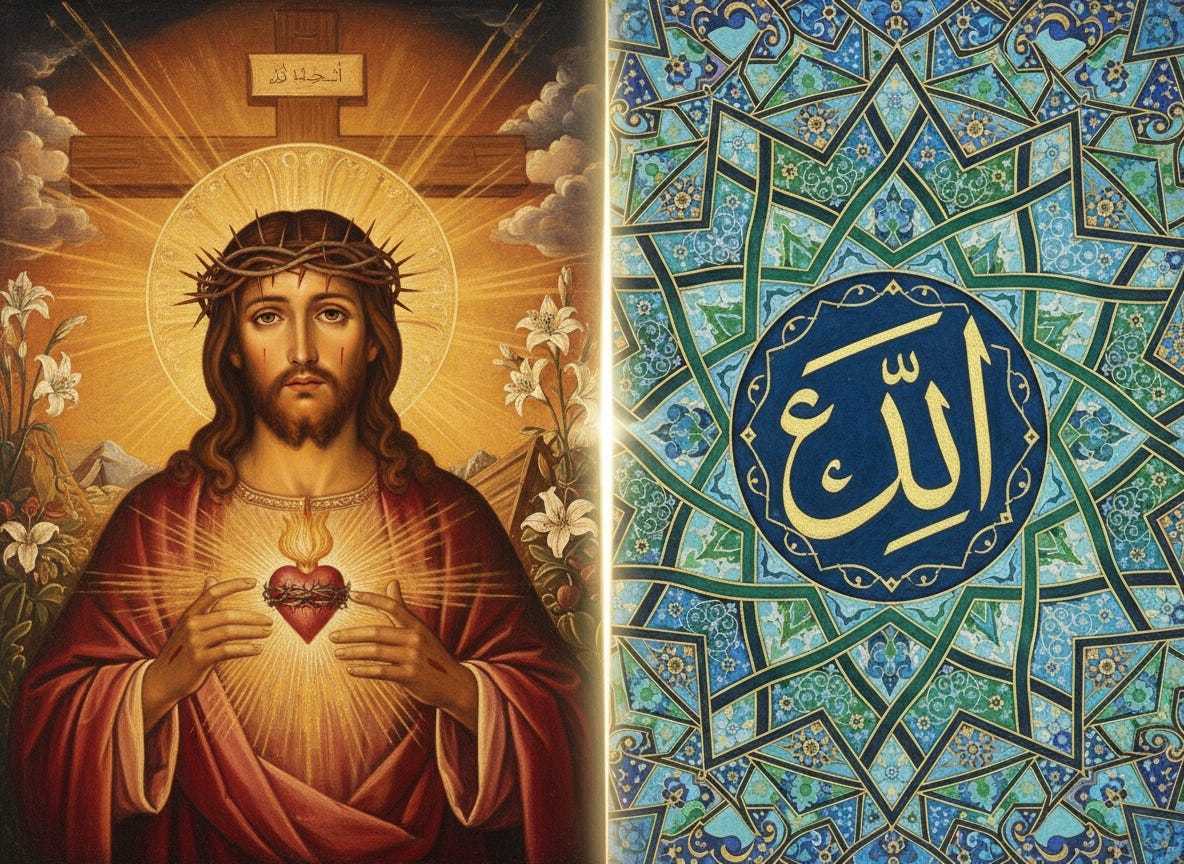
Tucker Carlson Network posted a claim this week that has circulated widely among commentators seeking interfaith common ground: “The people in charge don’t want you to know this, but Muslims love Jesus.”
The statement is technically true yet profoundly misleading. Islamic eschatology does revere Jesus (Isa in Arabic) as a “major prophet and messenger.” But the Jesus whom Muslims expect to return is not a savior. He is an enforcer: a figure who will abolish Christianity, subordinate himself to a different leader, and establish Islamic law as the sole legitimate religion.
This is not a semantic difference. It is a collision between two eschatologies that cannot be reconciled.
What Islamic Tradition Actually Says About Jesus’s Return
The belief in Jesus’s second coming is rooted in both the Quran and the hadith literature- collections of sayings attributed to Muhammad. According to Islamic teaching, Jesus was not crucified (Quran 4:157-158); God raised him to heaven later, and he will return to earth before the Day of Judgment.
But the mission he returns to complete is not the one Christians anticipate.
A widely cited hadith in Sahih al-Bukhari—one of Sunni Islam’s most authoritative collections states:
“The Hour will not be established until the son of Mary (i.e. Jesus) descends amongst you as a just ruler, he will break the cross, kill the pigs, and abolish the Jizya tax.”
The phrase “break the cross” is not metaphorical. Islamic scholars interpret it as Jesus actively invalidating Christianity by destroying its central symbol. According to a fatwa from IslamWeb, “He will allow breaking the crosses and prohibit owning them as a way of invalidating the Christian religion.”
The killing of pigs, animals forbidden in Islam, is understood similarly: a ritualistic repudiation of Christian practices. Together, these acts signal that Jesus’s return will mark the end of Christianity as a recognized faith- establishing Islam as the one true relgion.
Jesus Will Pray Behind the Mahdi—Not Rule
In Islamic eschatology, Jesus does not return as king. He returns as a deputy.
When Jesus descends, according to hadith narrated in Sunan Ibn Majah, he will arrive in Damascus at the time of morning prayer. The Muslims’ leader, a figure known as the Mahdi, will offer to let Jesus lead the prayer. But Jesus will refuse.
The hadith describes the exchange: Jesus will place his hand on the Mahdi’s shoulder and say, “Go forward and pray, for the Iqamah was given for you.”
This moment is theologically critical. Islamic scholars explain that Jesus prays behind the Mahdi to demonstrate that he is not bringing a new religious law (Sharia). His role is subordinate. He comes to enforce the Sharia of Muhammad- not his own.
“Jesus will be like the minister for Imam Mahdi,” one Shi’a theological source explains, “and his main mission will be to correct the dogma of Trinity and to clarify his humane personality and servitude to God.” Jesus will place the Madhi on the throne and serve him.
In Christian eschatology, Christ returns to reign from his throne in Jerusalem. In Islamic eschatology, he returns to serve- and to correct the error of Christendom.
The Core Theological Incompatibility
Islamic teaching is unambiguous: Jesus was never divine. The Quran explicitly rejects the Christian doctrine of the Trinity and the claim that Jesus is the Son of God. When he returns, according to Islamic belief, one of his central tasks will be to deny those claims himself.
He will proclaim that he was never crucified, never resurrected in the Christian sense, and never divine. He will affirm that Muhammad, not himself, was the final and authoritative prophet.
Christians believe Jesus will return to establish His kingdom. Muslims believe he will return to dismantle the religion built in his name.
What About the Dajjal and Violence?
Islamic eschatology also teaches that Jesus will confront and kill the Dajjal—a false messiah figure often compared to the Antichrist. After defeating the Dajjal, hadith literature describes a period in which “Allah will defeat the Jews,” and trees and stones will call out to Muslims, saying, “O Muslim, there is a Jew behind me, come and kill him.”
Some Islamic scholars have contextualized these passages as referring to a specific eschatological battle rather than a blanket command. But the texts remain canonical, and their language is explicit.
Christians who convert to Islam during this period will be accepted. Those who do not will face a world in which, according to the hadith, the jizya tax, paid by non-Muslims living under Islamic rule, will be abolished because “there will be no excuse” for non-Muslims to remain outside Islam. Meaning convert or perish,
A Love That Demands Conversion
So yes: Muslims revere Jesus. They honor him as a prophet, believe in his miraculous birth, and await his return.
But the Jesus they await is a figure who will validate Islam, not Christianity. He will destroy the cross and teach salvation was never through him. He will enforce Islamic law, not establish a throne in Jerusalem. He will subordinate himself to the Mahdi, not reign as Lord.
To say “Muslims love Jesus” without clarifying what they believe about him is not interfaith dialogue. It is theological equivocation. And it obscures a fundamental truth: the Jesus of Islamic eschatology is not the Christ of Christianity. He is a different figure entirely- one whose return would mark not the fulfillment of Christian hope, but its definitive refutation.