


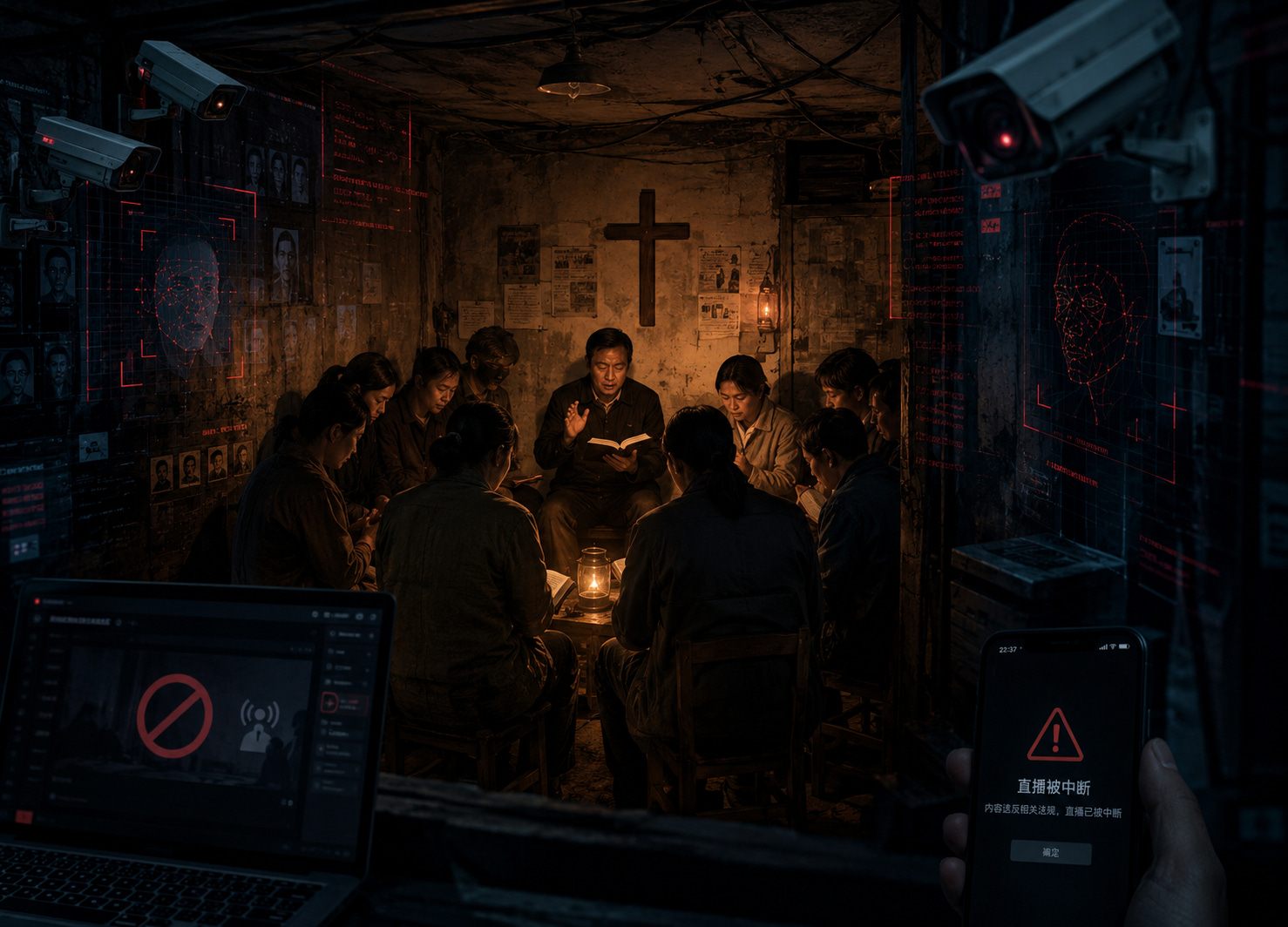
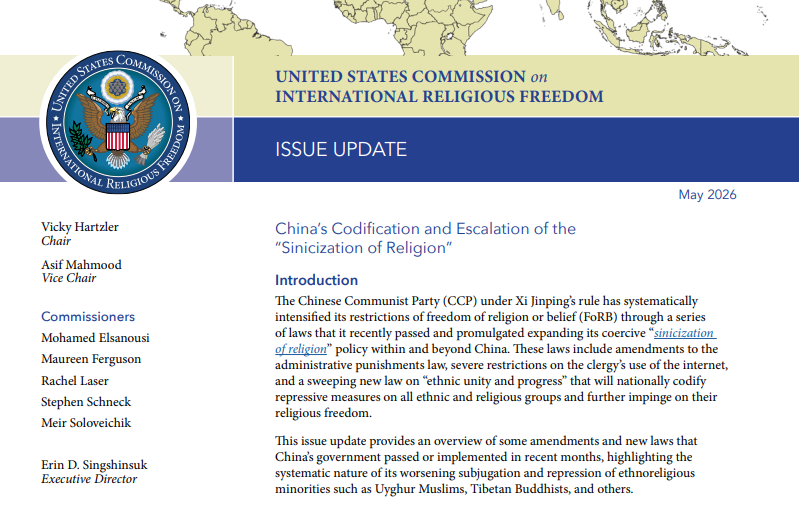
A May 2026 report from the U.S. Commission on International Religious Freedom documents how China enacted three laws in less than one year that together constitute “an escalation in the CCP’s systematic, ongoing, and egregious efforts to make all religion and belief throughout China entirely subservient to CCP ideology.”
The laws—revisions to the Public Security Administration Punishments Law (June 2025), an Online Code of Conduct for Religious Professionals (September 2025), and the Ethnic Unity and Progress Law (March 2026) — create what USCIRF characterizes as a legal architecture enabling “forced ethnoreligious assimilation nationwide by all levels of government — including the military.” The enforcement mechanism is already operational: at 2:00 a.m. on October 12, 2025, Pastor Ezra Jin Mingri and 27 other leaders of Zion Church were arrested across multiple provinces, just 30 days after the internet code took effect.
The USCIRF Finding: Three Laws, One System
The USCIRF report identifies the June 2025 Public Security Administration Law as the first time China included “illegal religious activities” within the scope of administrative punishments. Article 31, effective January 1, 2026, permits detention of 10 to 15 days and fines up to 2,000 RMB for organizing or inciting “illegal religious activities.” USCIRF notes this “in effect targets unregistered religious groups, such as Protestant house churches—thereby placing an additional layer of pressure on them to register and subject themselves to the authorities’ efforts to compel them to promote CCP ideology.”
The September 2025 Online Code restricted online religious activity exclusively to organizations holding government licenses. Article 13 banned livestreams, WeChat groups, and online services for unlicensed groups. Article 8 codified transnational repression, stating that “religious professionals must not collude with foreign forces through the internet.”
The March 2026 Ethnic Unity and Progress Law, adopted March 12 and effective July 1, drew particular alarm from USCIRF for its scope. Eight UN Special Rapporteurs sent a formal letter April 16, 2026, expressing concern that the law violates multiple international treaties. USCIRF highlights Article 46 as explicitly requiring religious groups to “persist in the direction of Sinicization” and Article 63 as codifying extraterritorial pursuit of critics.


Case Study: Pastor Jin and the 30-Day Timeline
USCIRF cites Pastor Ezra Jin’s arrest as direct evidence that “Chinese authorities invoked this new code” for enforcement. On October 10, 2025, police arrested Jin and 27 other Zion Church leaders across Beijing, Shenzhen, Shanghai, Hangzhou, Chengdu, and six other cities for “illegal use of information networks”— one month after the code’s release.
The arrest violated Article 17 of the code itself, which stipulates violators should receive warnings before penalties. USCIRF notes that “authorities gave no such warning to Pastor Jin or other members of the Zion Church before their detention.” Eighteen remain formally arrested under Criminal Law Article 287-1, facing potential sentences up to three years.
Zion Church had survived previous persecution. In 2018, the church refused government demands to install 23 facial recognition cameras. Police seized the building on September 9, 2018. The church adapted through hybrid online-offline meetings, eventually reaching 5,000 members in 40 cities. The September 2025 code eliminated that survival strategy. Grace Jin Drexel testified before USCIRF in January 2026 that detainees are forced to sleep on floor mats, subjected to sleep deprivation, and denied adequate medical care despite serious health conditions.
From Regional Atrocities to National Policy
USCIRF emphasizes that the Ethnic Unity Law “marks a clear departure from past pretenses to provide for regional ‘autonomy’” by nationalizing practices previously confined to borderlands. Tibet enacted ethnic unity regulations in 2020; Xinjiang and Inner Mongolia followed in 2021. Carl Minzner at the Council on Foreign Relations describes this trajectory as originating with the 2014 Central Ethnic Work Conference.
Article 15 mandates Mandarin from preschool forward. USCIRF reports that “long prior to this law, the CCP had overseen the removal of millions of Tibetan Buddhist and Uyghur children from their homes to place them in boarding schools.” UN experts warned in February 2023 that approximately one million Tibetan children were affected by forced assimilation through residential schools. In Xinjiang, boarding enrollment increased by 382,000 between 2017 and 2019.
Article 20 prohibits parents from instilling ideas “not conducive to improving ethnic unity” in minors. USCIRF observes this “denies them the right to foster religious upbringing in their own homes and impart traditions to their own children.” Article 48 potentially legitimizes “Chinese military operations against ethnoreligious groups and religious organizations that are not in full compliance with CCP ideology.”
The Vulnerable Population
China has 44 million Christians registered in state-approved churches. “Tens of millions” more are estimated to worship in illegal house churches. The three-law system creates escalating enforcement: administrative punishment (10-15 days detention), criminal prosecution (up to 3 years), and systematic pressure to register and submit to state ideology.
Transnational Reach
Article 63 permits pursuing “legal responsibility” against individuals “outside the mainland territory” who “undermine ethnic unity.” USCIRF notes this “codifies and further entrenches the Chinese government’s already extensive engagement in transnational repression.”
Freedom House describes China as conducting “the most sophisticated, global, and comprehensive campaign of transnational repression in the world.” Safeguard Defenders documented Operation Fox Hunt in more than 50 countries. The Department of Justice convicted a Fox Hunt leader in March 2025. The International Consortium of Investigative Journalists interviewed more than 100 victims in 23 countries in 2025. What was covert is now explicit statutory authority.
What happened to Uyghurs and Tibetans is now the codified framework for 1.4 billion people. Pastor Jin’s arrest 30 days after the internet code demonstrates operational readiness. The question is no longer whether China will enforce these laws. The question is whether the international community will respond before the Xinjiang model becomes the China model — for everyone.
Common denominator to modern totalitarian regimes regardless of party: The State = God.