


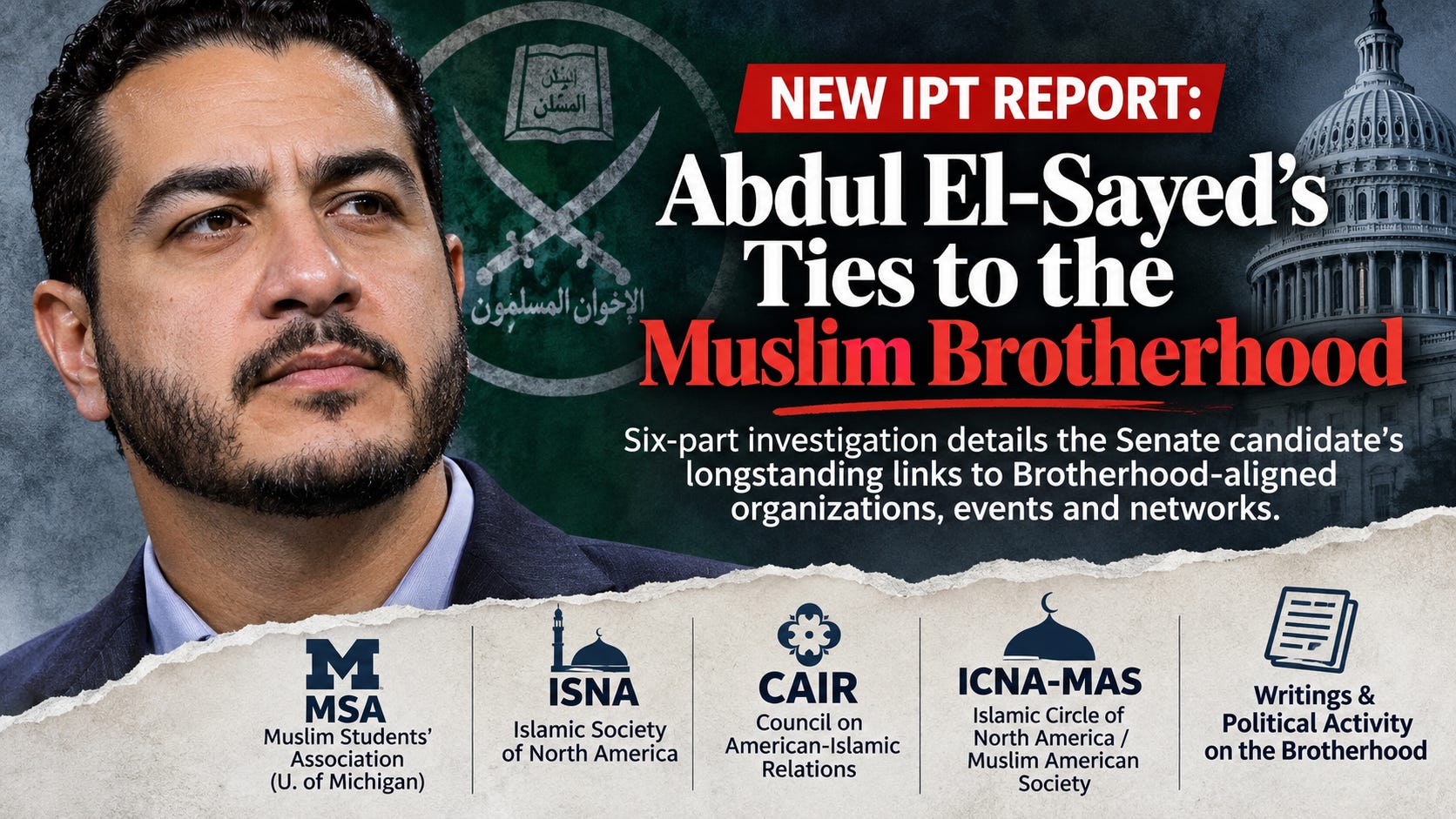
A new six-part investigation by the Investigative Project on Terrorism has assembled a two-decade record of Democratic Michigan Senate nominee Abdul El-Sayed’s involvement with organizations that Muslim Brotherhood documents, FBI records or federal prosecutors have linked to the Brotherhood’s historical U.S. network.
The Investigation Project on Terrorism report, published October 28 by IPT founder Steven Emerson, does not claim that El-Sayed was a formal member of the Muslim Brotherhood. Instead, it traces his leadership role in the Muslim Students’ Association at the University of Michigan, appearances before organizations including the Islamic Society of North America and the Council on American-Islamic Relations, fundraising appeals for CAIR and writings and political activity involving the Brotherhood and its associates.
El-Sayed, who faces Republican Mike Rogers in Michigan’s November 3 Senate election, has said unequivocally that he has never belonged to the Brotherhood. “I have never been a member of the Muslim Brotherhood. I never will be,” he told Fox News in October. His campaign has characterized scrutiny of his family and religious associations as a bad-faith political attack.
From the Muslim Students’ Association
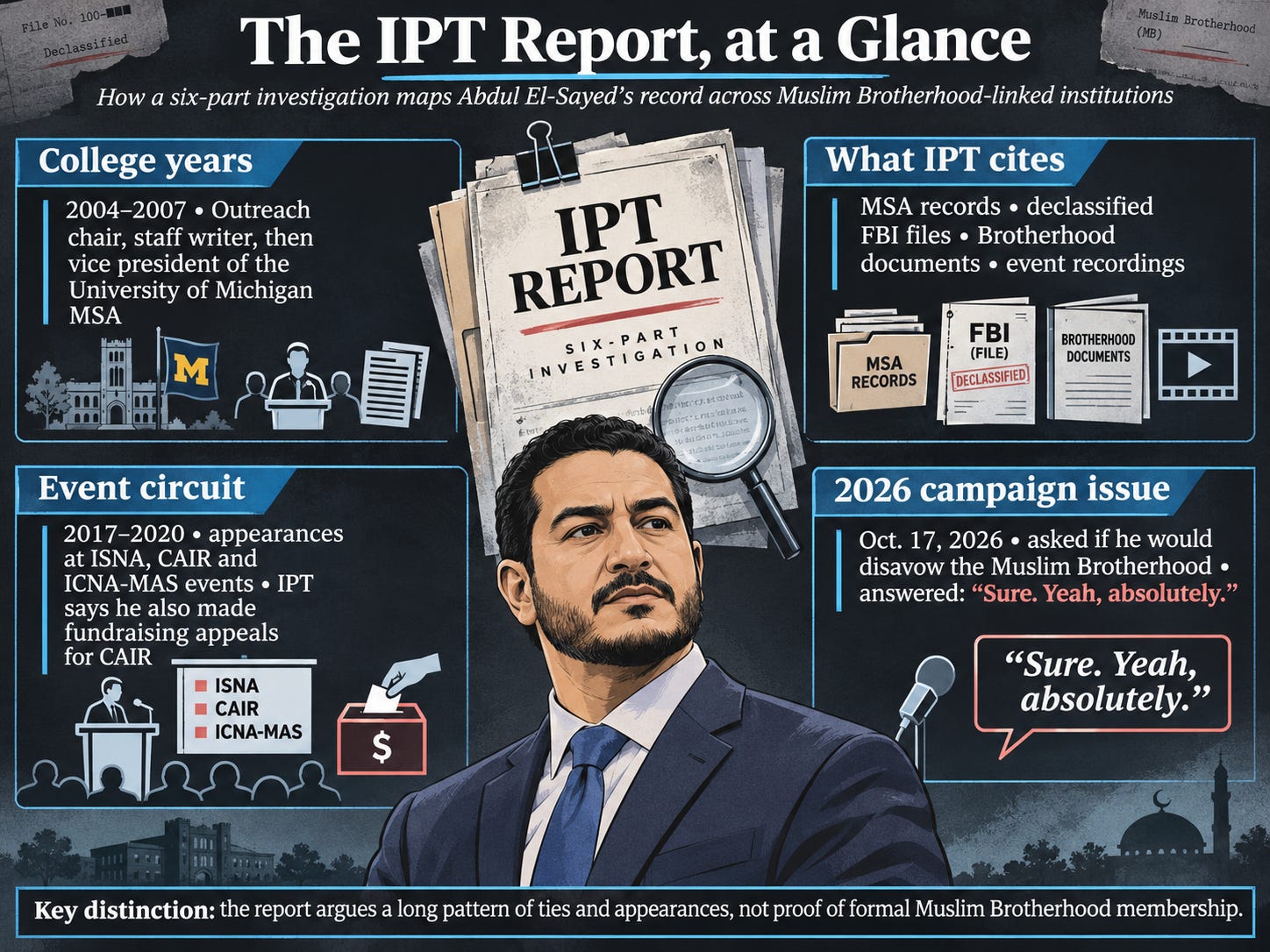
Much of IPT’s investigation focuses on El-Sayed’s years at the University of Michigan.
Archived MSA newsletters and board records reviewed by IPT identify El-Sayed as the chapter’s outreach chair in 2004 and later as vice president. As outreach chair, the records describe him as responsible for bringing students into the organization and show him participating in planning for recruitment and da’wah, or Islamic outreach.
Those positions matter to IPT because of the national MSA’s history.
An internal Muslim Brotherhood document entered into evidence during the Holy Land Foundation terrorism-financing prosecution described the student organization as having been founded by some of the Brotherhood’s first members in North America. A separate 1991 Brotherhood memorandum listed the Muslim Students’ Association among “our organizations and the organizations of our friends.”
A 2007 FBI intelligence assessment obtained through the Freedom of Information Act went further, describing the MSA as “the first formal U.S. MB organization,” according to the document published by IPT. Historical congressional material has separately documented FBI records concerning Brotherhood involvement in the formation of American Muslim organizations including MSA and ISNA.
IPT found that the Michigan chapter was formally affiliated with the national organization while El-Sayed was an officer.
The chapter’s records also show its board discussing a national MSA campaign supporting scholar Tariq Ramadan after the United States revoked his visa, as well as considering a fundraiser involving KindHearts, a Muslim charity that later became the subject of federal terrorism-financing action. IPT does not establish that El-Sayed personally initiated either effort.
ISNA, CAIR and ICNA-MAS
IPT then follows El-Sayed into national political and Muslim organizational circles during his rise as a public figure.
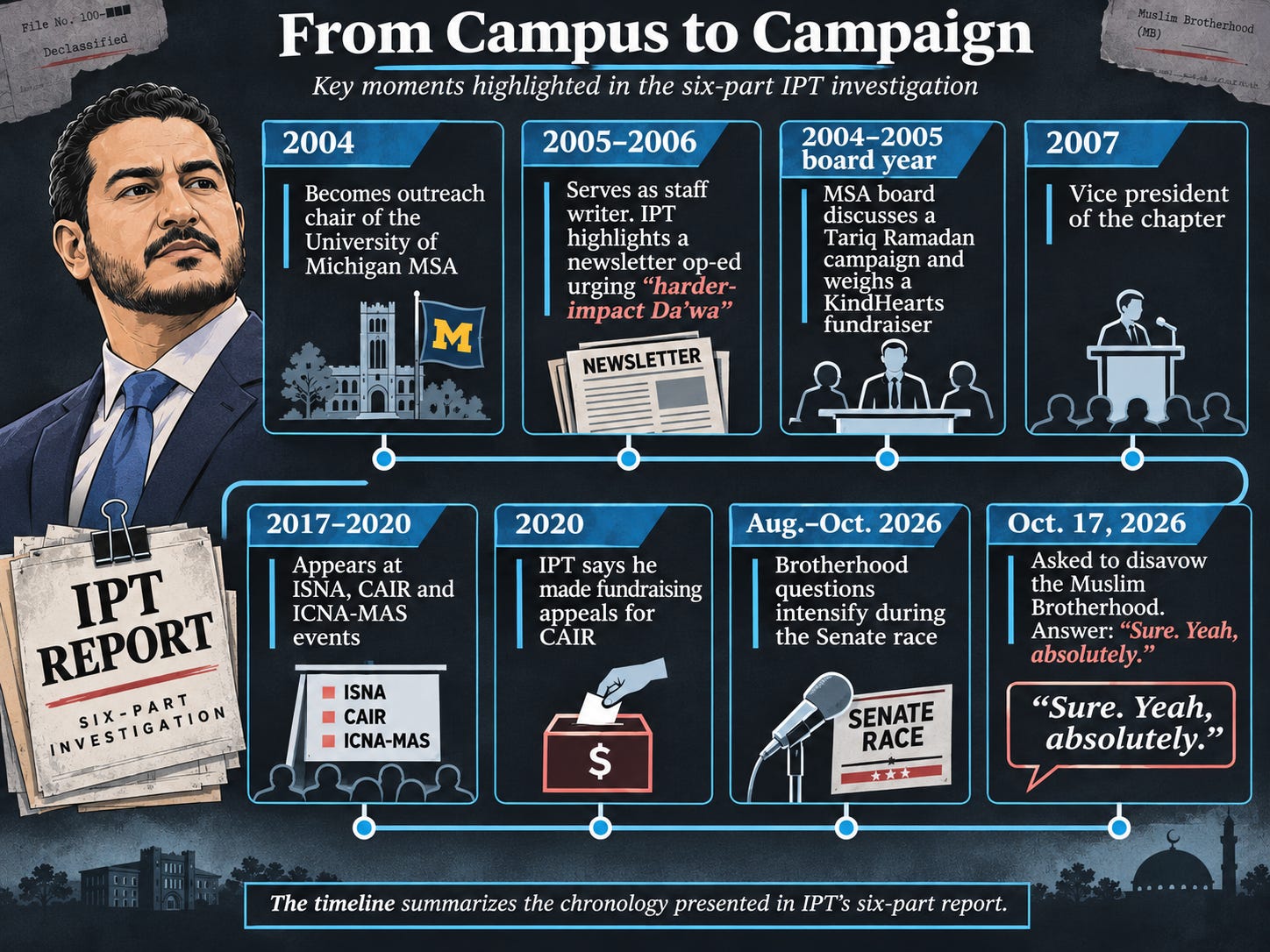
Between 2017 and 2020, the investigation documents appearances by El-Sayed at ISNA national conventions, CAIR banquets and events, and the joint convention of the Islamic Circle of North America and Muslim American Society. In at least two appearances, IPT says, El-Sayed personally appealed to audiences to donate to CAIR.
The significance again rests on the organizations’ histories.
ISNA appeared first on the 1991 Brotherhood memorandum’s list of “our organizations and the organizations of our friends,” while MSA appeared second and ICNA was also included. Federal prosecutors in the Holy Land Foundation case wrote that evidence established ISNA and the North American Islamic Trust as organizations created by the U.S. Muslim Brotherhood.
The Holy Land Foundation itself was convicted in 2008 of providing material support to Hamas. The Justice Department said the government’s case showed that Hamas’s parent movement, the Muslim Brotherhood, had established a U.S. network and that the Brotherhood-created Palestine Committee was tasked with supporting Hamas.
CAIR also appeared in evidence surrounding that network. IPT cites federal prosecutors as saying the organization was later added to the Palestine Committee.
El-Sayed’s Own Words
The investigation also revisits El-Sayed’s public comments about the Brotherhood itself.
In a 2011 HuffPost essay written during Egypt’s uprising against Hosni Mubarak, El-Sayed argued against predictions that a Brotherhood government would resemble Iran and dismissed comparisons between an Egyptian Brotherhood government and Hamas rule in Gaza as “foolish.” IPT acknowledges that the essay was not an endorsement of the Brotherhood, describing it instead as an argument that a Brotherhood-led government could operate differently from its critics expected.
A more direct controversy concerns a November 2012 statement published in Egypt under the names of 46 U.S.-based supporters of President Mohamed Morsi.
The statement bearing El-Sayed’s name backed the Brotherhood president following his decree shielding presidential decisions from judicial review and called for a “purging of the media and the police as soon as possible,” according to translations cited by IPT and other reporting.
A Broader Dispute Over the Brotherhood
The report arrives amid weeks of scrutiny of El-Sayed’s family history.
His half-sister, University of Chicago sociologist Eman Abdelhadi, wrote in 2012 that her family had “long been MB” and separately described their mother as having participated in Muslim Brotherhood activism while in college in Egypt. El-Sayed has said he had no knowledge of such involvement and noted that he was raised primarily by his father after his parents divorced.
The distinction is central to assessing IPT’s report.
It does not produce evidence that El-Sayed secretly held formal Muslim Brotherhood membership. Rather, it compiles a record stretching from his leadership in an MSA chapter, through later appearances and fundraising for organizations with historical Brotherhood ties, to political writings and associations involving figures and institutions in the same ecosystem.
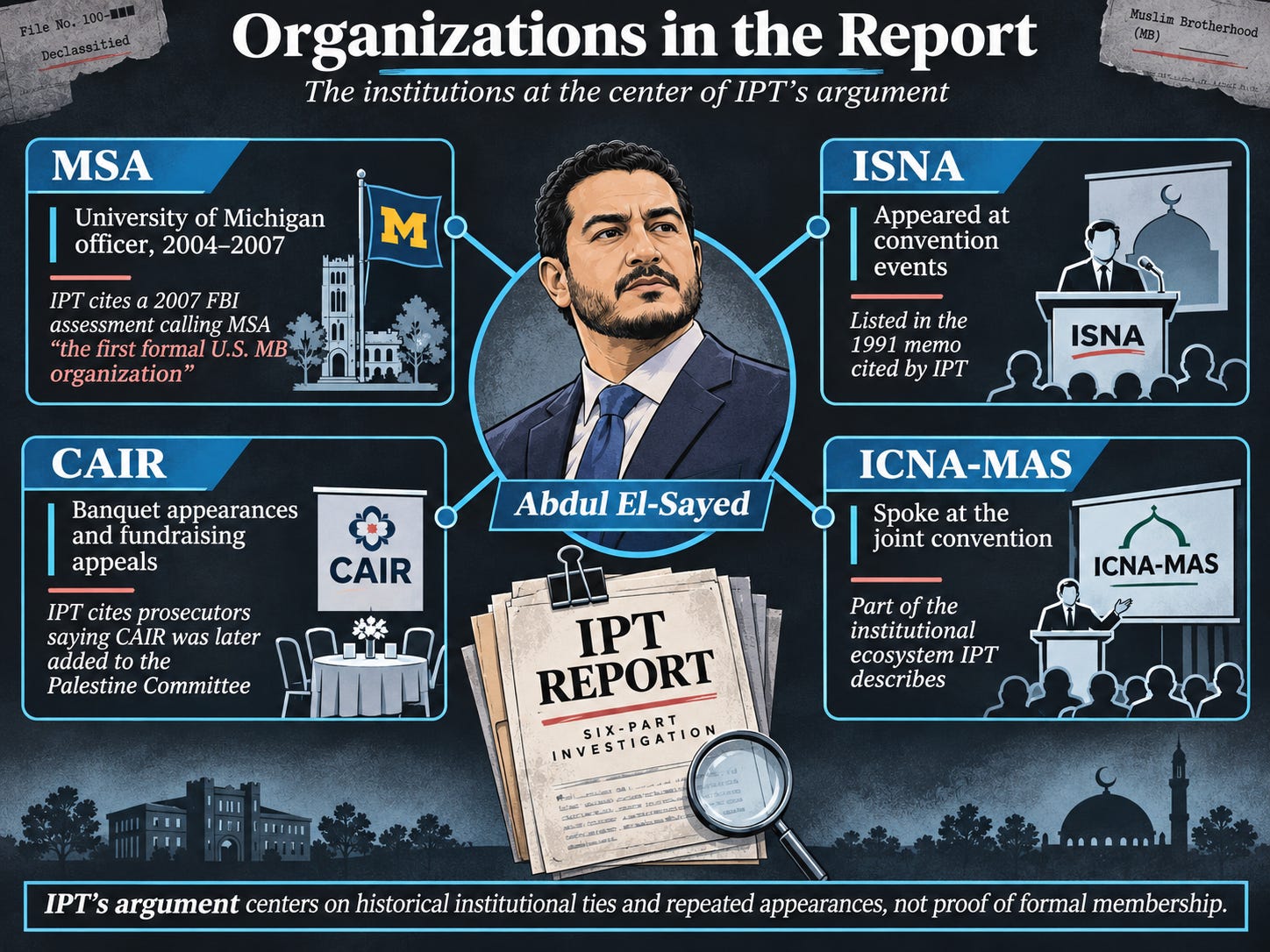
When directly asked at an October 17 town hall whether he would disavow the Muslim Brotherhood, El-Sayed answered, “Sure. Yeah, absolutely,” before challenging the premise of the question and arguing that such scrutiny was being used to suggest Muslims hold divided loyalties. Days later, he stated more explicitly that he had never been and would never be a Brotherhood member.
IPT’s six-part investigation therefore centers on a narrower question than membership: how much significance voters should attach to the institutions, events and political networks that recur throughout El-Sayed’s public career.
The underlying records provide considerably more material for that debate than the family controversy that has dominated the closing weeks of Michigan’s Senate race.