


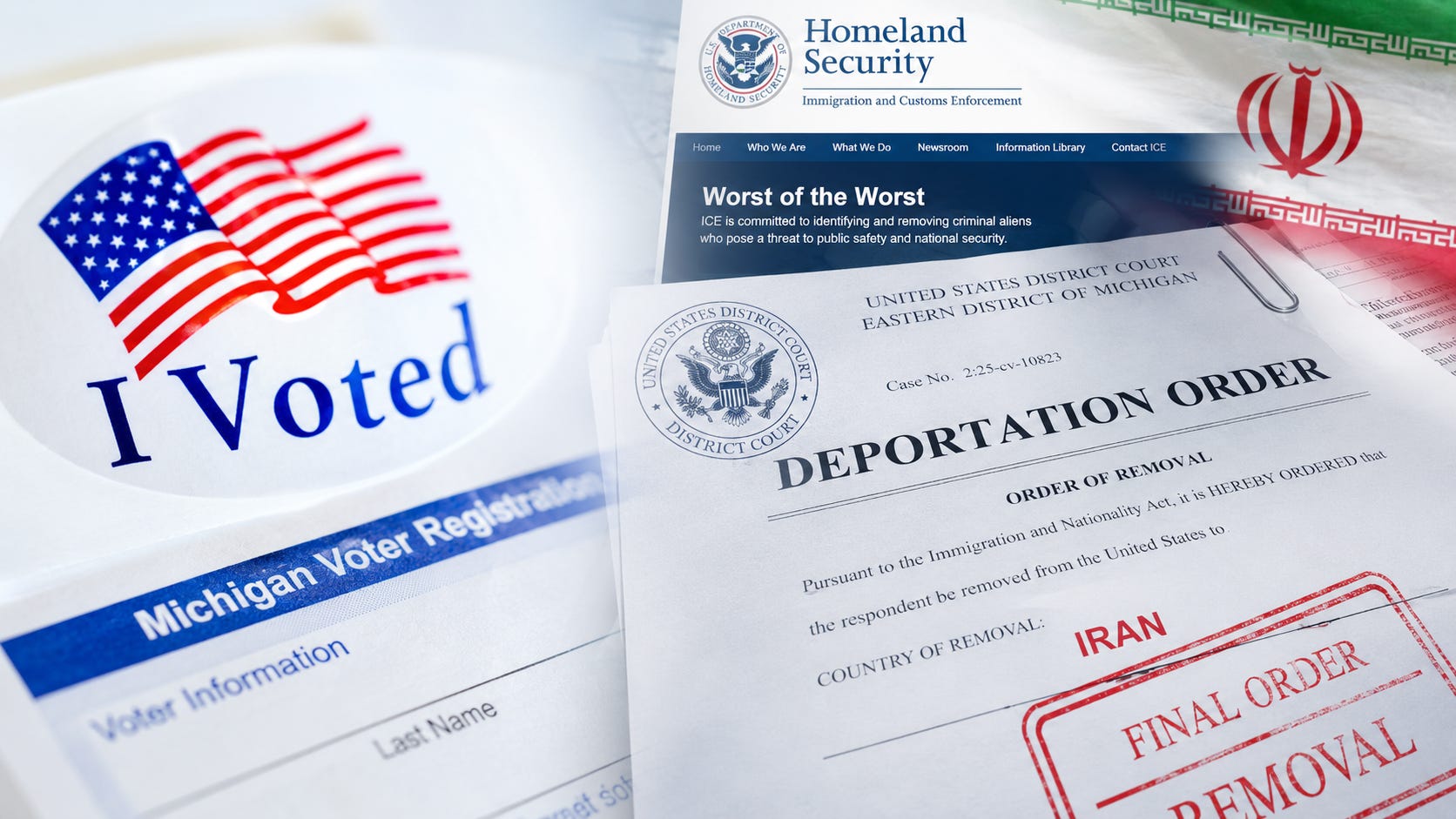
An investigation released this week uncovered that at least two Iranian nationals identified in federal court records as non-U.S. citizens were registered to vote in Michigan’s August 4, 2026 primary election—and that election workers at polling locations confirmed their registrations and were prepared to provide them with ballots.
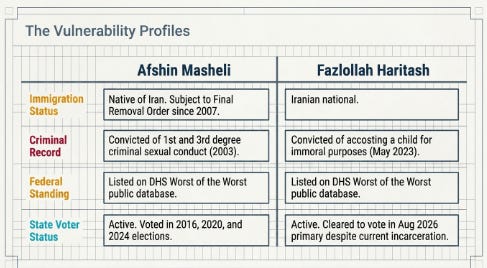
One of the individuals, Afshin Masheli, is a convicted sex offender who entered the United States on a visitor visa from Iran in 1991 and later became a lawful permanent resident. After convictions for first-degree and third-degree criminal sexual conduct in 2003, an immigration judge ordered his removal to Iran in 2005—a final order that has remained in effect since 2007. The second individual, Fazlollah Haritash, is an Iranian national convicted in May 2023 of accosting a child for immoral purposes and child sexually abusive activity; Michigan’s public sex offender registry lists him as currently incarcerated.
Both men have been featured on the Department of Homeland Security’s “Worst of the Worst” list—a public database launched in December 2025 highlighting criminal non-citizens arrested by Immigration and Customs Enforcement.
O’Keefe Media Group’s undercover journalists visited polling locations associated with both voter registrations on primary day. At McDonald Elementary School in Dearborn, an election worker confirmed that a registration under Masheli’s name appeared in the poll book. When the undercover operative stated he was not a U.S. citizen and asked if he could still vote, the worker replied: “All I know is you’re registered to vote here.” When the operative added that he was a convicted sex offender, a supervisor interjected: “If your name is here, you can vote. I’m sorry, the rest of the information is not important to me.”
At a second location—a mosque serving as a polling place in Farmington Hills—an election worker similarly confirmed that Haritash’s name appeared on the voter rolls and directed the operative to the correct voting station.



Federal Records Document Non-Citizen Status
U.S. District Court documents from January 2026 confirm the core facts of Masheli’s immigration status. The court opinion states he “is a native and citizen of Iran” who was admitted on a visitor visa with authorization to remain until June 1992. After becoming a lawful permanent resident in 1995, he was convicted of criminal sexual conduct in 2003, charged with removability, and ordered removed to Iran following a May 2005 immigration court hearing.
The critical detail: Masheli has been subject to a final order of removal since July 2007—nearly 19 years—yet remained in the United States. ICE released him on supervision in 2007, re-detained him briefly in 2010, then released him again. He was re-arrested in June 2025, but a federal judge ordered his release in January 2026 after finding the government failed to demonstrate that removal to Iran was “reasonably foreseeable.”
This presents a disturbing paradox: an individual under a final order of deportation to a country the United States considers an adversary and convicted of serious sex crimes—was living freely in Michigan under ICE supervision. And during that time, Michigan’s voter registration system allowed him to register and maintain active voter status.
Michigan voter roll data accessed by investigators indicated Masheli voted in 2016, 2020, and 2024. When confronted on camera on August 4, Masheli initially denied voting recently, then acknowledged he may have voted “three election, four election ago” when presented with the documented voting history.
How Michigan’s System Failed
Michigan requires all voter registration applicants to attest under penalty of perjury that they are U.S. citizens. Federal law imposes the same requirement at multiple points: when registering, when applying for an absentee ballot, when returning that ballot, and when requesting a ballot in person. Penalties for false statements include prison time, fines, and deportation.
The state’s automatic voter registration system at the Department of Motor Vehicles does not permit registration when an applicant provides non-citizen documents. Secretary of State employees “can’t override the system or add them to the voter registration list another way,” according to the Secretary of State’s website.
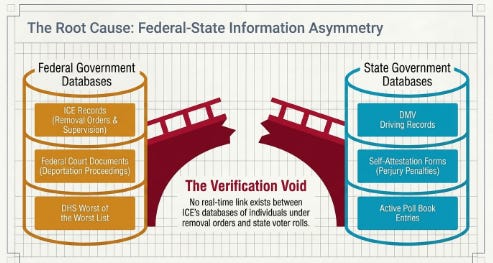
Yet the system clearly failed in these cases. How did individuals with final removal orders—documented in federal court filings and DHS databases—end up on Michigan’s voter rolls?
One possibility: both individuals at some point held lawful permanent resident status before their criminal convictions triggered removal proceedings. If they registered to vote during that window — when they possessed green cards and state-issued identification — Michigan’s front-end verification systems would not have flagged them. The breakdown occurred on the back end: after federal immigration judges ordered their removal, Michigan’s voter rolls were never updated to reflect their changed legal status.
A Michigan Department of State review completed in April 2025 found this exact problem. Comparing 7.9 million driving records to 7.2 million registered voters, the state identified 15 individuals who appeared to be non-citizens and had cast ballots in the 2024 general election—representing 0.00028% of the more than 5.7 million votes cast. Thirteen cases were referred to the Attorney General for potential prosecution.
Secretary of State Jocelyn Benson announced the state was establishing “an ongoing review process to identify possible cases of noncitizens improperly registered to vote so those records can be cancelled.” But that review clearly did not catch Masheli or Haritash before the August 2026 primary.
What Happens Next
The Department of Justice has indicated it intends to “take swift action” on cases where non-citizens remain on voter rolls. Whether that includes criminal prosecutions of election officials as Dhillon’s letters threatened or simply increased federal oversight remains unclear.
Michigan Secretary of State Benson has defended the state’s processes as “open and transparent” and committed to working with the legislature on additional security measures. In February 2026, she announced plans for the Michigan Election Security Act, which would codify ongoing reviews comparing motor vehicle records to voter rolls.
But codifying a review process that already failed to catch these cases offers limited reassurance. The fundamental problem is the lack of real-time integration between federal immigration databases and state voter rolls. Until ICE removal orders, federal court rulings on citizenship status, and state voter registration systems are linked—until there is an automatic trigger that removes individuals from the rolls when a federal judge orders them deported—gaps will remain.
And in those gaps, Iranian nationals with criminal records and pending deportations will continue to receive voter registration cards in the mail, see their names in poll books, and—if they choose—cast ballots in American elections.
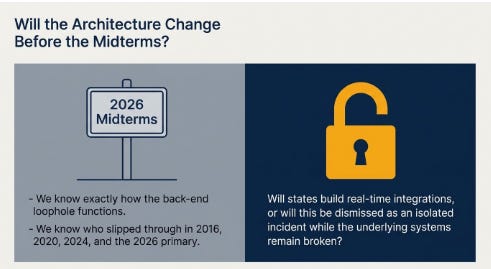
That’s not a hypothetical concern. It happened in Michigan in 2016, 2020, 2024, and was poised to happen again in August 2026. The question is whether Michigan—and other states—will close the loopholes before the 2026 midterms, or whether this investigation will be dismissed as an isolated incident while the underlying systems remain unchanged.
Until election officials who choose to look the other way and put their feelings over the laws are punished, and severely, none of this is going to change.